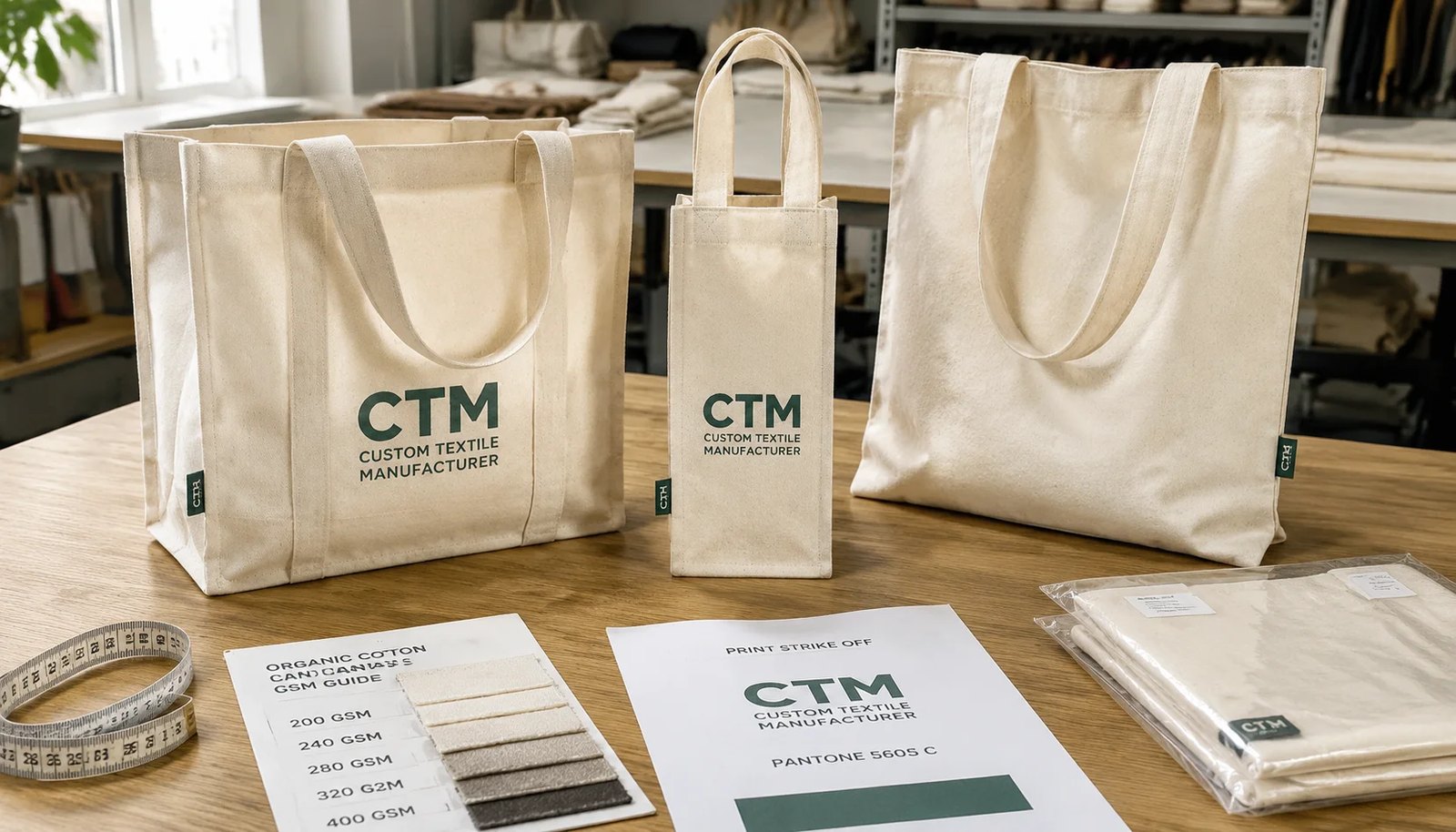
Why liquor retail tote programs fail at the compliance stage
The common failure is not usually the tote itself. It is the mismatch between a buyer's sustainability claim, the retail use case, and the paperwork the supplier can actually support. A bag sold as an organic cotton promotional tote for bottle purchases may still be rejected if the factory cannot connect the fabric lot to the claimed source, if the print chemistry declaration is missing, or if the product was built too lightly for glass-bottle use.
Liquor retail adds extra pressure because these bags often move through branded promotions, chain store reviews, distributor checks, and internal legal signoff. That means the RFQ has to do more than request a size and logo. It has to define the claim standard, physical performance, packing format, and approval flow. If one of those is left vague, quote comparisons become misleading and the lowest price usually hides the highest downstream risk.
- Organic claim risk: supplier declaration only versus traceable lot-backed documents
- Use-case risk: one-bottle carry bag is not the same construction as a two-bottle or gift-set tote
- Retail review risk: natural fabric variation can be rejected if no shade standard was approved
- Import risk: missing carton labeling, barcode format, or packaging detail can create receiving delays
Start with the right tote construction for bottle retail use
For liquor retail, construction matters more than trend language. A 140-180 GSM lightweight organic cotton shopper may be fine for brochures or small accessories, but it is not a safe default for carrying wine or spirits. Most bottle-carry applications work better in 280-340 GSM organic cotton canvas, roughly 10 oz to 12 oz, especially when the tote includes a bottom gusset. This gives better shape retention, less handle stress, and fewer complaints about the bag collapsing around the bottle base.
If the program is intended for one standard wine bottle, a narrower body with a 10-12 cm bottom gusset controls movement better than a wide flat tote. For two bottles or mixed gift packs, buyers usually get more stable performance from a side-and-bottom gusset construction with reinforced handles. Flat totes still have a place in low-cost giveaways, but they should not be quoted against bottle carriers as if they are equivalent products.
- Single bottle tote example: 14 x 35 x 10 cm with 2.5-3 cm handle width
- General retail tote example: 30 x 35 x 10 cm for one bottle plus small add-on items
- Heavier-duty option: 340 GSM canvas with full boxed corners for premium gift packaging
- Reinforcement options: bartack, box stitch, cross stitch, or extra inside handle patch
What compliance evidence matters most for organic cotton claims
Buyers often use the term organic loosely in early sourcing, then discover the retailer wants evidence tied to the actual production lot. A practical compliance file should identify the fabric mill, the claimed standard or declaration route, the validity period of any supporting documents, and how the factory links the purchased fabric to the finished order. Without that chain, the claim can be challenged even if the cotton itself started from a legitimate source.
You do not need to overbuild the compliance file, but you do need consistency. If your internal team wants transaction-level support, write that into the RFQ. If a supplier only offers a generic self-declaration, that quote should be compared in a different risk category from a quote that includes lot-backed fabric records. The same logic applies to restricted-substance declarations and print chemistry information. A clean document pack saves more time than a last-minute compliance scramble after bulk production is already booked.
- Fabric source identity: mill name and location
- Claim support: declaration only, scope certificate, transaction-linked document, or retailer-specific format
- Lot linkage: invoice, batch, roll numbers, or internal production record
- Chemical documentation: ink declaration, REACH or retailer-restricted-substance statement if required
- Factory profile: audit status, sewing site address, subcontractor disclosure where relevant
Print method choices that affect compliance, color, and bag feel
Most organic cotton liquor retail totes use simple one-color or two-color branding. Water-based screen printing is usually the most practical route because it keeps hand feel softer than heavy plastisol-style layers and works well on natural canvas. But buyers should not treat all screen print as interchangeable. Ink system, cure standard, print coverage, and fabric pretreatment all influence rub resistance and visual consistency.
If the branding area is small, a woven side label can reduce print variability and support a cleaner premium look. Heat transfer can work for detailed logos or short runs, but it adds a different hand feel and can crack or peel if the wrong transfer system is used on textured canvas. For dark dyed bags, pigment consistency and crocking become bigger issues. For unbleached natural bags, the challenge is often the opposite: achieving clean logo contrast while accepting that the base fabric shade may not be perfectly white.
- Best value for simple graphics: water-based screen print
- Small brand mark option: woven label sewn into side seam or handle base
- Premium but slower option: embroidery for small logos only, not large coverage
- Approval items: pantone target if applicable, print strike-off, placement measurement, rub test standard
- Common print defects: pinholes, ghosting, off-register colors, overcuring scorch, undercured rub-off
MOQ logic: how to compare quotes without being misled
MOQ disputes happen because buyers compare prices from suppliers who are counting quantity differently. One factory may quote MOQ per size and per print color. Another may quote MOQ by total order volume if fabric, construction, and handle set stay the same. A third may accept mixed artwork but charge full setup costs for each version. Unless the RFQ defines what can be shared across SKUs, the cheapest unit price may only apply to a single undivided run that does not match your actual assortment.
For liquor retail programs, an efficient MOQ strategy is often to standardize one bag body and fabric, then split branding by region, campaign, or store group. This keeps cutting and sewing stable while only varying the print screens or labels. Buyers should request a quote grid showing the cost effect of splitting quantities, because the unit price delta may be smaller than expected if material consumption remains unchanged.
- Clarify MOQ basis: per SKU, per artwork, per color, or total mixed order
- Ask for quantity breaks at realistic buy levels, not only headline bulk tiers
- Separate one-time costs: screens, labels, barcode stickers, carton marks, sample fees
- Hold body size and fabric constant if you need regional artwork splits
Sample approval should test production reality, not just artwork layout
A digital proof is not enough for this product. The sample stage should prove fabric hand feel, panel shape, gusset balance, print behavior, and handle comfort under realistic load. A development sample made from available stock can help confirm dimensions, but it should not be the final approval standard if the bulk fabric will be different in GSM, color, or finish. The pre-production sample should be made from the intended bulk fabric and with the actual print method.
For bottle retail use, sample review should include a simple load test with the intended bottle type, not only visual inspection on a flat table. Bags that look acceptable empty can twist badly once loaded if the body width, gusset depth, or handle position is slightly off. Buyers who approve only a front-view photo often miss these functional problems until the shipment is already in transit.
- Review points on sample: body dimensions, gusset opening, handle drop, stitch density, print position, label placement
- Use actual bottle size or weighted equivalent during sample review
- Record agreed tolerances in the sample approval sheet
- Keep an approved sealed sample or signed reference for bulk inspection
Quality thresholds that prevent rework and store complaints
Organic cotton canvas is a natural material, so some texture variation is normal. The issue is not eliminating every slub or shade shift. The issue is defining what level is acceptable for your retail channel. A discount promotion can tolerate more natural variation than a premium boxed gift launch. Without written thresholds, inspectors and suppliers end up arguing over subjective opinions after goods are packed.
The most expensive defects on liquor totes are usually structural, not cosmetic. Broken handle reinforcement, weak seam closure at boxed corners, and excessive dimensional variation create actual use failures and returns. Print defects matter too, but a slightly imperfect natural fabric appearance is often less commercially damaging than a bag that cannot safely carry a bottle. QC should prioritize function first, appearance second, and documentation accuracy third.
- Critical defects: wrong fiber claim paperwork, major seam failure, wrong print artwork, wrong barcode, unsafe handle attachment
- Major defects: dimension out of tolerance, severe print rub-off, obvious panel shade mismatch, missing label or care mark if required
- Minor defects: small slubs within agreed natural-fabric standard, light pressing marks removable in handling
- Useful in-line checks: first-cut panel measurement, first-print strike, handle pull review, packed-carton count audit
Packing details that change cost, compliance, and warehouse handling
Packing is often treated as a line item, but it affects labor, carton cube, arrival condition, and receiving speed. Liquor retail programs may need plain bulk-packed bags for distribution centers, or retail-ready packed units with hangtags, inserts, barcode labels, and stricter fold presentation. These are very different operations. If the quote only says 'standard export packing,' you do not yet have a usable comparison.
For importer-friendly handling, a simple folded bag packed in moisture-protected master cartons is usually the most efficient. If the bags are unbleached natural cotton, avoid overcompressing them in cartons that create hard crease marks across the print area. Carton weight also matters. A too-heavy master may lower freight efficiency once warehouse safety limits or pallet stacking constraints are applied.
- Per-piece options: loose, tissue wrap, individual polybag, belly band, swing tag, barcode sticker
- Master carton basics: carton size, quantity, gross weight, liner bag, desiccant if required
- Marking details: item code, quantity, PO number, country of origin, carton sequence
- Warehouse note: align carton dimensions with pallet pattern to reduce wasted air
Lead time planning: where schedules usually slip
The visible sewing time for a tote bag is short, so buyers sometimes underestimate total lead time. The delays usually come earlier: fabric booking, certificate collection, dye or shade approval if color is involved, print strike-off, and pre-production signoff. If the program needs retailer compliance review before bulk, that approval window should be built into the calendar rather than treated as a side task.
A realistic schedule separates development sample, pre-production sample, material readiness, cutting and sewing, printing, packing, and final inspection. If any one of those is compressed without changing the others, the quality risk simply moves downstream. For example, cutting before final print approval may protect a nominal ship date but increases the chance of holding finished blanks that become unusable if artwork changes.
- Illustrative timeline only: 5-10 days for development sample, 7-12 days for PPS, 20-35 days for bulk after approval depending on quantity and material readiness
- Natural color programs can move faster than custom dyed fabric if documents and capacity are ready
- Artwork changes after screen making typically add cost and delay
- Peak-season loading and carton booking can be the final bottleneck even after production is complete
How to compare supplier quotes on landed value, not just unit price
A lower ex-factory price can still be the more expensive option if the supplier uses lighter GSM, weaker handles, high defect allowance, or pack formats that increase cubic volume. Procurement teams should normalize quotes into the same commercial basis: actual GSM, finished size, reinforcement method, print method, sample inclusion, packaging level, and documentation included. Without normalization, you are comparing unlike-for-like products and rewarding under-spec pricing.
The easiest way to do this is to build a landed-value view rather than a headline-price view. Add expected testing or compliance costs, sampling charges, setup costs, inner packing labor, freight effect of carton cube, and likely defect contingency. Even rough estimates are useful. A bag that is 8 percent cheaper but needs repacking, re-labeling, or heavy inspection on arrival is not the better buy for most retail programs.
- Normalize fabric by GSM and usable weight, not by vague 'canvas' wording
- Separate recurring unit cost from one-time setup and approval charges
- Estimate carton cube impact if one supplier uses thicker folded presentation
- Treat missing compliance documents as a cost and timing risk, not a neutral omission
Specification comparison for buyers
| Supplier option | What to verify | Commercial advantage | Buyer risk to control |
|---|---|---|---|
| Direct sewing factory | fabric batch documents, dye-lot photos, approved sample archive, and final QC record | Better sample-to-bulk control and faster production feedback | May be weaker on export paperwork or branded packing unless checked early |
| Trading company | Factory name, production photos, trim-source proof, and who owns QC decisions | Can coordinate small mixed orders and extra services | Markup can hide real factory capability and slow defect decisions |
| Specialized bag workshop | seam allowance, handle reinforcement, label attachment, fabric pre-shrink note, and batch shade control | More practical for detailed construction, trims, and repeat programs | Capacity may be limited during peak seasons |
| Low-price general supplier | organic cotton canvas, batch documentation where available, undyed or low-impact dyed fabric, and shrinkage control | Useful for simple promotional runs with loose specs | Material downgrades, weak packing, and vague inspection scope can erase savings |
| Retail-ready supplier | plastic-reduction request, recycled carton note, bundle count, carton mark, and moisture protection without overpacking | Can handle labels, SKU separation, carton marks, and receiving rules | Higher unit cost must be compared against reduced warehouse work |
| Compliance-focused supplier | Fabric records, labeling review, test plan, and production traceability | Safer for retail programs and repeat brand orders | Documentation claims need evidence, not only sales language |
| Local sample room plus bulk factory | Signed sample, bulk factory handoff, first-piece photos, and deviation owner | Good for complex branding before large production | Sample room quality may not match bulk line unless handoff is controlled |
Buyer checklist before sampling
- State whether the organic claim must be supported by transaction certificates, scope certificates, or only a supplier declaration
- Define intended load: one bottle, two bottles, or mixed gift items, so fabric GSM and handle reinforcement can be matched to use
- Specify finished size with tolerance, including gusset depth, handle width, and handle drop
- Name the print method you will accept: water-based screen print, pigment print, heat transfer, embroidery, or woven label
- Require fabric shade reference if using natural or dyed organic cotton; unbleached fabric lots can vary
- Set seam and bartack expectations for bottle-carrying bags, not just general tote construction
- List retail compliance documents needed before production: fiber claim support, chemical restrictions declaration, factory audit status, testing plan
- Require a pre-production sample made in actual bulk fabric, not only a development sample in substitute stock
- Define packaging format per bag, inner pack quantity, carton weight limit, barcode placement, and carton markings
- Request a quote split showing fabric, printing, trims, packaging, sampling, and any compliance or testing charges separately
Factory quote questions to send
- Which mill supplies the organic cotton fabric, and can you link the mill document to the production lot used for this order?
- Is the quoted fabric weight finished GSM or greige GSM, and what tolerance do you apply after washing or printing?
- Will handles be self-fabric, webbing, or reinforced folded straps, and how many bartacks are included in the quote?
- What is the tested safe carrying load you recommend for this construction if the bag is used for glass bottles?
- Is the print done in-house or by a nominated printer, and what ink system is used on organic cotton canvas?
- What is included in MOQ: per color, per artwork, per size, or per total order across mixed SKUs?
- Can you provide a pre-production sample in actual bulk fabric and print before cutting all material?
- What carton dimensions, net weight, and gross weight are expected for the quoted packing method?
- Which common defects trigger your internal rework: print misregistration, seam puckering, oil marks, needle damage, or shade variation?
- What lead time is needed separately for lab dips or fabric approval, sample approval, production, and final packing?
Quality-control points to confirm
- Fabric weight should stay within the agreed tolerance band, for example plus or minus 5 percent of the approved GSM
- Finished dimensions should meet tolerance, commonly plus or minus 0.5 inch for body panels and handle drop unless tighter tolerances are agreed
- Print placement must align to the approved artwork position with a measurable tolerance, such as plus or minus 5 mm
- No obvious shade panel mismatch between front, back, gusset, and handles within the same bag
- Seams must be even and secure with no skipped stitches, broken threads, raw-edge exposure, or seam grin at stress points
- Handle attachment must include the agreed bartack or box stitch reinforcement and withstand the expected bottle load
- Natural cotton fabric should be free from major slubs, holes, oil stains, mildew odor, or visible contamination beyond the approved standard
- Cartons must match pack count, barcode, shipping mark, and moisture protection requirements before container loading