What salon chains actually need from a bulk tote quote
Salon procurement teams typically need two outcomes from a single quote: a tote that feels premium enough to represent the brand in a retail or service environment, and a quote structure that can be compared across stores, regions, and reorder cycles. When the RFQ only states "organic cotton tote," suppliers will quote different fabric weights, handle constructions, and packing assumptions. That makes the lowest unit price meaningless because the bags are not the same product.
For salon chains, the tote often functions as a retail carrier, gift-with-service item, or membership sign-up incentive. That means the quote must define the use case before the factory prices it. A tote that only carries a brochure is not the same as one that needs to hold shampoo, conditioner, and a retail box without stretching. Procurement teams that write the end use into the RFQ get quotes that reflect real performance, not just material cost.
- State the end use: retail sale, gift with service, onboarding pack, or retail carrier.
- Define the weight the bag must carry in real use, not only a generic marketing description.
- Use one approved spec per quote round so factories are pricing the same construction.
Choose the fabric weight before you compare prices
GSM is one of the main price drivers, but it also controls hand feel, opacity, and print stability. For salon chains, 180-220 GSM organic cotton is the workable range when the bag needs to feel substantial without becoming overly heavy or expensive. Lighter fabric can save money, but it often shows more seam distortion and gives cheaper print results. A 160 GSM tote may look acceptable in a photo but feel flimsy when a client carries a retail purchase.
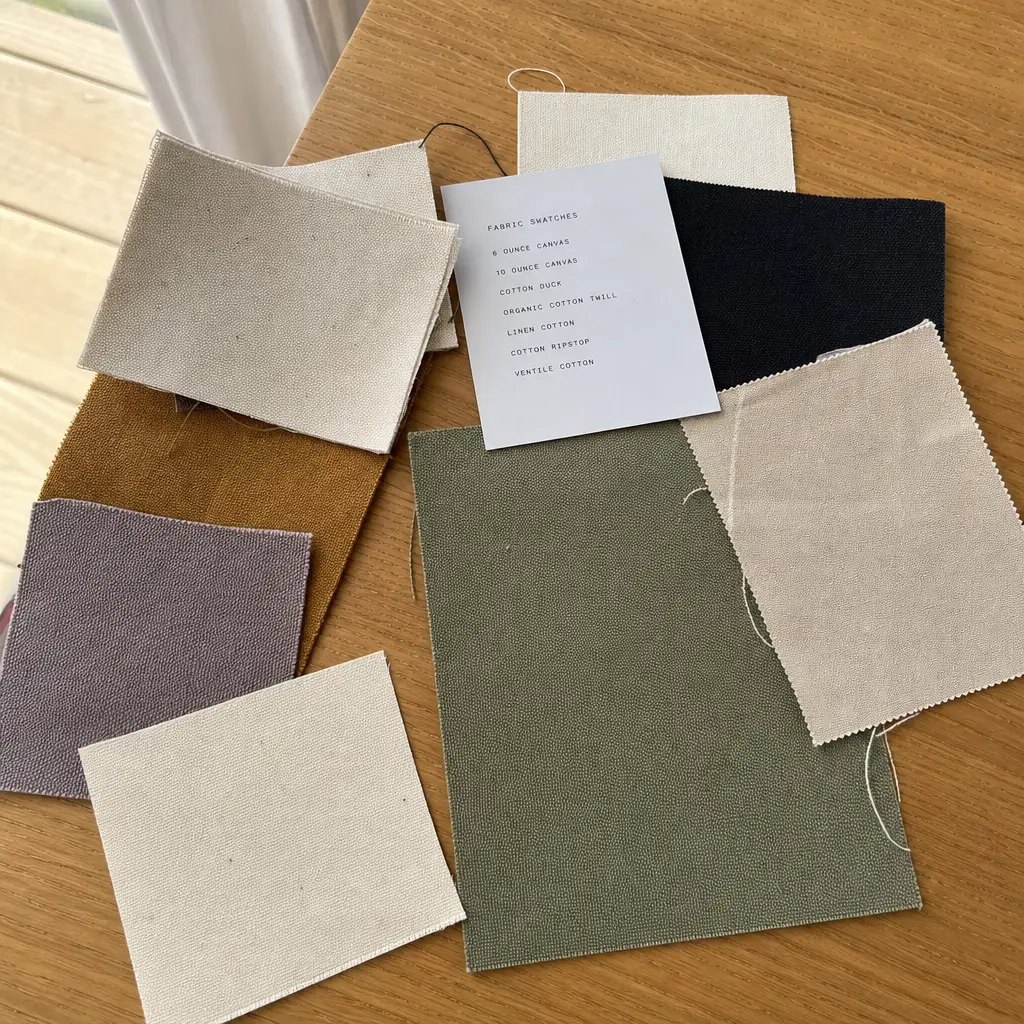
If the tote is for resale or premium gifting, the fabric should be selected for appearance first and cost second. Natural cotton in a midweight range usually gives the best balance. If the brand wants a cleaner surface and less lint, bleached or pre-washed fabric may be worth the added cost, but that finish must be written into the quote because it changes both price and lead time. Supplier verification should go beyond a GSM agreement on paper. Request a lab test report or a physical swatch card that confirms the finished fabric weight, not just the greige weight before processing. Ask the factory to state whether the quoted GSM is measured on greige, bleached, or finished fabric, because each stage can shift the number by 5–10%. A factory that cannot provide a clear reference point for its GSM claim is likely quoting a nominal value, not a controlled spec.
- 180 GSM: lower cost, lighter hand, more risk of visible contents.
- 200 GSM: common middle ground for branded salon totes.
- 220 GSM: better structure and print base, but higher fabric and sewing cost.
Construction details that change the quote more than buyers expect
The same tote size can price very differently depending on seam allowance, gusset depth, handle width, and reinforcement. A flat bag with narrow handles is easier to sew and cheaper to ship, but a gusseted tote with wider handles usually performs better for salon use. If the tote is meant to carry boxed products, the bottom and handle reinforcement matter more than decoration.
Ask factories to quote the same size in a clearly defined construction. For example, a 38 x 42 cm bag with a 10 cm gusset, 60 cm handles, and cross-stitch reinforcement gives a more usable comparison than a loose description. If one supplier quotes a light construction and another quotes reinforced handles, the lower unit price is not a real win. Procurement teams should treat construction details as non-negotiable line items in the RFQ, not as afterthoughts.
- Specify finished dimensions, not cut panel dimensions.
- Require handle width and handle drop length in the RFQ.
- State whether cross-stitch, box stitch, or simple seam reinforcement is required.
Best print options for salon branding
For bulk salon orders, the cleanest pricing usually comes from one- or two-color screen print on natural cotton. It is stable, easy to repeat, and appropriate for logos, appointment messaging, loyalty campaign branding, or simple retail marks. If the art has fine text or gradients, the quote must identify whether the factory will use screen print, heat transfer, or digital print, because each method changes setup, feel, and durability.
Do not send artwork and assume the factory will optimize it for you. A large logo with thin strokes may look fine on screen but fail during print on woven cotton. The better RFQ gives the exact print size, print position, color references, and the acceptable variation. For salon chains, a smaller logo placed consistently across branches is usually easier to reproduce than a full-front graphic. Procurement teams should also ask for a print durability expectation: how many rubs or washes the print should survive without visible degradation.
- Use screen print for simple solid logos and repeat orders.
- Use heat transfer only when the artwork truly needs detail or multiple tones.
- If print durability matters, ask for rubbing and wash expectations in sample review.
How to read MOQ logic instead of just accepting the headline number
MOQ is not only about fabric availability. It is usually driven by fabric dye lots, print setup, cutting efficiency, and carton planning. A factory may give one MOQ per color, another per print design, and another per order line. If your chain wants multiple salon colors or branch-specific versions, those splits can make a modest order much more expensive than the headline quote suggests.
The right way to compare is to ask for a base MOQ at the standard spec, then ask what changes if you increase volume or simplify the design. For example, one tote color with one print location often prices better than three colors with separate pack-outs. If the chain needs regional versions, the supplier should show where the extra cost appears: setup, labeling, packing labor, or leftover fabric risk.
- Confirm MOQ by color, by print version, and by packing version.
- Ask whether a higher unit price can lower MOQ for the first order.
- Separate true factory MOQ from customer-friendly mixed-order convenience.
Comparison of sourcing routes for salon tote bulk orders
Salon buyers often compare direct factories, trading companies, and local stockists. These are not equivalent routes. Direct factories typically offer stronger control over spec repeatability and long-term cost, but they require cleaner RFQs and longer coordination. Trading companies may simplify communication and combine products, yet their quote can hide the real factory spec. Stockists can move fast on small urgent orders, but they rarely give the same control over fabric, print, and packing.
When the order is a chain-wide rollout, the quote should be judged on landed reality, not just unit price. That means carton data, internal packing count, sample stage, and lead time all belong in the comparison. A factory-direct quote that includes a pre-production sample, carton specs, and a dimensional tolerance sheet is often the lower-risk choice for multi-location salon chains that need consistent branding.
- Direct factory: best for repeatability, custom spec control, and larger volume.
- Trading company: useful when coordinating mixed items or complex communication.
- Local stockist: useful for urgent short runs, but limited for custom branding.
Supplier comparison table for salon chains
Use the table below to compare sourcing routes on the same buying terms. It is designed for procurement teams that need a real RFQ, not a brochure quote. The best route depends on whether the salon chain values speed, control, or the ability to hold a spec steady over multiple reorders.
If two suppliers quote the same unit price but one includes clear carton data, sample approval steps, and dimensional tolerance, that supplier is usually the lower-risk choice. Missing quote data is a cost driver later. The table should be placed prominently in any internal sourcing document so stakeholders can see at a glance which route aligns with the chain's replenishment model.
- Compare only like-for-like specs.
- Treat sample process and packing detail as part of the price.
- Use landed cost, not ex-factory price, for the final decision.
Sample approval: where most quote mistakes show up
A good sample process prevents the most common tote problems: wrong size, weak handles, print shift, and fabric that looks too thin in person. For salon chains, the sample should be reviewed with the exact artwork, target color, and intended use. A digital proof is not enough when the tote is going to be handed to clients in a branded environment.
The useful sample sequence is usually artwork confirmation, material confirmation, pre-production sample, then bulk run. At each step, the buyer should compare the sample against the exact approved spec. If the factory changes fabric supplier, print method, or label placement after approval, that change needs to be re-approved before mass production. Procurement teams should build a sample approval gate into the purchase order terms so no bulk production starts without written sign-off.
- Measure finished size after stitching and finishing.
- Inspect print edge, logo alignment, and handle symmetry.
- Load test the sample with a real salon product set before approval.
Packing, carton data, and replenishment planning
Packing is a real quote item because it changes labor time, carton size, freight density, and warehouse receiving effort. Salon chains often want one carton count that is easy to distribute across locations. If the supplier packs loosely or mixes branch assortments, the inbound team pays for that later in sorting time and inventory errors.
For bulk tote orders, ask for the number of pieces per inner pack, pieces per carton, carton dimensions, gross weight, and whether cartons are pallet-ready. If the totes are going to be shipped into a chain distribution center, the carton spec needs to match DC receiving rules. A slightly smaller carton can materially improve freight cost if the bag is bulky.
- Get carton size and gross weight before approving the quote.
- State whether polybagging, tissue, or simple bulk stacking is allowed.
- Require clear outer carton marks for item code, color, and carton count.
Landed-cost comparison: what to put on the quote sheet
The right quote sheet compares more than the factory price. For salon chains, unit cost should be viewed together with printing, sample charges, carton packing, inland handling, and freight assumptions. A quote that looks cheaper at the product level can become more expensive once the buyer adds repacking, a second sample round, or oversized cartons. For example, a supplier may quote a low ex-factory price but later charge a repacking fee of $0.12 per bag because the original carton count does not match the DC's receiving requirements. That fee, multiplied across 20,000 units, adds $2,400 in unplanned cost—erasing the initial price advantage.
Ask each supplier to quote the same reference structure: fabric GSM, size, handle spec, print method, packing count, and lead time after sample approval. If one quote leaves out artwork setup or carton costs, treat that as incomplete rather than favorable. In sourcing, incomplete usually means deferred cost. Procurement teams should build a landed-cost template that line-items every charge so no fee arrives as a surprise after the order is placed.
- Compare ex-factory, sample, packing, and freight assumptions separately.
- Record what is included in the first quote and what is extra.
- Use the same spec sheet across every supplier you invite.
Specification comparison for buyers
| Spec decision | Recommended option | When it fits | Buyer risk to check |
|---|---|---|---|
| Fabric weight | 180-220 GSM organic cotton | Salon retail, member gifts, and resale bags that need a better hand feel and fewer see-through issues | Thin fabric can look cheap, distort print, and fail load expectations after repeated use |
| Bag construction | Gusseted tote with reinforced handles | When clients will carry product samples, retail items, or bundled salon kits | Flat bags price lower but lose usable volume and may stress handle stitching sooner |
| Print method | 1-2 color screen print or heat transfer for small graphics | Best for clean logos, simple brand marks, and controlled bulk pricing | Complex artwork or gradients may trigger extra setup, color drift, or reprint risk |
| Branding placement | Front panel center or lower-right brand lockup | For retail-facing salons that want consistent shelf presentation across locations | Overlarge graphics can warp on natural cotton and create uneven ink coverage |
| MOQ route | Factory direct with one repeatable spec | When the chain needs stable replenishment and can commit to a clear annual demand | Too many fabric or print variations raise minimums and slow repeat orders |
| Sample path | Pre-production sample after material confirmation | When artwork, handle length, or color tone must be signed off before mass production | Skipping physical sample approval increases the chance of wrong hand feel, shade, or print position |
| Packing method | Bulk packed by master carton with clear inner count | For distribution to multiple salon locations or DC-based replenishment | Loose packing or mixed assortments create counting errors and slower inbound receiving |
| Supply route | Direct factory quote with carton data and print spec | When comparing landed cost, not just unit price | A low ex-factory quote can hide repack fees, pallet charges, or weak carton strength |
| Lead time strategy | Standard fabric in stock, decoration scheduled after sample approval | For seasonal launches, new-store openings, or fast replenishment | Custom dyeing, special labels, or complex artwork can push schedules out by several weeks |
Buyer checklist before sampling
- Confirm finished bag size, gusset width, handle length, and target carry use before requesting quotes.
- Specify organic cotton fabric weight in GSM and whether the bag must be bleached, natural, or garment-washed.
- Provide print artwork in vector format and state the exact print area and number of colors.
- State expected order split by color, logo version, and delivery destination so MOQ is quoted correctly.
- Ask for sample photos, carton size, carton quantity, and gross weight with the quote.
- Request material declaration, label placement details, and packaging count per master carton.
- Compare unit price, print setup, sample cost, and inland carton cost together, not separately.
Factory quote questions to send
- What GSM range are you quoting, and is that based on greige, bleached, or finished fabric?
- What is the exact MOQ by color and by print version, and can it be reduced with a higher unit price?
- Which print method is included in the quote, and what are the setup charges for additional colors?
- What handle length, handle stitch type, and seam reinforcement are included in the quoted construction?
- What is the approved tolerance for bag dimensions, print position, and carton count?
- Can you quote with carton size, master carton pack count, and estimated gross weight included?
- What sample stage is included: digital proof, pre-production sample, or production sample?
- What is the lead time after sample approval, and what parts of that lead time are fixed versus variable?
Quality-control points to confirm
- Fabric weight should match the quoted GSM within a practical production tolerance agreed before order release.
- Handle stitching must stay even, with no skipped stitches, seam fraying, or loose thread tails at stress points.
- Print should be centered within agreed tolerance, with no pinholes, ink bleeding, or color mismatch across cartons.
- Bag size should be measured after finishing, not from cut panels, because shrinkage and sewing loss affect final dimensions.
- Carton count must be verified against packing list and location split before shipment leaves the factory.
- Labels, care marks, and country-of-origin marking should be placed exactly where the buyer approved them.
- Load test the sample with real salon-use weight, especially if bottles, product kits, or retail purchases will be carried.