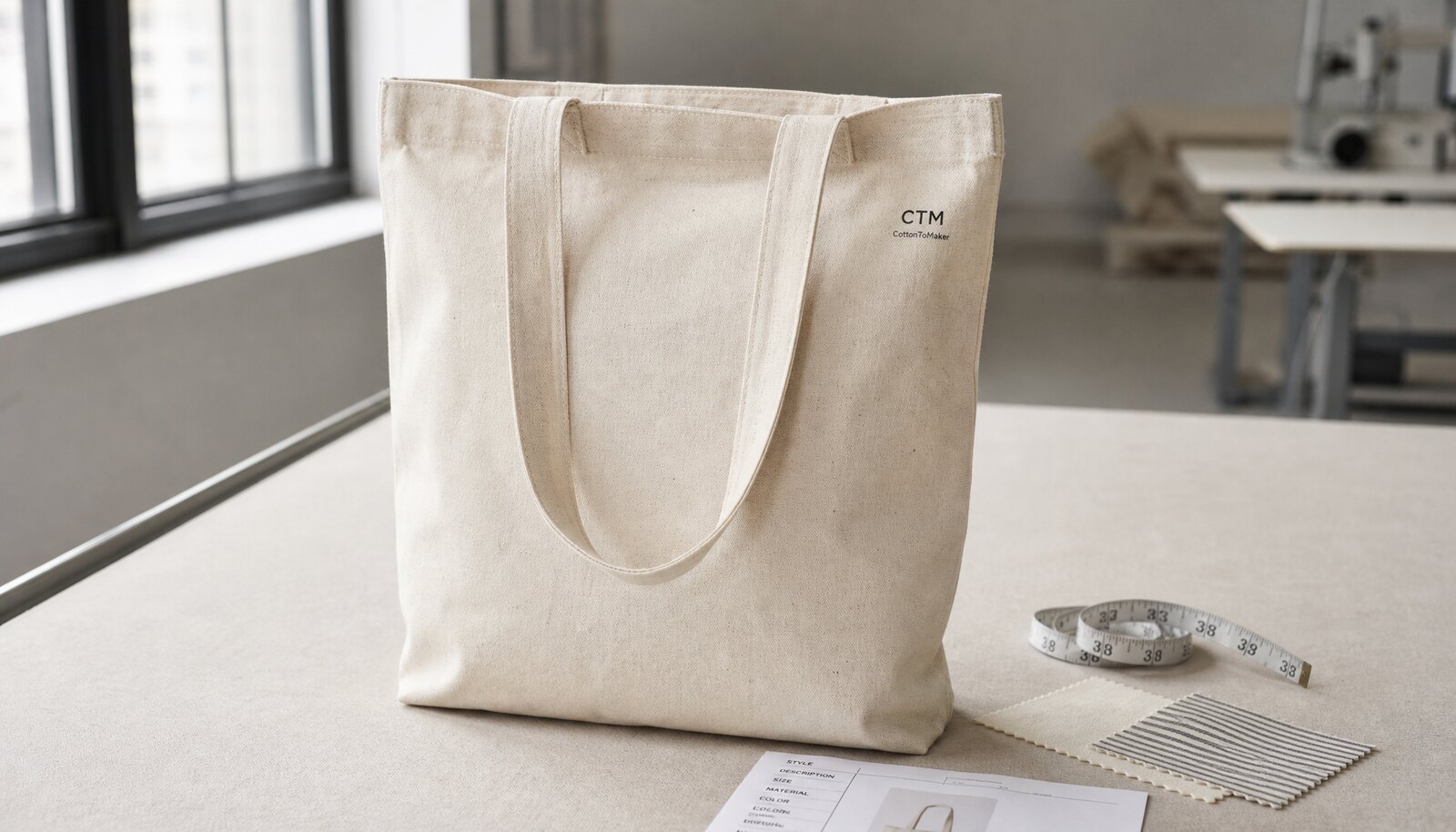
What a procurement buyer should actually spec
For organic cotton tote bags, the useful sourcing question is not 'what is the cheapest tote?' It is 'what construction will hold the brand standard, protect the print, and still land at an acceptable cost?' That means the tote should be written like a small piece of retail product, not treated as an afterthought on a merch order. The fabric, handles, stitching, print system, and packing method all affect how the bag looks in store and how it performs after delivery.
Eco apparel labels usually need the bag to support the same standard as the garment line. The tote may be used as an insert, sold as an add-on, or handed to customers as part of the unboxing experience. If the material choice is too light, the bag can look disposable. If it is too heavy, freight and unit cost may become hard to defend. The right brief starts with use case, carry load, and acceptable visual finish, then moves into GSM, weave, and construction.
- Define the tote's role: insert, gift-with-purchase, resale item, or standalone merch.
- Write the spec around measurable inputs: GSM, weave, handle width, stitch type, and print method.
- Treat traceability and QC as part of the product, not as optional paperwork.
Choose the fabric weight and weave for the job
Fabric weight is the first filter, but it does not tell the full story. Two bags at the same GSM can feel different if one uses a loose plain weave and the other uses a tighter canvas-style construction. A lighter plain weave can print cleanly and fold flat, while a denser weave adds body, opacity, and a more premium handfeel. For organic cotton tote bags for eco apparel labels, the right answer depends on whether the bag is supposed to vanish into the purchase or stand beside the garments as a branded item.
A practical procurement split is to treat 140-170 GSM as the lower-cost, lighter-use zone and 180-220 GSM as the premium, repeat-use zone. But do not let GSM alone decide the quote. Ask the supplier to identify the weave type, finishing, and expected shrinkage after the first wash or steam cycle if that matters to your customer. The same weight in a tighter weave can carry better and print more cleanly than a looser fabric that only looks thicker on paper.
- 140-170 GSM: good for inserts, launch packs, and lower price points, but it needs opacity and shrinkage checks.
- 180-220 GSM: better for premium retail, structured bags, and repeat use, but freight and sewing cost rise.
- Ask for an actual sewn sample from the exact fabric roll, not just a mill swatch.
- If the tote must carry heavier garments, check the weight under a realistic load, not only a visual inspection.
Organic claim documentation should be explicit
The words 'organic cotton' are not enough for a serious buying decision. The supplier should state what they can support in writing and which documents will travel with the order. Depending on your compliance needs, that may include GOTS or OCS scope information, transaction documents, and batch-level traceability records. If you need the claim on product copy, hangtags, or e-commerce listings, the paperwork has to match the actual goods shipped.
This is where procurement teams often lose time. A factory may say the cotton is organic, but that does not automatically mean the final tote is eligible for the exact claim your brand wants to use. If the bag includes non-certified trim, inks, labels, or secondary packaging, those details can affect the wording you are allowed to use. The safest rule is simple: ask the factory to describe the claim they can support before artwork is final and before you approve the spec.
- Ask for order-specific documentation, not a generic certificate screenshot.
- Confirm whether the claim applies to the fiber, the finished bag, or only selected inputs.
- Check whether inks, labels, and trims affect the final wording you can use.
- Do not finalize consumer-facing sustainability language until the supplier's document trail is clear.
Construction details decide whether the bag feels cheap or retail-ready
Construction is where a tote becomes either a simple carrier or a credible retail item. Handle type is the fastest visible signal. Self-fabric handles give a cleaner, lower-profile look and usually fit well with minimal branding. Cotton webbing handles can improve strength and carry comfort, but they change the visual language and may raise cost. The right choice depends on whether the bag is supposed to blend into the apparel line or behave like a separate accessory.
Stitching is just as important as the handle material. For procurement, insist on specific reinforcement at load-bearing points. Box-X stitching with a bar tack is a better commercial reference than 'strong stitching' because it gives the factory a measurable target. Also define whether seams are single-needle or double-needle, where topstitching should sit, and how the factory should finish thread tails. If the quote does not specify these details, you are not comparing the same bag across suppliers.
- Self-fabric handles: cleaner branding, usually better for minimalist retail programs.
- Webbing handles: stronger visual structure and often better for heavier carry loads.
- Box-X plus bar tack at the handles is a better default than basic topstitch-only construction.
- Require handle length and stitch placement to be measured from a flat, finished bag.
Print method should match artwork complexity and wash risk
For most organic cotton tote bags, screen print is still the most predictable option. It works well for simple logos, flat colors, and repeat orders because the ink deposit and edge quality are relatively stable on woven cotton. If your artwork is a small wordmark or a one- to three-color emblem, screen print often gives the best balance of cost, durability, and visual clarity.
Transfer methods can make sense for launch tests, small quantities, or artwork that needs gradients and fine detail. The tradeoff is durability. A transfer can look excellent when fresh and still fail after repeated folding, abrasion, or a light wash. If you choose a transfer system, the sample should be handled the way the customer will handle the product. Fold it, rub it, and inspect it after stress. That is more useful than approving a perfectly flat sample on a table.
- Screen print: best default for simple logos and reorders.
- Transfer print: useful for short runs or complex art, but test folding and abrasion.
- Define the maximum number of colors before quoting so setup charges are not hidden.
- Set a minimum line thickness and small-text size that the factory can reliably reproduce.
Build the RFQ so quotes are genuinely comparable
A tote quote is only meaningful when every supplier is pricing the same object. If one factory quotes a lighter fabric, a simpler seam, a different handle width, or a more compact packing method, the unit price comparison is distorted. The RFQ should lock the basics: finished size, fabric GSM, weave type, handle construction, print method, label type, folding style, and carton count. Once those are set, buyers can compare like for like instead of decoding hidden differences after the fact.
The best way to compare suppliers is to convert the quote into a landed-cost view. Include the base bag, print setup, labels or hangtags, packing, cartonization, inland handling, and freight allocation. Then read the operational answer behind the number: who can reserve fabric, who can make a true pre-production sample quickly, and who can repeat the same spec on reorder. A lower ex-factory number is not useful if the factory cannot hold the fabric shade or construction standard on the next lot.
- Normalize all quotes to one finished spec before comparing price.
- Ask for separate lines for fabric, sewing, print setup, trims, and packing.
- Require the supplier to state whether the quote assumes a direct factory or a trading route.
- If the quote is unusually low, check whether it excludes reinforcement, labels, or export packing.
Use MOQ and lead time rules that reduce production risk
MOQ and lead time should be treated as operational constraints, not negotiation slogans. For organic cotton tote bags, minimums are usually driven by fabric reservation, print setup, cutting efficiency, and packing labor. If you want a reasonable MOQ, reduce the number of variables. One body size, one handle length, one print position, and one packaging format gives the factory the best chance of keeping the order efficient and repeatable.
Lead time risk is usually concentrated in fabric sourcing, artwork approval, and sample correction, not in sewing itself. A quote that promises a fast sew time but is vague about fabric reservation or print approval should be treated cautiously. A supplier can often move quickly on a repeat order with an already approved spec, but first-time orders need more buffer. The buyer rule should be simple: if the supplier cannot name the critical path step and the date each gate is expected to clear, the lead time is not yet real.
- Keep the first order simple enough to learn from.
- Limit colorways and SKUs unless the sales plan clearly justifies them.
- Do not promise a launch date until sample approval is locked.
- Treat reorders as a quality-control test of the supplier's process, not just a restock.
Sampling should prove the actual production process
A real approval sample must match the bulk process. That means final fabric, final print method, final labels, and final fold or pack format. A swatch is useful for touch and shade, but it does not prove how the tote behaves when sewn, printed, or packed. A pre-production sample should be treated as the production reference: measure it, photograph it, mark it, and keep it as the standard the factory must hit in bulk.
The sample review should be objective. Measure body dimensions, handle length, handle placement, print position, and seam finish. Check whether the bag holds its shape, whether the print sits cleanly, and whether the handles twist or pull asymmetrically. If the bag will be washed, test the intended wash path before approving the order. If the supplier resists making a final-method sample, the risk is not cosmetic; it usually means the production process is not fully controlled yet.
- Request a sample made from the exact production fabric roll if possible.
- Use a measured spec sheet for approval, not just visual sign-off.
- Keep the approved sample sealed and labeled for bulk comparison.
- If the sample differs in fabric, print method, or trimming, it should not be used as final approval.
QC needs clear acceptance criteria and rejection triggers
Quality control for tote bags is often described too vaguely. 'Good stitching' and 'nice print' are not inspection criteria. A procurement-ready QC plan should state what gets measured, what gets counted, and what triggers rejection. For a commercial order, that usually means checking GSM against the approved band, verifying seam finish, confirming handle symmetry, checking print registration, and inspecting carton integrity. If the bag is part of a retail program, the inspection standard should be closer to a true production control plan than a casual packaging check.
Use named methods where possible. GSM can be checked against ASTM D3776 or ISO 3801 equivalents, and overall inspection can follow an AQL plan such as ISO 2859-1 if that is part of your supplier process. For print durability, use actual rub and fold checks on the approved artwork. For shrinkage, if the bag is washable, confirm the expected laundering method and inspect distortion after the test. The key is not the acronym alone; it is whether the factory knows exactly what passes and what fails before bulk sewing starts.
- Reject obvious shade jumps, fabric contamination, and uncontrolled flecking.
- Reject open seams, skipped stitches, and weak handle joins that fail a pull test.
- Reject print drift, smeared edges, ink bleed, or visible cracking on the fold line.
- Reject cartons that are crushed, mixed by SKU, or overpacked beyond the agreed format.
- Require corrective action in writing if defects exceed the agreed AQL or tolerance table.
Packing and cartonization affect the finished product as much as the bag spec
Packing is often the last decision made and one of the easiest to get wrong. A bag that looks acceptable in bulk can arrive with permanent creases, distorted handles, or mixed SKUs if the pack method was not defined. For export orders, buyers should state whether the tote is to be flat-packed, folded a specific way, bundled by count, or polybagged. Each choice affects freight efficiency, presentation, and the chance of scuffing the print.
Carton planning should be part of the RFQ. Ask for carton dimensions, gross weight, bag count per carton, and whether there are size or color separations inside the master carton. If the tote is a premium retail item, it may need a cleaner presentation method than a bulk promotional bag. If the goal is warehouse efficiency, the pack should maximize density without compressing the print or handle joins. In other words, packing is not a back-office detail; it is part of product quality.
- Flat pack improves freight efficiency but can crease print if over-compressed.
- Polybags protect surface finish but add cost and may conflict with sustainability goals.
- Carton size should match warehouse receiving and shelf replenishment needs.
- Shipping marks should match the SKU coding used on the PO and packing list.
Specification comparison for buyers
| Spec decision | Recommended option | When it fits | Buyer risk to check |
|---|---|---|---|
| Fabric weight | 140-170 GSM plain weave | Apparel inserts, event bags, launch packs, and price-sensitive retail programs | Can feel thin or show contents; confirm opacity, shrinkage, and print holdout |
| Fabric weight | 180-220 GSM plain weave or canvas-like weave | Premium retail, repeat-use bags, and structured shelf presentation | Higher freight and cost; verify thread strength and handle attachment match the heavier body |
| Weave type | Plain weave for sharp print and cleaner cost control | Most logo-led programs with one to three ink colors | Too open a weave can telegraph the contents and reduce print edge crispness |
| Weave type | Tighter canvas-style weave for body and structure | Bags that must stand up better, feel heavier, or support a premium handfeel | Can raise cost and make folding less compact; ask for actual sewn samples, not just mill data |
| Handle construction | Self-fabric handles, double-folded and topstitched | Retail totes with a clean, minimal look and common eco-apparel branding | Handle twist, uneven length, or weak edge stitching can cause early failure |
| Handle construction | Cotton webbing handles with reinforced stitching | Higher-carry loads or bags that will see frequent use | Webbing can change the visual language of the bag; confirm width, color, and handfeel |
| Seam reinforcement | Box-X plus bar tack at handle joins | Most serious retail orders where the bag must carry weight and survive repeated use | If reinforcement is vague in the quote, the supplier may only do basic topstitching |
| Finishing | Unbleached natural fabric with controlled shade range | Brands that want a raw, low-processed look and lower chemical finishing exposure | Natural cotton varies lot to lot; define fleck level, shade band, and stain limits |
| Print method | Screen print for simple art and repeat orders | Strong logos, flat color blocks, and stable production on woven cotton | Fine type and tiny marks can fill in; require line thickness and cure standards |
Buyer checklist before sampling
- Confirm the exact GSM, weave type, and whether the fabric is bleached, unbleached, or pre-shrunk.
- Define the acceptable natural shade range, fleck tolerance, and stain rejection standard for the base fabric.
- Specify handle width, handle length, fold method, stitch count, and reinforcement at every load-bearing point.
- State the print method, ink system, maximum color count, minimum line thickness, and required cure or adhesion standard.
- Request the exact certification documents needed for your claim, including scope, transaction, and traceability records where applicable.
- Approve a true pre-production sample made from final fabric, final print method, final label, and final packing method.
- Set packing rules for folding, bundling, polybag use or omission, carton count, and carton markings before order confirmation.
- Require a measured inspection plan with AQL level, tolerance table, and rejection triggers before bulk production starts.
Factory quote questions to send
- What exact GSM, weave type, finished shrinkage, and fabric finish are included in this quotation?
- Which organic claim can you support in writing, and what scope or transaction documents will ship with the order?
- Is the price based on self-fabric handles or webbing handles, and what is the handle width, length, and reinforcement spec?
- How are seams constructed at the handle attachment points, and does the quote include box-X stitching or bar tacks?
- Which print method is quoted, how many colors are included, and what are the setup charges for screens, plates, or film?
- What are the minimum accepted line thickness, registration tolerance, and cure or wash-resistance expectations for the artwork?
- What is the MOQ per size, per color, and per print design, and do mixed cartons change the minimum order quantity?
- What sample stages are included: swatch, pre-production sample, top sample, and production reference sample?
- What is the production lead time by stage, and which step is the current critical path: fabric reservation, print approval, or bulk sewing?
- How are bags packed for export, what is the carton size and gross weight, and what carton test standard do you use if the pack is dense?
Quality-control points to confirm
- Fabric GSM should stay within the agreed tolerance band; a practical commercial target is usually about plus or minus 5 percent unless the supplier can justify a tighter control plan.
- Fabric shade should match the approved range across rolls and cartons; reject cartons with obvious tone jumps, dark streaks, or uncontrolled fleck density.
- If the claim depends on certification, the shipment should match the approved transaction or traceability documents exactly; do not accept generic certificate references without order-specific linkage.
- Handle length, width, and placement should be measured on a flat table. Bags that look centered when hanging can still be out of tolerance after folding.
- Handle joins should use even stitching with no skipped stitches, loose knots, open seams, or thread breaks. Box-X or bar tack reinforcement should appear where specified, not omitted on some units.
- Seam strength should be checked with a pull test on representative samples. If the bag fails by seam opening before fabric deformation, the construction is too weak for retail use.
- Print placement should stay within the approved tolerance for centering, top margin, and side offset; do not accept visibly drifting logos across cartons.
- Ink should not crack when the bag is folded along the production fold line. Rub or crocking performance should be checked on the actual final print system, not a hand sample.
- If the tote will be washed by customers, run a wash shrinkage and distortion check on the final sample before bulk approval. Use the approved laundering method, not an informal rinse.
- Cartons should match the packing list, SKU code, and count. Reject cartons with crushed corners, mixed SKUs, or overpacked bundles that distort the bag body and print.