Why MOQ Is Not One Fixed Number
For an organic cotton tote bag, MOQ is usually controlled by several production steps, not only sewing capacity. A factory may be able to sew 300 bags, but the fabric mill, dye house, label supplier, and print setup may each have their own minimum. This is why two suppliers can quote very different MOQs for what appears to be the same bag.
A buyer should ask which part of the order creates the MOQ. If the MOQ comes from fabric roll usage, changing the bag size or GSM may help. If it comes from custom dyeing or woven labels, simplifying the branding package may reduce the first order quantity.
- Natural organic cotton in available fabric is usually easier to support at lower quantities than custom dyed cloth.
- Heavier organic canvas uses more fabric per bag, so the same fabric roll produces fewer finished pieces.
- Large print areas need more setup control and may not be efficient for very small runs.
- Individual retail packing increases labor time and may create a separate packing MOQ.
Start With the Real Use Case Before Asking MOQ
The best MOQ discussion starts with how the tote bag will be used. A lightweight conference bag, a supermarket reusable shopper, and a paid retail tote should not use the same fabric, handle, or seam construction. If the RFQ only says organic cotton tote bag MOQ, the supplier must guess the specification and will protect themselves with a safer price or higher MOQ.
For procurement teams, the practical target is to define the lowest safe specification for the intended use, then ask the factory where MOQ breaks occur. This makes the quote easier to compare and reduces later changes after sampling.
- For events and giveaways, consider 140-170 GSM organic cotton with simple one-color printing.
- For retail merchandise, consider 220-280 GSM organic cotton canvas with stronger handles and cleaner seams.
- For grocery or heavy-use programs, confirm load expectation and handle reinforcement before locking price.
- For folded mailer inserts, check folded size and packing thickness, not only open bag dimensions.
Fabric GSM and Weave Drive MOQ More Than Buyers Expect
Organic cotton fabric is commonly discussed by GSM, but GSM alone is not enough. A 180 GSM plain weave cotton and a 280 GSM organic canvas have different hand feel, strength, cutting behavior, and cost structure. The heavier the fabric, the more roll usage per tote, and the more important cutting yield becomes.
If your order requires certified organic cotton, ask whether the certification applies to the yarn, fabric, processing, or finished product transaction. Do not put broad organic claims on labels or retail packaging unless the factory can provide documents matching the scope you need.
- Ask for fabric width because it affects panel layout and waste.
- Ask for GSM tolerance because minor variation is normal in cotton fabric production.
- Confirm whether the natural color is unbleached, bleached, or dyed to a natural shade.
- If custom color is required, ask for dye lot MOQ and lab dip lead time before finalizing the order plan.
Print Method Can Raise or Lower the Starting Quantity
For most organic cotton tote bag MOQ discussions, screen printing is the practical baseline. It works well for one-color and limited-color logos, gives stable coverage, and is efficient once the screen is made. Water-based ink is often requested for a softer hand feel, but curing and fabric absorption must be controlled.
Digital printing can help with multi-color artwork or small image runs, but it may not be the cheapest or most durable option for every cotton texture. Heat transfer can work for certain designs, but buyers should check hand feel, cracking risk, and whether the finish matches the natural positioning of organic cotton.
- Send vector artwork when possible to avoid fuzzy print edges.
- State print size in centimeters, not only logo percentage on a mockup.
- Confirm whether the print is one side, two sides, or includes gusset or pocket positions.
- Ask for rubbing, curing, and color fastness checks if the bag will be sold at retail.
Construction Choices That Change the Quote
Small construction changes can shift labor time and MOQ. A basic flat tote with overlocked inside seams is faster to sew than a French-seamed retail tote with inside pocket, zipper, gusset, and boxed bottom. Buyers often request a low MOQ and then add details that belong to a higher-complexity sewing program.
If the bag must carry heavier goods, handle design deserves attention. Handle width, length, stitch pattern, and fabric layers at the attachment point matter more than a simple statement such as strong handle. For a factory quote, specify the handle length and reinforcement method.
- Flat tote bags are simpler and usually easier for low MOQ orders.
- Bottom gussets improve capacity but add cutting and sewing steps.
- Inside pockets, zipper closures, and snap buttons create extra material purchasing points.
- Cross-stitch or box-stitch handle reinforcement should be shown on the approved sample.
Sampling Should Prove the MOQ Assumptions
A sample is not only for appearance approval. It should verify whether the chosen MOQ, fabric, print, and packing method are practical. A factory may make an attractive hand sample from available cloth, but bulk production can change if the actual fabric batch, dye lot, or print setup differs.
For serious procurement, approve a pre-production sample made from the intended bulk fabric and with the correct printing and label placement. This sample should become the reference for inspection, especially if the order is split across colors, SKUs, or packing formats.
- Measure finished width, height, handle drop, and gusset after sewing.
- Check fabric feel and opacity against the intended usage.
- Inspect print registration, ink penetration, and edge sharpness.
- Confirm the side label, care label, barcode sticker, and hangtag position before bulk sewing.
- Keep one approved sample with the buyer and one with the factory inspection team.
Packing and Carton Details Affect Landed Cost
MOQ is only one part of the buying decision. Packing can change labor cost, carton quantity, warehouse handling, and freight volume. A tote bag packed bulk in export cartons will have a different cost and CBM from the same tote folded into individual polybags or paper belly bands.
Retail buyers should provide barcode, SKU, country of origin marking, and carton label requirements at RFQ stage. If these details are added after production starts, the factory may need repacking time, extra labels, or revised carton dimensions.
- Ask for pieces per inner bag, pieces per carton, gross weight, net weight, and carton size.
- Confirm whether bags are flat packed, folded once, or folded to a retail shelf size.
- Separate recyclable paper band, polybag, and no-individual-pack options in the quote.
- If mixed colors or SKUs are packed in one shipment, request a packing list format before production.
Lead Time Should Be Broken Into Production Stages
A reliable lead time is not just a single number. Organic cotton tote bag production may include fabric booking, dyeing, lab dip approval, print screen setup, sample approval, cutting, printing, sewing, trimming, inspection, and packing. If the buyer delays artwork or sample approval, the shipment date moves.
For lower MOQ orders using available natural fabric and simple printing, the schedule is usually easier to control. For custom dyed fabric, special labels, multiple print positions, or retail packing, buyers should expect more coordination and should not compare lead time against a basic blank tote quote.
- Ask when lead time starts: deposit date, artwork approval date, or sample approval date.
- Confirm whether bulk fabric is reserved before or after sample approval.
- Ask if printing happens before or after sewing because this affects defect handling.
- Include inspection and repacking time in the shipment plan.
Specification comparison for buyers
| Spec decision | Recommended option | When it fits | Buyer risk to check |
|---|---|---|---|
| Fabric weight | 140-170 GSM organic cotton for lightweight promotions; 220-280 GSM organic canvas for retail use | Use lighter cloth for giveaways and folded inserts; use heavier canvas for paid merchandise or repeated shopping use | Do not compare quotes unless GSM, weave, and finished bag size are the same |
| Bag construction | Plain tote with inside overlock seam or French seam depending on price level | Overlock works for low-cost bulk orders; French seam gives a cleaner interior for retail | Interior seam choice affects labor cost, appearance, and MOQ if the sewing line must be adjusted |
| Handle specification | Self-fabric handles, 2.5-3 cm wide, reinforced with cross stitch | Good for most organic cotton tote bag orders where strength and natural look matter | Thin handles may reduce cost but increase return risk when customers carry heavy items |
| Print method | One-color screen print for low MOQ; water-based ink if soft hand feel is needed | Best for logos, slogans, and clean brand graphics on natural or dyed cotton | Confirm print size, ink type, curing, and wash/rub resistance before approving bulk |
| Color choice | Natural unbleached cotton for lower MOQ; dyed organic cotton when brand color is required | Natural fabric is easier to source and schedule; dyed fabric suits retail programs | Custom dyeing normally raises MOQ because the mill needs a minimum dye lot |
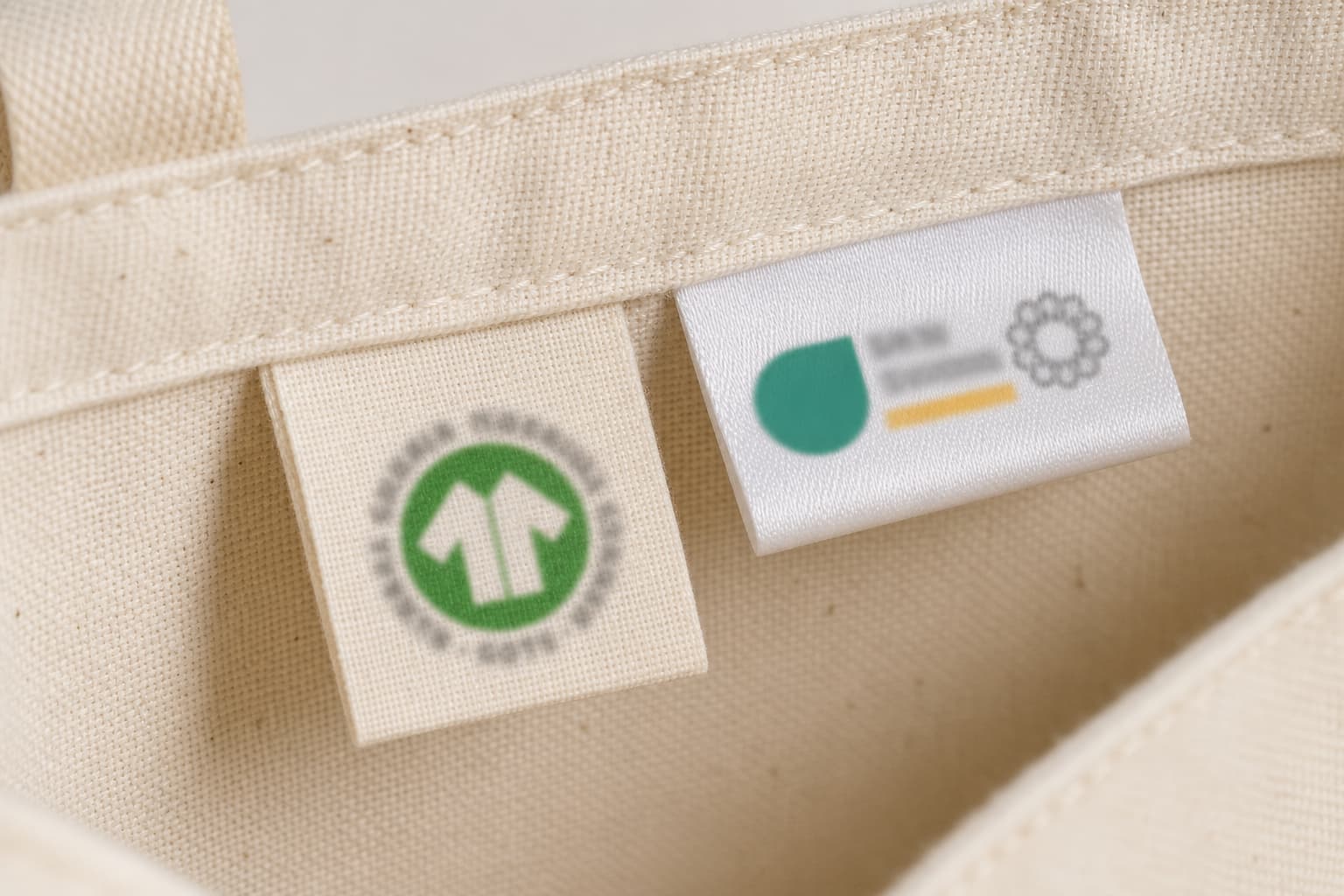
| Labeling | Printed care label or woven side label with organic claim controlled by buyer artwork | Useful for retail, distributor, and brand compliance requirements | Any organic claim on label or hangtag should match the certification scope and documents requested |
| Packing | Bulk carton packing for promotional orders; individual polybag or paper band for retail | Bulk packing reduces labor and material; retail packing improves shelf readiness | Packing can change carton size, CBM, labor time, and barcode control requirements |
Buyer checklist before sampling
- Define whether MOQ is required for a confirmed order, trial order, or sample run.
- State finished bag size, gusset if any, handle length, seam type, and target loading use.
- Specify fabric as organic cotton with GSM, weave, color, and whether certification documents are required.
- Separate fabric MOQ, print MOQ, label MOQ, and packing MOQ instead of asking only for one final MOQ.
- Send logo files with print size, Pantone or ink reference, placement, and number of print positions.
- Confirm whether the quote includes sampling, bulk fabric shrinkage allowance, inner packing, carton packing, and export carton marks.
- Ask for sample photos showing fabric texture, stitch density, handle reinforcement, print edge quality, and label placement.
- Check lead time by stage: material booking, sample approval, cutting, printing, sewing, inspection, and packing.
Factory quote questions to send
- What is your MOQ for natural organic cotton tote bags using available greige or stock fabric?
- What MOQ applies if we need custom dyed organic cotton fabric in our brand color?
- Is the quoted MOQ driven by fabric roll quantity, printing setup, label production, or sewing line efficiency?
- Which GSM and weave are included in the quote, and what is the tolerance on finished fabric weight?
- Does the price include one-color screen printing, and what is the maximum print area included?
- What sample type will you provide before bulk: blank size sample, printed sample, pre-production sample, or full packing sample?
- Can you quote bulk carton packing and retail individual packing separately with carton dimensions and estimated CBM?
- What inspection standard do you use for stitch defects, stains, print registration, color variation, and packing quantity errors?
Quality-control points to confirm
- Check finished bag size after sewing, not only cutting panel size, because shrinkage and seam allowance affect final dimensions.
- Verify fabric GSM with a measured swatch and compare against the approved sample tolerance.
- Inspect handle attachment using visual cross-stitch checks and a reasonable load test based on the intended use.
- Review print curing, ink coverage, edge sharpness, and rubbing resistance before approving mass packing.
- Confirm that organic cotton labels, hangtags, and documents do not overstate certification beyond the actual order scope.
- Check needle holes, loose threads, seam puckering, oil stains, fabric slubs, and shade variation under consistent lighting.
- Verify inner packing count, carton quantity, carton marks, barcode placement, and mixed SKU separation before shipment.