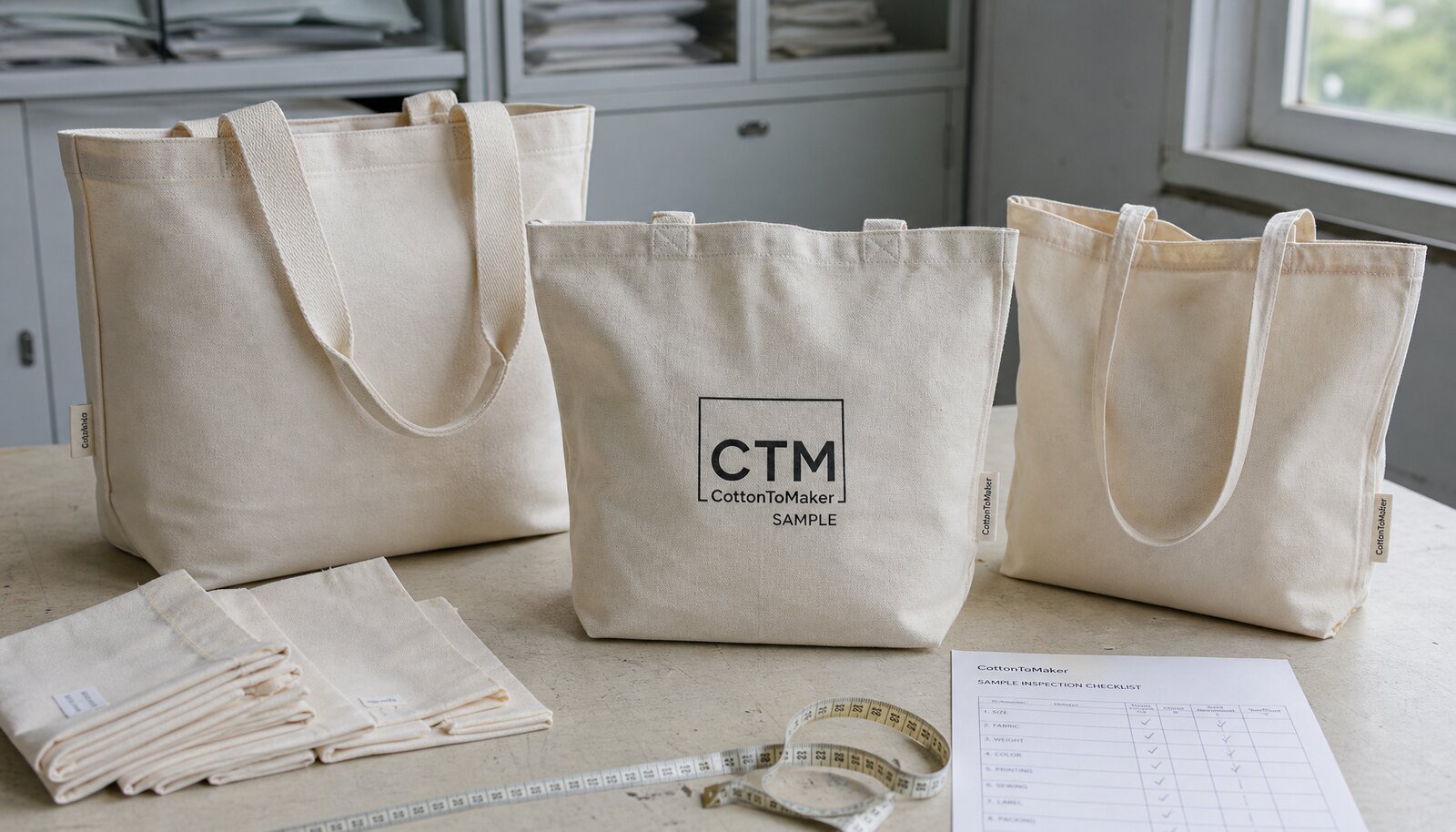
Why the Audit Should Focus on Real Production Risk
An organic cotton tote bag factory audit should not only check whether the supplier has a clean office or a standard company profile. For buyers, the useful audit question is simple: can this factory repeatedly make the same bag you approved, with the same fabric, print, label, packing, and shipment timing?
Organic cotton tote bags look simple, but problems often come from unclear material claims, unstable GSM, weak handle sewing, poor print selection, mixed packing, or quotes that hide setup costs. A good audit helps your team compare suppliers before deposit and reduces the chance of arguments after shipment.
- Audit the actual production flow, not only the sales presentation.
- Match the audit checklist to your exact tote bag construction.
- Ask for evidence from similar production, such as samples, inspection photos, and packing records.
- Separate compliance capability from sewing capability; both matter, but they are not the same thing.
Start With Organic Cotton Traceability and Fabric Control
For organic cotton bags, the first audit point is fabric control. Your RFQ should ask how the factory identifies organic cotton material, who supplies the fabric, whether certification documents are available when required, and how organic fabric is separated from conventional cotton fabric in storage and cutting.
Do not rely on a quote that only says "organic cotton tote bag" without fabric details. Ask whether the fabric is plain weave, canvas, twill, or drill; whether the color is natural, bleached, dyed, or washed; and whether the quoted GSM is before or after finishing. A 270 GSM tote and a 340 GSM tote can both be called canvas, but they do not feel or perform the same.
- Common light tote range: about 140-200 GSM for simple giveaway or packaging bags.
- Common midweight range: about 200-270 GSM for retail, event, and distributor use.
- Common heavier range: about 300-400 GSM for structured reusable totes and premium retail programs.
- Natural organic cotton may show cotton seed flecks; confirm whether your brand accepts this appearance.
- Dyed organic cotton usually needs more attention to shade tolerance, shrinkage, and color fastness.
Check Cutting, Sewing, and Handle Strength Before Price
A low unit price is not useful if the tote fails at the handle or arrives with uneven shapes. During the audit, ask how the factory controls cutting layers, fabric direction, seam allowance, handle placement, and top hem folding. Tote bags with the same dimensions can have very different durability depending on seam construction.
For heavier organic cotton canvas, reinforced handle stitching is not optional for retail use. Cross stitch, box stitch, or bar tack reinforcement should be defined in the RFQ. Also specify handle drop, handle width, and whether the handles are self-fabric, cotton webbing, or contrast color webbing.
- Define finished size tolerance, such as plus or minus 0.5-1.0 cm depending on bag size and construction.
- Ask for stitch density guidance, especially on top hem and handle attachment.
- Check whether handles are inserted into the top hem or sewn onto the outer panel.
- Ask the factory to test handle pull strength with realistic loading, not only visual inspection.
- Keep one approved handle construction sample as the production standard.
Audit Printing Capability Against Your Artwork
Printing is one of the most common reasons tote bag orders are delayed or rejected. The right print method depends on fabric texture, artwork detail, color count, order quantity, and expected hand-feel. Organic cotton fabric can absorb ink differently from coated synthetic materials, so the print strike-off should be made on the actual fabric or closest available bulk fabric.
Screen printing is usually practical for solid logos and larger quantities. Water-based ink gives a softer feel but requires good curing control. Heat transfer can handle fine artwork or small runs, but buyers should check film edge, cracking risk, and whether it changes the natural fabric feel. Embroidery is possible for premium bags but may distort lighter fabric if the artwork is too dense.
- Provide vector artwork with exact print size and placement from bag edges.
- Specify Pantone color targets and acceptable shade tolerance on cotton fabric.
- Ask for a print strike-off before pre-production sample approval.
- Check curing, rub resistance, wash behavior, and ink penetration on textured fabric.
- Do not approve artwork only from a digital mockup; approve a physical printed sample.
Use MOQ Questions to Find Hidden Cost Drivers
MOQ is not only a sales number. For organic cotton tote bags, MOQ usually comes from fabric roll quantity, custom dye lot, print setup, label production, packing material, or the factory's line efficiency. A factory that quotes a very low MOQ may still be workable, but buyers should understand what changes at that quantity.
When comparing quotes, ask the supplier to separate stock fabric MOQ from custom fabric MOQ. A natural cotton tote using available fabric may have a different MOQ than a dyed organic cotton canvas bag with custom woven label and retail barcode sticker. If you need repeat orders, also ask whether the same fabric specification can be reserved or repeated.
- Ask for price breaks by quantity, but keep the same GSM, size, print, and packing in each quote.
- Check whether sample cost is refundable or separate from bulk order cost.
- Confirm if low MOQ uses substitute fabric, shared fabric stock, or a different production route.
- Ask whether mixed colors or mixed designs increase setup cost or extend lead time.
- Do not compare one supplier's stock fabric quote against another supplier's custom fabric quote.
Sampling: What a Buyer Should Approve Before Bulk Production
A useful sample is not just a pretty tote bag. It should confirm the exact construction, fabric weight, handle feel, print result, label position, folding method, and packing style. If the first sample uses substitute fabric or temporary printing, mark it clearly as a development sample and do not treat it as a production standard.
Before mass production, request a pre-production sample made as close as possible to bulk conditions. For larger or repeat programs, keep a signed gold sample at the factory and another with your inspection team. The approved sample should include bag, label, print, hangtag if any, polybag if any, carton mark, and folding method.
- Measure sample dimensions after the bag is fully relaxed, not stretched flat under tension.
- Compare fabric hand-feel with your expected retail positioning.
- Check print alignment after folding and when the bag is carried.
- Review the inside seams for loose threads and raw edge exposure.
- Approve packing with the sample if the order ships to retail, Amazon-style warehouses, or distributors.
Packing and Carton Details That Prevent Claims
Packing is often treated as an afterthought, but it affects freight cost, warehouse receiving, and customer complaints. Organic cotton bags can absorb moisture and odor if stored poorly, so cartons should be dry, clean, and suitable for export handling. If the order is retail-ready, the fold method and barcode placement must be part of the specification.
Bulk packing may reduce cost and plastic use, but it can create wrinkles and counting issues if not controlled. Individual packing improves presentation and warehouse handling, but increases material cost and packing time. Your audit should check whether the factory has a clean packing area, carton weighing process, SKU separation system, and final inspection before sealing.
- Define pieces per polybag or pieces per carton instead of leaving it to the factory.
- Set maximum carton gross weight suitable for your warehouse handling rules.
- Confirm carton dimensions early because they affect freight estimates.
- Require SKU, color, size, PO number, and carton count on carton marks where needed.
- Ask how the factory prevents moisture, odor, and mixed-design packing errors.
Lead Time Audit: Build a Schedule Around Bottlenecks
Lead time should be checked by production stage, not accepted as one general number. Organic cotton fabric sourcing, custom dyeing, print setup, sample approval, and packing material can each create delays. A factory that gives a fast delivery date without a material plan may be assuming fabric is available or may plan to substitute fabric later.
For a reliable RFQ, ask the factory to quote lead time after deposit, artwork approval, and sample approval separately. If your order has multiple colors, multiple logos, retail packing, or third-party inspection, add those steps to the timeline. Buyers should also ask when final inspection can happen and whether cartons will be fully packed before inspection.
- Ask for estimated days for fabric purchase or weaving, dyeing if any, cutting, printing, sewing, packing, and inspection.
- Confirm when the production sample will be available after artwork approval.
- Check whether printing happens before or after sewing for your design placement.
- Ask if peak season, holidays, or subcontracted printing will affect the schedule.
- Do not release shipment based only on production completion; confirm packing and inspection completion.
Specification comparison for buyers
| Spec decision | Recommended option | When it fits | Buyer risk to check |
|---|---|---|---|
| Fabric weight | 10 oz / 340 GSM organic cotton canvas | Retail reusable tote, bookstore bag, lifestyle merchandise, heavier giveaway | Confirm finished GSM after washing or finishing, not only greige fabric weight |
| Budget fabric option | 6-8 oz / 200-270 GSM organic cotton | Event tote, light retail packaging, flat mailer insert, short-term promotion | Bag may look thin with dark print and may not hold shape in product photos |
| Print method | Water-based screen print for 1-3 solid colors | Most logo totes with clean artwork and medium to large order volume | Ask for ink hand-feel, wash test, and print edge sharpness on actual fabric |
| Small detailed artwork | Heat transfer or digital print sample for approval | Fine gradients, small text, multi-color artwork, lower quantity test order | Check cracking, color migration, and whether transfer film changes the organic cotton hand-feel |
| Handle construction | Self-fabric handles with reinforced cross stitch | Retail use, grocery tote, heavier content, repeated carrying | Audit stitch density, handle length tolerance, and pull strength at top seam |
| MOQ logic | MOQ linked to fabric sourcing, dyeing, printing setup, and packing style | Custom GSM, custom size, custom logo, private label, mixed carton packing | Avoid accepting a low MOQ quote without checking fabric availability and setup cost allocation |
| Packing | Individual folded bag in recyclable polybag or bulk pack by carton | Retail-ready orders or distributor replenishment shipments | Confirm fold method, carton size, carton weight, barcode placement, and moisture control |
Buyer checklist before sampling
- Confirm the factory can state the organic cotton certification route for the fabric lot and provide transaction or scope documents when required by your compliance team.
- Ask whether the quoted GSM is greige fabric, finished fabric, or finished bag fabric after washing, dyeing, or calendaring.
- Check whether the factory makes the tote bag in-house or subcontracts cutting, sewing, printing, washing, or packing.
- Request photos or a video of cutting tables, sewing lines, print tables or machines, needle control, inspection area, and packing area.
- Specify finished bag size, gusset, handle length, handle width, seam type, stitch density, fabric shrinkage allowance, and tolerance before sampling.
- Approve artwork with Pantone or CMYK reference, print size, print position, ink type, and whether printing is one side, two sides, or over seam.
- Review one pre-production sample made with bulk fabric, bulk print method, bulk label, and final packing method before releasing mass production.
- Check carton packing quantity, carton dimensions, gross weight, inner polybag use, barcode or SKU label placement, and moisture protection.
- Require a production schedule showing material arrival, cutting, printing, sewing, inspection, packing, and ex-factory date.
- Compare supplier quotes line by line, including fabric GSM, certification handling, print method, sample cost, packing cost, carton spec, and defect allowance.
Factory quote questions to send
- Is the organic cotton fabric in stock, made to order, or purchased after deposit, and what GSM options are stable for repeat orders?
- Can you quote the bag using finished dimensions and finished GSM, not only fabric yardage or ounce weight?
- Which processes are done in your own facility and which are outsourced, especially printing, dyeing, washing, label sewing, and final packing?
- What is the MOQ for this exact construction, and which cost item creates the MOQ: fabric roll, dye lot, print setup, label MOQ, or packing material?
- For our logo, do you recommend screen print, heat transfer, digital print, embroidery, or woven label, and what are the risks on organic cotton fabric?
- Can the pre-production sample be made from the same fabric lot, ink system, label, and packing method planned for bulk production?
- What are your normal tolerances for bag size, handle length, print position, GSM, color shade, and carton weight?
- What inspection standard do you use before shipment, and can you share photos of rejected defects from similar tote bag production?
- How many days are required for material sourcing, sampling, production, packing, and export document preparation after artwork and sample approval?
- Please separate the quote into bag unit cost, print cost, label cost, individual packing cost, carton cost, sample cost, and any certification document cost if applicable.
Quality-control points to confirm
- Measure finished bag size at top width, bottom width, height, gusset depth, handle drop, and handle width against the approved sample.
- Check fabric weight by cutting a measured fabric area or requesting a fabric test report, then compare it with the quoted GSM tolerance.
- Inspect handle attachment with pull testing, especially where self-fabric handles are sewn into the top hem.
- Check stitch density, skipped stitches, loose threads, broken needles risk, seam allowance, and whether the top hem is straight.
- Rub test the print surface when dry and slightly damp to check ink adhesion, smearing, and color transfer.
- Compare print position from bag edge and handle centerline, not only visual alignment from the front.
- Check labels for correct artwork, sewing position, fiber claim wording, country of origin, barcode, and SKU consistency.
- Review packing for moisture, odor, carton compression, incorrect fold marks, mixed SKUs, and missing carton marks.
- Keep signed gold sample, print strike-off, fabric swatch, and packed sample as references for final inspection.