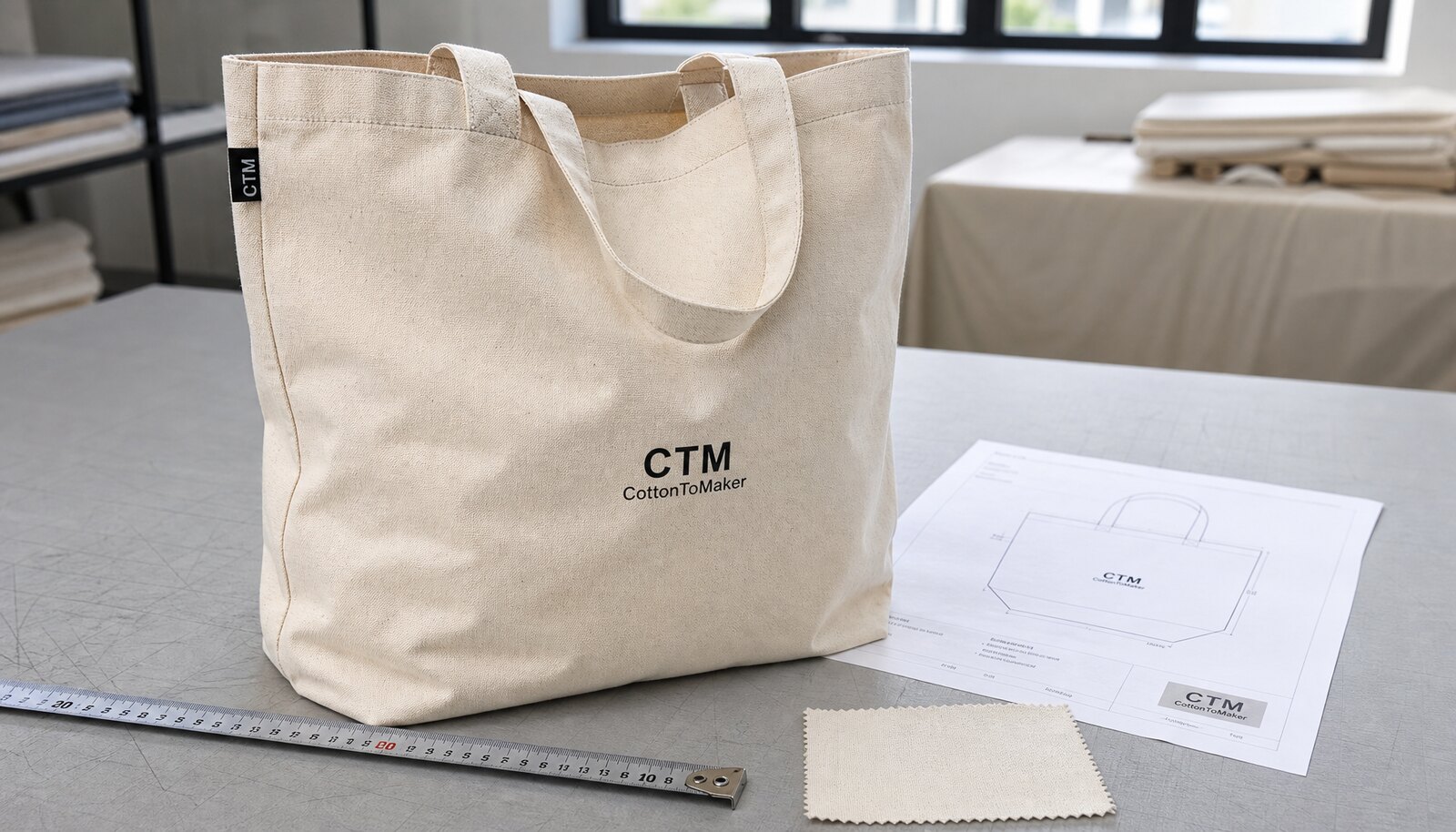
1. Why proof approval matters before bulk production
For an organic cotton tote bag, the print proof is not a design formality. It is the last point where the buyer can still control how the logo will sit on the bag, how the color will read on natural cotton, and whether the artwork is actually practical for the chosen print method. Once a factory cuts screens, prepares transfer files, or starts bulk printing, small mistakes become expensive fast. The most common failure is not a broken machine; it is a proof that was approved too quickly.
Buyers often look only at the logo image and ignore the bag itself. That is where problems start. A logo that looks balanced on a computer screen may sit too low on the finished tote, wrap across a seam, or shrink so much that fine text becomes unreadable. Natural organic cotton also changes how ink appears because the fabric texture and color are visible through lighter inks. The proof should answer one question clearly: will this exact logo on this exact tote still look acceptable when it leaves the factory?
- Treat the proof as a production control document, not a design mockup.
- Check logo layout against the actual tote panel, not just against a white page.
- Assume natural cotton texture will affect color, sharpness, and perceived size.
2. Start with the bag spec, not the logo file
A clean logo file does not guarantee a good tote bag. The factory needs the bag spec first: fabric weight, bag dimensions, handle length, seam construction, and whether the bag is bleached, dyed, or left natural. For organic cotton tote bags, common fabric choices usually sit in the 140 to 220 gsm range, but the right number depends on the use case. A lightweight promotional tote is not the same as a premium retail carry bag, and the proof should reflect that difference.
The bag body affects the print area more than many buyers expect. A wide gusset changes the front panel proportion. A narrow body can make a large logo feel crowded. If the tote is unbleached, small white text may need thicker strokes than the same artwork on a bright white bag. Before you approve any proof, make sure the factory has the actual production measurements, not a guess from an old style sheet. A logo can only be approved in context.
- Confirm GSM, fabric color, tote dimensions, handle length, and gusset depth first.
- Ask whether the production bag is prewashed, enzyme washed, or left raw.
- Match logo scale to the real panel area, including seam margins and handle clearance.
3. Choose the print method that fits the artwork
The best print method depends on the logo, not on habit. Water-based screen print is usually the first option for simple spot-color logos because it gives strong coverage and a good retail look on cotton. If the artwork uses multiple colors, gradients, or tiny details, the factory may suggest a transfer method instead. That can be the right answer for short runs, but it changes how the bag feels in hand and how the print ages after use.
Do not let the factory send a proof that assumes the wrong method. A digital proof can look fine even when the actual method will soften lines, darken a color, or reduce detail. If you need a clean one-color logo on a natural tote, ask for a screen-print proof or a printed strike-off. If you need a full-color brand graphic, ask how the image will be separated and whether the final look will have a hard edge or a softer transfer edge. The proof should show the method, not hide it.
- Use screen print for simple logos, open shapes, and repeat orders.
- Use transfer methods only when the artwork really needs color complexity or short-run flexibility.
- Avoid approving small text unless the factory confirms the line thickness it can hold on cotton.
4. Read the proof like a production document
The first thing to inspect is placement. Measure where the logo sits from the top edge, from the centerline, and from the handle stitching. Do not trust eyeballing alone. On a tote, a few millimeters can make the logo appear visibly off-center, especially when the bag is folded or hanging on a display hook. If the proof shows the logo too close to the top seam, you may lose readability after sewing tolerance is added.
Next, check size and spacing. A logo that is too large can feel crowded and may distort near the edge of the print area. A logo that is too small can disappear on natural cotton. Read the proof at actual size if possible, then compare it with the bag panel dimensions. Check text spacing, icon spacing, and any legal copy. If the art includes a thin line or small tagline, ask the factory to confirm the minimum printable stroke width. Proof approval should be a measurement exercise, not a taste test.
- Measure logo placement from fixed bag points such as top seam, center fold, and side seam.
- Check the logo at actual size, not only on a scaled digital file.
- Confirm minimum stroke width for small text, rules, and fine-line graphics.
5. Compare proof types before you sign off
Not all proofs answer the same question. A digital proof is good for layout, wording, and basic color direction, but it cannot show fabric texture or ink behavior. A printed strike-off is better for checking how the logo behaves on the chosen cotton. A pre-production sample goes one step further because it uses the actual bag and production process. Buyers who skip the later stage often approve a file that looks right on screen but fails once it is printed on fabric.
For a custom logo tote, the practical sequence is usually digital proof first, then a printed sample or strike-off, then bulk approval. If the order is large or the logo is sensitive, require a pre-production sample from the same fabric lot or a very close equivalent. That matters when the bag is organic cotton and the print sits on a natural background. The proof type should match the commercial risk. Small promotional orders can live with a simpler proof path. Retail or brand launch orders usually cannot.
- Digital proof checks layout and text only.
- Printed strike-off checks ink, edge sharpness, and color on fabric.
- Pre-production sample checks the full bag, including sewing, placement, and packing logic.
6. Use a simple comparison table to judge the order setup
Buyers sometimes compare quotes only by unit price, then discover the cheapest quote is built on a weak proof process. That is a mistake. A better comparison is to align fabric weight, print method, proof stage, and revision count before you compare numbers. Two quotes that look close can be very different if one includes a production sample and the other stops at a digital mockup. The same logic applies to MOQ. A lower MOQ may sound attractive, but it can carry extra setup fees that make the total order cost higher.
You want the quote to answer how the factory will control print quality, not just how much it will charge. Ask for the proof path, the number of screens or plates, the included revision rounds, and whether the sample uses the same fabric as bulk production. This is the fastest way to compare suppliers on a real manufacturing basis. If one quote is vague on proof details, treat that as a risk, not as a convenience.
- Compare total setup cost, not only unit price.
- Check whether the sample uses production fabric and production ink.
- Treat weak proof detail as a sourcing risk.
7. Lock the acceptance criteria before sample approval
A proof is only useful if the buyer knows what counts as pass or fail. Set acceptance criteria before the sample arrives. Define the logo size tolerance, placement tolerance, color target, and whether slight fabric shade variation is acceptable for natural cotton. If you do not define these points, the factory will defend its own interpretation later. That is how a buyer ends up approving a sample that looks close but not consistent enough for retail use.
Keep the criteria practical. For example, a natural cotton tote may show tiny fiber specks or slight shade variation, and that can be normal. But a print that creeps into a seam, a logo that shifts off-center, or a text line that fills in is not normal. A good acceptance note also tells the factory whether the bag will be judged under daylight, showroom light, or warehouse inspection conditions. The standard should match the selling channel.
- Define size tolerance in millimeters, not just as good enough.
- State the accepted color reference method, such as pantone target or approved physical sample.
- Confirm the lighting condition used for final approval.
8. Ask for the quote data that exposes hidden risk
Many quote sheets leave out the details that matter most to a procurement team. For a custom logo organic cotton tote bag, the factory should state fabric GSM, bag dimensions, print area, print method, setup charge, sample charge, MOQ, and lead time after approval. If the quote only says custom print available, it is not enough. You need to know whether the quoted price assumes one color, one side, one size, or a more complex decoration plan.
Lead time should also be tied to proof approval, not to the date of inquiry. That difference matters because artwork revisions can add days or weeks. If the supplier says bulk can ship in a short window but never explains when the proof must be signed off, the schedule is not real. Ask how many days it takes to produce the sample, how long revisions take, and whether the bulk order can start only after a signed proof is returned. Reliable quotes show the path from artwork to shipment, not just the end date.
- Request all setup charges in writing, including screens, plates, and revisions.
- Tie lead time to proof approval date, not inquiry date.
- Make the factory show the MOQ logic by color, print side, and decoration method.
9. Pack the approval into a clean workflow
The best proof review process is short, documented, and hard to misread. Start with the artwork file, then the digital proof, then the printed sample, then the final sign-off. Each stage should have one named approver and one documented comment set. If buyers, sales teams, and marketing all edit the proof separately, the factory can easily print the wrong version. A clean workflow saves more time than extra email discussion.
Do not ignore packing just because the topic is logo proof. If the bag is folded differently in the carton, the logo may crease, mark, or print-transfer against another bag if the ink is not fully cured. Ask for the folded size, polybag if any, carton count, master carton marking, and moisture protection plan. For retail programs, even a perfect logo can become a warehouse problem if the packing method is inconsistent. Proof approval should cover the bag as a finished sellable item, not only as a printed panel.
- Use one approval owner to avoid conflicting revisions.
- Approve folding, carton count, and labeling with the final sample.
- Check whether the print can mark other bags if stacked before full cure.
10. Common mistakes buyers should prevent early
The most common mistake is approving a logo proof without seeing it on the correct fabric color. White art on natural cotton is not the same as white art on bright white cotton. The second mistake is using artwork that is not ready for production. Low-resolution files, unoutlined fonts, and tiny line work create avoidable print defects. The third mistake is failing to specify the print method, which leaves the factory to choose the lowest-risk option for itself rather than the best option for the buyer's brand.
Another frequent issue is underestimating how much a tote bag changes in the sewing room. The panel can shift, the fabric can soften, and the print area can move closer to a seam after stitching. Buyers who only check a flat artboard miss that reality. If you want a reliable result, make the proof process address fabric, construction, print method, and packing in one chain. That is the difference between a nice-looking file and a sellable tote.
- Do not approve artwork that was never checked against the real fabric color.
- Do not rely on low-resolution images for a production quote or proof.
- Do not treat printing as separate from sewing, folding, and packing.
Specification comparison for buyers
| Spec decision | Recommended option | When it fits | Buyer risk to check |
|---|---|---|---|
| Fabric weight | 140-160 gsm for standard retail, 180-220 gsm for premium hand feel | Daily-use tote programs, store giveaways, and buyers who want better drape and less show-through | Too-light fabric can distort the logo and expose print bleed; too-heavy fabric may push cost and packing volume up |
| Print method | Water-based screen print for simple spot-color logos | One to three colors, larger logo areas, and repeat programs | Fine text, gradients, and tiny details can fill in or lose edge sharpness if the mesh and ink choice are wrong |
| Print method | Heat transfer or digital transfer for full-color artwork | Short runs, many colors, photo-like graphics, or urgent sample orders | Check edge lift, hand feel, and wash durability; some buyers approve the look but miss the longer-term wear issue |
| Proof format | Digital proof first, then printed strike-off or pre-production sample | Most orders before bulk commitment | A screen-only digital proof can hide real color shift, placement drift, and fabric texture effects |
| Artwork style | Bold logo with clear spacing and thick enough strokes | Brand marks, retail promos, and bags viewed from a distance | Thin fonts, small legal copy, or crowded layouts often look fine on screen but fail on fabric |
Buyer checklist before sampling
- Send vector artwork in AI, EPS, or editable PDF, with fonts outlined and the exact logo version marked as final.
- State the tote fabric weight, color, and finish, including whether the bag is bleached white, natural, or dyed organic cotton.
- Confirm the print method you want the factory to quote, not just the logo artwork, because method changes cost and quality.
- Specify logo size, placement, and tolerance in millimeters, including front, back, side, or gusset if any.
- Share the target order quantity, sample quantity, and any split by color or size so MOQ logic is clear.
- Ask for the proof type in writing: digital mockup, printed strike-off, or pre-production sample with production fabric.
- State the packing method, carton count target, and any retail barcode or hangtag needs before proof approval.
- Nominate one approval owner and one backup reviewer so the factory does not get conflicting feedback from multiple teams.
Factory quote questions to send
- Which proof stage is included in the quote, and what is the cost for extra revisions or a second strike-off?
- What fabric GSM, weave, and finishing process will you use for the quoted tote bag?
- What print method do you recommend for this artwork, and why is it better than the other options for this order?
- What is the MOQ by print color, bag color, and logo size, and does the MOQ change if we need a side label or inner print too?
- What is your expected lead time after proof approval, and what can delay the bulk schedule?
- What are the exact extra charges for screens, plates, color matching, sample shipment, and carton marking changes?
- What tolerances do you use for logo size, placement, and color shift between proof and bulk production?
- What inspection or test checks do you run before shipment, and can you share the defect limits you use for this order?
Quality-control points to confirm
- Logo size matches the approved proof and stays within the agreed placement tolerance.
- Print edges are clean, with no broken letters, skipped ink, smudging, or obvious banding.
- Color matches the approved target under daylight and indoor warehouse light, not just under a bright sample lamp.
- Fabric weight and bag dimensions match the approved spec so the print does not look stretched or undersized.
- The print is fully cured and dry, with no tackiness, cracking, or offset transfer when stacked.
- The logo does not cross seams, seam allowances, or heavy folds unless the design was approved for that construction.
- Handle stitching, side seams, and bottom gusset are not distorted by the print area or heat transfer process.
- Any woven label, side label, or care label is placed exactly where the buyer approved.
- Carton count, inner packing, and polybag use match the confirmed packing instruction.
- Production lots are checked against the signed sample so fabric shade, logo shade, and print placement stay consistent.