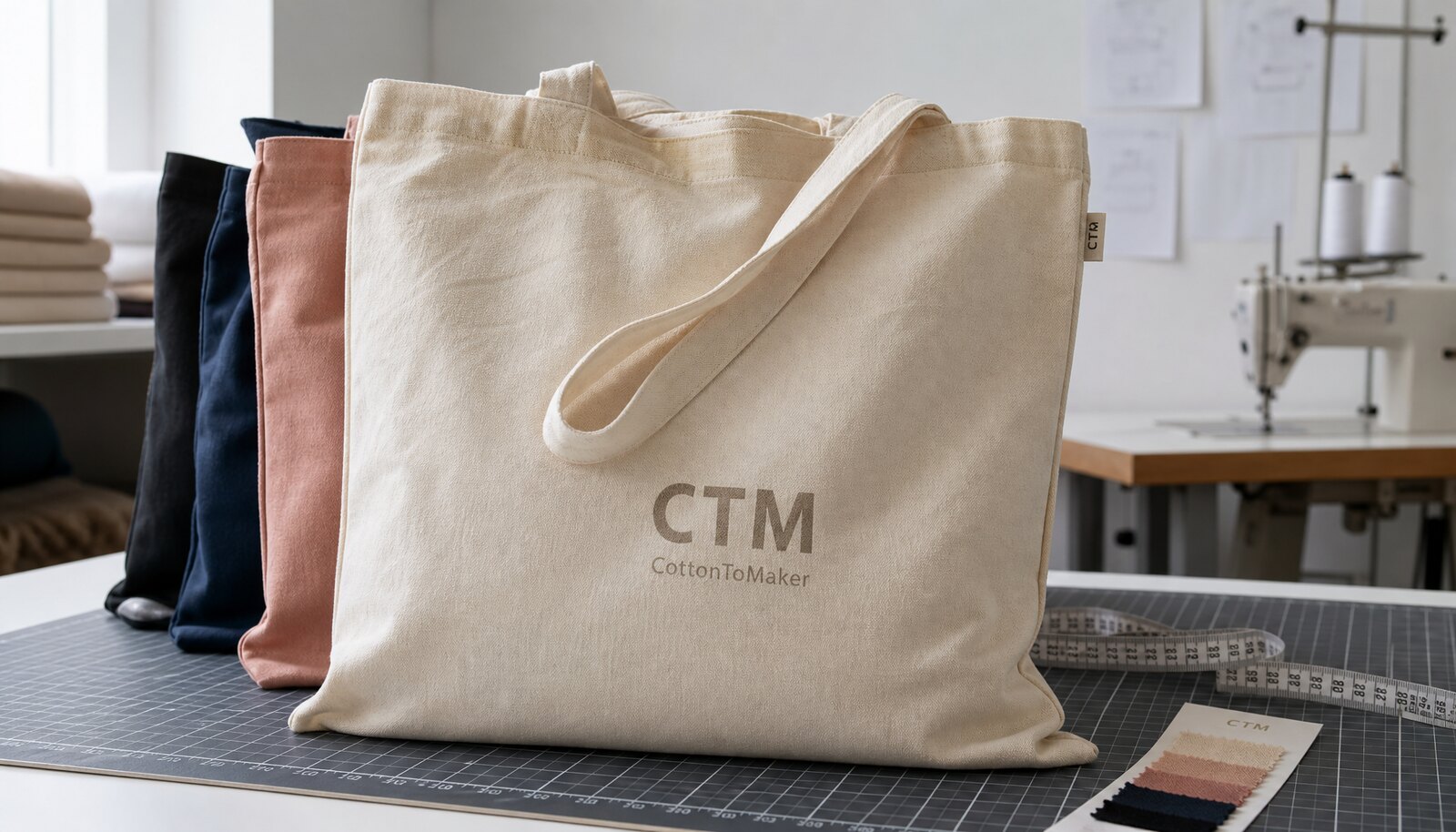
What Retail Buyers Need To Solve
Organic cotton promotional bags for retail are a sourcing problem, not just a merchandising one. The bag has to satisfy brand presentation, margin pressure, packaging rules, and repeatability across reorder cycles. If the spec is vague, the supplier will fill the gaps with its default fabric, default print method, and default carton style. That usually creates quote gaps first and quality problems later.
The core issue is consistency. Buyers need a bag that looks clean on shelf, prints well on natural cotton, ships in retail-friendly packs, and can be reordered without rebuilding the specification. That means the RFQ should read like a production instruction. If the supplier has to guess, the buyer is already paying for that uncertainty in the quote.
- Treat the bag as a retail SKU with a service life, not only as a giveaway.
- Define the construction, decoration, and pack format together.
- Build the first order so it can become a reorder spec without rework.
Fabric Decisions That Change Perceived Value
Fabric weight is the first decision that changes both appearance and cost. Light fabric in the 100 to 120 GSM range can work for low-cost promotions, but it wrinkles more, shows contents, and feels thin on shelf. For most retail promotional programs, 140 to 180 GSM is the practical range because it gives better body, a cleaner drape, and more reliable print performance without pushing the bag into an unnecessarily heavy cost band.
Heavier fabric can support a more premium retail position, especially if the bag needs to stand up on its own or survive repeated customer use. Once you move above 180 GSM, the rest of the construction has to keep pace. If the seam allowance is narrow, the thread count is weak, or the handles are lightly attached, the bag can still fail visually or physically even though the fabric itself is strong.
You should also ask how the fabric is finished. Pre-shrunk cloth, enzyme washed cloth, and raw cloth do not behave the same way after cutting and sewing. A supplier who only quotes 'organic cotton' is not giving enough information for a retail purchase decision. The buyer needs the weave, yarn count, GSM, finish, and expected shrinkage range in writing.
- Use 140 to 180 GSM for most retail promotional tote programs.
- Use heavier fabric if the bag must hold shape on shelf or support repeated reuse.
- Ask whether the fabric is raw, pre-shrunk, or washed because shrinkage affects finished size.
Organic Claim, Traceability, And Label Risk
For buyers, the phrase 'organic cotton' is not enough. The commercial risk is not only quality; it is also claim support. Ask the supplier what they can document at the fiber, yarn, and fabric level, and whether the lot you are buying is traceable to that documentation. If the bag or hangtag will mention organic content, the wording should match the supplier's evidence and the rules in your market.
A practical procurement step is to ask for the exact claim language before the PO is issued. That forces alignment between sales, packaging, and compliance. If the supplier can only support a fiber-origin claim but not a finished-product certification for the final bag, the label copy may need to be adjusted. It is cheaper to catch that before printing inserts and hangtags than after the order is in transit.
The same logic applies to labels and retailer compliance packs. If you need a side label, care label, or swing ticket, ask whether the sewing line can place it consistently and whether the artwork needs approval before production. Organic claims are easy to overstate casually and expensive to correct later.
- Ask for the exact certification or traceability documents that support the claim.
- Align label copy with what the supplier can prove, not what the catalog says.
- Approve any claim wording before printing hangtags or packaging.
Print Methods And Artwork Constraints
Print method should be selected after the fabric and artwork are fixed. Screen print is still the most reliable option for simple logos and repeat retail orders because it is cost-efficient and stable on cotton. It works best for solid shapes, limited colors, and artwork that does not depend on delicate gradients or tiny text. A strong one-color print on natural cotton often looks more premium than an overworked multicolor design on poor fabric.
If the artwork contains gradients, fine detail, or special effects, you may need digital print, transfer print, or a hybrid process. Those methods can improve appearance, but they also raise the risk of color shift, cracking, slower output, and higher rejection if the fabric surface is unstable. The approval sample should be printed on the actual production fabric, not on a random substitute, because organic cotton can absorb ink differently from one lot to another.
For B2B procurement, the key is control. Define artwork file format, Pantone targets or visual references, print area, and acceptable variation. If the supplier cannot tell you the ink coverage, curing method, or expected wash resistance for the chosen process, the quote is incomplete.
- Screen print fits most simple retail branding and larger repeat quantities.
- Use digital or transfer decoration only when the artwork actually needs it.
- Approve a physical strike-off on production fabric before bulk printing starts.
How MOQ Really Works On These Bags
MOQ is usually a stack of constraints, not one number. Fabric booking minimums, cutting efficiency, print setup, and carton economics all influence the order floor. A supplier may quote a low MOQ for blank bags but a much higher one once you add multiple print colors, custom labels, special folds, or retail inserts. Retail buyers should separate the body MOQ from the decoration MOQ so the real driver is visible.
The most effective way to reduce MOQ friction is to simplify the first run. Keep one bag size, one fabric color, one print position, and one packaging method. Then ask the supplier which of those items is actually driving the minimum. If the MOQ exists because of loom width or print setup, that is a technical constraint. If it exists because the supplier does not want a small run, that is a commercial constraint and should be treated differently in negotiation.
A useful commercial question is whether the supplier can offer a mixed MOQ across sizes or colors while holding the same fabric. For retail buyers with several SKUs, the answer matters more than a headline number. The best supplier is not the one with the lowest stated MOQ; it is the one whose MOQ structure matches your replenishment plan.
- MOQ rises with more print colors, more sizes, and more pack configurations.
- Blank bag MOQ is not the same as decorated bag MOQ.
- A single retail SKU is much easier to quote than a mixed size bundle.
Supplier Evaluation Beyond Route Selection
Route selection matters, but it is not the whole supplier decision. Two factories on the same route can produce very different outcomes. The buyer should score suppliers on production ownership, documentation quality, sample discipline, response speed, and willingness to hold to a written spec. If a supplier cannot explain where the fabric comes from, who does the sewing, and how they inspect print and stitching, the risk is not abstract; it is built into the order.
A practical scorecard helps. Give weight to evidence, not sales language. Ask for current production photos, a copy of a recent inspection report format, a sample traceability path from fabric to finished bag, and the named person who will handle your order after the quote. The best suppliers can answer these without deflection. The weakest ones rely on generic promises and catalog pictures.
Commercial reliability is part of quality. A supplier that gives clear redlines on the sample, flags risk early, and explains cost drivers honestly is usually easier to manage than a supplier that gives a low price and then renegotiates every assumption later. For organic cotton promotional bags for retail, that difference often matters more than a small unit-cost gap.
- Score suppliers on ownership of sewing, printing, and final QC, not only on price.
- Require current production photos and a sample traceability path.
- Weight communication clarity and documentation quality as part of the commercial decision.
What A Useful Quote Should Show
A useful quote should expose the assumptions that shape the price. For these bags, that means fabric GSM, bag dimensions, handle length, print method, print area, sewing style, packing count, carton size, and any testing or labeling charges. If those items are not broken out, two quotes can look close while actually describing different bags. That creates false price comparisons and weak purchasing decisions.
Retail buyers should also normalize the quote for the hidden costs that often get omitted. One supplier may include retail folding and barcode stickers while another excludes them. One may quote ocean-ready cartons, while another quotes loose packing with no inner protection. The unit price is only useful when the pack-out is clear. Otherwise the landed cost can diverge sharply from the quoted cost.
The quote should also say what is excluded. Thread color changes, extra sewing reinforcement, special labels, and testing charges often appear later as add-ons. A clean quote does not eliminate variance, but it makes the variance visible before the PO is issued.
- Request separate lines for fabric, sewing, printing, packing, cartons, and testing.
- Make fold method, pack count, and barcode location explicit.
- Compare exclusions as carefully as you compare the unit price.
Sample Approval That Prevents Bulk Mistakes
For this category, one sample is not enough. Buyers should expect at least a fabric reference, a sewn blank sample, and a printed pre-production sample. The blank sample proves the construction; the printed sample proves the decoration. If the order includes a special fold, insert card, hangtag, or barcode label, those items should be included in the approval cycle because packaging often introduces the first bulk error.
The approval process should be measured, not casual. Check width, height, gusset depth if used, and handle length against the spec sheet. Inspect print placement relative to the seam line, not just relative to the fabric edge. Confirm that the fabric shade and handfeel are acceptable under daylight, because natural cotton can show lot-to-lot variation more visibly than synthetic materials.
The cleanest practice is to mark the approved sample set as the production reference in the PO. Then require the factory to keep one retained sample and to sign off before cutting bulk. That small discipline reduces arguments later about whether a deviation was acceptable or accidental.
- Approve fabric, blank construction, print, and retail pack-out separately.
- Measure the physical sample rather than judging by eye only.
- Tie the approved sample set to the purchase order as the production reference.
QC Tests, Thresholds, And What To Reject
Quality control should be written as measurable acceptance criteria. Start with fabric weight. A practical rule is to allow a GSM tolerance of plus or minus 5 percent unless you have a tighter commercial reason to hold it closer. If the quote says 150 GSM, a delivered fabric that lands well outside that range should not be accepted without approval. Visual similarity is not a substitute for a weight check.
For decoration, use a colorfastness method that fits the end use. If the bag may be handled frequently, ask for rub resistance and wash resistance testing by standard methods such as ISO 105-X12 or AATCC 8 for dry rub and ISO 105-C06 or AATCC 61 for wash. Set the acceptance level in the contract. A common buyer target is dry rub grade 4 minimum and wet rub grade 3 to 4 minimum on a 5-point scale, but the exact threshold should match your market and artwork.
For sewing, do not settle for 'looks strong.' Ask the supplier to use a defined seam strength or seam slippage method such as ASTM D1683 or ASTM D5034, or an agreed internal pull test that mimics the bag's use. A useful acceptance rule is no seam opening, no stitch breakage, and no handle detach at the agreed test load. If the order is a heavier retail tote, the test load should reflect that use case rather than a generic promotional bag standard.
Reject visible stains, oil marks, dye smears, hard spots, loose threads in retail-visible areas, print misregistration, and handle twisting. Also reject packed cartons that do not match the written fold direction, count, or label position. The goal is not to create paperwork. The goal is to stop the supplier from deciding quality on your behalf.
- Set a GSM tolerance, commonly plus or minus 5 percent unless you specify otherwise.
- Use standard methods such as ISO 105-X12, ISO 105-C06, AATCC 8, or AATCC 61 for decoration durability when applicable.
- Define a seam strength or pull test method and reject any bag with seam opening or handle failure at the agreed load.
- Reject cosmetic defects that affect shelf appearance, not only functional failures.
Packing, Cartons, And Retail Handling
Retail buyers often lose money in packing rather than sewing. A bag that is folded one way in the sample can be packed differently in bulk if the instruction is not precise. That changes shelf appearance, carton fit, and warehouse receiving speed. If the bag is sold in a retail environment, the fold direction, stack height, and barcode location must be controlled from the first sample onward.
Carton planning matters because organic cotton bags are bulky relative to many synthetic promotional items. A small change in fold size can alter carton loading, freight volume, and pallet stability. Ask the supplier to quote carton dimensions, net and gross weight, and pack count. That lets the logistics team compare landed cost rather than discovering space loss after production is complete.
If you need retail-ready presentation, specify whether the bag should be loose folded, banded, polybagged, or individually tagged. Each option changes labor, packing speed, and the risk of scuffing or wrinkling. The cheaper pack format is not always cheaper operationally if it creates rework at the warehouse or in store.
- Define whether the bag ships loose, folded, banded, or individually bagged.
- Confirm barcode, hangtag, and label placement before bulk packing begins.
- Check carton dimensions against your warehouse and retail distribution constraints.
Specification comparison for buyers
| Spec decision | Recommended option | When it fits | Buyer risk to check |
|---|---|---|---|
| Direct factory sourcing | Work with a bag factory that controls fabric booking, cutting, sewing, printing, and final packing | Best for repeat retail programs, private label, and buyers who need stable specs across reorder cycles | Confirm the factory owns the core sewing line and does not quietly move bulk to subcontractors |
| Trading company route | Use a trading partner that consolidates approved factories and manages export paperwork | Useful when you need multiple bag styles, accessory add-ons, or lower internal sourcing bandwidth | Check for markup layering, sample provenance, and whether the same team controls bulk follow-up |
| Domestic decorator | Source blank organic cotton bags locally and decorate near the market | Fits urgent launches, low initial quantities, or regional fulfillment programs | Verify blank bag consistency, decoration compatibility, and the landed cost at higher volumes |
| Integrated packaging supplier | Buy bags from a supplier that also handles tags, inserts, barcodes, and retail-ready pack-out | Good for shelf-ready programs where folding, labeling, and carton marks must match retail rules | Make sure print color, fold method, and pack counts are written into the quote |
| Nearshore converter | Use a nearby country or region for shorter transit and easier production follow-up | Helpful for seasonal drops, replenishment programs, or volatile demand | Ask what fabric is local versus imported because fabric availability often drives lead time |
| Marketplace supplier | Use an online listing to benchmark styles, price bands, and basic market direction | Useful for early scans or rough range checks before you build an RFQ | Treat listings as preliminary only; request current production photos and a live spec sheet |
| Private-label specialist | Choose a supplier used to branded programs and retailer compliance packs | Best when hangtags, UPC labels, and carton marks must follow retailer rules | Confirm they can mirror your packaging layout and will not substitute materials without approval |
| Low-cost general bag maker | Use a general sewing factory with organic cotton capability | Works for simple promotional totes with minimal finishing | Check whether organic documentation, print registration, and seam quality are actually controlled |
Buyer checklist before sampling
- Define the use case first: shelf display, paid retail item, giveaway, or in-store promo pack.
- Lock the fabric spec in GSM, weave, yarn count, and finish instead of using only the phrase 'organic cotton'.
- State bag size with seam tolerance, handle length, gusset depth, and usable interior dimensions.
- Choose one print method and define the fallback if artwork detail or volume changes.
- Request photos of the raw fabric, blank sewn sample, print strike-off, and packed carton sample.
- Write pack count, fold size, barcode placement, carton marks, and master carton dimensions into the RFQ.
- Ask for an approval sample that matches bulk fabric color, handle construction, and label placement.
- Normalize quotes for fabric GSM, print colors, packing, testing, and any special handling before comparing price.
- Confirm lead time from fabric booking and artwork approval, not from purchase order date alone.
- Set a written defect standard for stitching, print alignment, stains, shade variation, and measurement tolerance before production starts.
Factory quote questions to send
- What is the exact fabric specification, including GSM, weave, yarn count, and whether the cotton is certified organic or only made from organic cotton fiber?
- Which certification documents can you provide for the fiber or fabric, and do they match the lot you will ship?
- Does your quote include pre-shrunk fabric, enzyme wash, calendering, or any finish that changes handfeel and shrinkage?
- Which print method are you quoting, and what changes in price if we move from one color to two colors or to a larger coverage area?
- What is the MOQ by size and by print color, and does it change if we keep the same body but change handle length or label type?
- Can you separate fabric cost, sewing cost, printing cost, packing cost, cartons, and any testing or certification charges in the quote?
- What sample stages are available before bulk order: fabric swatch, blank sewn sample, printed strike-off, and pre-production sample?
- What is your standard overrun or underrun tolerance, and how do you handle rejected pieces found during final inspection?
- What carton size, inner pack count, and folding method do you include by default, and what changes if we need retail-ready presentation?
- What is the realistic production lead time after print approval and deposit, and what events usually delay the shipment?
Quality-control points to confirm
- Fabric weight should match the agreed GSM within a written tolerance, commonly plus or minus 5 percent unless you specify tighter control.
- Verify GSM by weighing a defined sample area, not by visual inspection alone.
- If the bag is dyed or printed, request colorfastness testing such as ISO 105-C06 or AATCC 61 for wash and ISO 105-X12 or AATCC 8 for rub; set the acceptance level in advance, for example dry rub grade 4 minimum and wet rub grade 3 to 4 minimum on a 5-point scale.
- Measure seam strength or seam slippage with a defined method such as ASTM D1683, ASTM D5034, or an agreed internal pull test; require no open seam or stitch failure under the agreed load.
- Inspect stitch density on side seams, bottom seams, and handle joins for even spacing, no skipped stitches, and no loose thread tails.
- Check print registration, edge sharpness, and color density on first, middle, and last cartons, not just on the approval sample.
- Confirm handle reinforcement at stress points so the handles do not twist, stretch excessively, or pull away under normal retail use.
- Reject visible contamination such as oil marks, dye smears, hard spots, or fiber slubs that create a poor shelf appearance.
- Measure bag dimensions after sewing and packing, not only on cut panels.
- Verify fold direction, pack count, barcode placement, carton marks, and master carton dimensions against the retail distribution plan.