What retail buyers actually need from organic cotton produce bags
Organic cotton produce bags for retail are not one product category. Buyers use them in at least three different ways: as a reusable item sold at shelf, as a branded utility bag for store or grocery programs, and as part of a private-label bundle where packaging and presentation matter as much as the bag itself. The buying logic changes with each use. A produce bag sold beside fresh food needs visibility, airflow, and a clean look. A bag used at checkout needs easy handling and a closure that does not frustrate staff. A bag sold as part of a premium set may need more substantial fabric, a label, and retail-ready packing.
Where procurement projects go wrong is in treating all of those as a single quotation exercise. If the RFQ simply asks for 'organic cotton produce bags' with a size and quantity, suppliers will quote different assumptions. One may price a light mesh bag in bulk cartons, another a heavier woven bag with a sewn label and retail insert card. The unit price gap can look large even when the offers are not comparable. The fix is to define the role of the bag first, then specify the product in operational terms: what the buyer sees, how the bag is used, how it ships, and what claims the retailer wants to make. That framing produces cleaner quotes and fewer disputes later.
Retail teams also need to think beyond the bag itself. The product has to fit store handling, shelf presentation, cartonization, and replenishment. A bag that looks good flat on a sample table may fail in store if it packs badly, wrinkles heavily, or obscures produce labels. In practice, a good sourcing spec for this category should connect product design to merchandising, logistics, and compliance. That is the level at which procurement decisions become easier to compare and harder to misquote.
Choose the right fabric style before you compare suppliers
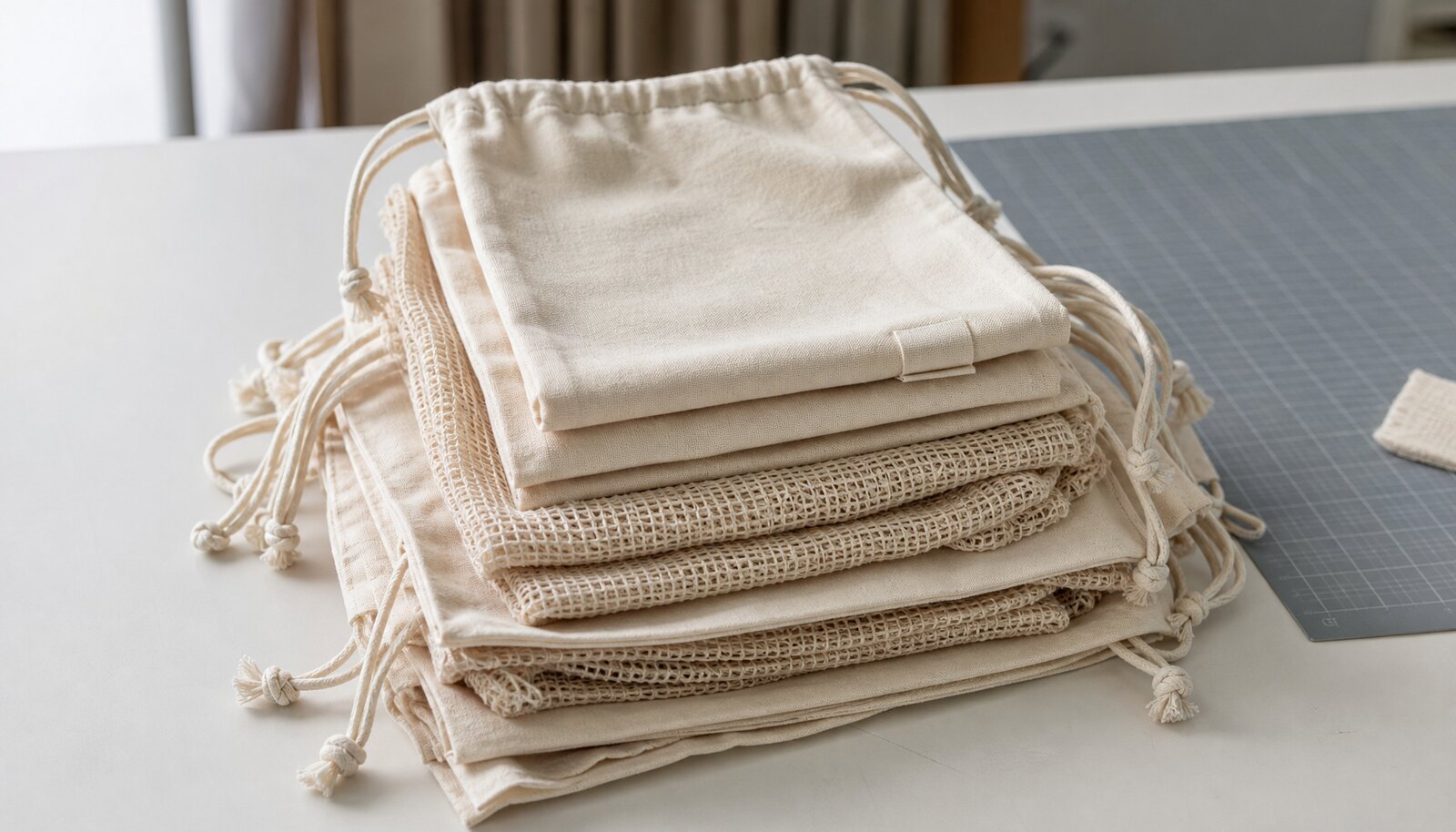
The first major decision is construction: mesh or solid woven cotton. Mesh gives visibility and airflow, which is why it is often used for produce that benefits from ventilation or quick visual checks at checkout. Solid woven cotton creates a more polished retail appearance and can be the better choice for herbs, multi-use household kits, or branded packs where contents do not need to be seen through the fabric. Many buyers eventually use both: mesh for fresh produce-facing SKUs and solid fabric for general-purpose retail bundles.
Fabric weight changes the quote, the feel, and the shipping profile. Lower GSM fabric uses less material and usually lowers the unit cost, but it may look limp, distort under load, or give a less premium impression. Heavier fabric improves body and may hold up better through repeat use, but it raises both material cost and carton weight. In practical retail sourcing, the correct GSM is the one that matches the product role, not a universal 'best' number. A lightweight bag may be appropriate for a grocery program where the bag is treated as a functional consumable. A heavier build may be worth the cost for a branded item sold on shelf or included in a gift set.
Buyers should also ask how the fabric is finished. Unbleached natural cotton is common in this category, but the exact shade can vary by mill lot. If the retailer is sensitive to appearance, ask for a shade reference or lab dip-style approval on the fabric before bulk starts. For repeated programs, consistency across reorders is often more valuable than chasing a marginal cost improvement. A lower-priced bag that changes tone or hand feel from season to season creates more downstream friction than it saves.
Size, closure, and construction details that change the quote
For produce bags, the dimension line on the quote is not enough. The buyer should distinguish between cut size, finished size, and how the bag behaves after sewing. A one- or two-centimeter increase can affect the cut plan, seam allowance, cord channel, and the number of bags that fit into a carton. If the bag has a gusset, the construction style matters too. A flat gusset, boxed gusset, and side gusset all produce different load behavior and different sewing effort. Two suppliers can quote the same nominal size while building very different products.
The closure deserves equal attention. A simple cotton drawstring is the most common option because it is easy to understand, easy to sew, and easy for customers to use. But even a simple drawstring needs a defined cord diameter, end finish, and channel width. If the cord is too thin, it can disappear into the channel or twist awkwardly. If the channel is too narrow, the closure becomes stiff. If it is too loose, the mouth of the bag may not sit neatly. A cord stop makes the bag easier to use but adds cost, extra assembly time, and another component to manage in QC.
Do not overlook seam placement and reinforcement. The top channel should not crowd the branding area if a logo is printed near the opening. Bottom seams should be planned for the intended load, especially when the bag is likely to hold heavier produce such as potatoes, onions, or multi-item packs. If the bag is meant to stand upright on a shelf or in a grocery bin, ask the factory how the bag maintains its opening shape. That question often reveals whether the supplier has experience with the product category or is simply adapting a generic cotton pouch.
How to compare supplier quotes without missing hidden cost
The lowest unit price rarely equals the lowest landed cost. For this product category, hidden cost usually shows up in print setup, packing labor, carton density, and documentation handling. One quote may include only the bag itself, while another includes folding, polybagging, labels, barcode stickers, and carton marks. If those details are not standardized in the RFQ, buyers end up comparing different offers as if they were identical. The result is a quote that looks attractive until the warehouse discovers the goods are not packed the way the retail team needs them.
A useful quote comparison breaks the offer into components. Start with fabric and sewing, then look at branding, then packaging, then documentation. Ask whether the supplier is quoting a blank bag, a printed bag, or a retail-ready bag. Ask what is included in setup. Ask whether artwork changes or size changes would require a new charge. For repeat programs, also ask whether the factory can hold the same fabric source and packaging format on reorders. A cheap first order is not helpful if the second order requires a new approval cycle and a new packing configuration.
Route selection matters too. Direct factory sourcing usually gives the best visibility into construction, fabric booking, and production control, especially when the same SKU will be reordered. Trading companies can be practical when you need several items in one program or are still testing the market, but the buyer should confirm who actually owns the sewing and QC process. Local converters can be helpful when timing is tight, but buyers should expect higher unit cost and should verify whether the converter is manufacturing in-house or outsourcing the sewing anyway. The right channel is the one that matches your order shape, not the one with the shortest sales pitch.
Comparison table: what to compare in the offer, not just the sourcing route
This table is designed for procurement review. It compares product and commercial details buyers actually need to evaluate, rather than only the channel used to source the bag. Use it to line up supplier offers and spot where one quote is missing a cost element or a spec item that another supplier included.
When quote differences are large, the question is rarely 'which supplier is cheaper?' The better question is 'which offer matches the same product definition, packing plan, and QC expectation?' That is the level at which decision-making becomes reliable.
- Keep the spec sheet version number on every quotation and sample approval record.
- Ask suppliers to note any assumption they made about packing, print, or fabric source.
- If something is not written, treat it as excluded until the supplier confirms otherwise.
Sample approval: what to inspect before bulk sewing starts
The sample stage should answer more than one question. It should confirm fit, construction, print placement, hand feel, and packability. A blank sample tells you something about dimensions and fabric feel, but it does not prove the print will stay clear of the seam or that the label will not distort the opening. For that reason, a retail purchase order should usually move through at least one of three sample types: fabric swatch, blank sample, and pre-production sample. If branding is critical, the pre-production sample should use the actual print method and the actual packing style.
Retail buyers should test the sample the way the customer or store team will use the bag. Fill it with mixed produce or equivalent weight, close the drawstring several times, and check whether the mouth opens easily when the bag is emptied. Fold it as it would be stored at home or placed in a display tray. If the bag is intended to be washed, ask whether the supplier can explain any shrinkage expectations. It is better to see a little movement in the sample than to discover after shipment that the closure no longer functions well or the print has shifted against the seam line.
It also helps to use a simple sample checklist rather than a general approval note. The checklist should include dimensions, stitch quality, print placement, cord length, carton fit if packing is part of the sample, and any organic claim wording. That creates a paper trail that the factory can follow when bulk production begins. It also reduces the common problem where one person approves the artwork, another approves the bag size, and nobody checks whether the final pack format matches the customer-facing version.
Print and branding choices that suit retail channels
The best branding method depends on how the bag will be sold and how long it is expected to stay in circulation. For simple retail programs, one-color screen printing is often the most practical choice. It works well on natural cotton, keeps setup manageable, and is usually the best option for repeatable logos and straightforward brand messaging. If the artwork needs to remain crisp through repeated folding, washing, and shelf handling, a sewn-in woven label or side label may be more reliable than a printed design placed across the bag body.
Heat transfer can be suitable for small runs or more detailed graphics, but it should be specified carefully. Buyers should ask how the transfer behaves on the chosen fabric, whether it can crack after repeated folding, and how close it can sit to a seam or drawstring channel without distortion. On mesh, fine text and intricate art can disappear visually, so a logo that looks good on a screen may not be legible on the real bag. The buyer should request an artwork proof at actual size, not only a digital mockup.
Retail channel matters too. A grocery chain may prefer subtle branding and clear product function, while a specialty retailer may want a cleaner, more giftable presentation. If the bag is sold as a reusable item, the logo should support the shelf message without turning the product into an ad object. In this category, the best branding often looks restrained: readable, durable, and positioned where it does not interfere with use.
MOQ logic, packing format, and why carton count matters
MOQ in this category is usually driven by the number of variables, not just the total volume. Fabric weight, size, color, print method, label type, and packing style all affect the factory's setup burden. A supplier may accept a modest order if the buyer keeps one size, one fabric type, and one print location. The same supplier may push for a much larger order if the buyer splits the first run into several SKUs or asks for retail packaging that needs manual assembly. For a first order, the smartest approach is usually to keep the product family narrow and prove demand before multiplying variations.
Packing format should be treated as a commercial decision, not an afterthought. Bulk polybagging into cartons is usually the cheapest and most space-efficient format. It is a good fit for warehouse distribution and B2B replenishment. Retail-ready packing, however, may require folding standards, retail inserts, barcode labels, and a higher level of cosmetic consistency. Those steps add labor, materials, and QC time. They also change how many units fit in a carton. That matters because carton dimensions affect pallet efficiency and freight cost, and freight can erase the savings from a slightly lower unit price.
Buyers should request units per carton, inner pack count if used, gross weight, and carton dimensions as part of the quote. If the supplier cannot provide those numbers early, the landed-cost comparison is incomplete. A product that is cheaper at the factory gate can still cost more once it is packed for retail and moved internationally. In procurement terms, the carton is not a packaging detail; it is part of the cost model.
Lead time, schedule risk, and production checkpoints
A useful lead-time discussion starts with the process, not the promise. For a standard retail program, sample development may take around one to two weeks and bulk production may take several weeks after approval, but the real timeline depends on fabric availability, print setup, packaging complexity, and document review. Those variables matter more than a generic 'fast delivery' claim. If the buyer needs a launch date, the supplier should identify what must happen before cutting begins and what could delay shipment after bulk production starts.
The key production checkpoints are fabric approval, sample approval, artwork approval, packing approval, and pre-shipment inspection. If any of those are unclear, the schedule can slip even when the sewing itself is routine. Organic cotton programs can be slowed further if the buyer needs documentation for a specific market or retailer claim standard. That does not mean the product is difficult to produce; it means the document chain should be reviewed early rather than at the end of the order. Late-stage corrections tend to be the most expensive kind.
For a launch-sensitive order, ask the factory which step is on the critical path. A supplier that can tell you where the delay risk sits is usually more useful than one that only states a short total lead time. If the answer is vague, the buyer should assume the timetable is aggressive and build in buffer for sample changes, carton adjustments, and export booking.
QC thresholds that prevent store complaints and chargebacks
Quality control for organic cotton produce bags should be written in measurable terms. Start with dimensions, then set acceptable variation for seam placement, stitch quality, cord length, and print position. If the spec sheet says the bag is 30 by 40 cm, the approval sheet should say what deviation is acceptable and whether that tolerance applies before or after a light load test. That may sound small, but it is exactly the type of detail that stops disputes when bulk goods arrive in mixed cartons.
The defect list should separate functional problems from cosmetic ones. A bag with an uneven stitch line may be acceptable if it still functions and the deviation is within limit. A bag with a torn drawstring channel, loose cord stop, or blocked opening is a functional failure. For printed bags, the buyer should define what counts as a print defect: off-center placement, missing ink, blurred edge, poor adhesion, or color deviation from the approved sample. If the item will be retailed under a private label, the buyer should also define how many visual defects are permitted per carton or production lot.
Do not ignore packaging and claims QC. Carton marks, barcode placement, hangtag content, and any organic wording need to be aligned before mass packing. A product can pass sewing QC and still create a retail problem if the carton labeling is wrong or the claim wording is overstated. For this reason, the QC plan should cover both the bag and the outer packaging. That is especially important when the same product is sold through multiple channels with different claim standards.
Specification comparison for buyers
| Comparison point | Option A / Option B | Procurement value | What to verify in the supplier offer |
|---|---|---|---|
| Fabric construction | Mesh vs. solid woven | Mesh improves airflow and product visibility; solid woven gives a cleaner premium look and better privacy for multi-use retail sets | Mesh opening size or weave density, fabric weight, and whether the supplier is quoting the same construction for all sizes |
| Fabric weight | 110–130 GSM vs. 140–160 GSM vs. 160–180 GSM | Lower GSM usually lowers cost and carton weight; higher GSM improves hand feel and perceived durability but raises material and freight cost | Actual GSM tolerance, whether the quote includes fabric shrinkage allowance, and whether the factory measures GSM before or after finishing |
| Closure build | Simple drawstring vs. drawstring with cord stop vs. reinforced channel | Simple closures are cheaper and easier to produce; cord stops improve convenience but add component cost and assembly steps | Cord material, cord diameter, channel width, knot finish, and whether cord stops are included or optional |
| Branding method | 1-color screen print vs. woven label vs. heat transfer | Screen print is usually the lowest-cost branding route; woven labels often hold up better for repeated wash-and-reuse retail products | Print size, number of colors, placement, setup fees, overrun allowance, and whether the sample uses the exact print method |
| Packing style | Bulk polybag/carton vs. folded retail pack vs. retail pack with hangtag and barcode | Bulk packing maximizes carton density and lowers handling cost; retail-ready packing adds shelf convenience but increases labor and materials | Units per inner pack, inner pack type, carton dimensions, gross weight, label placement, and who supplies barcodes or hangtags |
| Supplier route | Direct factory vs. trading company vs. local converter | Direct factory can improve price and process control; trading companies help with mixed programs; local converters can shorten replenishment lead times | Whether the supplier owns sewing or outsources it, who controls fabric booking, and whether the quoted lead time includes printing and packing |
| Lead time shape | Sample-first vs. direct bulk after artwork approval | Sample-first reduces risk for retail launch programs; direct bulk can be faster only if the spec is already stable | Days for fabric confirmation, pre-production sample, bulk sewing, packing approval, inspection, and export booking |
| QC standard | Visual-only check vs. measurable tolerance sheet | A written tolerance sheet reduces disputes and helps repeat orders match the approved sample | Allowed variation for finished size, stitch count, print alignment, cord length, and defect categories by severity |
| Documentation set | Basic invoice/packing list vs. organic documentation pack | A complete document set supports retailer claim review and import recordkeeping | Which certificates or transaction documents are available, what claim language is permitted, and whether the supplier can match document names to invoice names |
Buyer checklist before sampling
- Confirm the end use before asking for quotes: loose produce at point of sale, private-label retail resale, or reusable household bundle. Each use case changes fabric weight, printing, and packing.
- Lock finished dimensions, gusset depth if needed, drawstring length, and closure details before RFQ release. Avoid quoting only by bag size name.
- State whether the bag must be breathable, semi-transparent, or fully opaque. If airflow matters, ask the supplier to define mesh opening size or weave density in writing.
- Request a sample set that includes the real fabric, actual stitching method, and actual branding method. A blank sample is not enough if print placement or label placement matters.
- Ask for the organic documentation set up front and name the claim you intend to make. Some buyers need only certified fiber sourcing; others need transaction records or a stricter chain-of-custody file.
- Require carton dimensions, units per carton, gross weight, and inner pack configuration in the quote. Freight cost depends heavily on how efficiently the bags pack.
- Define acceptable tolerances in the PO or spec sheet: finished size, seam straightness, print position, cord length, and defect limits. If the order is repeated later, keep the same tolerance sheet version.
- Ask whether price includes folding, barcode stickers, hangtags, retail inserts, or export marks. These line items often explain why two quotes look similar but land very differently.
- Compare landed cost rather than unit price only. Include sampling, packing, carton volume, freight density, and any labor needed to make the item retail-ready.
- Build a timeline with approval gates for fabric, sample, artwork, packaging, inspection, and shipping booking. The launch date should allow buffer for rework or document corrections.
Factory quote questions to send
- What exact fabric construction, GSM, and finishing are included in this quote, and what is excluded from the price?
- Are you quoting the same construction for every size, or do larger sizes use a different fabric weight, gusset, or seam method?
- What is the actual mesh opening or weave density, and can you confirm it with a sample swatch or technical sheet?
- Which print method is included, how many colors are covered, what is the setup charge, and is a print overrun allowance built into the quote?
- What is the MOQ by size, color, print version, and packing style? Please show whether MOQ changes when retail packing is added.
- Can you provide carton dimensions, units per carton, gross weight, and estimated carton loading for this order?
- What sample stage will you provide first: swatch, blank sample, printed sample, or pre-production sample with final packing?
- What is the production lead time after sample approval, and which steps could extend it if artwork or documentation changes?
- Which QC checks do you perform before shipment, and do you work to a written AQL or internal defect standard?
- If we need hangtags, barcode stickers, belly bands, or retail inserts, are those included, optional, or quoted separately?
Quality-control points to confirm
- Finished size: define the acceptable tolerance by dimension, then measure a sample from each production lot against the approved spec sheet. A small variation is normal, but the bag must still close and fit the intended produce load.
- Fabric consistency: check GSM or fabric hand against the approved sample and inspect for visible thin spots, uneven weave, or shade variation across cartons.
- Mesh or weave uniformity: verify that openings are even and that the bag does not have accidental loose areas that change appearance or create weak points.
- Seam quality: inspect side seams, bottom seam, and the drawstring channel for skipped stitches, broken thread, or seam waviness. Pull-test the channel by hand on a small number of units from each lot.
- Cord performance: make sure drawstrings move smoothly, are cut to equal length, and do not slip back into the channel during use. If a cord stop is specified, test that it holds position.
- Print placement and durability: confirm the logo sits clear of seam lines and folded edges, and rub/fold a sample to see whether ink transfer, cracking, or lifting appears.
- Packaging accuracy: count units per inner pack and cartons per case, then verify barcode placement, carton marks, and retail inserts before mass packing continues.
- Organic claim control: check that labels, invoices, and packaging language match the documentation level the supplier can actually support. Do not rely on generic wording like 'eco' or 'organic-style' if your retailer needs formal substantiation.
- Pre-shipment inspection scope: separate critical defects that cause rejection from minor defects that may be acceptable in small quantities. Use a written threshold so the factory understands the pass/fail line before shipment.