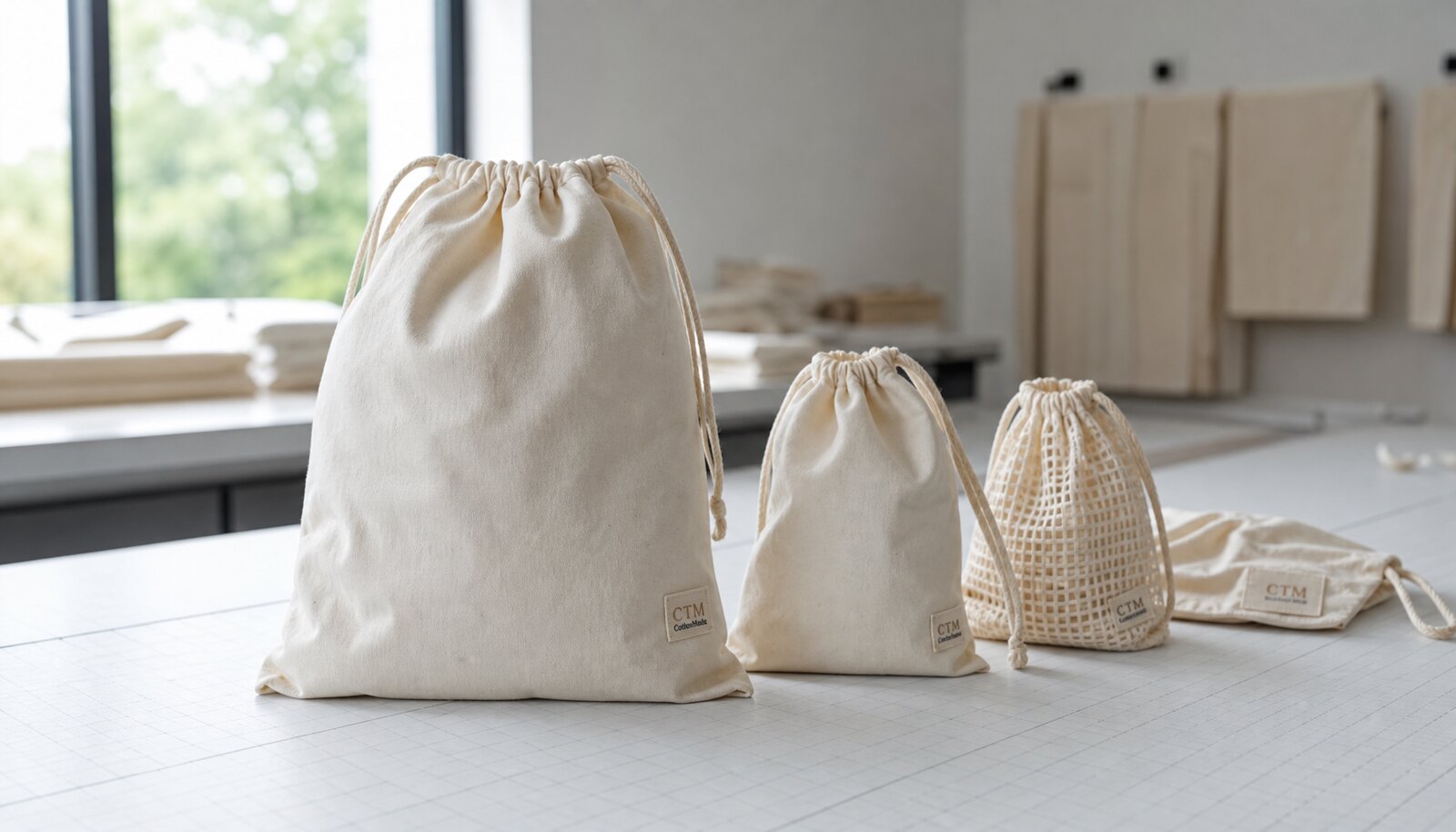
Why event buyers choose this bag format
Organic cotton produce bags are often selected for events because they do more than carry an item. They can act as a reusable handout, a sampling pouch, a brand touchpoint, or a light retail carrier. That mix makes them useful for farmers markets, food festivals, wellness activations, produce promotions, and gift kit programs. The sourcing challenge is that the same-looking bag can behave very differently depending on fabric weight, closure, stitching, and packing format.
For procurement buyers, the practical question is not whether the bag looks natural. It is whether the bag fits the event flow. A bag that must be handed out quickly at a booth has different needs from one that will be filled with produce samples, branded literature, or a curated kit. If the bag is too soft, it folds poorly and feels less premium. If it is too heavy, it increases sewing time, carton bulk, and freight cost without adding much value. The best spec is the one that matches handling, not just aesthetics.
- Match the bag to the event workflow, not only to the brand style.
- Treat reusable bags as a product with structural requirements.
- Build organic claims into the sourcing process, not just the marketing copy.
Start with a bag spec that factories can quote accurately
A clean quote starts with a finished specification. Buyers should define size, fabric weight, closure, print area, packaging, and any claim language before asking for pricing. If those items are left open, each factory will quote a different assumption. The result is often a misleading comparison where the cheapest offer is simply the weakest interpretation. For event bags, the usual starting point is a flat or lightly gusseted cotton bag with a clean hem or drawcord closure and a cloth weight that supports repeated handling without making freight inefficient.
Write the spec the way a production team reads it. State whether the bag is open-top, drawcord, or another closure style. Give the exact finished dimensions, and if a gusset is required, note the gusset depth and whether it must run the full side or only partway. If the bag needs a natural, unbleached look, say so. If the event team wants a label, care note, hang tag, or side seam branding, include it from the start. Every added component changes labor, packing, and approval timing.
- Define finished size, seam allowance, and gusset depth.
- Separate the bag body spec from cord, label, and carton requirements.
- Include artwork size and placement limits with the RFQ.
Fabric weight, weave, and construction drive the real performance
Fabric weight is a useful guide, but it should not be the only guide. A lighter cloth can work well when the bag carries herbs, lightweight produce, or a few event inserts. A denser cloth is better when the bag must look more substantial, survive repeated reuse, or hold heavier items. For most event use, a practical range is often 110 to 140 GSM. That range usually gives enough body for a decent print surface and a more reliable feel without making the product unnecessarily heavy to ship.
Heavier options, often around 150 to 180 GSM, make sense when the buyer wants a more premium presentation or expects the bag to be reused many times. But the added fabric only helps if the construction supports it. Buyers should ask how the bag is cut, whether the top edge is single-fold or double-fold, how the seam allowance is set, and whether stress points are reinforced. If the bag is used for produce, ventilation matters too. A tightly packed structure with no practical airflow may be less useful than a slightly lighter cloth with a good open weave and clean finish.
- Use GSM as a starting point, not as the only performance measure.
- Ask for the seam allowance, top hem style, and reinforcement points.
- Choose fabric structure based on the weight and handling of the items inside.
Closure style and dimensions should match the event use case
Closure choice affects both price and usefulness. An open-top bag is usually the simplest and lowest-cost option for quick handout events or retail-style produce use. A drawcord closure is better when the bag needs to close quickly, hold smaller items, or prevent contents from spilling during transport. If the bag will be tied repeatedly, the cord channel and knot area need to be strong enough to survive normal use. Buyers should not assume all drawcords are the same; cord material, thickness, length, and anchoring method all change the end result.
Dimensions also matter more than many buyers expect. A few centimeters can determine whether a bag fits a standard produce selection, an event pack, or a folded brochure set. If the bag is too narrow, the product may bulge and distort the print. If it is too deep, it may look overbuilt and consume extra fabric. For event programs, it is worth aligning the bag size with the actual contents rather than copying a standard retail dimension. Ask the supplier to confirm that the final size allows easy packing, clean presentation, and practical folding into cartons.
- Choose open-top when speed and low cost matter most.
- Choose drawcord when spill control or reusable closure matters.
- Verify that the bag dimensions fit the actual contents, not just the mockup.
Print and branding choices can change cost, feel, and approval time
Decoration often decides whether the bag feels like a useful event item or a generic blank. One-color screen printing is usually the most practical route for branded giveaway bags because it is clear, repeatable, and relatively efficient to produce. A small woven label or side label can be a cleaner solution when the buyer wants a more restrained look. More colors, larger coverage, and fine-line artwork increase setup time and registration risk, especially on natural cotton surfaces that may have slub or slight texture variation.
The safest way to quote decoration is to separate the artwork setup from the print method. Ask whether the supplier charges by color, screen, position, or setup run. If the logo includes small text, outlines, or reverse knockouts, ask for a production strike-off on the actual fabric before bulk approval. A digital mockup can hide problems that appear immediately on cloth, such as ink spread, weak contrast, or a logo that needs to be reduced to fit the print window. For procurement, the key point is simple: a cheaper print method is only cheaper if it still reproduces the brand legibly and consistently.
- Keep artwork simple unless the brand needs more detail.
- Ask for a real-fabric strike-off when the logo has small type or fine lines.
- Check whether the print area is limited by seam placement or bag curvature.
Use a comparison matrix, not just a quote list
Buyers often receive quotes that look comparable but are actually built on different assumptions. One may include a lighter cloth, a looser hem, and bulk packing. Another may include heavier fabric, a better finish, and individual packing. To compare offers properly, the buyer needs a decision matrix that captures not only unit price but the inputs that shape total value. That includes fabric construction, closure style, print setup, packing format, certification paperwork, lead time, and Incoterms.
A useful comparison also shows where a supplier is strong and where the risk sits. A factory with strong sewing capacity but weak documentation may be fine for a non-claim order but risky if the marketing copy says organic. A supplier with a low unit price but bulky packing may create higher freight cost than a more expensive unit offer. The comparison should make these differences visible before the buyer gets pulled toward the lowest line item. In practice, the best table is the one that helps you rule out the wrong option quickly.
- Compare like-for-like specs before comparing price.
- Include packing, paperwork, and lead time in the decision matrix.
- Use the matrix to identify risk, not just cost.
Procurement routes and MOQ logic are not interchangeable
The route you choose changes the commercial profile of the order. A single factory that sources the fabric, cuts the panels, sews the bag, and applies decoration usually gives the cleanest accountability. That is often the best route for repeat event programs because there are fewer handoffs and less chance of the mill, printer, and sewing shop blaming one another. A fabric mill plus separate cut-and-sew contractor can work when the buyer needs a specific certified textile, but it adds schedule risk and paperwork coordination. A local decorator using imported blanks can be useful for urgent or very small runs, but it gives the buyer less control over seam quality and fiber traceability.
MOQ should be understood as a function of setup and handling, not as a random factory policy. If the order includes special packaging, organic documentation review, or a unique print setup, the practical MOQ rises because the factory has more coordination work. If the bag is standard and the decoration is simple, the MOQ may be lower. The buyer should ask what drives the minimum: fabric consumption, sewing line efficiency, decoration setup, packing labor, or paperwork cost. That answer matters more than the number itself because it tells you whether the quote is scalable for future events.
- Integrated factories usually reduce handoff risk.
- Blank-bag decoration is best only when construction risk is low.
- Ask what actually drives MOQ before negotiating quantity alone.
How to verify organic claims with audit-ready paperwork
When a buyer needs an organic claim, the paperwork has to be as disciplined as the bag. A printed label or a supplier statement is not enough on its own. Ask for the certificate number, scope validity, and the legal entity name on the certificate. Then check that the entity name matches the one on the quotation, invoice, and shipping documents. If the order uses more than one supplier, verify which party owns the fabric traceability and which party is allowed to issue the supporting transaction records. The documents should form a chain, not a loose collection of claims.
Buyers should also ask what supporting documents will be available before shipment. Depending on the route and market, that may include certificate references, transaction certificates, material declarations, or lot-level traceability references. If the artwork or packaging says organic, the factory paperwork should support the same wording. If the cord, label, or packaging material is not organic, the supplier should state that clearly so the buyer does not overclaim. The cleanest approach is to align product claims, invoice description, packing marks, and certificate references before production starts. That prevents awkward corrections at the last minute.
- Confirm the certificate number and legal entity name.
- Verify chain-of-custody or transaction paperwork before PO release.
- Keep the claim wording on artwork, invoice, and carton marks aligned.
Quote structure should expose real landed cost, not just unit price
A useful quote breaks out the bag body, decoration, labels, packing, documentation, and any testing or approval cost. If everything is bundled into one number, it becomes difficult to compare vendors or spot hidden changes. Ask for price breaks at several quantities, such as 5,000, 10,000, and 25,000 pieces. That reveals how much of the price is setup and how much is actual unit production. It also shows whether the low-volume offer is artificially inflated or whether the supplier has a realistic run rate. For procurement, the point is to make the cost structure visible before negotiation starts.
Landed cost needs the same treatment. Cotton bags are often light but bulky, so freight can matter more than the raw unit price suggests. The carton size, carton count, pallet count, and shipping mode can move the final cost meaningfully. If the bags are part of an event kit, the packing labor may matter as much as the bag production itself. Buyers should request the Incoterm, included freight leg, and any local charges that are not obvious in the quote. A lower EXW number can become a more expensive delivered order once export handling, ocean or air freight, and local receiving costs are added.
- Request itemized pricing for bag, print, labels, packing, and documents.
- Compare at several quantity bands, not just one order size.
- Ask for Incoterms and all included freight or handling assumptions.
Sampling should mirror the exact production path
A sample is only useful if it proves the real production method. A cloth swatch can help with touch and color, but it cannot validate print quality, closure behavior, or seam finish. For event bags, the important sample is a production-intent sample that uses the same fabric weight, seam construction, closure style, and decoration method planned for bulk. If the supplier changes the cord, stitch pattern, or label location after sample approval, that should be treated as a new approval point rather than a minor tweak.
The buyer should judge samples against measurable criteria, not just appearance. Record the target dimensions, acceptable tolerances, print placement window, and visible defect limits. Confirm whether natural cotton slub is acceptable and whether small color shifts are normal for the chosen fabric. If the bag must be packed in a particular carton count or inner pack, include that in the sample review too. Otherwise the production sample may look fine on the table but fail in warehouse handling. A disciplined sample sign-off reduces disputes later because both parties are working from the same reference.
- Ask for a full pre-production sample, not only a cloth swatch.
- Approve packing style if event distribution depends on it.
- Record measured dimensions and defect limits on the sample sign-off.
Specification comparison for buyers
| Decision point | Best option for most event buyers | When to choose it | What to verify before PO |
|---|---|---|---|
| Bag style | Open-top or drawcord cotton produce bag with simple hem | Suitable for sampling tables, market activations, and giveaway handouts where speed matters | Confirm finished opening width, hem type, and whether the bag must stand open or close fast |
| Fabric weight | 110 to 140 GSM for most event programs | Balances structure, print appearance, and freight cost for reusable handouts | Ask for actual finished GSM, expected shrinkage, and whether the quoted cloth is prewashed or unfinished |
| Heavy-duty option | 150 to 180 GSM for premium reuse or heavier contents | Use when the bag carries produce, gift packs, or repeated customer use is expected | Check carton volume, hand feel, folding bulk, and whether the higher weight still fits the target budget |
| Closure | Cotton drawcord with reinforced channel or folded hem | Helpful when bags hold loose items, samples, or mixed event kits | Verify cord material, cord length, knot security, and whether closure is included in the organic claim |
| Print approach | 1-color screen print or small woven/side label | Best for sponsor logos, event marks, and clean brand presentation | Confirm print area, color count, artwork limits, and whether a strike-off on actual fabric is required |
| Supplier route | Single factory handling fabric sourcing, cutting, sewing, and decoration | Best for buyers who want one accountable party and fewer handoff delays | Check who owns traceability, approvals, final carton count, and defect responsibility |
| Organic verification | Documented chain-of-custody with certificate references and transaction records | Needed when the artwork, invoice, or marketing copy makes an organic claim | Request certificate numbers, transaction certificates, scope validity, and name matching across documents |
| Packing | Bulk packed by count with clear outer carton marks | Usually best for event distribution, kitting, and warehouse handling | Confirm inner pack needs, carton dimensions, quantity per carton, and label format |
| Freight planning | Compare by carton count and carton volume, not unit price alone | Important when bags look cheap but ship in large cartons | Ask for packing dimensions, gross weight, palletization, and Incoterms before comparing offers |
Buyer checklist before sampling
- Define the event use case first: giveaway handout, produce sampling, gift pack, retail resale, or kit component.
- Lock the finished size, fabric weight, closure style, and acceptable tolerance range before requesting quotes.
- State the print method, number of colors, decoration placement, and whether one or both sides must be decorated.
- Confirm whether the bag body, cord, label, and packaging all need to support an organic claim.
- Ask for pricing at several volume breaks so setup cost and MOQ pressure are visible.
- Request a sample that matches the actual fabric weight, seam finish, print method, and packing format.
- Specify carton pack, carton dimensions, master carton count, and any barcode, label, or pallet requirement.
- Write the acceptance criteria for shade, stitch quality, print alignment, odor, and dimensional tolerance.
- Confirm lead time by stage: material readiness, sample approval, production, inspection, and booking or delivery.
- Compare landed cost, not unit price alone: freight, duty, carton cost, label cost, testing, and rework allowance.
Factory quote questions to send
- What is the exact fiber content, fabric construction, finished GSM, and expected shrinkage after washing or steam exposure?
- Can you provide the organic traceability paperwork that matches the fabric source and the wording on our artwork and invoice?
- What are the MOQ and price breaks for 5,000, 10,000, and 25,000 pieces, including setup and repeat-order pricing?
- Which print method is included, how many colors are covered, and what is the setup charge per color or position?
- Is the quote based on a blank bag, a decorated pre-production sample, or a full production-ready sample?
- What are the lead times for sample approval, bulk production, packing, inspection, and shipping or domestic delivery?
- What packing configuration is included, and how does the price change if we revise carton count, inner pack, or palletization?
- What tolerances do you use for size, stitch quality, print placement, shade variation, and defect handling?
- Which Incoterms are available, and what exactly is included in the quoted price?
- If defects are found, what is your replacement, credit, or rework threshold and process?
Quality-control points to confirm
- Fabric weight matches the approved range with no thin spots, streaking, holes, or obvious yarn faults in the main panel.
- Finished size is within the agreed tolerance on length, width, and gusset, with consistent bag-to-bag measurement.
- Seams are straight, securely locked at stress points, and free from skipped stitches, loose thread tails, or seam puckering.
- The top hem or drawcord channel is even, reinforced, and does not fray after normal opening and closing.
- Drawcord or closure cord slides smoothly, knots hold under pull, and the opening closes without twisting or snagging.
- Print alignment stays within the approved placement window and ink coverage is even, clean, and not over-inked.
- Shade is consistent across the lot and within one production run, with no obvious panel mismatch on the same bag.
- Bag surface is clean, dry, and odor-free at packing, with no oil marks, lint contamination, or needle damage.
- Carton count matches the PO, and carton labels, item codes, and outer marks match the approved packing list.
- If the order carries an organic claim, the bag, packaging, invoice wording, and factory paperwork all match the approved claim language.