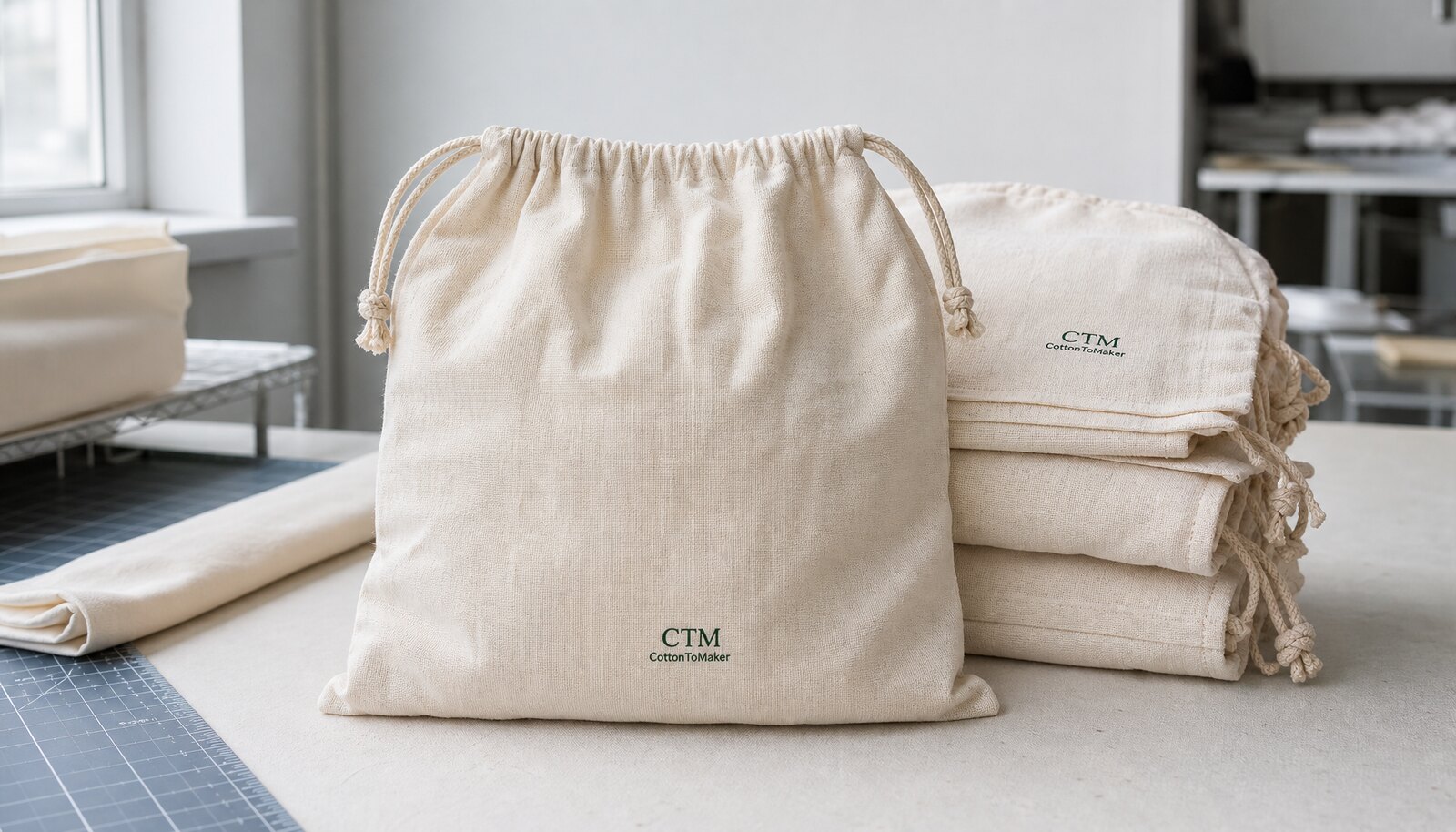
Why organic cotton produce bags are a launch-stage packaging choice
For a brand launch, organic cotton produce bags do more than hold product. They become part of the shelf story, the unboxing moment, and the customer’s first repeated interaction with your logo. That means the buying decision is not only about fabric cost. It is also about how the bag looks in a retail display, whether it keeps shape after use, and whether the packaging format is easy for a warehouse to receive and repack.
The common mistake is treating these as generic drawstring pouches. Produce bags need better airflow, a practical opening size, and a fabric weight that balances transparency, hand feel, and price. If the bag is too thin, it looks disposable. If it is too heavy, the unit cost rises and the bag stops feeling like a simple produce accessory. A good launch spec usually sits in the middle, with clear rules for print, packing, and size control.
- Use organic cotton when the bag itself supports a sustainability story or retail brand positioning.
- Treat the bag as a visible branded item, not only a logistics container.
- Define the filled product use before requesting prices.
Start with the use case, not the decoration
The first sourcing decision is what the bag will actually carry. Loose produce such as onions or apples needs a different shape than subscription add-ins, dry goods, or refill packs. A produce bag for a launch program should open easily, close securely, and stay readable once the logo is printed. If the bag is intended for mixed retail use, the size has to accommodate the largest intended SKU without looking oversized for the smallest one.
This is where many RFQs fail. Buyers send only a logo and ask for a quote. The supplier then fills in the gaps with a standard size and standard construction, and the result is often wrong. A proper brief should state target contents, expected fill weight, and whether the bag must hang, stack, or sit flat in a carton. That information affects cloth consumption, seam allowances, print panel area, and carton density.
- State the primary contents in grams or approximate volume.
- Specify whether the bag will be touched often, washed, or only used once for launch kits.
- If there are multiple produce SKUs, identify the largest and smallest item sizes.
Fabric weight, weave density, and hand feel
For most organic cotton produce bags, the practical buying range is 120-180 GSM. At 120-130 GSM, the bag is lighter and cheaper, but it can appear thin under bright retail lighting. At 140-160 GSM, the cloth usually gives a better retail hand feel and improves structure without making the bag bulky. At 170-180 GSM, the bag feels more premium and durable, but freight volume and cost rise quickly.
Ask for the fabric spec in a way that the factory can actually cut and sew against. GSM alone is not enough if the weave is loose or the yarn count is uneven. A buyer should also request whether the cloth is bleached white or natural, whether the fabric is preshrunk, and whether the supplier uses rolled or folded stock cloth. These details matter because shrinkage and width variation can change the finished bag size by a few millimeters that become visible at retail.
- 120-130 GSM: suitable for low-cost launch giveaways or light refill packs.
- 140-160 GSM: a balanced choice for most retail brand launches.
- 170-180 GSM: better for premium presentation, heavier contents, or reuse marketing.
Print method should match logo complexity and wash expectation
For organic cotton produce bags for brand launches, screen print is usually the most stable option for one to two spot colors. It gives solid coverage and is easy to reproduce across repeat orders. If the artwork has gradients, fine lines, or many colors, a transfer method may look cleaner on the first sample, but it can add curing risk, edge lift, or a less natural textile finish. Woven labels or sewn-on side labels are often better for premium branding when the surface print area is limited.
Do not choose a print method only by quote line item. A low quote can hide a weak ink deposit, poor curing, or artwork placement that interferes with the drawstring channel. For launch items, the print must survive handling, folding, and, if relevant, light washing. The supplier should provide a pre-production sample with the actual fabric and actual ink, not a generic print swatch on unrelated cloth.
- Screen print for bold logos and repeatable production.
- Heat transfer only when artwork complexity justifies it and wash demand is low to moderate.
- Woven or sewn labels when the brand wants a premium textile look without large print coverage.
How MOQ really works for custom launch programs
MOQ is not a single number. It depends on fabric source, size, color, print complexity, and whether the factory must set up a separate cutting run. A direct factory may quote one MOQ for natural unprinted bags and a much higher MOQ for dyed fabric plus two-color print. That is normal. The problem comes when a buyer compares quotes without understanding that one supplier is using stock fabric and another is weaving or dyeing to order.
For a launch, the right MOQ logic is usually based on how many SKUs you can realistically sell through before reorder. If the brand is testing three sizes, it may be smarter to keep one fabric weight and one artwork across all sizes, then change only the bag dimensions. That reduces setup charges and simplifies packing. If the launch is high risk, ask for a stock-fabric option alongside a full custom option so you can compare unit price against flexibility.
- Lower MOQ often means less flexibility on exact color or cloth width.
- Multiple sizes should share as many components as possible.
- Separate setup fees should be compared against the total launch volume, not just per thousand pieces.
Supplier routes: direct factory, trading company, and stock-program sourcing
For organic cotton produce bags, the sourcing route changes both price and control. A direct factory is usually the better route when the buyer needs a controlled fabric spec, repeatable print placement, and a stable reorder file. A trading company can help if the buyer needs coordination across different factories, but the quote may bundle layers of markup and make it harder to trace where the cloth and print are actually coming from. Stock-program sourcing works for speed, but it is the least flexible route for size, label, and packing customizations.
The right route depends on launch timing and risk tolerance. If the brand needs a quick in-market test, a stock base bag with a simple logo may be enough. If the launch is tied to retail standards, distributor onboarding, or a sustainability claim, then the buyer usually needs a direct supplier who can show cloth source, sample control, and packing consistency. The table below compares the practical choices buyers usually face.
- Direct factory: best for repeat orders and tighter spec control.
- Trading company: useful when the buyer lacks sourcing bandwidth, but margins and traceability need more scrutiny.
- Stock-program route: fastest, but least tailored to brand packaging.
Supplier comparison table: what to buy from which route
Use this comparison to separate the quote that looks cheap from the quote that is actually workable for launch production. The main difference is not just unit price; it is how much control you retain over fabric, print, and packing.
Packing rules should cover plastic-reduction request, recycled carton note, bundle count, carton mark, and moisture protection without overpacking. These details affect cost, damage rate, receiving speed, and whether the goods can move directly into retail or distribution.
- Write decisions in measurable language, not only descriptive wording.
- Ask for sample photos plus one physical approval sample for important orders.
- Keep quotation, sample approval, and inspection notes tied to the same spec version.
Sample approval: what should be frozen before bulk starts
A launch sample should not be treated as a display sample only. It should become the production reference. That means the sample must use the final fabric weight, final stitch path, final cord, final print size, and final packaging format. If the supplier substitutes any of those elements, the sample is no longer a reliable approval tool. Approving a lighter cloth or a different cord is one of the easiest ways to create a bulk mismatch.
The buyer should approve three things before mass production: dimensions, visual placement, and assembly quality. The dimensions should be checked after light pressing, because cotton can relax after sewing. The visual placement should be checked against seam location so the logo does not sit too close to the channel. The assembly quality should include seam tension, drawstring glide, and any label attachment. If the supplier cannot reproduce the sample exactly, the order spec is not mature enough for bulk release.
- Request a pre-production sample made from the same fabric roll range as bulk.
- Mark acceptable measurement tolerances on the sample approval sheet.
- Keep one sealed reference sample for final inspection comparisons.
QC thresholds that protect your launch from avoidable rejects
For organic cotton produce bags, most quality failures are visible and preventable. The usual issues are uneven cutting, crooked seams, weak drawstring channels, print misalignment, and short counts in bundles. Because the product is simple, buyers often assume QC is automatic. It is not. Cotton fabrics can vary across rolls, and stitching tension can shift during the run. Without a measurable standard, the factory may treat minor inconsistencies as acceptable when they are not acceptable for retail presentation.
Set practical thresholds that match the product level. For a standard launch bag, a small measurement variation may be acceptable, but the logo position should stay stable and the bag opening should function smoothly. If the bag is going into premium retail, tighten the visible defect threshold and require cleaner packing. The goal is not perfection on every piece; it is consistency across the carton and across reorders.
- No open seams, broken stitches, or exposed raw edges at the channel.
- Print should remain centered within the approved art box.
- Bundle count and carton count must match the packing list exactly.
Packing, carton density, and the hidden cost of freight
Packing is often ignored until the freight quote arrives. Organic cotton bags are light, but they are bulky. If the supplier over-folds or over-bundles them, the carton size grows and the air freight or parcel cost rises. If the bags are stuffed loosely into cartons, the warehouse may save volume but spend more time counting and repacking. The better route is a controlled flat pack with clear bundle counts and carton markings that match the buyer’s receiving process.
For retail or distributor programs, inner packaging should support quick checks without opening every bag. A common practical format is a flat-packed bag in bundles of 50 or 100, then packed into master cartons with size and artwork labels on two sides. If the bags go directly into ecommerce fulfillment, barcode labels and carton count integrity matter more than decorative inner packaging. Always request carton dimensions and estimated CBM before you compare quotes, because the landed cost can change materially once freight is included.
- Flat pack usually reduces volume better than bulky stuffing.
- Bundle counts should align with warehouse receiving and store replenishment.
- Carton size should be part of the quotation, not an afterthought.
Specification comparison for buyers
| Spec decision | Recommended option | When it fits | Buyer risk to check |
|---|---|---|---|
| Fabric weight | 140-180 GSM organic cotton for retail feel; 120-130 GSM for price-sensitive giveaways | Brand launches where the bag is part of the product experience or needs better shelf appearance | Too-light fabric turns thin and see-through; too-heavy fabric raises cost and bulk in packing |
| Bag size | Small 20 x 25 cm for herbs/nuts; medium 25 x 30 cm for produce; larger 30 x 35 cm for mixed-use retail packs | When the bag must fit a defined SKU set or merch bundle | Wrong size causes returns, overstuffing, or poor display in-store |
| Closure type | Cotton drawstring with double cord channel or single hem channel | For produce, refill packs, and retail gift bundles that need easy opening and resealing | Loose channels slip; cords can fray if the hem allowance is too narrow |
| Print method | 1-2 color screen print for bold logos; heat transfer only for short runs or detailed artwork; woven label for premium brands | When the logo must stay legible after handling and washing | Fine details may blur on textured cotton; some inks crack if cure is poor |
| Supplier route | Direct factory with sample room and in-house printing | When the buyer needs stable repeat orders, custom sizing, and controlled QC | Trading layers can hide fabric source, add markup, and slow sample corrections |
| MOQ logic | 1,000-3,000 pcs per size/color/artwork for custom production; lower MOQ only when using stock fabric and simple print | New launches with uncertain sell-through or multiple SKU testing | Very low MOQ often means leftover stock cloth, limited size flexibility, or higher unit cost |
| Packing format | Flat packed in inner polybag or bundle with paper band; cartons marked by size and artwork | Retail distribution, ecommerce, or mixed-SKU warehouse handling | Bulk stuffing can crease bags and slow counting, while overpacked cartons raise freight volume |
| Compliance evidence | Organic claim support, fiber composition, and production traceability docs; washing/care label artwork approved before bulk | When the buyer sells through retail channels or needs documented origin claims | Do not rely on verbal claims; missing records can block onboarding or trigger claim issues |
| Landed-cost route | Compare EXW factory, FOB port, and delivered-to-warehouse only after packing spec is fixed | When freight, carton volume, and inland handling can change the final margin | Buying on unit price alone hides the impact of carton size, packing density, and reprint risk |
Buyer checklist before sampling
- Confirm the exact use case: loose produce, retail refill pack, subscription box insert, or branded carry bag.
- Lock the bag size with the filled product dimensions, not just the empty bag width and height.
- Set fabric weight target in GSM and state whether the cloth should be bleached white, natural, or dyed.
- Define closure style, cord length, seam allowance, and whether the bag needs a hanging loop or label tab.
- Choose print method by artwork complexity and required wash durability, not by unit price alone.
- Request a pre-production sample with the final fabric, final print, and final packing method.
- Approve carton count, barcode placement, and bundle packing before mass production starts.
Factory quote questions to send
- What is your fabric source, and can you quote separate options for 120 GSM, 140 GSM, and 180 GSM organic cotton?
- Is the quoted price based on stock cloth or dyed-to-order cloth, and what happens to MOQ if we change the color?
- What print method is included in the quote, how many colors are included, and what is the setup charge per artwork?
- What is the exact seam allowance, hem width, and drawstring channel construction in the sample spec?
- Can you share carton size, pcs per carton, net/gross weight, and estimated CBM for each size?
- What sample stages do you offer before bulk approval, and what will be reproduced exactly in the PPS?
- What inspection standard do you use for measurements, print placement, hole damage, loose stitching, and packing count?
Quality-control points to confirm
- Fabric weight tolerance should be agreed before cutting; a practical buyer tolerance is about +/- 5% on GSM if the cloth source is stable.
- Measure finished bag size after sewing and after a light press; do not accept specs measured only on flat cut fabric.
- Print registration should hold inside the visible panel margin; artwork too close to seams or drawstring channel will distort.
- Stitch density should be even, with no skipped stitches at stress points and no raw edges exposed at the channel opening.
- Cord length should be symmetrical, and the drawstring must glide without snagging on the hem or thread tails.
- Check odor, dust, oil marks, and color migration, especially if the bags are stored with paper or printed cartons.
- Carton count and inner bundle count must match the packing list; random overfills or short packs create warehouse disputes.