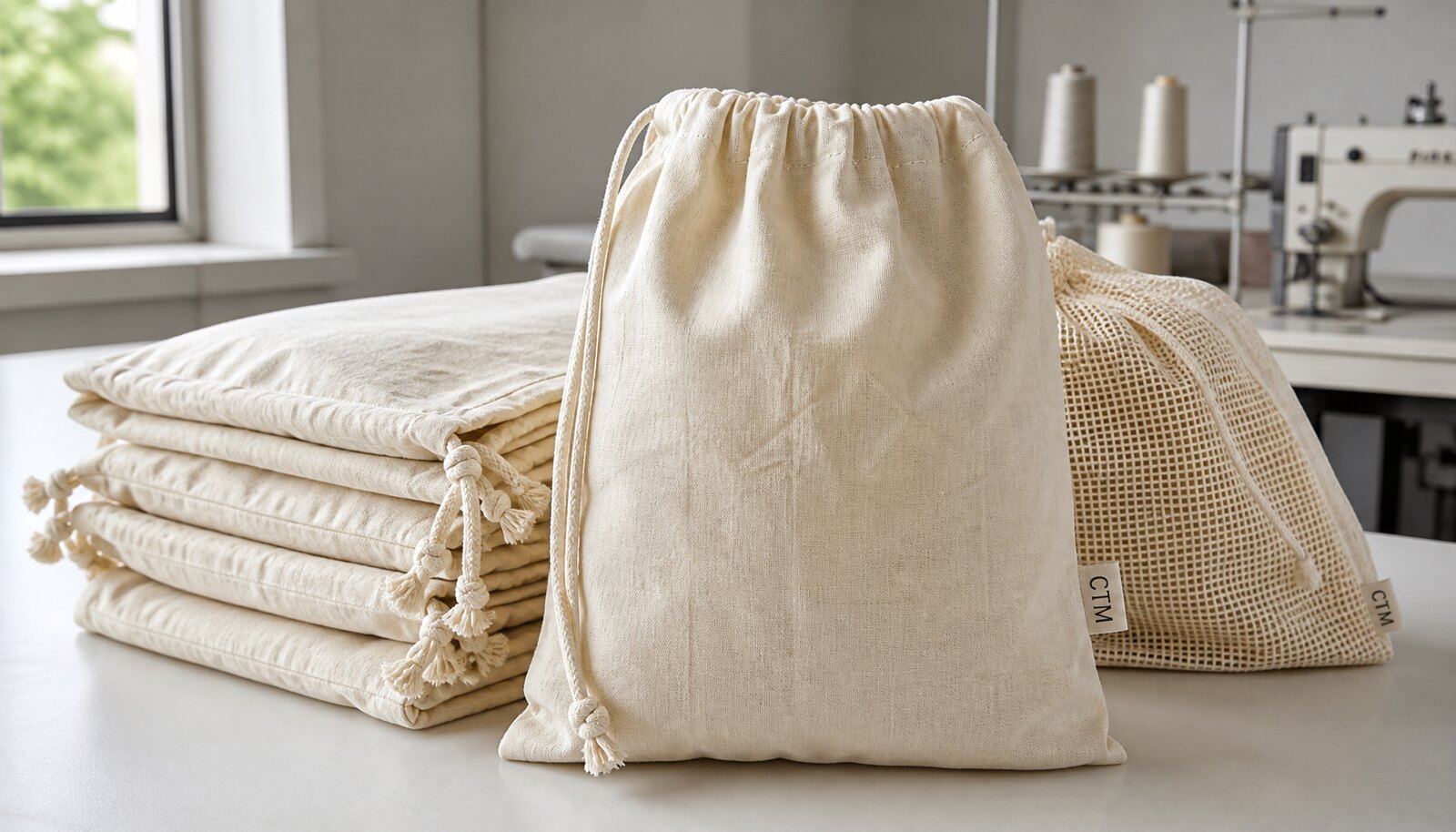
Start With the Use Case, Not the Bag Name
Organic cotton produce bags sounds like one product, but buyers usually need several different constructions under that label. A bag for loose apples, a bag for leafy greens, and a bag for retail shelf display do not need the same fabric density, closure, or print method. If you send a vague inquiry, factories will fill in the gaps with their own defaults, and the quotes will not be comparable.
The cleanest RFQ starts with how the bag will be used, then works backward into the build. State whether the bag is for in-store produce packing, consumer resale, giveaway programs, or a store-brand reusable line. That one decision drives fabric weight, breathability, service life, packaging, and even how much you should spend on branding.
- Define the produce category: greens, citrus, root vegetables, dry bulk, or mixed fruit.
- State whether the bag must be breathable, washable, shelf-ready, or strong enough for repeated reuse.
- Tell the factory if the buyer cares more about unit cost, retail presentation, or long service life.
Fabric Weight and Weave Decide the Real Performance
For organic cotton produce bags, fabric weight is the first number that separates a serious quote from a placeholder quote. A lighter cloth around 90-110 gsm is often enough for standard grocery produce use, while heavier bags at 120-140 gsm are better when the bag must feel substantial, carry heavier contents, or survive repeated washing. If the fabric is too light, the bag can stretch, lose shape, or look thin on a retail peg. If it is too heavy, the bag becomes bulkier, more expensive to ship, and less convenient for shoppers who want it to fold into a pocket.
Weave choice matters just as much as GSM. Plain weave gives a cleaner surface for printing and a tighter feel for smaller items, while mesh bodies improve airflow for produce that stays in the bag longer or needs visible content. Some buyers use a solid top band with a mesh lower body to keep branding readable while still letting the produce breathe. Natural off-white fabric is usually the easiest route for cost control and consistency; bleaching or custom dyeing adds process risk and should only be used when the brand language really needs it.
- Use 90-110 gsm for standard reusable produce bags that need a balance of cost and durability.
- Use 120-140 gsm when the bag must handle heavier produce or survive frequent washing.
- Use mesh only when airflow and drainage matter more than print area and opacity.
Sizes, Closures, and Stitching Control the Quote and the Field Failure Rate
A good produce program usually needs more than one size. Small bags reduce overpacking of herbs or berries, medium bags work for general produce, and larger bags handle bulk fruit or family-sized shopping. If you try to force one universal size, the bag either becomes wastefully large for small items or frustratingly small for heavier produce. That creates slow pack-out at store level and uneven customer satisfaction after launch.
The closure and seam structure should match the expected load and handling pattern. Simple cotton drawstrings are easy to produce and easy to explain to buyers, but the cord tunnel must be stitched cleanly or the opening will distort after repeated use. For larger bags, a cord lock can improve user experience, but it also adds cost and another part that must be checked at receiving. Reinforce the top hem, corners, and any label attachment points so the bag does not fail where the load concentrates.
- Specify finished dimensions, not only the flat cut size.
- State whether the opening should be drawstring, cord lock, or open-top.
- Call out any reinforcement at the corners, hem, or label attachment point.
- If you need a set, define each size separately rather than asking the factory to propose one set.
Printing and Labeling Need to Match the Market Claim
Branding on organic cotton produce bags should be simple enough to survive production without turning into a color-control problem. One-color screen print is usually the safest choice because it gives the factory a clear target and keeps costs predictable. Woven labels and sewn side labels work even better when the buyer wants a premium, understated look. Heavy artwork, tiny legal text, or several print colors increase the chance of misregistration and make the bag harder to inspect quickly during incoming QC.
If the buyer plans to make an organic content claim, the RFQ should define the claim path instead of assuming the factory already knows it. Some markets require specific certifications, fiber declarations, or traceability documents, and the bag label must follow the rules that apply in the destination country. Do not leave this to the end of the project. The print location, label size, care instructions, and origin marking should be approved together so the first bulk run does not get blocked by compliance edits.
- Use one-color screen print for the most stable production result.
- Use a sewn woven label when the brand wants a premium look and low print risk.
- Write down the required legal text, fiber content, country of origin, and care wording before sampling.
- If a specific organic standard is required, name the standard and request the supporting document set in the quote.
How Factories Build the Quote, and Why Unit Price Alone Misleads
Organic cotton produce bags are priced from a chain of small cost drivers, not one simple labor number. Fabric consumption is usually the biggest driver, followed by cutting efficiency, sewing time, print complexity, packing style, and whether the factory has to source a special label or cord. Even the finished width of the fabric roll changes yield. If two suppliers quote the same bag but one uses a wider roll, a lower GSM, or a simpler fold, the unit price will look similar while the real value is very different.
A useful quote should separate the work into visible lines so procurement can compare like with like. Ask for the price at several quantities, a note on MOQ by size and print color, and clear terms for sample fees and tooling if any special label or artwork plate is needed. If the supplier only gives one all-in number, it is hard to know whether the quote includes proper packing, document handling, or a realistic allowance for waste. That is how a cheap-looking offer turns into a schedule or quality problem later.
- Request pricing at 1,000, 3,000, and 5,000 pieces, or the nearest realistic quantity break.
- Ask whether the quote includes printing, labels, packing, and carton marking.
- Separate fabric cost, sewing cost, print cost, and packing cost if the supplier is willing to quote that way.
- Ask the factory to identify the one cost item most likely to move if you change the spec.
Sample Approval Should Prove the Final Build, Not Just the Look
A sample is only useful if it proves the actual production method. A hand-made marketing sample that looks good in photos is not enough for a reusable produce bag program. The buyer should see the correct fabric weight, actual stitch pattern, final print method, and the same packing format that will be used in bulk. If the sample uses a different cloth, a different cord, or a cleaner edge finish than the real run, the approved sample becomes misleading and the bulk lot will drift away from it.
The approval process should be treated like a mini production audit. Measure dimensions, inspect the print edge, test how smoothly the cord runs, and fold the bag the way it will be packed for shipping. If the bag is washable, wash one sample before signoff and see whether size, shape, and print quality still hold. Approval should end with written comments and photos, not just an email that says the sample is okay.
- Approve the actual fabric, not a substitute cloth.
- Measure finished dimensions before and after a wash test if the bag is meant to be washable.
- Confirm the final label size, position, and wording before bulk cutting starts.
- Keep one signed sample at the buyer side and one at the factory side as the control piece.
QC Thresholds That Matter in Production
For this product, QC should focus on fit, stitching, and pack consistency more than cosmetic perfection alone. A small size variation may be acceptable if the bag still folds, breathes, and carries the intended load, but mixed dimensions inside one shipment will create problems for warehouse teams and store staff. A practical tolerance band is usually tighter on smaller bags and slightly wider on larger ones. The key is to set one band in writing before production and apply it consistently.
Seams deserve more attention than most buyers give them. The top hem, drawstring tunnel, and side seams should be checked for skipped stitches, thread breaks, loose ends, and weak backtacks. If the product will be reused and washed, test a sample for shrinkage and re-check print placement after laundering. Do not let the factory treat a loose thread as cosmetic only if it appears in a load-bearing area. A minor defect on paper can become a return if the bag fails in the first week of use.
- Set a finished-size tolerance in writing before the first bulk run.
- Reject skipped stitches, broken seams, and loose thread bundles on structural seams.
- Test one or two samples for shrinkage, print rub resistance, and cord function.
- Inspect carton count and inner pack count before shipment leaves the factory.
Packing and Lead Time Can Break a Launch Even When the Bag Specs Are Right
Packing is not an afterthought on reusable produce bags. The wrong fold, loose count control, or a weak carton spec can make a good product arrive as a warehouse problem. Decide early whether the bags will be bulk packed, banded in sets, or retail-ready with inserts and barcodes. If the buyer is sending the bags into stores, a clean fold and reliable count are usually more valuable than decorative packaging. If the bags are going into e-commerce or gift bundles, a simple retail-friendly inner pack can reduce labor on receipt.
Lead time risk usually comes from three places: late sample approval, fabric availability, and printing queues. Natural cotton is less risky than custom-dyed fabric, but the buyer still needs to know whether the factory is buying greige stock or waiting on a mill. Holiday shutdowns, customs document corrections, and artwork changes can all push delivery out. Build a buffer between sample approval and ship date, especially for seasonal programs or store launches with a fixed ticket date.
- Confirm the fold method and packing count before bulk production.
- Define carton labels, barcode location, and gross weight limits early.
- Hold a time buffer for sample approval, print corrections, and packing rework.
- If the launch is seasonal, lock the spec before the factory starts cutting.
Compare Sourcing Routes Before You Compare the Unit Price
Direct factory sourcing is usually the best route when the order is repeatable and the buyer wants control over fabric weight, print quality, and packing. It gives the cleanest view of what the bag actually costs to make, but it also places more responsibility on procurement to manage sampling, documents, and inspection. Trading companies are useful when the order is mixed, the buyer needs faster coordination across several items, or the internal team wants one contact for multiple product lines. Local stock or a domestic decorator can shorten delivery time, but the buyer usually gives up control over fabric choice, price consistency, and exact organic content details.
The right route depends on the commercial goal. If the goal is to build a long-term private-label program, go direct and lock the spec. If the goal is a quick replenishment or a small test run, a trading route may be acceptable. Either way, compare landed cost, not only factory price. Freight, duties, labeling, packing changes, and sample rounds can change the real cost per bag more than a small difference in ex-factory price. For organic cotton produce bags, the lowest quote is not always the best buying decision if it adds risk to compliance or schedule.
- Use direct factory sourcing for repeatable bulk programs with stable specs.
- Use a trading route when you need coordination across several SKUs or faster communication.
- Use local stock only when lead time matters more than exact spec control.
- Compare landed cost, not just ex-factory price.
Specification comparison for buyers
| Spec decision | Recommended option | When it fits | Buyer risk to check |
|---|---|---|---|
| Fabric weight | 90-110 gsm for standard produce use; move to 120-140 gsm for heavier items or longer service life | Grocery programs that need a balance of breathability, hand feel, and cost | Too-light cloth can stretch after washing; too-heavy cloth can reduce packability and raise freight |
| Weave style | Mesh body with solid top band for airflow, or plain weave for finer produce and print clarity | Mesh suits onions, citrus, and mixed fruit; plain weave suits herbs, greens, and branded retail packs | Mesh openings that are too large can let small items fall through; plain weave may hold moisture if the bag is stored damp |
| Size set | Three-size set instead of one universal size | Retail programs that need clear shelf logic and lower picking errors | A single size often forces overfilling or underfilling, which creates complaints and inconsistent pack-out |
| Closure | Cotton drawstring with secure knot or cord lock on larger bags | Reusable bags that will be opened and closed many times in store or at home | Weak cord ends or cheap locks fail in use; loose knots can create return issues |
| Branding method | One-color screen print or sewn woven label for the cleanest production control | Private label, subscription box inserts, and store-brand reuse programs | Multi-color artwork or fine text can blur on textured fabric and raise rejection risk |
| Source route | Direct factory for repeat bulk runs; trading company for low-volume or mixed-item orders; local stock for urgent replenishment | When you need either the lowest ex-factory cost, easier consolidation, or the fastest ship date | Comparing only unit price hides differences in MOQ, lead time, and document control |
| Packing format | Bulk inner pack by dozens with clear master carton labels, or retail-ready folded sets if the buyer needs shelf handling | Warehouse distribution, e-commerce, or store delivery programs | Loose packing leads to count errors, wrinkles, and harder QC checks at receipt |
| Lead-time strategy | Order fabric and approvals early, then lock print and packing details before bulk cutting starts | Programs with seasonal promotions or fixed retail launches | Late artwork changes or missing approval samples can push the whole shipment by weeks |
Buyer checklist before sampling
- Define the produce type, target bag sizes, and whether the bags must breathe, carry weight, or display branding in store.
- State the fabric weight in gsm, the weave type, and whether the material should be natural, bleached, or dyed.
- Specify the closure style, seam construction, and any reinforcement needed at stress points.
- State the print method, print area, number of colors, and whether a woven label or care label is required.
- Set the packaging format, pack count per inner pack, carton size limits, and barcode placement.
- Ask the factory to quote at multiple quantities so you can see the MOQ break and price curve.
- Request pre-production samples with actual fabric, actual print, and final packing method.
- Confirm the inspection standard, shrinkage limit, and acceptable tolerance for size, seam, and color variation.
Factory quote questions to send
- What exact fabric GSM, weave, and finished width are you quoting, and how much shrink allowance is built in?
- Is the price based on direct factory production, outsourced printing, or a trading arrangement?
- What is your MOQ per size, per print color, and per packing format?
- How much does the price change at 1,000, 3,000, and 5,000 pieces, and what is the price trigger behind the break?
- What sample stage will you provide before bulk cutting, and what will the sample include - fabric, print, label, and packaging?
- What is the standard lead time after sample approval, and what events usually extend it?
- What carton count, carton dimensions, and master carton markings will you use for shipment?
- Which documents can you provide for organic content claims, origin labeling, and customs clearance if required by the market?
Quality-control points to confirm
- Measure finished size against the approved spec and hold a practical tolerance band, typically tighter on smaller bags and slightly wider on larger bags.
- Inspect stitch density and seam consistency on load-bearing seams, especially at the side seams, top hem, and cord tunnel.
- Check print registration, ink coverage, and rub resistance after handling, folding, and a light wash test if the program requires washing.
- Verify drawcord length, knot security, and smooth operation of cord locks if they are used.
- Confirm that fabric is free from holes, obvious slubs, oil marks, and foreign fibers before cutting.
- Test shrinkage after washing or steaming if the bag is sold as washable or if the buyer expects repeated use.
- Check carton count, inner pack count, and barcode accuracy before dispatch.
- Reject any production lot with mixed shades, inconsistent label placement, or obvious odor from packing materials or print curing.