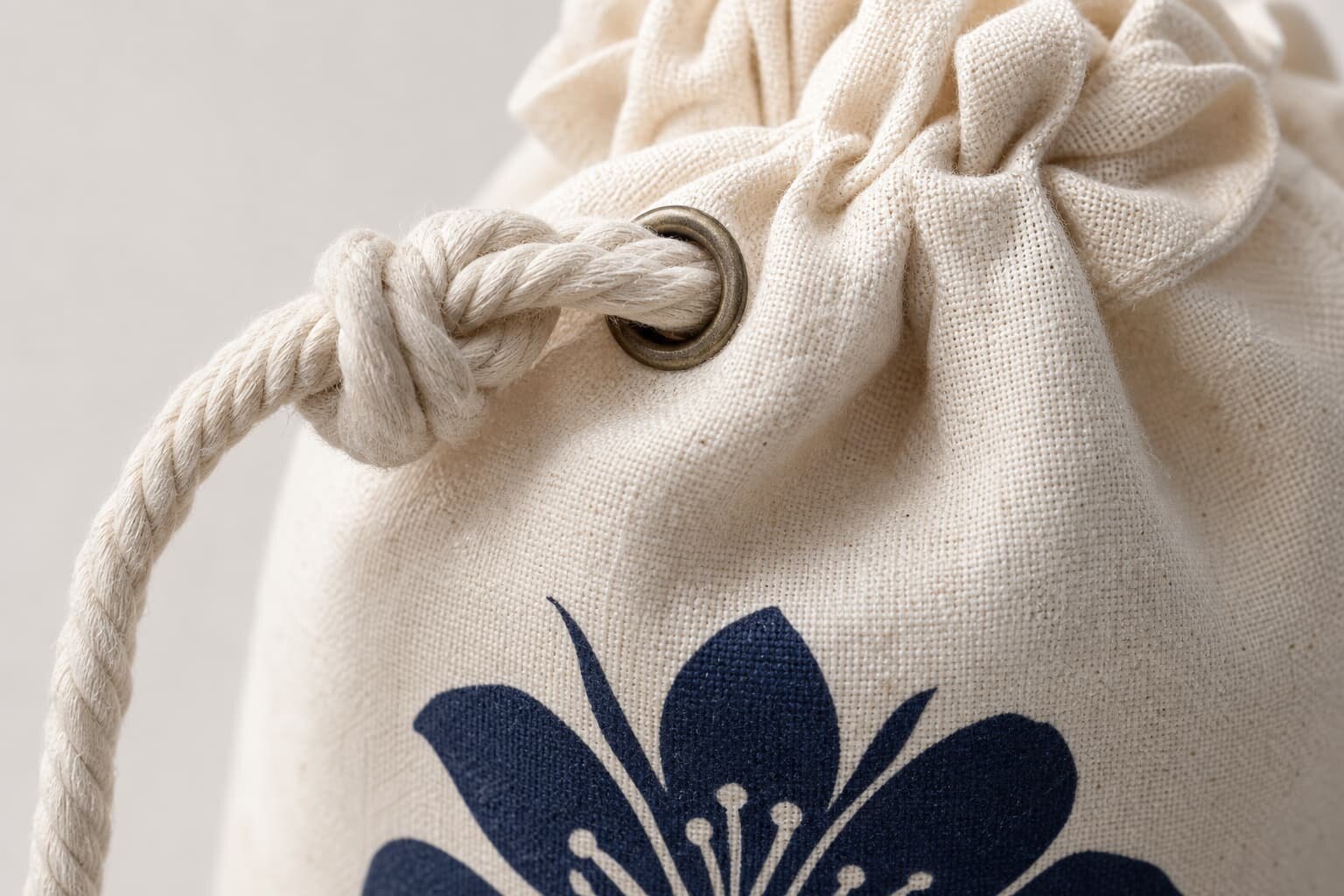
1. What the inspection has to prove
A quality inspection for an organic cotton pouch is not about whether the bag looks acceptable in a single photo. It has to prove that the pouch matches the approved spec, can survive packing and transit, and will still look consistent when your warehouse or customer handles it. For ecommerce brands, the risk is usually not one dramatic defect. It is a stack of small problems: thin fabric that goes translucent, a crooked drawstring channel, print that rubs off, and carton counts that do not match the packing list.
The best inspection plan starts with the end use. If the pouch will carry small accessories, gift sets, cosmetics, or subscription inserts, the fabric, closure, and print must hold up to repeated handling. If it will only hold a single lightweight item, you can accept a lower fabric weight and a simpler build. The mistake is asking for one generic organic cotton pouch and then reviewing supplier quotes as if all versions are equal. They are not.
- Define whether the pouch is for storage, gifting, shipping inserts, or repeat retail use.
- Treat print quality, seam strength, and packing accuracy as inspection items, not just cosmetic details.
- Use the approved sample as the benchmark for all bulk checks.
2. Lock the product spec before you compare quotes
Most quote disputes begin because the buyer asked for an organic cotton pouch without freezing the specification. A proper RFQ should state finished size, fabric weight, closure style, print method, logo placement, label type, packing unit, and tolerance. Once those items are fixed, suppliers can price the same product. Without them, one factory may quote a 120 gsm unlined pouch with a simple screen print, while another prices a 160 gsm pouch with reinforced seams and an inner polybag. Those are not comparable quotes.
For ecommerce buying, the cleanest spec is usually a finished size range, not a loose description like small or medium. State the exact width and height, whether the pouch is flat or gusseted, the drawstring construction, the number of print colors, and whether you need an organic cotton side label or a printed logo directly on the pouch. If your team later changes artwork size or adds a retail hangtag, that is a spec change and should be quoted separately.
- Finished size with tolerance
- Fabric weight in gsm or oz
- Closure and cord finish
- Print method and color count
- Packing unit and barcode rule
3. Fabric weight and handfeel decide most buyer complaints
For organic cotton pouches, fabric weight is the first real quality decision. A pouch around 110-130 gsm works for lightweight inserts and low-cost gift packaging, but it may feel thin once the customer touches it. A 140-160 gsm fabric is a better middle ground for most ecommerce brands because it gives better opacity, better shape, and less distortion at the seams. If the pouch is going to be reused as a small storage bag, moving into 180 gsm or higher is usually safer. The right choice depends on the product inside and how often the pouch is expected to be reused.
Inspection should not stop at the GSM number on paper. Ask the factory how they source the fabric, whether the cloth is pre-shrunk, and what shrinkage allowance they assume after finishing. Check roll consistency, fabric width, slubs, oil marks, weave gaps, and color variation from roll to roll. Organic cotton is not automatically better quality than regular cotton. The material still needs a stable weave and a predictable finish.
- Ask for fabric weight in gsm, not only in vague terms like light or heavy.
- Check shrinkage risk if the pouch will be washed, steamed, or pressed after sewing.
- Inspect opacity by placing a sample over a dark insert and reading whether the contents show through.
4. Stitching and closure details make or break the pouch
Most pouch failures show up at the opening, side seams, and bottom seam. The drawstring channel needs enough width for the cord to move smoothly without chewing the fabric edge. The seam allowance should be consistent enough that the pouch keeps its shape after repeated packing. If the pouch has stress points, such as a thicker cord or a heavier fill item, ask the factory to add bar-tacks or denser stitching at those points instead of relying on standard seams alone.
A buyer should inspect stitch density, thread trimming, and edge alignment on the first sample and again on the pilot run. Loose threads are not just cosmetic. They usually indicate poor trim control or rushed finishing, and they often travel with the same supplier discipline problem into bulk production. If the pouch uses a folded channel, make sure the fold is even and the opening does not twist. If it uses eyelets or reinforced holes, inspect whether the hole placement is symmetrical and whether the reinforcement distorts the fabric.
- Check that the drawstring moves freely without snagging.
- Inspect seam straightness on both sides, not only the front view.
- Confirm that stress points have reinforcement, not just a single line of stitching.
- Reject samples with twisted openings, uneven channels, or visible puckering at the top edge.
5. Print method should match the artwork and use case
The print method must be chosen for the logo, not for convenience. Screen print is often the most practical option for a simple ecommerce logo because it handles flat artwork, reads well, and is usually easier to control on cotton fabric. Woven labels work well when the pouch needs a premium finish or the logo has very fine detail that would not survive a low-cost print. Embroidery can look strong, but on a thin pouch it can also pull the fabric and distort the pouch shape. Heat transfer should only be used if the buyer is comfortable with its durability profile and feel.
Inspection should focus on placement, coverage, and durability. The logo should sit where the buyer asked for it, not where the factory found it easiest to print. Check edge sharpness, color density, cracking, rubbing, and whether the print remains readable after bending the pouch. If the artwork includes small text or thin lines, ask the factory to confirm the minimum printable size before bulk production. Many quote disagreements start when a logo is technically printable but not practical on the chosen fabric and print method.
- Match logo detail to the print method before approving production.
- Ask for a rub or tape-style check on the final sample if the pouch will be handled often.
- Confirm print position from seam to logo, not only from the top edge.
6. Sample approval should be a workflow, not a formality
A good sample process prevents expensive surprises later. Start with a development sample if the pouch spec is new, then move to a pre-production sample that uses the actual fabric, print method, cord, and label. Do not approve a sample only because it looks close. Measure it, open it, fill it, and inspect it from the inside. The goal is to catch issues before the factory cuts bulk fabric or prints a large run of logos.
Keep one sealed golden sample and one working reference sample. The sealed one is the control piece that should remain untouched until final acceptance or dispute resolution. The working sample is for daily comparison during incoming inspection. Ask the factory to confirm whether the bulk line will match the sample exactly or whether any substitutions are expected, such as a different cord supplier or label construction. If there is a substitution, the buyer should see it before bulk starts.
- Measure finished size, cord length, and print position on the approved sample.
- Test the pouch with the actual product fill, not an empty bag only.
- Keep one sealed reference sample and one working inspection sample.
7. Packing and carton control matter for ecommerce fulfillment
For ecommerce brands, packing errors are expensive because they create warehouse rework and order delays. Define whether the pouch is packed flat, folded, individually polybagged, or bundled in a fixed inner pack. If the pouches are destined for fulfillment centers, the barcode label position and readability should be specified in the quote, not added later. A clean packing spec also helps with counting, storage, and shelf presentation if the pouch will be sold through retail or distributor channels.
Carton control matters just as much as product control. Ask for the exact pack count per inner and master carton, the carton dimensions, the gross weight target, and the shipping mark format. If the carton is overpacked, the cotton can crease and the pouch shape can deform. If the carton count is loose, the factory may ship the right total quantity in the wrong unit structure, which creates a problem for warehouse receipt and distribution.
- Define whether the pouch ships individually or in controlled inner packs.
- Confirm barcode type, placement, and scanability before bulk packing begins.
- Require carton counts and marks that match the purchase order exactly.
8. Read the quote the way the factory built it
A quote for an organic cotton pouch should be read as a set of decisions, not one line item. The price is influenced by fabric weight, logo method, color count, closure style, label construction, packing format, and MOQ. If one supplier appears cheaper, check what was left out. Many low quotes omit the cost of sampling, extra print setup, reinforced seams, or individual packing. The right comparison is not the lowest unit price. It is the lowest price for the spec you actually need.
MOQ logic matters because it tells you where the factory is spending setup time. A pouch with one simple color and a standard size may support a smaller run, while a custom print, special label, or mixed size order will usually push the minimum higher. Ask whether MOQ is per color, per artwork, per fabric weight, or per packing format. That detail can change the commercial result more than a small difference in unit price. If you need multiple SKU variants, ask the factory to show how they will combine production without mixing labels or carton counts.
- Compare quotes only after spec, print, and packing are fixed.
- Ask what part of the price changes when artwork, label, or packing changes.
- Check whether MOQ applies per design, per size, or per color.
9. Final inspection should focus on visible and functional defects
Final inspection is where the buyer confirms that the bulk run still matches the approved sample. The practical review order is simple: measure the pouch, inspect the fabric surface, check the stitching, verify the print, test the closure, count the packing, and review the carton marks. This sequence catches both cosmetic and functional issues before the shipment leaves the factory. If the pouches are going into ecommerce fulfillment, a single pack count error can create more damage than a minor print shift because it affects warehouse intake and order availability immediately.
The final inspection should also look for defects that are easy to miss during a fast line check. These include loose needle marks, uneven cord length, hidden stains near seams, misplaced labels, and print misalignment that only shows when pouches are stacked side by side. Keep defect photos tied to lot numbers and carton numbers. That gives the factory a correction path and gives the buyer a clear record if the shipment has to be reworked or partially rejected.
- Measure and compare against the sealed reference sample.
- Check side-by-side consistency across cartons, not just one carton.
- Record defect photos with carton and lot references.
10. Common buyer mistakes that create avoidable cost
The most expensive mistake is approving a sample that has not been tested in the real use case. A pouch can look clean on a table and still fail when filled, stacked, or reopened many times. Another frequent mistake is assuming the factory will automatically choose the correct fabric weight or print method. If you do not specify the decision, the factory will usually optimize for ease of production and quote speed, not for your brand standard.
A second set of mistakes comes from weak RFQs. Buyers sometimes forget to specify seam reinforcement, label placement, packing format, or overrun tolerance. Later, the factory may be technically right and commercially wrong. The best way to avoid this is to treat the RFQ, sample approval, and inspection checklist as one connected document set. If those documents agree, the production run is far easier to control.
- Do not approve a pouch only by appearance.
- Do not accept a quote that hides fabric, print, or packing assumptions.
- Do not leave size tolerance, label location, or carton count open to interpretation.
Specification comparison for buyers
| Spec decision | Recommended option | When it fits | Buyer risk to check |
|---|---|---|---|
| Fabric weight | 110-130 gsm for light inserts, 140-160 gsm for balanced ecommerce use, 180 gsm and up for premium reuse | Brand kits, accessories, samples, or pouch orders that will be handled repeatedly | Too-light fabric can show contents, shrink unevenly, or feel cheap after packing |
| Closure style | Simple drawstring channel with reinforced corners and cord ends finished cleanly | Fast packing and low unit cost for ecommerce fulfillment | Weak channel stitching can tear, and loose cords can fray or pull out |
| Decoration method | 1-2 color screen print for most logos, woven label for long wear, embroidery only when the fabric weight supports it | Simple branding that must survive storage, shipping, and customer handling | Small text can fill in, print can crack, or heavy embroidery can distort thin fabric |
| Construction | Single or double-needle seams with consistent seam allowance and bar-tacks at stress points | Orders that will be filled, reopened, or reused by the customer | Uneven seam allowance creates size drift and weak spots at the top edge or corners |
| Packing format | Individual polybag or controlled inner pack with barcode and master carton count | Marketplace fulfillment, retail distribution, and mixed-SKU handling | Count mismatch, barcode placement errors, and carton damage during transit |
Buyer checklist before sampling
- Confirm finished size, fabric weight, and shrinkage allowance before the factory cuts bulk fabric.
- Lock the print method, artwork file, print position, and color count in writing.
- Approve one sealed golden sample and one pre-production sample before bulk start.
- Check seam allowance, stitch density, and bar-tack reinforcement at the opening and stress points.
- Verify drawstring length, cord finish, and whether cord ends are knotted, heat sealed, or tucked cleanly.
- Confirm packing unit, barcode placement, carton count, and carton mark format.
- Ask the factory to state MOQ by size, color, and decoration method, not just one headline number.
- Request a clear lead time split for sample making, bulk production, inspection, and packing.
Factory quote questions to send
- What exact fabric weight, weave, and finish are included in the quote?
- Is the quoted price for blank pouches or printed pouches, and how many print colors are included?
- What is the MOQ per size, color, and logo version?
- What sample stages are included, and is the sample charge credited back on bulk order?
- What seam allowance, stitch type, and reinforcement points will be used?
- What is the finished packing spec per inner pack and per master carton?
- What lead time covers sample approval, bulk production, inspection, and shipment readiness?
- What are your overrun and underrun tolerances, and how are they handled on invoice?
- What defect criteria do you use for fabric holes, print misalignment, staining, and measurement variance?
Quality-control points to confirm
- Check finished dimensions against the approved sample and written tolerance.
- Measure fabric GSM and inspect whether the material feels consistent across the roll and across cartons.
- Inspect shrinkage or distortion after any required washing, steaming, or finishing process.
- Confirm seam allowance is even and that stress points are reinforced with bar-tacks or dense stitching.
- Verify drawstring channel width, cord length, and smooth cord movement without snagging.
- Inspect print sharpness, placement, color density, and rub resistance.
- Check for stains, holes, broken stitches, loose threads, and fabric slubs in visible areas.
- Count inner packs and master cartons to confirm quantity accuracy before shipment release.
- Verify barcode readability, carton marks, and SKU labeling against the purchase order.
- Keep a sealed reference sample from approval so the inspector can compare bulk output side by side.