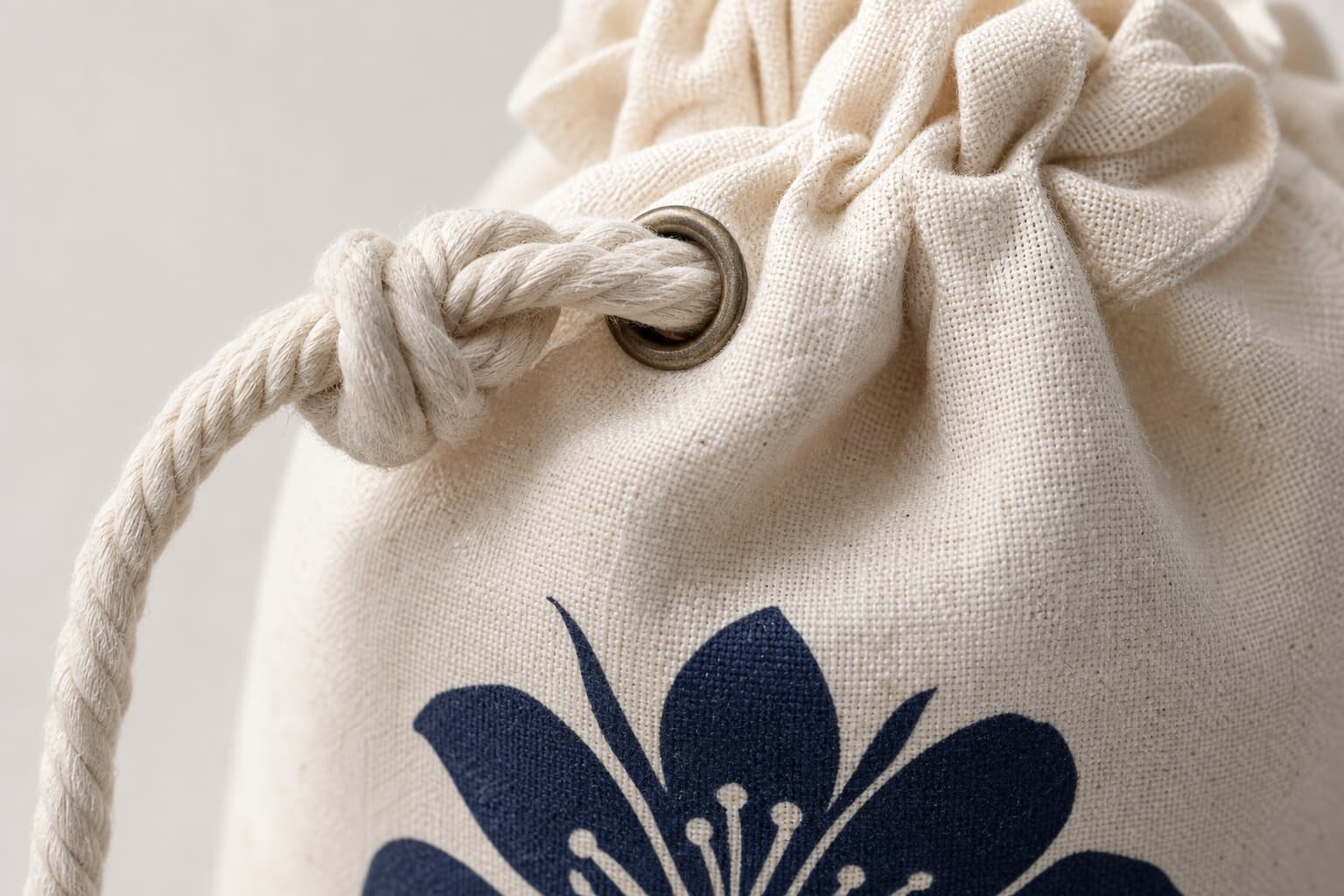
1. Start with the job the pouch has to do
The right organic cotton pouch is not chosen by fabric alone. It is chosen by use case. A pouch for jewelry, a skincare gift set, a wine accessory, or a small retail add-on all need different fabric weight, opening width, and closure behavior. If the pouch must protect a product in transit, it needs more structure and tighter seams. If it is only meant as presentation packaging, the priority may be appearance, print quality, and fast packing rather than load strength.
Buyers often ask suppliers for a "cotton pouch" without defining the actual job. That usually creates quote drift. One factory prices a thin promotional pouch, another prices a dense reusable pouch, and both are technically correct but commercially incomparable. Start the RFQ with the end use, the product dimensions, the required look, and whether the pouch must survive repeated reuse. Those four points drive almost every material decision.
- State the product to be packed, not only the pouch size.
- Tell the factory whether the pouch is for presentation, storage, or shipping protection.
- Define the expected reuse life: one-time gift use, seasonal reuse, or retail-grade reuse.
2. Use GSM to control handfeel, opacity, and cost
For organic cotton pouches, gsm is the first number to lock. In practice, 140-160 gsm works for light promotional use, 180-220 gsm is the safest middle range for most gift buyers, and 240-300 gsm gives a more premium body with better structure. Lower gsm saves material cost and can reduce shipping weight, but it also increases the risk of transparency, wrinkling, and weak seam appearance. Higher gsm feels more substantial, but it may shrink more, consume more ink, and raise the unit price faster than buyers expect.
Do not assume a heavier fabric is automatically better. A very heavy pouch can feel overbuilt for a small gift item and may make the opening stiff if the channel and cord are not adjusted. The right choice is the one that matches the product value, packing method, and retail expectation. For most gift buyers, 180-220 gsm organic cotton gives the best balance between cost, print result, and a clean handfeel. Ask the supplier to quote at least two fabric weights so you can compare the real delta, not a theoretical one.
- 140-160 gsm: light, lower cost, but more risk of show-through and shape collapse.
- 180-220 gsm: balanced option for most gift and retail programs.
- 240-300 gsm: premium structure, better drape control, but higher cost and more shrink risk.
- Ask for post-wash or post-finish gsm if the pouch will be laundered or steam-pressed.
3. Choose weave and finish based on print and product feel
Plain weave, canvas, and twill all behave differently on a pouch. Plain weave gives a clean, simple look and is often the best value for basic gift packaging. Canvas and twill bring more body, a stronger retail feel, and better visual weight on larger pouch faces. If your logo is small and your brand language is minimal, a plain weave may be enough. If the pouch is part of the product experience, the texture and body of canvas or twill can make the item feel more deliberate.
Finish matters as much as weave. Unbleached natural cotton keeps the look honest and earthy, but it can vary slightly from lot to lot. Bleached or optic-white fabric gives a cleaner print background, though it may cost more and show contamination more easily. Pre-shrunk or properly finished fabric is worth asking for when the pouch dimensions must remain stable. Buyers should also confirm whether the factory is using any surface softening or calendering that may affect print adhesion.
- Plain weave works well for simple, high-volume gift pouches.
- Canvas or twill is better when the pouch must feel premium or hold shape.
- Natural cotton is more forgiving for eco positioning, but white fabric can improve logo contrast.
- Ask if the fabric is pre-shrunk, bio-washed, or softened, because finish changes sizing and print behavior.
4. Pick the closure and construction before you approve artwork
A pouch can fail on the closure even when the fabric looks correct. The drawstring channel, cord thickness, and stitch density determine how the pouch opens, closes, and survives repeated handling. If the channel is too narrow, the cord drags and production slows. If the cord is too thin, the pouch feels cheap and the ends can fray. If the channel stitch is weak, the pouch may fail under pulling even when the body fabric is fine.
For gift buyers, the safest construction is usually a reinforced top channel with cotton cord or braided drawstring that matches the fabric weight. A side seam or bottom seam should be clean and consistent, with no twisting that affects the pouch standing shape. If the pouch will be used for heavier items, ask the factory whether they recommend bar-tack reinforcement or a denser stitch count at stress points. That small detail often separates a pouch that looks fine from one that performs well.
- Confirm channel width and cord diameter together; they must be designed as one system.
- Ask for a pull test on the drawstring and top seam.
- Check that the pouch opens fully and closes evenly without one side bunching.
- If the product is heavy, request reinforcement at the seam junctions.
5. Match the print method to the fabric, not to the mockup
The logo method should be chosen after the fabric is selected. Screen printing is usually the first option for simple one- or two-color logos because it is economical and clear on cotton. It works well on natural fabric, especially when the design has strong shapes and limited fine detail. Heat transfer can work for special effects or shorter runs, but it is not always the best choice on a pouch that will be flexed, folded, and packed tightly. Embroidery, woven labels, stitched badges, and embossed side tags all create a more finished feel, but they raise labor time and can change the pouch handfeel.
The biggest mistake is approving art on a digital mockup and only later discovering that the real fabric surface changes the result. A thin logo can disappear on textured cotton. A very dark print can look harsh on natural fiber. Fine lettering may close up on a small pouch front. Ask for a strike-off or pre-production sample on the actual material with the final color and print position. That is the only way to compare logo scale, ink density, and registration honestly.
- Use screen print for simple branding and cost control.
- Use embroidery or woven labels when the pouch is part of the product, not just packaging.
- Avoid designs with tiny type unless the fabric is smooth and the print method supports detail.
- Approve a real strike-off on final fabric before bulk production.
6. Size the pouch around the packed item and the packing method
Pouch dimensions should be based on the product inside, not on a standard factory pattern. A pouch that is too tight slows packing and stresses the seams. A pouch that is too large looks sloppy and can waste material. Measure the packed item with any inserts, tissue, or tag attachments included. Then add the clearance needed for easy insertion and closure. For gift buyers, the visible shape after packing matters as much as the internal fit.
Also define how the pouch will be packed into outer cartons. If the item will be folded flat, the seam and print should still present neatly. If the pouch will be pre-filled with products, the opening must allow quick packing without wrinkling or logo distortion. A good factory will suggest a workable size range, but the buyer should still control the finished dimensions and tolerances. This is especially important when the pouch sits inside a gift box or a display set where appearance is part of the sale.
- Measure the packed product, not the unpacked item.
- Add clearance for insertion and closure without overstretching the fabric.
- Confirm whether the pouch must stand, lie flat, or fit inside another box.
- Set a size tolerance in the PO so inspection is not subjective.
7. Read the quote like a factory, not like a price tag
A clean quote for an organic cotton pouch should separate fabric, printing, sewing, packaging, and sampling. If those pieces are bundled together, it becomes hard to compare suppliers. Ask whether the quoted price is based on a stock fabric, a custom fabric, or a sourced organic cotton option. Ask whether print setup, plate charges, and sampling are included or listed separately. If one supplier is cheaper, check whether they are quoting a lighter gsm, a smaller size, simpler packaging, or no organic claim support.
MOQ logic matters because pouches are often priced by several variables at once: color, size, print color count, and fabric type. A supplier may quote one low MOQ for a plain pouch and a much higher MOQ for printed or special-finish versions. That is normal. What matters is whether the MOQ is driven by fabric minimums, dye batch size, print setup, or cutting efficiency. Once you understand the driver, you can negotiate the right lever instead of asking for a vague discount.
- Separate unit price from setup cost, sample cost, and packaging cost.
- Ask what changes the MOQ: fabric, print, size, or closure option.
- Check whether the quote includes inspection, carton packing, and inner polybag.
- Compare suppliers only after the spec is identical.
8. Use sample checks to prevent the usual production errors
Sampling is where most avoidable mistakes are exposed. A useful sample review should not stop at the logo look. Check fabric weight by hand against the approved reference, inspect seam straightness, test how the cord runs through the channel, and confirm that the pouch closes evenly. If the print is too heavy, it may crack at folds later. If the logo placement is too close to the seam, it may distort when the pouch is filled. If the side seam twists, the pouch may never sit properly on shelf or in carton.
Ask for a pre-production sample after the final fabric and print method are approved. That sample should be treated as the production benchmark, not a rough concept piece. On receipt, compare it to your spec sheet and document any deviation before bulk runs start. For repeated programs, keep one approved master sample with the artwork version, fabric weight, and date. That saves time on reorders and reduces disputes when staff or factories change.
- Check seam alignment, not only the printed logo.
- Test cord movement and closure speed with actual hands and actual product inside.
- Review the sample under daylight, not only under warehouse lighting.
- Keep one signed-off master sample for repeat orders.
9. Lock packing, lead time, and shipment details before approval
Packing decisions affect both cost and product condition. A pouch may ship flat in bulk, folded with tissue, or individually polybagged depending on your channel. Individual packing improves presentation and protection but adds labor and material cost. Flat bulk packing is cheaper, but it can increase wrinkles and make final receiving more labor-intensive. If your buyer sees the pouch before the product launch, presentation may matter enough to justify the extra packing step. If the pouch is only an insert inside a larger gift kit, bulk packing may be the correct commercial choice.
Lead time should be broken into steps: sample making, sample approval, bulk fabric or trim sourcing, production, inspection, and shipment booking. Organic cotton supply can lengthen the sourcing window if the factory does not hold the exact fabric in stock. Ask for a realistic timeline that reflects your print method and any special packing. If the factory gives a very short promise without explaining how they will control fabric, print, and packing, that is a sign to push for more detail before placing the order.
- Decide whether the pouch ships flat, folded, or individually packed.
- Confirm master carton size and carton count for inbound warehouse planning.
- Ask for a step-by-step lead time, not a single date.
- If the pouch supports a launch, build in time for one round of corrections.
Specification comparison for buyers
| Spec decision | Recommended option | When it fits | Buyer risk to check |
|---|---|---|---|
| Fabric weight | 180-220 gsm plain weave organic cotton | Gift pouches that need a balanced handfeel, decent structure, and broad cost control | Too-light fabric can show contents and wrinkle; confirm opacity and seam strength |
| Premium feel | 240-300 gsm cotton canvas or twill | Higher-value gift sets, cosmetic kits, premium retail packaging, and repeat use | Heavier fabric can shrink more and raise cost; check wash behavior and print sharpness |
| Low-cost bulk use | 140-160 gsm organic cotton | Light promotional inserts, short-life packaging, or simple product bundling | May feel thin and lose shape; confirm it still passes your load and appearance standard |
| Print method | 1-color screen print | Simple logos, high volume, and clean brand marks on natural cotton | Fine detail and gradients may be limited; request pre-production strike-off on final fabric |
| Premium branding | Woven label, embroidery, or debossed side tag | When the pouch itself must feel like a finished retail item | Added cost and lead time; confirm placement does not interfere with closure or packing |
| Closure style | Cotton drawstring with reinforced channel | Most gift pouches and reusable presentation bags | Weak channels or thin cord can fail early; test pull force and cord glide |
Buyer checklist before sampling
- Define the exact use case first: gift wrap, product insert, retail pouch, or reusable carry pouch.
- Confirm the target fabric weight in gsm and ask for actual swatches, not only photos.
- State whether you need organic claim support, and ask the factory what documents they can provide.
- Lock the print method, logo size, and color count before sampling.
- Specify pouch dimensions, seam allowance, cord length, and closure construction in the RFQ.
- Ask for sample photos under daylight and close-ups of seams, drawstring channel, and label placement.
- Request carton pack count, polybag requirement, and master carton dimensions early.
- Confirm lead time separately for fabric sourcing, sampling, production, and shipment booking.
Factory quote questions to send
- What fabric options do you recommend for this pouch size, and what is the gsm of each option after finishing?
- Can you confirm whether the cotton is organic cotton, and what supporting documents can you provide for the order?
- What is the minimum order quantity by color, print method, and size?
- Which print methods work best on this fabric weight, and what are the setup costs for each method?
- What tolerance do you allow on finished size, seam alignment, and drawstring length?
- Can you share the packing spec, carton size, carton weight, and units per carton for this quotation?
- How many days do you need for sample making, pp sample approval, and bulk production after approval?
- What are the most common production risks for this pouch style, and how do you control them on the line?
Quality-control points to confirm
- Fabric weight and handfeel match the approved swatch or pre-production sample.
- Logo placement, print density, and color match the approved strike-off within agreed tolerance.
- Seam strength is consistent at side seams, bottom seam, and drawstring channel.
- Cord ends are secured cleanly and do not fray during pull testing.
- Finished dimensions fall within the allowed tolerance after pressing and packing.
- No excessive slubs, contamination, stains, or oil marks appear on visible surfaces.
- Carton packing count, inner pack method, and label data match the purchase order.