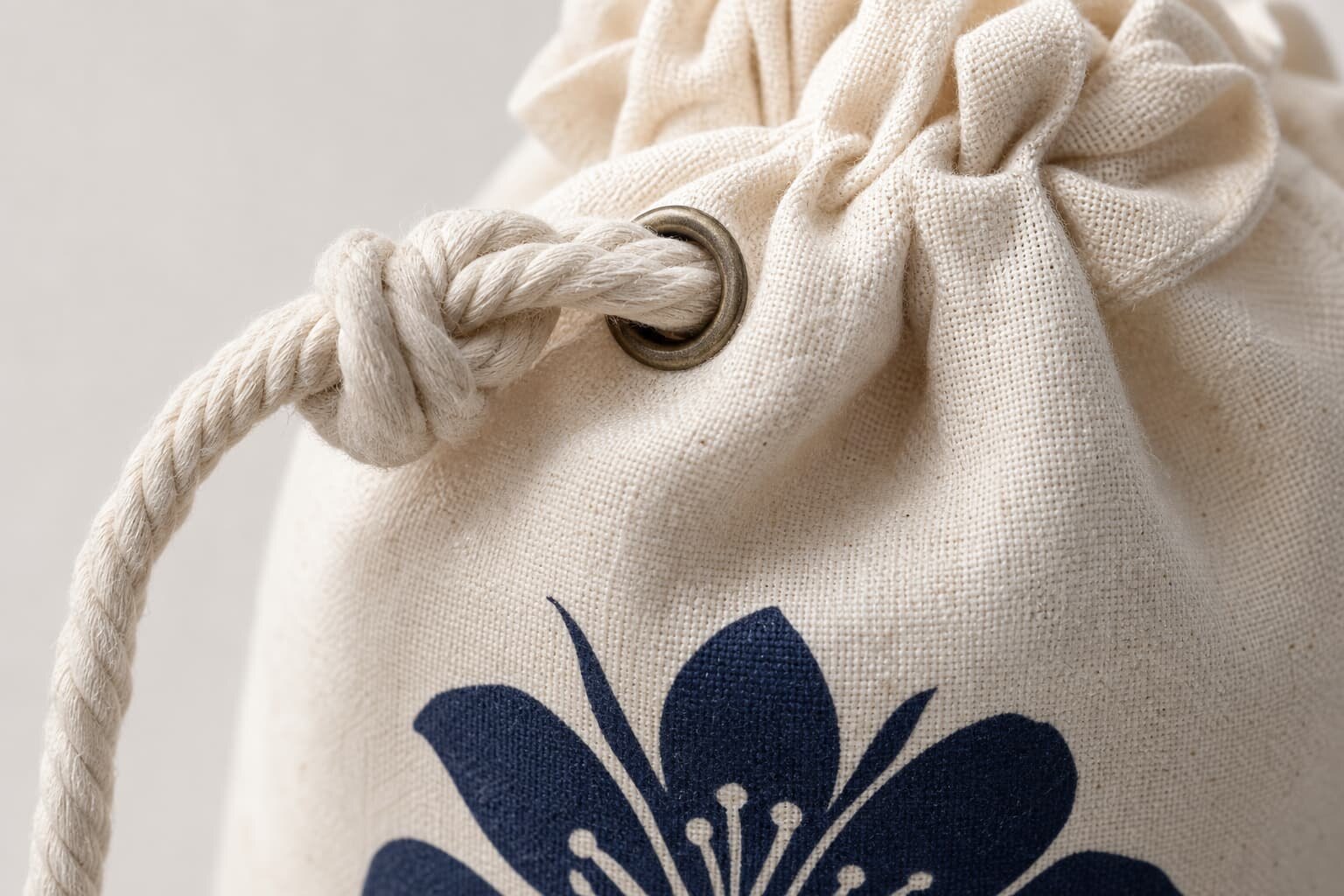
1. What a factory quote for an organic cotton pouch should actually include
Most buyers ask for a pouch quote and get a number that is impossible to compare. One factory may quote only the pouch body, another may include printing, inner labels, and carton packing, while a third may price a basic sample finish that cannot be used for retail. For an organic cotton pouch for ecommerce brands, the quote should separate the cost of fabric, sewing, logo application, packing, and any setup charges so you can see where the real cost is hiding.
If you are buying for ecommerce, the pouch is usually not just a storage bag; it is part of the product experience. That means your RFQ should read like a manufacturing instruction, not a marketing brief. Give the factory the finished size, fabric GSM, print method, closure type, packing requirements, and estimated annual volume if you want a usable quote instead of a placeholder price.
- Ask for unit price by MOQ tier, not one flat price.
- Separate sample fee, setup fee, and bulk price.
- Require the supplier to state whether tax, export packing, and carton marks are included.
- Request a quote based on finished size and approved artwork area.
2. Choose the right fabric weight before you ask for samples
Fabric weight changes how the pouch looks, prints, folds, and protects the contents. For most ecommerce use, 140–180 GSM organic cotton is the practical range. Around 140 GSM, the pouch stays flexible and cost-controlled, but it may show a little more of the contents under light. Around 180 GSM, the pouch feels more premium, holds its shape better, and usually gives cleaner print results, but the cost and carton weight rise.
Do not choose GSM only by hand feel. A soft 120 GSM bag may look attractive in a sample room and fail when packed with sharp-edged products. A 200 GSM pouch can be excellent for premium gifting, but if your brand sells low-value add-ons, that weight may push the landed cost too high. The right answer depends on what the pouch must protect, how it will be presented online, and whether it is reused by the customer.
- Use 140–160 GSM for light packaging and lower landed cost.
- Use 160–180 GSM for a better balance of structure and print quality.
- Use 180 GSM plus if the pouch must feel premium or carry heavier contents.
- Ask the factory to confirm GSM tolerance, not just a nominal spec.
3. Print method matters more than most buyers expect
For an organic cotton pouch, the print method affects appearance, cost, minimum quantity, and defect risk. Screen printing is usually the best choice for one-color or simple two-color logos because it is stable, economical, and easy to repeat across reorders. If you need a soft, subtle effect or a smaller brand mark, a woven label or sewn patch may be more reliable than trying to print tiny artwork on textured cotton.
Digital printing can work for detailed graphics, but it often comes with higher cost, more color variation, and stricter fabric preparation requirements. Heat transfer may look sharp on day one, but some buyers dislike the feel or worry about long-term rub resistance. If your pouch is going into ecommerce shipments and will be handled multiple times, ask the factory to show which method will survive packing, transit, and customer use without looking cheap.
- Screen print: best for simple logos, repeat orders, and cost control.
- Woven label: useful when the logo is small or the fabric texture is too rough for fine print.
- Embossed or sewn label: good for premium positioning with minimal ink risk.
- Ask for print placement dimensions in millimeters, not just 'center front'.
4. MOQ logic: why low quantity quotes often cost more than they look
The MOQ for an organic cotton pouch is not only about sewing capacity. It is driven by fabric sourcing, cutting efficiency, print setup, label procurement, and packing labor. If your order needs a special fabric shade, a custom woven label, and individual retail packing, the factory will usually require a higher MOQ or add surcharges. Buyers sometimes compare a 1,000-piece quote from one supplier with a 5,000-piece quote from another without realizing that the lower MOQ may carry a much higher hidden unit cost.
The practical way to handle MOQ is to separate what must be custom from what can stay standard. If you can keep the fabric natural, use one print color, and avoid custom packaging, you usually unlock better pricing and shorter lead time. If the brand needs multiple pouch sizes, ask the factory to state MOQ per size and whether mixed sizes can be produced in one fabric run.
- MOQ often changes by size, logo color count, and packing style.
- Custom woven labels and special cartons can raise the minimum order.
- Mixed-SKU orders may need split pricing if cutting layouts differ.
- Ask whether the quoted MOQ is for one color, one size, or one total style.
5. Sample approval is where most pouch orders are won or lost
A sample should prove more than appearance. It should confirm that the pouch closes properly, the logo sits in the right position, the fabric weight feels correct, and the stitching is consistent at stress points. For ecommerce buyers, the approved sample becomes the standard for the bulk order. If the sample is rushed, vague, or not checked against a written spec sheet, the bulk order will drift and the supplier will argue that the production result is acceptable because the sample was not defined well enough.
Use a two-step sample process when the order is important. First, request a basic pre-production sample to check size, material, cord length, and logo placement. Then approve a sealed sample that is signed or referenced in writing. This is especially important if your product will be inserted with apparel, cosmetics, jewelry, or gift items where a wrong fit or weak closure creates customer complaints.
- Check finished size after stitching, not cut-panel size.
- Confirm logo placement against a ruler or marked template.
- Inspect seam quality inside and outside the pouch.
- Test the drawcord by opening and closing it at least several times.
6. Compare a pouch spec by function, not by a generic item name
When buyers say 'organic cotton pouch,' factories may picture very different constructions. One supplier may quote a thin promotional pouch with loose stitching, while another is pricing a tighter retail-ready pouch with reinforced seams and better folding. That is why a comparison table based on function is more useful than comparing only size and price. You need to know whether the pouch is packaging, a gift item, a product protector, or a reusable brand accessory.
The right spec depends on how the end customer uses it. If the pouch is only for shipping accessories inside a box, you may optimize for low cost and fast packing. If it will be sold as a standalone reusable pouch, the finish must be cleaner, the print must be sharper, and the closure must feel smoother. That functional difference should be visible in your RFQ and in the supplier quote.
- Packaging pouch: prioritize cost, count accuracy, and simple branding.
- Retail pouch: prioritize finish, print quality, and presentation.
- Protective pouch: prioritize fabric weight and seam strength.
- Premium gift pouch: prioritize texture, labeling, and clean folding.
7. Packing details affect freight cost, warehouse speed, and damage rate
Packing is often the part buyers forget to specify. If the factory folds pouches inconsistently, mixes SKUs in the same carton, or uses weak outer cartons, your warehouse team will spend time re-sorting product and your freight cost may rise unexpectedly. For ecommerce brands that ship to multiple fulfillment centers, carton labeling and quantity discipline matter as much as the pouch itself.
State the packing method in your order before production begins. Decide whether each pouch should be loose packed, polybagged, bundled by ten, or packed with inserts. Then ask the factory for carton dimensions and carton weight so your logistics team can estimate cubic volume and receiving workload. If the pouches are packed for direct-to-consumer kits, ask the factory to confirm the sequence of inserts and whether count checks happen before final carton sealing.
- Specify carton count per SKU and per carton.
- Ask for carton marks, barcode needs, and outer carton strength.
- Confirm whether fold direction is standardized.
- Request a packing photo from the pilot run before bulk completion.
8. Cost drivers buyers should break out in the quote
A clean quote lets you see which design choices are expensive. The biggest drivers for an organic cotton pouch are usually fabric weight, print complexity, number of logo colors, woven label or care label addition, and packing requirements. If the factory is making the pouch from organic cotton but you do not specify unbleached natural color, the supplier may add a dye step or substitute a different base cloth, which changes both cost and appearance.
Use the quote to compare design choices. For example, moving from a one-color screen print to a woven label may reduce print setup complexity but add label sourcing and sewing labor. Increasing the pouch size by a few centimeters can reduce cutting efficiency across the fabric width and raise unit price more than buyers expect. Ask the factory to explain the cost impact of each change instead of simply asking for a cheaper price.
- Fabric GSM and fabric width influence cutting yield.
- Print color count changes setup and labor.
- Size changes can affect fabric usage per piece.
- Packing and labeling often add hidden labor cost.
9. Common sourcing mistakes that cause avoidable rework
The most common mistake is treating the pouch like a simple commodity item. Buyers approve artwork before size, then discover the logo is too close to the seam or too small to print cleanly. Another frequent error is assuming that all 'organic cotton' cloth feels the same; in reality, weave density, GSM, and bleaching state all change the hand feel and opacity. If you do not define these details, the factory will choose whatever is easiest to source, not what fits your brand standard.
Another source of trouble is weak specification control across multiple SKUs. Ecommerce buyers often reorder a pouch months later and expect the previous version to be repeated exactly, but if the original approved sample was not documented, the supplier may substitute a slightly different cord, label, or seam finish. Keep the spec sheet, artwork dimensions, sample reference, and carton packing notes together so the reorder is repeatable.
- Do not approve artwork before confirming final pouch dimensions.
- Do not leave cord type and length open to factory interpretation.
- Do not assume reorder consistency without a stored spec record.
- Do not forget to ask whether the fabric is prewashed or may shrink.
10. A practical RFQ workflow for ecommerce buyers
The fastest way to get useful quotes is to send a short but complete RFQ package. Include finished size, fabric GSM, color, logo artwork, print location, label needs, packing method, target quantity, and required date. If you have more than one option, ask the factory to quote each version separately so you can compare the trade-off between price and finish. The goal is not to collect ten vague quotes; it is to narrow down to two or three apples-to-apples options.
After the first quote round, ask for clarification on any line that is not explicit. For example: is the price based on 140 GSM or 160 GSM, one print color or two, natural unbleached cotton or bleached white, bulk loose pack or individual polybag? When the supplier answers in writing, you reduce the risk of surprise charges later. That is especially useful when your import plan has tight margin targets or scheduled ecommerce launch windows.
- Send one spec sheet and one artwork file set to every supplier.
- Ask for separate pricing by size or packaging variation.
- Compare lead time, MOQ, and included packing line by line.
- Store the supplier’s written assumptions for future reorders.
Specification comparison for buyers
| Spec decision | Recommended option | When it fits | Buyer risk to check |
|---|---|---|---|
| Fabric weight | 140–180 GSM organic cotton | Most ecommerce orders needing a balance of hand feel, print clarity, and unit cost | Too light can look transparent; too heavy raises cost and changes pouch drape |
| Closure style | Single drawcord with cotton rope or cotton tape | General product packaging, gift sets, apparel, and subscription inserts | Cord length, knot security, and smooth closing action |
| Logo method | 1-color screen print or woven label | Simple branding, low-to-mid run quantities, and repeat orders | Fine details may fill in; confirm print size, ink density, and wash rub resistance |
| Interior finish | Clean stitched seams with no raw-edge exposure | Retail-ready or premium ecommerce packaging | Loose threads and uneven seam allowance can cause QC failures |
| Packing method | Bulk packed by size/color with carton labels | Importers consolidating SKUs and handling their own kitting | Mixed sizes in one carton increase picking mistakes |
| Sample stage | Pre-production sample plus approved sealing sample | Any first order or new logo placement | Skipping approval leads to size drift, print shift, and wrong cord length |
| MOQ approach | Set by fabric color, print setup, and size | Brands with multiple SKUs or seasonal launches | Low MOQ on paper may hide high surcharge or limited options |
| Lead time | Sample plus bulk production with buffer for material sourcing | Orders with custom dyeing, labeling, or packed inserts | Holiday peaks and fabric sourcing delays can push shipment |
Buyer checklist before sampling
- Confirm pouch size in finished dimensions, not cut size, and state tolerance for width and height.
- Specify fabric GSM, organic cotton requirement, and whether the cloth must be unbleached natural color or dyed.
- Choose logo method, print size, print position, and artwork file format before requesting a quote.
- State cord type, cord length, closure style, and whether a woven side label or care label is needed.
- Define packing format: loose bulk, individual polybag, carton count, barcode label, or kit assembly.
- Request a pre-production sample and written approval point for size, print placement, stitching, and packaging.
- Ask for carton dimensions, gross weight, and estimated carton loading to help calculate freight.
- Verify lead time separately for sample, bulk production, and any special packing work.
Factory quote questions to send
- What is the finished pouch size, fabric GSM, and seam allowance used for the quote?
- Is the quoted fabric 100% organic cotton, and is it unbleached, bleached, or dyed?
- What logo method is included, what print size is assumed, and how many colors are priced?
- Does the MOQ change by size, print color, or packing requirement?
- What is included in the price: pouch only, label, printing, packing, and carton mark?
- How many days are needed for sample approval and bulk production after approval?
- What defect standard will you use for stitching, stains, print shift, and size tolerance?
- Can you share carton size, quantity per carton, and approximate CBM for shipping planning?
Quality-control points to confirm
- Finished size tolerance checked against an approved sample, not the artwork flat size.
- Fabric weight verification using supplier spec and spot check of actual hand feel and opacity.
- Stitching quality: even seam allowance, no skipped stitches, no loose threads at stress points.
- Drawcord function: smooth pull, equal cord length, secure knots, no fraying at cut ends.
- Print alignment and coverage: logo centered or intentionally placed, no ghosting or pinholes.
- Label attachment: woven or care label stitched straight, no twisting or edge curling.
- Packing accuracy: correct SKU, count per carton, barcode or carton label matching the PO.
- Color and shade consistency between production sample and bulk lot when dyed fabric is used.