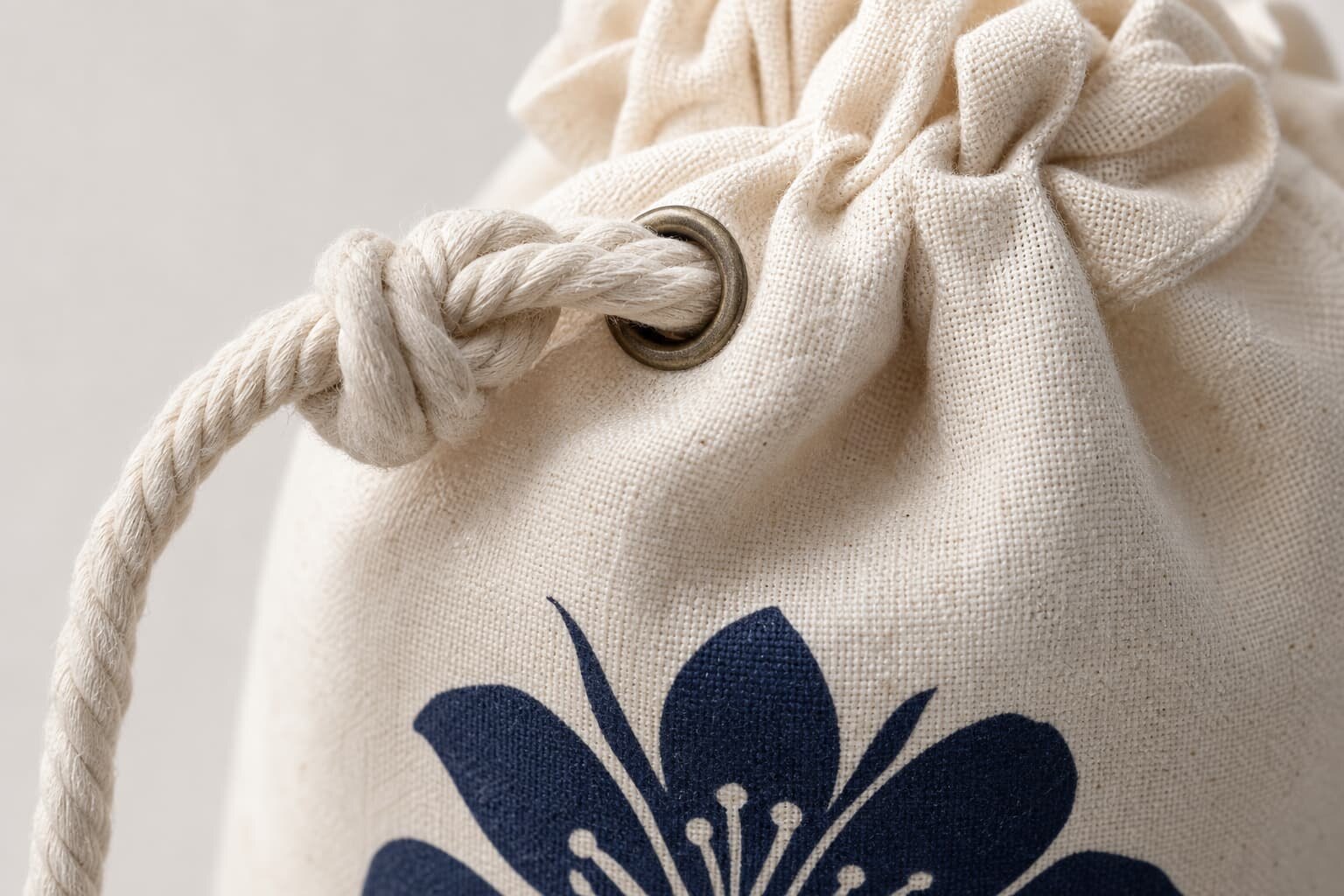
Start With The Packed Product
For ecommerce brands, the pouch is not only a bag. It is part of the packing process, the unboxing experience, and sometimes the reusable storage item after delivery. A good organic cotton pouch specification starts with the item going inside it: product dimensions, product weight, surface finish, sharp edges, insert cards, and whether the customer will open the pouch once or use it many times.
Do not ask a factory to quote only by a photo and a general size. Two pouches that look similar online can behave differently in packing. A candle jar needs more bottom room and stronger seams than a silk scarf. A jewelry pouch needs softer fabric and cleaner drawcord closure. A skincare set may need enough height above the product so the cord can close without squeezing the cap.
- Send the factory the product size, product weight, and target pouch opening clearance.
- State whether the item goes directly inside the pouch or is first packed in a box, sleeve, or tissue.
- Allow extra height for drawstring closure, usually more than buyers first estimate.
- For fragile or premium items, request a fit photo or video during sample review.
Choose Fabric Weight By Function
Organic cotton pouch buyers often ask for a premium feel, but premium does not always mean the heaviest fabric. For small ecommerce packaging, 5 oz to 7 oz cotton, roughly 170 to 240 GSM, is a common practical range. It gives enough opacity and body without making a small pouch bulky. Lighter fabric can work for low-weight accessories, but it may look limp after transit and may show the shape of the product inside.
Heavier cotton, such as 8 oz or above, can be useful for larger reusable pouches, tool kits, or subscription packaging where durability matters more than foldability. The tradeoff is unit cost, carton volume, and a stiffer drawstring closure. If the pouch is small, heavy fabric can make the top channel thick and difficult to pull closed neatly.
- 3 oz to 4 oz: low-cost dust bags or very light accessories, with limited structure.
- 5 oz to 7 oz: common ecommerce brand pouch range for a balanced cost and hand feel.
- 8 oz and above: stronger reusable storage pouches, but higher cost and bulkier packing.
- Ask whether the quoted GSM is before washing, after finishing, or based on supplier average.
Define Organic Cotton Correctly
The word organic can create quotation confusion. Some buyers mean organic cotton fabric. Some need certified finished goods. Some need paperwork for a retailer, platform, or compliance team. These are different sourcing levels and can affect fabric availability, MOQ, lead time, and document cost. If you only write organic cotton pouch in the RFQ, suppliers may quote based on different assumptions.
Before requesting prices, decide what proof you need. For internal brand language, a fabric certificate may be enough. For regulated claims, retailer onboarding, or chain-of-custody requirements, you may need stronger documentation. The factory cannot price accurately unless it knows whether certification is required for the material, the finished pouch, or the transaction.
- State whether certified organic cotton fabric is required or preferred.
- Ask what certificates can be supplied and whether they cover fabric, factory scope, or transaction records.
- Avoid putting certification logos on the pouch unless your compliance team confirms permission.
- For large retail programs, align documentation requirements before sampling, not after production.
Size The Pouch For Real Closure
A pouch size should be written as finished flat width x finished flat height, with measurement tolerance. The most common buyer mistake is copying the product size and adding only a small margin. Drawstring pouches need extra head space above the item because the fabric gathers when closed. Without this allowance, the top will flare, the cord will not close smoothly, and the packed product will look forced.
For ecommerce packing, also think about labor speed. A pouch that technically fits may still slow the packing line if staff must push, twist, or adjust each item. The sample should be tested by the same packing method your warehouse or 3PL will use. If an insert card, care card, or barcode label is added later, include it in the sample fit test.
- Give the factory actual item dimensions and the target finished pouch size.
- Add closure allowance above the product, especially for rigid boxes and bottles.
- Set normal size tolerance, for example plus or minus 0.5 cm for small pouches, if acceptable.
- Confirm whether shrinkage after washing matters for the final customer use.
Specify Drawcord And Channel Details
The drawcord system affects both appearance and failure rate. A single drawstring is cheaper and works for simple packaging. A double drawstring feels more gift-ready and closes from both sides, but it adds labor and material. Cord can be cotton, recycled polyester, polyester, jute, or another material depending on price, color, strength, and brand positioning.
The top channel must be wide enough for the cord to move smoothly. If the cord is too thick or the channel is too narrow, customers feel friction immediately. If the channel stitching is weak, the top seam can tear during pulling. For small pouches, even a few millimeters change the user experience.
- Specify single or double drawstring, not just drawstring pouch.
- Confirm cord diameter, color, material, and whether knots or metal/plastic tips are allowed.
- Ask for a drawcord pull test during sample review.
- Check that the cord length looks balanced after closing, not excessively long or too short.
Match Logo Method To Artwork
For most ecommerce organic cotton pouches, screen printing is the practical default when the logo is one to three solid colors. It gives good cost control at volume and works well on natural cotton if the artwork is not too fine. However, textured cotton is less forgiving than coated paper. Thin lines, tiny serif text, and large solid ink blocks may need adjustment.
Woven labels are useful when the brand wants a retail-quality reusable look without a big print on the front. Embroidery can look premium but may pucker lightweight cotton and is usually better for thicker pouches. Heat transfer and digital print can support gradients or many colors, but buyers should check hand feel, wash resistance, and cracking risk depending on the process.
- Send vector artwork in AI, EPS, or PDF format and include Pantone references.
- State print size, print position, and acceptable position tolerance.
- Request a strike-off on the selected fabric before approving bulk printing.
- Avoid very small QR codes or long fine text unless the factory confirms scan and readability tests.
Understand MOQ Logic
MOQ is not only a factory preference. It can come from fabric procurement, dyeing minimums, printing setup time, label production, cutting efficiency, and sewing line changeover. A natural cotton pouch with one-color screen print may have a lower MOQ than a dyed pouch with custom woven label and multiple sizes. When quotes vary widely, the underlying MOQ driver is often different.
If your first ecommerce run is small, ask the factory to separate stock material options from custom material options. You may find that natural organic cotton fabric in an available weight can support a lower trial order, while custom dyeing requires a much larger commitment. This gives procurement a cleaner way to compare launch order and reorder strategy.
- Ask for MOQ by size, color, and logo method, not only total order quantity.
- Request price breaks at realistic quantities such as 500, 1000, 3000, 5000, and 10000 pieces.
- Clarify whether assorted sizes can share the same MOQ if fabric and print color are the same.
- Check whether sample, setup, and printing screen charges are one-time or repeated on reorders.
Build A Quote Sheet That Can Be Compared
A useful quote for organic cotton pouches should show more than a unit price. It should state material, GSM, size, construction, logo method, packing, carton quantity, estimated carton dimensions, gross weight, sample cost, setup cost, payment terms, delivery terms, and lead time assumptions. Without this data, the cheapest supplier may simply be quoting a thinner fabric, simpler seam, or looser packing method.
For importers and distributors, quote comparison should also include landed cost drivers. A pouch is light, but carton volume can still matter. Heavy fabric and loose packing can increase freight. Individual polybags add labor and material cost, while paper bands may support plastic reduction targets but need confirmation for warehouse handling.
- Ask each supplier to quote against the same spec sheet and artwork file.
- Require GSM, not only fabric description.
- Ask for carton quantity, carton size, and gross weight for freight estimation.
- Separate product unit price from sample fee, setup fee, packing upgrade, label cost, and inspection cost.
Control Sampling Before Bulk
Sampling is where many pouch problems can be prevented cheaply. A photo approval is not enough for organic cotton pouches because hand feel, closure, fabric shade, odor, print texture, and product fit all matter. At minimum, buyers should review a fabric swatch and a physical sample before approving production. For printed orders, a print strike-off is often worth the time.
The approved sample should become the production reference. Mark it with date, version, fabric weight, print method, and any approved deviations. If you change fabric weight, cord type, logo size, or packing after sample approval, the factory should confirm whether a revised sample is needed. Small changes in a pouch can change sewing behavior and final appearance.
- Check sample dimensions after laying the pouch flat without stretching.
- Insert the real product and test closure at normal packing speed.
- Rub the print lightly with a white cloth to check obvious ink transfer.
- Keep one sealed sample with procurement and one with the factory production team.
Set Packing And Lead Time Assumptions
Packing instructions should be written before the quote is finalized. Ecommerce brands may need pouches bulk packed for their 3PL, bundled by 50 or 100 pieces, individually barcoded, packed with insert cards, or separated by SKU. Each method changes labor, carton size, and inspection process. If the packing method is decided after production, the factory may need to repack, which adds cost and delay.
Lead time depends on fabric availability, dyeing, printing, label production, sample approval speed, and factory capacity. A simple natural cotton pouch can usually move faster than a custom dyed, multi-size, multi-logo program, but buyers should avoid assuming any fixed schedule without checking the current production calendar. The cleanest RFQ asks for sample lead time, bulk lead time after approval, and transit-ready date.
- State whether pouches are bulk packed, bundled, paper banded, or individually packed.
- Confirm moisture protection for sea shipment and warehouse storage.
- Ask whether cartons can be packed by size and SKU without mixing.
- Request lead time separately for sampling, material preparation, bulk sewing, printing, inspection, and packing.
Specification comparison for buyers
| Spec decision | Recommended option | When it fits | Buyer risk to check |
|---|---|---|---|
| Fabric weight | 5 oz to 7 oz organic cotton, about 170 to 240 GSM | Small ecommerce accessories, cosmetics, candles, jewelry, and reusable unboxing pouches | Too light may show product shape and wrinkle badly; too heavy may increase freight and feel stiff on small sizes |
| Construction | Single drawstring or double drawstring with folded top channel | Single cord for lower cost packaging; double cord for gifting and better closure feel | Channel width must match cord diameter or the pouch will pull roughly and fail inspection |
| Logo method | Screen print for solid one to three color artwork | Most ecommerce brand logos, care icons, slogans, and simple line artwork | Fine lines can fill in on textured cotton; request print strike-off before bulk |
| Premium branding | Woven side label or cotton label sewn into side seam | Brands wanting subtle reusable packaging without large front print | Label placement and folding direction must be confirmed or bulk cartons may contain mixed orientation |
| Color | Natural unbleached cotton, optic white, or dyed brand color with lab dip | Natural for organic positioning; dyed when packaging must match a brand system | Natural fabric shade varies by lot; dyed colors need tolerance and approval under standard light |
| Packing | Flat packed in export cartons with inner polybag bundles or paper bands | Ecommerce fulfillment teams that need easy counting, kitting, or warehouse receiving | Over-compression can crease prints and deform drawcord channels |
Buyer checklist before sampling
- State finished pouch size as width x height in centimeters, with tolerance, and clarify whether measurement is flat and empty.
- Confirm organic cotton requirement clearly: fabric only, finished product certification, transaction certificate, or marketing claim support.
- Specify fabric weight in oz or GSM, not only words such as thick, premium, or lightweight.
- Attach artwork in vector format and note Pantone colors, print size, print position, and whether the logo must survive washing.
- Choose single or double drawstring, cord material, cord color, cord diameter, and knot or stopper requirement.
- Define seam type, top channel width, hem allowance, and whether raw edges must be overlocked or fully enclosed.
- Ask for sample approval stages: blank fabric swatch, pre-production sample, print strike-off, and final sealed sample.
- List product use, packed item weight, and whether the pouch will be used for shipping, gifting, storage, or retail sale.
- Confirm packing method, bundle quantity, carton size target, carton markings, barcode label needs, and any plastic reduction policy.
- Request quote data by quantity tier, including tooling, sample fee, printing setup, packing cost, estimated lead time, and shipment dimensions.
Factory quote questions to send
- What organic cotton fabric options do you have in stock, and what are the actual GSM, yarn count, weave, and shrinkage range?
- Can you quote the same pouch in two fabric weights so we can compare unit cost, hand feel, and carton volume?
- Is the MOQ driven by fabric purchase, dyeing, printing setup, label weaving, or sewing line efficiency?
- For our artwork, do you recommend screen print, heat transfer, digital print, embroidery, or woven label, and why?
- What is the smallest readable line thickness and text height for this print on the selected cotton fabric?
- Can you provide a print strike-off or pre-production sample using bulk fabric before we approve mass production?
- What tolerances do you apply for finished size, drawcord length, print position, color shade, and fabric GSM?
- How will you pack the pouches to avoid creasing, moisture, print transfer, and mixed sizes in the same carton?
- What quote assumptions are included for inner packing, carton markings, inspection access, export documents, and delivery terms?
- What information do you need from us today to issue a firm quotation instead of a rough estimate?
Quality-control points to confirm
- Measure finished pouch width, height, top channel, drawcord length, and logo position against the approved sample.
- Check fabric weight by GSM test or factory fabric report and compare hand feel with the sealed approved swatch.
- Inspect seams for skipped stitches, loose threads, open side seams, weak bartacks, and uneven top channels.
- Pull-test the drawcord closure to confirm smooth movement and no tearing at the channel edge.
- Check print adhesion, color, edge sharpness, registration, ink penetration, and rubbing resistance on textured cotton.
- Review shade variation across cartons, especially for natural unbleached or dyed organic cotton fabric lots.
- Confirm labels, hangtags, barcodes, carton marks, and packing quantities match the purchase order.
- Open cartons from different production batches to check odor, moisture, mildew marks, stains, and dust contamination.
- Run a basic product fit test using the actual ecommerce item, insert card, or gift set that the pouch is meant to hold.
- Keep one signed production sample and one carton packing photo set as reference for reorder comparison.