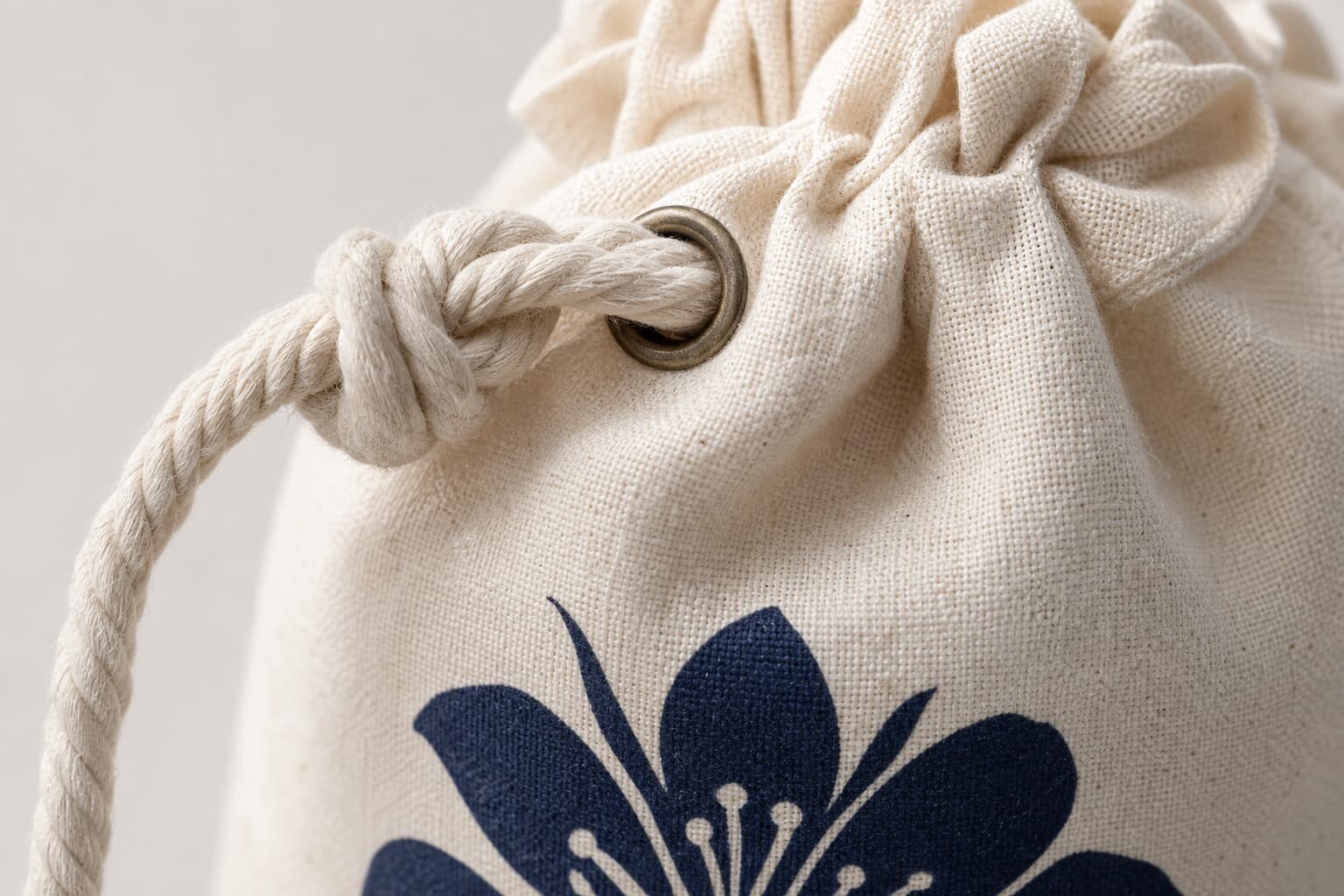
1. What This Cost Review Memo Should Solve
Organic cotton pouches look simple, but quotes can vary widely because suppliers may not be pricing the same product. One factory may quote a thin 4 oz pouch with basic bulk packing. Another may quote a heavier 6 oz pouch with double drawstrings, screen print setup, individual bags, barcode labels, and export cartons. If the RFQ is not specific, the lowest quote may only be lower because important cost items were excluded.
For gift buyers, the main problem is not only unit price. The pouch has to protect the gift, present the brand properly, fit the packing operation, and arrive with acceptable documentation. This memo helps procurement teams compare organic cotton pouch quotes on a like-for-like basis before approving samples or placing a purchase order.
- Use this guide when comparing supplier quotes for organic cotton drawstring pouches used for gifts, retail sets, cosmetics, candles, jewelry, accessories, or promotional packs.
- The focus is cost control through clear specification, not simply pushing factories for a lower price.
- The best quote is the one that matches your approved sample, packing requirement, and delivery schedule with the fewest hidden changes.
2. Start With Use Case Before Asking for Price
A pouch for a hotel amenity kit does not need the same fabric, stitching, or print handling as a premium retail gift pouch for a candle or skincare set. Before asking for a quote, define what the pouch must do after delivery. Is it a simple dust bag, a presentation pouch, a reusable retail package, or part of a paid product bundle? The answer changes GSM, cord type, packing method, and inspection standard.
Factories can quote faster and more accurately when the use case is clear. If you only ask for an organic cotton pouch with logo, many suppliers will quote their most common lightweight construction to win the first price comparison. That may create trouble later when your merchandising team says the fabric feels too thin or the print looks dull on natural cotton.
- For light gift inserts: 4 oz / 120-140 GSM may be acceptable if the item is not sharp, heavy, or dark-colored.
- For standard gift packaging: 5 oz / 150-170 GSM is often a practical balance between cost, appearance, and handling.
- For premium retail gifting: 6 oz / 180-200 GSM gives a stronger hand feel but increases fabric cost and carton volume.
- For repeated reuse or heavier goods: consider heavier cotton canvas, stronger seams, or a different bag construction.
3. Fabric Weight and Organic Cotton Claim Drive the Base Cost
Fabric is usually the largest cost driver for a plain organic cotton pouch. A small difference in GSM may look minor on paper, but it affects fabric consumption, feel, print result, sewing behavior, and shipping volume. A 6 oz pouch will generally cost more than a 5 oz pouch not only because the fabric is heavier, but also because folded cartons may become bulkier.
Buyers should also separate the wording organic cotton from the documentation required. Some RFQs only need organic cotton material from a supplier that can provide fabric-related information. Other orders need chain-of-custody documentation, transaction certificates, approved labeling, or retailer compliance paperwork. Those requirements can change supplier selection, MOQ, lead time, and administrative cost. Do not assume every organic cotton pouch quote includes the same level of certification support.
- Ask for GSM and oz together because suppliers in different markets may use different fabric descriptions.
- Clarify natural unbleached, bleached white, dyed color, or custom dyed fabric before comparing price.
- Natural cotton may show seed flecks; this is normal but should be approved by your brand team.
- Dyed organic cotton usually raises MOQ and lead time compared with natural stock fabric.
- If certification documents are required, list exactly which documents your importer, retailer, or platform needs.
4. Size, Sewing Allowance, and Product Fit Affect More Than Dimensions
Many pouch problems come from size assumptions. A buyer may provide a product size, while the factory quotes the pouch flat size. If the item has thickness, the finished pouch needs extra width and height. Cotton pouches also lose internal space at side seams, bottom seam, and drawstring channel. A pouch that measures correctly flat can still be hard to close when filled.
In the RFQ, state finished flat size and provide the packed product dimensions if available. For example, a 120 x 180 mm pouch may not fit a rigid box that is 110 x 160 x 35 mm comfortably after seam allowance and drawstring closure. If the pouch must close fully above the product, allow extra height for the channel and gathered fabric.
- Specify finished flat width x height, not fabric cut size.
- Tell the factory if the pouch must fully cover the product or only hold it loosely.
- For rigid products, send product dimensions or a physical sample if possible.
- Ask the factory to confirm usable inner space after seams and drawstring channel.
- Set a realistic tolerance, commonly a few millimeters for small pouches, depending on size and fabric.
5. Print Method: Screen Print Is Common, But Not Always Enough
For gift buyers, one-color screen print is often the most cost-efficient logo method on organic cotton pouches. It works well for simple logos, slogans, and clean brand marks. However, cotton texture, fabric absorbency, and natural color variation can affect sharpness and color appearance. Fine lines, small serif text, and detailed icons may not reproduce as clearly as they do on paper packaging.
Multicolor artwork, gradients, photographic graphics, or very small orders may push the factory toward heat transfer or digital printing. These methods can solve artwork limitations but may change the hand feel of the pouch. If your brand positions the pouch as natural and reusable, a thick transfer patch may feel inconsistent. Always approve a print strike-off on the final fabric weight before mass production.
- Use vector artwork for screen print and define the logo size in millimeters.
- State print position from top edge or bottom edge, not only centered.
- Provide Pantone references, but remember natural cotton may make ink appear warmer or duller.
- For small text, ask the factory what minimum line width they can hold on the selected fabric.
- For dark fabric or colored cotton, ask whether underbase printing is needed and included.
6. MOQ Logic: Why the Same Pouch Has Different Minimums
MOQ is not only a factory policy. It often comes from fabric sourcing, dyeing, print setup, cutting efficiency, sewing line arrangement, and packing labor. A natural organic cotton pouch in a standard size may be possible at a lower MOQ if the fabric is available. A custom dyed organic cotton pouch with matched drawcord, woven label, and retail barcode packing will have a higher practical minimum.
When comparing quotes, ask where the MOQ comes from. If the factory says 1,000 pieces for stock fabric and 3,000 pieces for dyed fabric, that is useful information. If another supplier offers a very low MOQ for a custom dyed organic cotton order, confirm whether they are using real dyed fabric, leftover fabric, or a non-organic substitute. Low MOQ is helpful only when the material and documentation still match the requirement.
- Body fabric MOQ: driven by stock availability or mill minimum.
- Dyeing MOQ: often higher because dye lots need minimum fabric quantity.
- Printing MOQ: affected by screen setup and ink preparation.
- Cord MOQ: custom color or custom material cords can carry separate minimums.
- Packing MOQ: printed paper bands, custom hangtags, and barcode labels may add their own setup requirements.
7. Quote Data Buyers Should Require Before Shortlisting
A useful supplier quote should include more than unit price. Procurement teams need enough data to calculate landed cost, compare risks, and prepare internal approval. If carton size, gross weight, packing method, and lead time are missing, the cheapest unit price may become expensive after freight or warehouse handling is added.
Ask each factory to quote the same quantity breaks. For example, 3,000, 5,000, and 10,000 pieces with identical size, GSM, print, and packing. This reveals whether the price difference is mainly setup cost, fabric purchasing, or production efficiency. It also helps buyers decide whether to consolidate orders across gift programs.
- Unit price by quantity break using the same specification.
- Fabric weight, composition, color, and finish.
- Print method, number of colors, print area, and setup charges.
- Sample charge, sample lead time, and whether the charge is refundable or not.
- Mass production lead time after sample approval and deposit.
- Packing method, pieces per inner pack, pieces per export carton.
- Carton size, gross weight, net weight, and estimated CBM.
- Payment terms, trade terms, and quote validity period.
8. Sample Review: What to Approve Before Production
The sample stage should not be treated as a photo approval only. For organic cotton pouches, the buyer should physically check fabric weight, hand feel, drawstring function, print clarity, stitching, and filled product fit. A sample made from similar fabric is useful for early shape discussion, but it is not enough for final approval if your purchase order depends on a specific GSM or organic cotton claim.
Keep one signed or sealed approved sample with your team and ask the factory to keep the same reference. If changes are made after sampling, document them clearly. Many production disputes happen because the buyer approved a shape sample, then changed print size, cord type, fabric weight, or packing by email without updating the final spec sheet.
- Weigh and measure the sample; compare actual dimensions with the RFQ.
- Insert the real product and test whether the pouch closes comfortably.
- Rub the print lightly with dry and slightly damp cloth if the pouch may be handled often.
- Check whether natural cotton seed flecks are acceptable to the brand team.
- Open and close the drawstring repeatedly to check cord movement and seam stress.
- Confirm the approved sample includes the same packing method expected for mass production.
9. Packing, Carton Planning, and Warehouse Handling
Packing is a common hidden cost in pouch quotes. Bulk packing is cheaper and suitable when the buyer will repack, kit, or distribute internally. Individual polybags, paper bands, hangtags, barcode stickers, and retail cartons all add material and labor. For brands trying to reduce plastic, paper bands or bulk packing may fit better, but they still need to protect the goods during sea or air transport.
Carton data should be requested early because organic cotton pouches can be bulky relative to their unit cost. A heavier GSM, thicker drawcord, or individual packing can increase CBM. If your freight budget is tight, ask the factory for carton quantity and dimensions before final approval. Warehouse teams also need carton marks, SKU separation, and packing list accuracy to avoid receiving delays.
- Bulk pack: lowest packing cost, good for warehouse repacking and event kitting.
- Individual polybag: protects against dirt and moisture but may conflict with plastic reduction goals.
- Paper band: cleaner retail presentation, but may not protect from moisture or rough handling.
- Barcode sticker: required by many retail and distribution systems; confirm label placement and data format.
- Master carton marks: include PO number, SKU, quantity, carton number, gross weight, net weight, and destination if required.
10. Lead Time and Change Control for Gift Programs
Gift programs often have fixed launch dates, event dates, or retail delivery windows. Lead time should be counted from final sample approval, deposit, confirmed artwork, and confirmed packing details. If the buyer is still adjusting artwork or waiting for certification document approval, production has not truly started. A realistic schedule should include sampling, approval, material preparation, printing, sewing, inspection, packing, and export handling.
Change control matters because small changes can reset cost and timing. Increasing logo size may require a new screen. Changing from natural fabric to dyed fabric may change MOQ and add dyeing time. Switching from bulk pack to individual barcode packing may add labor and label checking. Put final specifications into the purchase order and ask the factory to confirm before cutting fabric.
- Separate sample lead time from production lead time.
- Ask whether fabric is in stock or needs weaving, dyeing, or finishing.
- Confirm whether print strike-off approval is required before bulk printing.
- Do not approve mass cutting before size and product fit are confirmed.
- Freeze artwork, fabric, cord, label, and packing before deposit whenever possible.
- Build inspection time into the schedule instead of treating it as optional.
Specification comparison for buyers
| Spec decision | Recommended option | When it fits | Buyer risk to check |
|---|---|---|---|
| Fabric weight | 5 oz / 150-170 GSM organic cotton | Lightweight gift pouch, cosmetics, candles, small accessories, moderate retail presentation | Too thin if the product has sharp corners or dark inner packaging that may show through |
| Fabric weight | 6 oz / 180-200 GSM organic cotton | Better hand feel for premium gifting, reusable retail pouch, heavier small goods | Higher unit cost and bulkier carton volume; confirm folded size and freight effect |
| Drawstring style | Same-fabric cotton cord or round cotton cord | Natural brand look and plastic-free packaging positioning | Cord thickness can change closing tension; test after washing or steaming if needed |
| Printing method | One-color screen print | Most cost-efficient for logos, simple brand marks, and event gift programs | Fine text may fill in on textured cotton; approve strike-off on final fabric |
| Printing method | Heat transfer or digital print | Multicolor artwork, gradient graphics, lower order quantities | May feel less natural on organic cotton; check hand feel, cracking, and washing expectations |
| Closure construction | Single or double drawstring with reinforced top fold | Standard gift pouch with easy open-close and reliable sewing | Weak top hem stitching can fail if buyer packs heavy products tightly |
| Packing | Bulk pack in inner polybag or paper band by SKU | Distributor or brand warehouse receiving, repacking, or kit assembly | Retail teams may need individual packing, barcode labels, or carton marks quoted separately |
| Certification claim handling | Quote organic cotton fabric separately from finished-product certification request | Buyers who need verified material content but not a certified retail claim | Do not assume supplier quote includes transaction certificate, labeling approval, or audit documents |
Buyer checklist before sampling
- Confirm pouch use: loose gift packaging, retail packaging, product dust bag, event giveaway, or e-commerce insert.
- Specify finished size in width x height, and state whether dimensions are measured flat before filling.
- Choose fabric weight by product load: 4 oz for very light inserts, 5 oz for standard gifts, 6 oz or heavier for premium reuse.
- Ask whether the quoted fabric is organic cotton greige, bleached, dyed, or natural unbleached cotton.
- Define drawstring type: same-fabric tape, flat cotton tape, round cotton cord, or recycled/custom cord.
- Attach logo artwork in vector format and state print size, print position, number of colors, and tolerance.
- Request sample on actual fabric weight, not only a similar existing pouch.
- Clarify whether unit price includes print setup, sampling fee, export carton, inner packing, labels, and carton marks.
- Ask for carton quantity, carton size, gross weight, and estimated CBM for freight planning.
- Confirm lead time from sample approval and deposit, not from first inquiry.
Factory quote questions to send
- What exact organic cotton fabric weight are you quoting in GSM and oz, and is it natural, bleached, or dyed?
- Is the fabric in stock, greige stock, or woven to order? How does this affect MOQ and lead time?
- What finished pouch size tolerance do you normally control for this construction?
- What drawstring material and diameter or width are included in the price?
- Is the quote based on single drawstring or double drawstring closure?
- Which print method do you recommend for our artwork and fabric weight, and why?
- Does the unit price include print screen charges, color matching, and pre-production print strike-off?
- What is the MOQ for the pouch body, and is there a separate MOQ for dyed fabric, custom cord, or special packing?
- Can you quote 3,000 / 5,000 / 10,000 units with the same spec so we can see the price break logic?
- What packing method is included: bulk pack, individual polybag, paper band, barcode sticker, or retail-ready packaging?
Quality-control points to confirm
- Measure finished pouch width, height, and drawstring channel depth against approved sample and tolerance.
- Check fabric weight by GSM from production fabric, not only from supplier description.
- Inspect natural cotton color consistency, especially if production uses multiple fabric lots.
- Check print position, print size, ink coverage, registration, edge sharpness, and rubbing resistance.
- Confirm logo color against approved Pantone or physical print sample under consistent lighting.
- Pull-test drawstrings and top channel stitching to confirm the closure works without seam tearing.
- Inspect side seams, bottom corners, top hem, backstitching, loose threads, skipped stitches, and needle holes.
- Check odor, stains, oil marks, mildew marks, and foreign fibers before packing.
- Verify inner packing quantity, carton quantity, carton marks, SKU labels, and barcode accuracy if required.
- Keep one approved pre-production sample and one sealed production sample for dispute comparison.