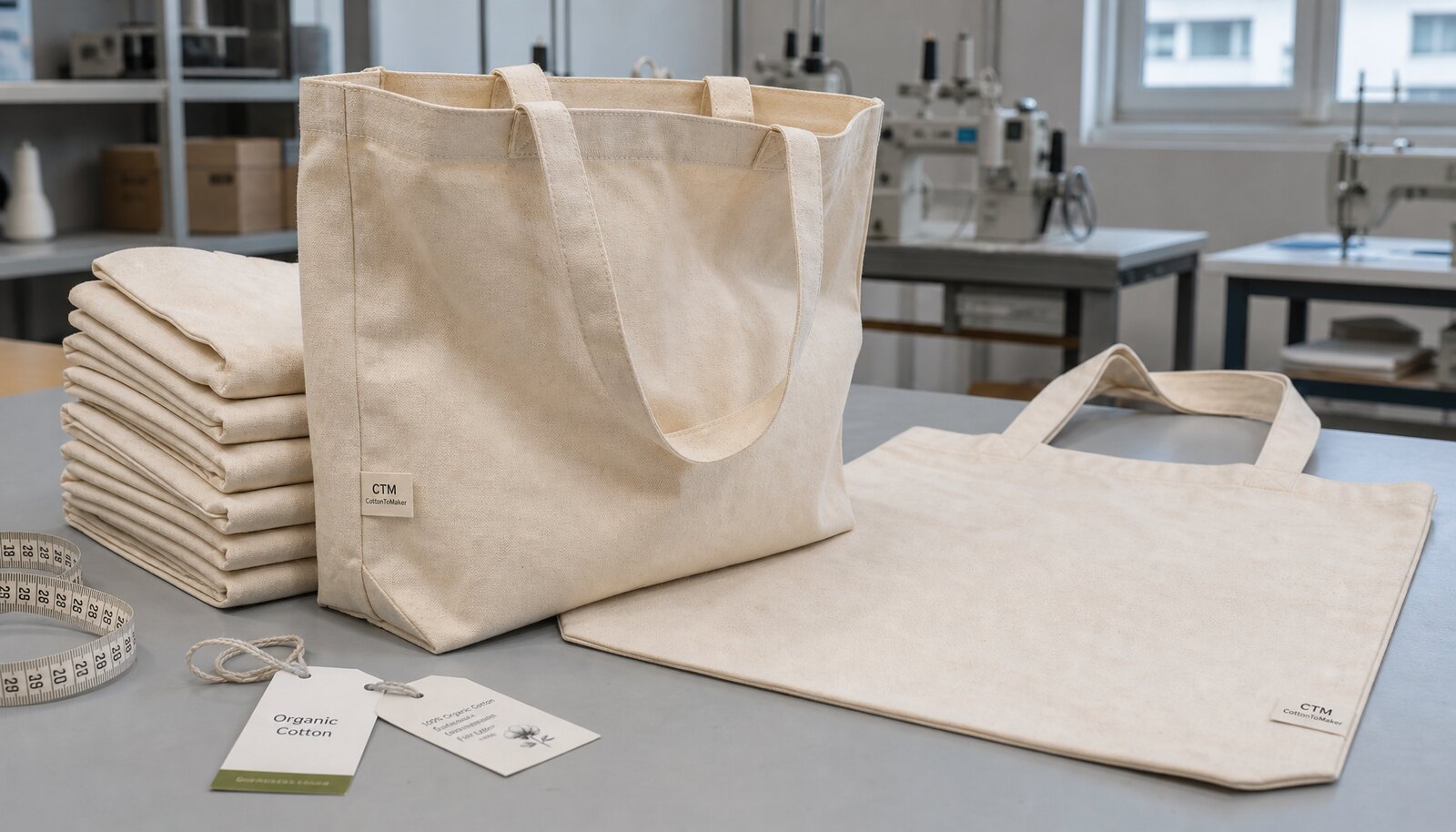
What retail buyers really need from an organic cotton gift bag
The buying problem is not simply finding an organic cotton bag. The real challenge is choosing a bag that fits the retail use case, prints cleanly, ships economically, and can be quoted without hidden assumptions. For retail gifting, the bag often sits between product packaging and merchandise, so the spec has to protect both presentation and unit economics.
Organic cotton gift bags for retail are usually bought for one of three jobs: store packaging, resale as a branded gift accessory, or seasonal promotional packaging. Each use case changes the acceptable GSM, construction, and finishing. A lightweight bag may be fine for jewelry or small cosmetics, but it can look underbuilt in premium retail. A heavier bag may improve perceived value but raise sewing time and freight cost.
- Use case drives spec: packaging-only bags can be lighter than resale-ready bags.
- Retail buyers should define visual quality, load needs, and branding limits in the RFQ.
- The wrong spec usually shows up later as wrinkling, poor print registration, or weak handles.
Start with the bag structure, not the artwork
For most retail programs, the simplest structure wins: flat cotton gift bag, folded top, clean side seams, and a secure closure only when needed. If the contents are light and the bag is mostly visual branding, a flat format keeps sewing efficient and avoids unnecessary cost. If the bag has to hold boxed products or multiple items, side gussets or a bottom gusset may be worth the extra fabric and labor.
The opening style matters more than many first-time buyers expect. Open-top bags are fast to pack and easy to re-use at point of sale, which makes them suitable for many retail counters. Drawstring closures help with product retention and a premium feel, but they add cord material, threading labor, and more QC points. That extra cost is justified only when the contents need to stay enclosed or the bag itself is meant to be part of the gift presentation.
- Flat bag: lower cost, fewer sewing steps, suitable for light gifting and POS packaging.
- Gusseted bag: better for boxy products, but quote the exact gusset depth and finished volume.
- Drawstring closure: useful for premium presentation, but specify cord length, stopper style, and tie method.
Fabric weight and finish: where the quote is won or lost
For organic cotton gift bags, 120–150 GSM is the most useful range for general retail. Below that, the bag can feel thin and lose shape after folding. Above that, the unit looks sturdier but the material cost climbs quickly, and the bag may become too stiff for small gift items. If the bag is meant for a luxury shelf program, 170 GSM may be justified, but the buyer should verify whether the extra weight is visible in the finished presentation or just adding cost.
Natural unbleached cotton is usually the most economical and easiest to position as an organic look. Bleached white cotton gives a cleaner print base for colorful logos but may increase cost and can affect the raw, eco-oriented look some brands want. Dyed fabric creates consistency for a specific brand palette, but it adds another variable: dye lot control. For repeat retail orders, a narrow GSM band and a controlled fabric finish matter more than chasing the lowest quoted price.
- 120 GSM: light, economical, suitable for inserts and small gifts.
- 140 GSM: common sweet spot for retail presentation and repeated handling.
- 150–170 GSM: better for premium feel or heavier contents, but compare freight and sewing cost before approving.
Print method selection should follow artwork, not habit
Many quote problems start with the wrong print method. Screen printing is usually the best commercial choice for organic cotton gift bags for retail when the artwork is limited to one or two colors and the reorder pattern is stable. It keeps unit cost predictable, gives strong coverage on natural cotton, and handles medium-to-large runs efficiently. The buyer should still define ink coverage and placement, because a large solid area on light cotton may need more careful curing than a small logo.
Heat transfer and digital printing are useful when the artwork has multiple colors, gradients, or short-run seasonal changes. They can solve design complexity, but they often create higher unit cost, different hand feel, or lower wash durability depending on the method and substrate. If the bag is being sold as part of retail merchandise, the print finish must survive handling, folding, and shelf display. A sample that looks fine in a photo but cracks after one fold is a production failure, not a cosmetic issue.
- 1–2 spot colors: screen print is usually the most cost-efficient option.
- Complex artwork or short run: digital or transfer methods may reduce setup burden.
- Define acceptable print shift, coverage uniformity, and cure quality in the sample approval.
MOQ logic: total quantity is not the same as production efficiency
Retail buyers often get a low headline MOQ that hides the real cost structure. A supplier may quote 5,000 bags total, but if the order is split across three sizes, two print versions, and two packaging formats, the factory still has to manage multiple cutting layouts, print setups, and carton configurations. The price then rises through setup waste rather than fabric cost. For that reason, MOQ should be reviewed by size, color, artwork version, and packing method.
The best way to manage MOQ is to identify which variables can remain fixed across the first order. If one natural cotton body is used with one print version and one packing format, the quote should tighten quickly. If your retail program needs multiple store groups or seasonal variants, ask the factory whether the fabric can stay constant while only the print plate changes. That often lowers the true cost of entry and makes replenishment smoother.
- Fix as many variables as possible on the first order: one size, one fabric color, one print version.
- Separate MOQ by setup item: fabric color, print color count, label type, and carton pack.
- A low total MOQ can still be expensive if each variation triggers separate setup charges.
Use supplier route comparison to avoid quote confusion
For this product, the sourcing route matters. A direct factory quote gives the best visibility into fabric weight, sewing method, and print control, which is important when the bag carries a retail brand identity. Trading companies can be useful for mixed-category sourcing or very small programs, but the buyer should understand whether the quote is from the actual workshop or an intermediary. If the line item looks unusually low, the missing cost may be hidden in packing, documentation, or a subcontracted print process.
Procurement teams should compare quote structure, not only unit price. Two suppliers can quote the same bag at the same size, but one includes a woven side label, individual polybag, carton marks, and export documentation while the other excludes all of them. Once the missing items are added back, the cheaper quote may no longer be cheaper. For retail buying, landed cost and presentation accuracy matter more than the first line on the email.
- Compare whether the quote includes labels, tags, polybags, cartons, and export marks.
- Check whether the factory controls cutting, sewing, printing, and packing in-house or across subcontractors.
- Ask for pricing by quantity break so you can see where the unit cost actually drops.
Comparison table: sourcing routes for organic cotton gift bags
The right supplier route depends on your order pattern, artwork stability, and whether your retail team needs strict control over the organic cotton claim and final packing. A direct factory is usually better for repeat programs, while a trader may work for small mixed orders where speed matters more than detailed process control.
Use the table below to match the sourcing route to your buying reality. The main risk is not choosing the wrong supplier type in theory; it is sending the wrong RFQ to the wrong route and then comparing quotes that were built on different assumptions.
- Write decisions in measurable language, not only descriptive wording.
- Ask for sample photos plus one physical approval sample for important orders.
- Keep quotation, sample approval, and inspection notes tied to the same spec version.
Sample approval should test fit, print, and retail handling
A pre-production sample should do more than match the artwork. It needs to prove that the bag size fits the intended product, the seams hold under handling, and the print still looks clean after folding. For retail use, the bag is often touched, stacked, and re-packed multiple times before it reaches the customer. A sample that looks attractive but dents easily or curls at the top will cause store-level complaints later.
The approval sample should be reviewed under the same conditions as the planned bulk order. Put the intended product inside, close the bag if applicable, and move it through handling similar to your receiving team or retail staff. Check the bag on a flat surface and in a carton, not only in a hand-held photo. If the artwork must align with a label or hangtag, confirm that relationship on the actual sample, not on a digital proof.
- Measure finished dimensions and compare them to the RFQ tolerance.
- Inspect print registration, color density, and curing quality on the physical sample.
- Test seam security, handle attachment, and product fit with the real retail item.
Packing and carton specs affect freight more than many buyers expect
Packing is a direct landed-cost issue. Organic cotton gift bags for retail are soft goods, so the packing method can swing carton size, volume weight, and the chance of creasing. Bulk packing in a clean inner polybag with export cartons is usually the most efficient route for wholesale and distribution. If the retail channel requires individual presentation, then header cards, hangtags, or individual bags can be added, but the labor cost should be visible in the quote.
Ask for carton dimensions, net weight, gross weight, and pack quantity per carton before you compare suppliers. A quote that looks slightly higher per unit may be cheaper on freight if the carton is denser and better organized. On the other hand, over-compressed cartons can flatten printed areas or crease gussets. The ideal pack is stable enough for transport but not so tight that the bags are permanently distorted when unpacked.
- Bulk pack is best for wholesale; retail-ready pack should be costed separately.
- Request carton dimensions and weight, not just carton count.
- Avoid overstuffing cartons if the bag shape or print needs to stay clean.
Lead time, schedule risk, and the mistakes that delay launch
A realistic schedule for this category usually includes sample development, sample approval, bulk production, packing, and export coordination. For a first order, buyers should allow roughly 3–4 weeks for sample iteration and 30–45 days for bulk after approval, with extra buffer if the order includes dyed fabric, multiple print colors, or special retail packing. If the supplier promises an aggressive turnaround without asking about artwork, pack format, or organic documentation, the quote is not yet fully scoped.
Launch delays often come from avoidable gaps: unapproved artwork files, size changes after sample approval, missing label copy, or unclear carton markings. Another common problem is trying to combine a new bag size with a new print method on a short timeline. The factory ends up adjusting too many variables at once, and the result is a slower approval cycle. The safest path is to freeze the core spec early and let only one variable move at a time.
- Build time for sampling, approval, bulk, and packing into the project calendar.
- Treat artwork and packaging text as production items, not post-order details.
- Expect longer lead times if the order needs custom dyeing or multi-version retail packing.
Specification comparison for buyers
| Spec decision | Recommended option | When it fits | Buyer risk to check |
|---|---|---|---|
| Fabric weight / GSM | 120–150 GSM organic cotton for standard retail gifting | Good balance of hand feel, print clarity, and cost for boutiques, museums, and lifestyle retail | Too light can show contents and wrinkle; too heavy raises cost and slows sewing |
| Bag construction | Simple flat bag with folded top and side gusset only if product volume needs it | Best for jewelry boxes, candles, cosmetics, books, and seasonal gift assortments | Gussets increase fabric use and sewing time; flat bags may underperform for bulky items |
| Print method | 1–2 color screen print for large repeats; heat transfer or DTG only for short runs | Screen print suits stable brand artwork and repeat replenishment | Fine gradients, small text, and light-on-dark prints can fail if the method is wrong |
| Closure style | Open-top for general retail; drawstring only if product retention is critical | Open-top works for point-of-sale gifting and packaging inserts | Drawcord adds component cost and can snag in packing; not needed for every use case |
| Supplier route | Direct factory quote for stable volume; trading route only for very small mixed SKU orders | Best when you need control over fabric, print, and packing detail | Trading quotes may hide fabric origin, GSM tolerance, and secondary subcontracting |
| MOQ approach | Set MOQ by fabric color and print version, not just total bags | Useful when one artwork runs across multiple store programs or seasonal campaigns | A low total MOQ can still create high cost if each color/artwork needs separate setup |
| Packing format | Bulk packed by inner polybag + export carton with carton marks | Fits wholesale distribution and lower unit cost | Retail-ready header cards or individual tags increase labor and carton volume |
| Compliance evidence | Organic content claim supported by transaction documents and supplier traceability records | Needed for brand claims, sustainability programs, and retailer onboarding | Do not rely on a logo on the bag alone; request document trail before PO |
| Lead time strategy | Reserve 3–4 weeks for sampling and 30–45 days for bulk after approval | Works for planned seasonal programs with confirmed artwork | Peak season, dyed fabric, and multi-color print can extend lead times materially |
Buyer checklist before sampling
- Confirm the end use: gift packaging, retail sell-through, premium shopping bag, or in-store promotion, because that changes GSM, handle strength, and finishing.
- Lock the finished size, not just the fabric cut size, and include tolerance limits for width, height, and gusset if applicable.
- Specify fabric weight range, organic cotton claim requirements, and whether natural unbleached, bleached white, or dyed fabric is acceptable.
- Provide artwork in vector format and define print area, Pantone references, and acceptable print registration tolerance.
- State packing method, carton count, and whether retail hangtags, barcodes, or individual polybags are needed.
- Request sample photos and a pre-production sample before bulk, especially for first-time suppliers or new artwork.
Factory quote questions to send
- What finished size, GSM, fabric width, and seam allowance are you quoting, and what tolerances apply?
- Is the cotton yarn, fabric, and organic claim traceable through transaction documents for the order lot?
- Which print method do you recommend for my artwork, and what is the setup charge per color, per size, or per side?
- What is the MOQ by color, by print version, and by carton configuration, not just the total quantity?
- What is included in the unit price: bag, print, label, packing, carton, and any testing or documentation fees?
- What is the sample timeline, bulk production lead time after approval, and the normal buffer for peak season?
- Can you show carton size, gross weight, packing quantity per carton, and estimate the impact on freight cost?
- What quality standard do you use for stitching, print alignment, size tolerance, and AQL inspection?
Quality-control points to confirm
- Fabric weight must stay within the agreed GSM range and feel consistent across the lot; avoid mixed hand feel between cartons.
- Stitching should be straight, secure at stress points, and free from skipped stitches, loose threads, and seam puckering.
- Print placement should stay within the agreed tolerance and remain legible after normal handling; no excessive bleeding or cracking.
- Bag dimensions should match the approved sample within a practical retail tolerance, especially for shelf display and insert fit.
- Handles must be secured with reinforcement appropriate to the load; pull strength should match the intended product weight.
- Carton packing must preserve shape and reduce creasing; count accuracy should be checked against carton marks and packing list.
- Organic claim documents should match the ordered lot and product description; avoid mismatches between invoice, packing list, and label copy.