Start with the event use case, not the bag shape
Organic cotton gift bags for events are often bought as if they were generic packaging, but procurement teams get better outcomes when the order begins with the use case. The bag for a conference welcome kit is not the same as the bag for a luxury product launch, a hotel amenity set, a tradeshow handout, or a retail redemption offer. Each use case changes the expected loading weight, appearance standard, packing speed, and how much tolerance there is for fabric softness or natural shade variation.
That is why a simple design file is not enough for a serious RFQ. A production-ready spec should describe what the bag must carry, where it will be opened, how it will be distributed, and whether the bag is part of the brand experience or simply a transport item. If the event team expects the bag to sit on a registration desk, be handed out pre-packed, or be reused after the event, those requirements need to be in the purchasing brief. Otherwise suppliers will optimize for the wrong thing: a low unit price rather than the right functional result.
For B2B buyers, the key is to convert a brand concept into measurable product terms. That means the quote request should include filled weight, approximate item dimensions, whether the bag must stand upright, whether it needs to close securely, and whether the event team wants a soft natural look or a cleaner premium finish. Those details reduce quote variance and make sample approval less subjective.
- Define the actual event contents and the heaviest realistic load.
- State whether the bag is for one-time giveaway, reuse, or retail-facing presentation.
- Specify what matters most: visual polish, speed of packing, or carrying strength.
Fabric, weave, and finishing: the details that change price and presentation
For most event programs, the practical organic cotton range sits around 140–180 gsm, but that range should be treated as a starting point, not a rule. Lighter fabrics can reduce cost and freight, yet they often feel less structured, crease more easily, and can show print through on the reverse side. Heavier fabrics usually feel more premium and tolerate repeated use better, but they also increase material cost, sewing effort, and carton cube. If the bag must be shipped in volume, that extra bulk matters to the landed cost as much as the item price does.
Weave also changes the final result. A tighter plain weave tends to print more cleanly and looks more controlled for corporate branding. A more open weave can feel natural and casual, which some sustainability-led brands prefer, but it may soften the edges of small copy or make fine lines less crisp. Buyers should ask for the weave description and not rely on the supplier’s broad “organic cotton” wording. The same badge of organic sourcing can still cover a wide range of fabric behaviors.
Finishing matters too. Natural, unbleached cotton gives a warmer organic look, while bleached or dyed fabric shifts the visual tone and can affect ink contrast. If the event design uses light-colored ink on a natural body, the buyer should ask for an actual print strike-off because paper proofs can mislead. The same artwork can read very differently once it lands on cotton with real texture and absorbency.
- Ask for finished GSM, not a broad category like lightweight or medium weight.
- Confirm weave type and whether the supplier has pre-shrunk or calendered the fabric.
- Request a strike-off on the actual fabric color you plan to buy.
Choose the construction that matches the contents and the handling flow
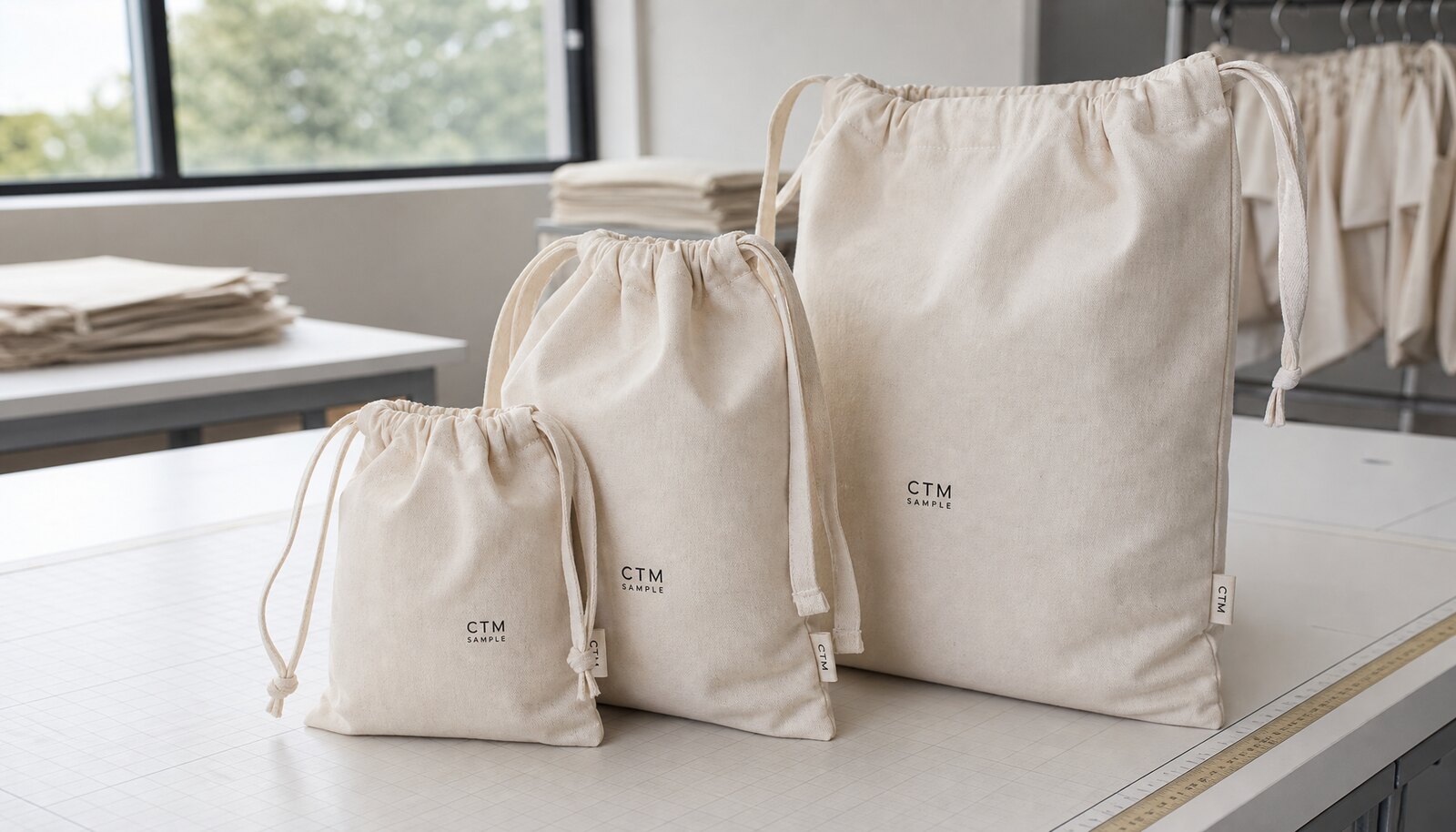
The right bag style depends on what the event team is putting inside it and how the bag will be handled. Drawstring pouches work well for compact kits, amenity items, jewelry, samples, or small promotional sets where presentation and quick closure matter more than volume. Flat totes are useful for brochures, apparel, or simple event kits where the contents are relatively thin and the goal is to keep freight and sewing cost down. Gusseted bags sit between those two options by adding volume and helping the bag hold shape when filled.
Construction affects both appearance and production risk. A drawstring pouch needs a clean channel, consistent cord insertion, and reliable end finishing so the cords do not slip unevenly. Totes need accurate seam alignment and controlled top hems so the bag does not twist after filling. Gussets require more cutting precision and a more careful sewing line, especially when the event buyer wants the bag to look straight on a display table or at a check-in counter.
For procurement purposes, the most important question is not “which style looks nicest?” but “which style supports the contents, the fill process, and the event timeline with the least rework?” If the bag is packed by an external fulfillment partner, the construction should be easy to load and close. If the contents are irregular shapes, the bag should be slightly more generous than the minimum estimate to avoid bulging seams and uneven print distortion.
- Choose drawstrings for small, high-perceived-value kits.
- Choose flat totes for simple, slim event packs and better freight density.
- Choose gusseted styles when shape retention and extra volume matter.
Print method selection should be driven by artwork and reuse expectations
Print is where a lot of event buyers over-specify visually and under-specify technically. Screen print is usually the most reliable method when the logo is simple, the colors are limited, and the order volume is meaningful. It tends to give strong color density on cotton and usually handles repeated handling better than more decorative options. If the program needs a crisp brand mark that will be seen quickly on a registration table or reused after the event, that is often the best balance of cost and durability.
Transfer and digital methods can be useful when artwork is detailed, contains gradients, or has many color elements. But buyers should be careful about assuming those methods are automatically superior. On soft natural cotton, some transfers can feel more like a film than part of the bag, and the surface may crack or lift after folding and abrasion if the process is not well controlled. That is not a problem if the bag is one-time only, but it becomes a procurement issue if the bag is meant to be reused.
A better RFQ asks the supplier to quote the preferred method plus one alternative so the buyer can compare cost against performance. The approval should happen on the final cotton body, at the final size, with the final print placement. Proofing on paper or on a different fabric is not enough when the actual substrate is absorbent, textured, and naturally variable.
- Use screen print for simple logos, repeated events, and better rub resistance.
- Use transfer or digital methods only when the artwork requires them.
- Require a strike-off and, if needed, a wash or rub test on the actual print.
Organic claim verification: what to ask for before you accept the quote
This is the area where sourcing advice needs to be concrete. A supplier saying the product is “organic cotton” is not enough for a procurement file if your organization needs a defensible claim. The buyer should ask how the supplier defines the claim at fabric level and whether the chain of custody is tied to the actual fabric lot being quoted. If the supplier cannot trace the material back to a relevant certificate scope or equivalent documentation, the claim is weak, even if the bag itself is made from cotton that looks natural.
The specific documents requested will vary by certification scheme and geography, but buyers should think in terms of three layers: supplier identity, fabric source, and transaction or lot linkage. Ask which entity is certified, what scope the certificate covers, and whether the fabric in your bag is included in that scope. Ask for the document that links the shipment to the material lot. If the supplier is a trading company, ask how they verify the upstream mill and whether the mill name can be disclosed on documents. If they hesitate, that is a red flag.
A few practical verification checks help separate real sourcing control from marketing language. Does the supplier know the exact fabric mill or only the trading source? Can they show a current document rather than an expired certificate screenshot? Does the sample you are approving match the claimed fabric category? Is the claim used only on the bag description, or is it also reflected correctly on carton marks and paperwork? These checks do not replace legal review, but they are useful procurement safeguards when buying at scale.
- Request certificate scope and lot linkage, not just a logo or slogan.
- If the supplier is a trader, ask how they verify the upstream mill and fabric batch.
- Do not accept “organic” language without a document trail tied to the order.
How to compare supplier routes without falling for a low headline price
Direct factory sourcing and trading-house sourcing each have a place, but they behave differently in procurement. A direct factory is usually better when the bag spec is stable, the order is repeatable, and the buyer wants tighter control over sample-to-bulk consistency. A factory can often quote more transparently on cutting, stitching, printing, and packing because those steps happen on-site or through a known production chain. That does not guarantee a better outcome, but it does make technical follow-up easier.
Trading suppliers can be useful when the order combines several product categories, when the buyer needs a mixed shipment, or when the internal team wants one commercial contact for a complicated program. The tradeoff is that the buyer may get less visibility into the actual production line, fabric procurement, and inspection standard. A trading quote can look flexible on MOQ and timing, but those benefits can be offset by less control over lot consistency or by extra handoffs if a problem appears mid-production.
To compare them properly, ask the same technical questions of both routes and compare only like for like. If one supplier is offering a lower price, check whether it includes the same fabric GSM, the same print count, the same carton structure, and the same organic documentation. A lower quote that quietly changes any of those elements is not a true savings; it is a different product.
- Prefer direct factories for repeat, spec-stable programs.
- Use traders when you need multi-category consolidation or faster commercial coordination.
- Compare route, spec, and documents together; never compare price alone.
Quote structure: what a useful procurement comparison should include
The strongest RFQ response is one that lets you calculate landed cost and operational risk rather than just unit price. For that reason, the quote should itemize fabric, cutting, stitching, printing, inner packing, carton packing, and any labels or tags. If the supplier only returns a single unit price, ask for a breakdown or at least a statement of what is included. Event orders are especially sensitive to packing labor because the bags are often counted into exact sets for booth kits, attendee packs, or regional allocations.
It also helps to ask for tiered pricing at realistic quantity bands. That lets buyers see whether the quote reflects actual production efficiency or whether the number is simply a filler price. The useful comparison is not just 1,000 versus 5,000 pieces, but what changes between those bands: print setup, carton optimization, extra labor, or material utilization. If the supplier cannot explain the price step-down, the buyer has less reason to trust the quote as a planning tool.
A procurement buyer should also ask what is not included. Does the unit price include a pre-production sample, or is that charged separately? Are artwork changes billed? Are export cartons standard or custom printed? Are freight and customs documents part of the service? This is where vague sourcing language turns into budget overrun, especially when several internal stakeholders assume someone else has already checked the details.
- Ask for a line-item quote or an itemized list of inclusions and exclusions.
- Use tiered quantity pricing to see real production breakpoints.
- Translate quote differences into landed cost, not just factory gate price.
Sampling and approval: how to keep the prototype stage honest
Sample approval should prove the order is manufacturable as specified, not just that the bag looks attractive in a photo. The most reliable sequence is a fabric swatch, a blank pre-production sample, and then a print strike-off on the final fabric. If the supplier skips one of those steps, the buyer should understand the risk being accepted. A finished sample without the right fabric lot can still hide shrinkage, print spread, or seam behavior that only appears in bulk.
A good sample review is partly visual and partly functional. Check the measured size, gusset depth, cord length, seam symmetry, label placement, and how the bag closes when full. Use the actual event contents or realistic substitutes during sample evaluation so the bag is tested under the way it will really be used. A gift bag that looks clean when empty can distort badly once a bottle or boxed item is inserted.
Do not forget the communication side of sample approval. Mark the approved sample, save dated photos, and note any acceptable variation ranges. That record becomes the reference when the bulk lot arrives or when a reorder is placed months later. If the buyer simply says “looks okay,” there is no clear basis for rejecting a bulk deviation later, even if the difference is commercially meaningful.
- Approve the sample against a measured spec sheet.
- Test the sample with realistic contents and a real closure cycle.
- Record the approved sample, photos, and tolerance notes before bulk release.
Packing, cartonization, and warehouse handling are part of the product spec
For event buyers, the shipping carton is not just transport packaging; it is the interface between the factory and the warehouse. If the bags are packed too tightly, they can arrive compressed and difficult to count. If they are packed too loosely, the sets can shift, pick up dust, or arrive with folds that make the first impression look cheap. The best carton structure depends on whether the bags are going to a fulfillment center, a regional event site, or direct retail distribution.
Inner bundle count should be decided early because it affects both labor and warehouse speed. Some buyers want bags banded in small bundles for quick counting. Others want loose folding to protect the fabric surface. Neither is universally correct. The right answer is the one that matches how the receiver will unpack and stage the goods. If a supplier suggests a standard packing format, ask whether it can be changed without affecting cost or lead time. Often it can, but only if it is identified before production begins.
Carton marks should be specific enough to support receiving. Event name alone is not enough if the order has multiple sizes, colors, or print variants. The receiving team needs to know which cartons belong to which PO line, and they need the count to reconcile quickly. For some buyers, this is also where label placement matters: a woven tag, barcode sticker, or hangtag may need to be fixed at the same stage every time so the warehouse receives a consistent product.
- Set inner bundle count, carton count, and carton dimensions before sampling is approved.
- Choose packing based on how the warehouse will receive and distribute the order.
- Use carton marks that map to PO lines, not just the event title.
Lead time planning: build around milestones, not a single promised date
Lead time claims are often too loose because they blur three different timelines: sample lead time, production lead time, and transit or customs time. For standard organic cotton event bags, a 25–40 day production window after sample approval is a reasonable planning range, but only if materials are available and the artwork is already locked. If fabric, cords, labels, or printing screens still need sourcing, the calendar can stretch quickly. Buyers should therefore ask for a milestone schedule rather than a single date.
The milestones that matter are artwork lock, sample approval, bulk material readiness, cutting, printing, sewing, packing, inspection, and dispatch. If the supplier cannot name these steps, the schedule is weak. This is especially important for event programs because the goods often have a hard deadline with no flexibility. A delay of a few days can be more costly than a small price difference if the bags are tied to a conference, launch date, or seasonal campaign.
To reduce risk, build a buffer into the buyer’s internal schedule and avoid last-minute changes to size or artwork. A new bag dimension can affect material usage and seam allowance; a new print color can require a different ink or setup. Suppliers should flag these impacts, but procurement should not rely on that alone. The safest plan is to lock the spec early enough that the factory can produce, inspect, and ship without compressing quality checks.
- Ask for a dated production calendar with key milestones.
- Add transit, customs, and inland delivery time to the factory estimate.
- Treat late artwork or content changes as schedule risks, not minor updates.
Specification comparison for buyers
| Spec decision | Operationally useful default | Quote logic / pricing driver | Testing or verification to request | Supplier-delivery distinction to watch |
|---|---|---|---|---|
| Fabric weight | 140–180 gsm organic cotton for most event gifting programs | Higher GSM usually increases fabric cost, cutting waste, sewing time, carton volume, and freight; lighter fabric lowers price but can reduce perceived quality | Ask for finished GSM, fabric width, weave type, and a physical swatch tied to the quoted lot | Direct factories often control fabric use more tightly; trading suppliers may source equivalent fabric from different mills unless the lot is locked |
| Bag style | Drawstring pouch for small kits; flat tote or gusseted tote for mixed event packs | Drawstring models add labor for cord insertion and channel stitching; gussets add material and sewing steps but improve usable volume | Request a loaded-bag fit check with representative contents, not an empty sample review | Factories usually quote each construction separately; trading routes may blur construction differences if multiple factories are involved |
| Print method | 1-color or 2-color screen print for repeat event branding | More colors, finer artwork, or specialty effects raise setup cost and may increase reject risk on natural cotton | Ask for a strike-off on final fabric with actual ink density, placement, and rub check | Factories can better control print setup; traders may outsource printing, which adds handoffs and approval delay |
| Closure detail | Cotton drawstring, sewn channel, or simple top hem depending on contents | Reinforced channels and better cord finishes add labor but reduce tear risk | Request a pull test on the closure and inspection of cord length consistency | A factory can verify stitch method at source; a trader may not know the exact sewing line standard without a sample audit |
| MOQ structure | Tiered pricing at 1,000 / 3,000 / 5,000 pcs or the supplier’s real production breakpoint | Price usually drops at better cutting efficiency or full carton optimization, but only if the spec stays unchanged | Request the same quote basis across tiers: size, color, print count, packing, and carton quantity | Factories often have clearer quantity breakpoints; traders may quote flexible MOQ but add change fees later |
| Sustainability claim | Organic cotton claim backed by traceability documents for the fabric lot used | Documented organic fabric can cost more than conventional cotton; price varies by certification chain and whether claims are made at fabric or product level | Request certification scope, transaction certificate, fabric lot reference, and chain-of-custody documents where applicable | Factories can sometimes provide clearer lot linkage; traders may need to request documents from upstream mills |
| Packing method | Bulk packed in export cartons with inner bundle counts defined before production | Higher carton counts can lower freight cost but risk compression; extra inner wrapping adds labor and material cost | Ask for carton dimensions, net/gross weight, inner bundle count, and packing photos from a recent order | Factories usually know carton loading patterns; traders may rely on a standard packing format that does not match your warehouse process |
| Lead time | Plan 25–40 days after sample approval for standard production, then add transit and customs time | Lead time can extend if fabric, cord, or labels need sourcing after order placement | Require a production calendar with milestones: artwork lock, sample sign-off, bulk cutting, print, packing, and pre-shipment inspection | Factories can usually give line-based timing; traders may give a delivery promise without visibility into the actual production queue |
| Inspection standard | AQL-based inspection for visible defects, count accuracy, and critical functional failures | Better inspection control can add cost if you require third-party checks or rework cycles, but it reduces event risk | Ask the supplier what AQL level they use for major/minor/critical defects and how failures are handled | Factories often follow one QC system consistently; traders may apply different standards depending on the source factory |
Buyer checklist before sampling
- Define the packed contents, target use case, and maximum filled weight before asking for quotes.
- Confirm finished bag size, gusset depth, handle or cord length, and any required closure type.
- Specify fabric construction, finished GSM, color tolerance, and whether the bag must be bleached, natural, or dyed.
- Send vector artwork and lock logo placement, print colors, and print coverage area.
- Request a physical swatch, a print strike-off, and a pre-production sample before bulk release.
- Ask for documentary proof of organic cotton claims tied to the actual fabric lot being quoted.
- Agree packing format, carton markings, label needs, and warehouse destination before production starts.
- Set defect definitions, AQL level, and corrective-action steps in writing before inspection.
- Clarify shipment terms, delivery window, and who owns transit risk once goods leave the supplier.
- Keep one spec owner across marketing, procurement, logistics, and sustainability review so changes do not conflict.
Factory quote questions to send
- What is the exact finished fabric specification for this quote, including GSM, weave, width, and expected shrinkage after washing or pressing?
- Can you state whether this is direct factory production or a trading arrangement, and which steps are done in-house versus subcontracted?
- What organic cotton evidence can you provide for the quoted fabric lot, such as certificate scope, transaction certificate, or other traceability documents tied to the material?
- How does unit price change at 1,000, 3,000, and 5,000 pieces if we keep the same size, same color, and same print method?
- What is included in the quote: cutting, stitching, printing, inner packing, carton marks, barcode labels, and export cartons?
- Which sample stage will you send first, and can you issue a print strike-off on the same fabric lot that will be used in production?
- What is your standard tolerance for size, seam alignment, print placement, and shade variation on natural cotton?
- Which AQL level do you inspect to, and how are major, minor, and critical defects defined for this product?
- What is the earliest realistic dispatch date after artwork approval, sample sign-off, and deposit, and what events usually cause delay?
- If a defect is found in pre-shipment inspection, what is your corrective-action process: rework, replacement, or partial shipment hold?
Quality-control points to confirm
- Agree defect thresholds in advance. For event bags, define critical defects such as broken seams, missing cords, wrong print, incorrect size beyond tolerance, contamination, or missing labels; define major defects such as crooked seams, weak closure stitching, or print misregistration that affects presentation; define minor defects such as slight thread trimming variation or small cosmetic inconsistency within the approved range.
- Use an AQL plan rather than a casual visual check. Ask the supplier or third-party inspector what sampling standard they use, and align the acceptance level before the order enters mass production. If your buyer organization has its own standard, document that standard in the PO or quality appendix.
- Inspect the pre-production sample against a measured specification sheet: finished size, gusset depth, cord length, print position, label placement, and carton configuration. Do not approve from photos alone if the bag is being used for a timed event or a visible brand activation.
- Measure fabric and construction against the approved sample, not the catalog description. The catalog can be broad; the sample is the real benchmark for handle feel, seam behavior, and print opacity on the chosen cotton base.
- Check stitch integrity at the side seams, top hem, base corners, and drawstring channel. Pull a small number of filled bags to the expected event load and look for seam opening, cord slippage, and shape distortion.
- Run a print check for density, registration, edge sharpness, and rub resistance on the actual cotton surface. If the artwork contains small text, test readability at the distance guests will actually see it.
- Open cartons randomly for count accuracy, odors, dust, stains, oil spots, and wrong packing labels. If goods are going to multiple event sites, verify the carton marks match the routing plan and PO line structure.
- If inspection fails, require written corrective action before shipment release. Ask for root cause, affected quantity, rework method, sorting plan, and a second inspection date. If the supplier cannot show containment measures, do not release the lot on a promise alone.
- Keep photo records of approved samples, inspection findings, and final carton labels. That record matters when a later reorder uses a different fabric lot or when the supplier changes a subcontracted process without notice.