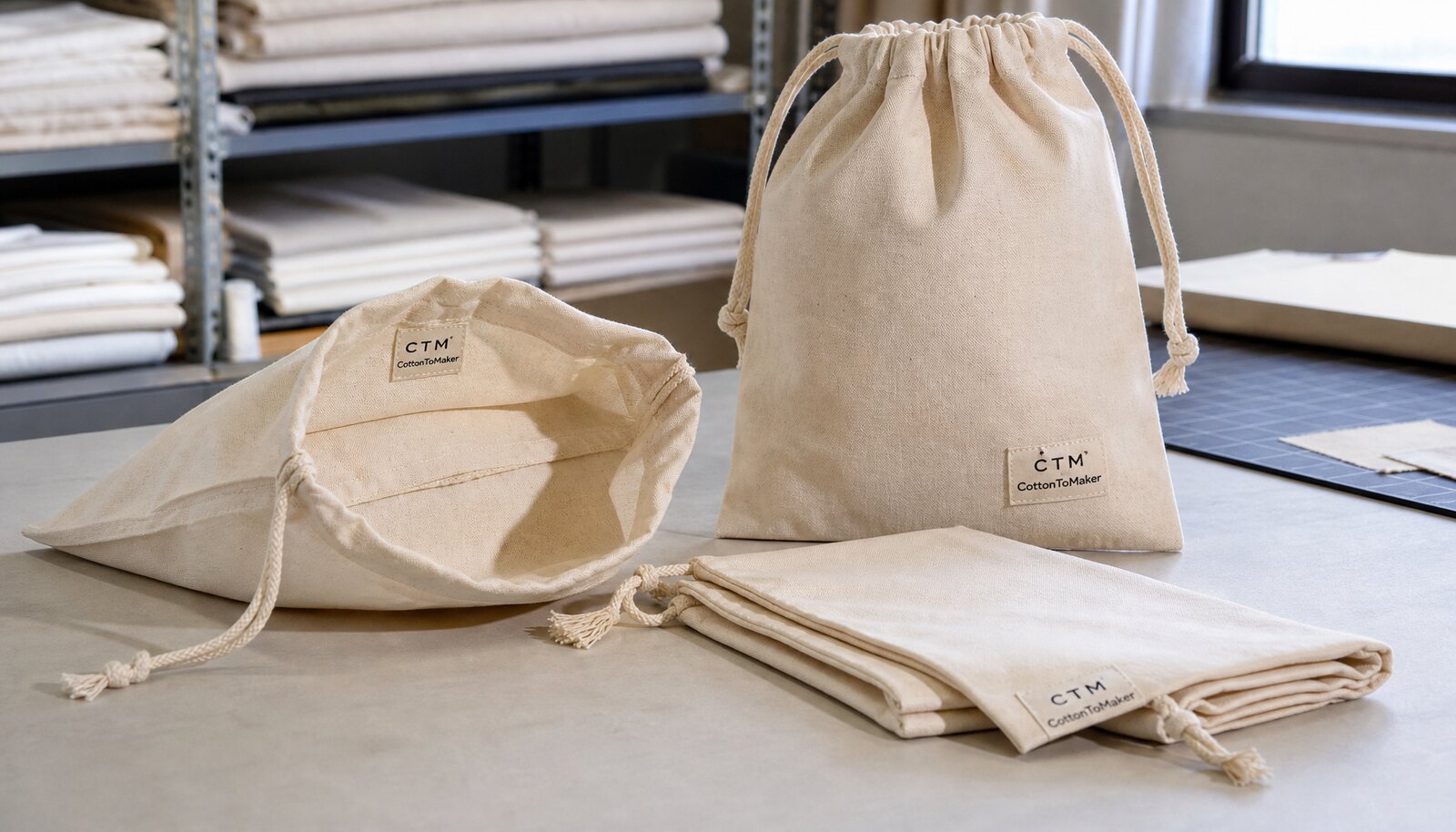
Start With the ecommerce use case
Organic cotton gift bags for ecommerce are not just a nice-looking accessory. They have to support a specific job: protect the product, improve the unboxing, move through a warehouse without friction, and keep the unit cost inside a margin that still works after freight, duty, and fulfillment. A bag that looks good on a sample table but slows packing, wrinkles badly, or arrives with weak print is a liability, not packaging.
The first decision is therefore the use case, not the decoration. A subscription box insert needs a different build than a premium gift-with-purchase pouch or a reusable bag sold as part of a bundle. If you do not define the role early, suppliers will quote to their own assumptions, and the comparison becomes useless because every factory is pricing a different product.
- Gift-with-purchase usually needs a low-friction bag with fast packing and a clean branded face.
- Subscription inserts often need a neat flat profile so the bag does not distort the outer carton.
- Retail-ready pouches may justify heavier fabric, a better label finish, and more careful packing.
Choose fabric weight and construction with the packed item in mind
For most ecommerce programs, 140-180 gsm organic cotton is the practical range. At the lower end, the bag stays light and economical, but it can look soft and collapse around hard-edged products. At the higher end, it feels more premium, holds structure better, and hides the contents more cleanly, but freight and unit cost go up. Buyers often lose money by picking a fabric that is too light for the brand position and then trying to fix the problem with print or packaging.
Construction matters as much as GSM. A flat pouch works for small accessories, skincare sets, cards, and lightweight inserts. A gusseted bag is a better fit for boxed kits or products with depth. Pay attention to seam allowance, corner stress, and opening width. If the product is difficult to insert at line speed, the warehouse will feel that pain on every order, even if the unit price looked attractive on paper.
- 120-140 gsm is usually a budget-leaning option for light inserts and soft goods.
- 160-180 gsm is a better default for reusable gift bags and more structured ecommerce kits.
- Gussets add real volume but also add sewing time and dimensional risk.
Pick a print method that survives warehouse handling
For organic cotton gift bags, the print method should be chosen for durability and production simplicity, not for theoretical design flexibility. Water-based screen print is often the most reliable option for one or two colors because it gives clean coverage, a good hand feel, and a familiar factory process. If the design is small, premium, and not heavily color-driven, a woven side label or sewn patch can be more durable than trying to reproduce fine details directly on fabric.
Avoid over-specifying artwork that the production line cannot hold consistently. Very small text, thin outlines, and gradient-heavy graphics often fail once they move from digital proof to fabric. If the bag will be handled by a warehouse, shipping team, and end customer, the print should be legible after folding, packing, and a few touches. Simple usually performs better than elaborate in this category.
- Screen print suits simple logos, short taglines, and repeatable ecommerce runs.
- Woven labels help when the brand wants a cleaner, more durable finish than direct ink.
- Embroidery can look strong on premium bags, but it adds cost and can distort thin fabric.
Compare supplier routes before you compare price
The lowest quote is not useful if it comes from a supplier route that cannot support the job. A direct factory usually gives better control over fabric, sewing, and packing, which matters when the order includes custom size and branded print. A trading company may be easier to work with for mixed programs or smaller buyers, but you need to know whether they are marking up the same factory or substituting a similar item. A local decorator can be useful for urgent print-only work, but that route often loses on fabric control and organic documentation.
For buyers who need a legitimate organic claim, supplier evidence matters more than sales language. Ask who buys the cotton, where the fabric is knitted or woven, who handles printing, and what documents travel with the shipment. A serious supplier should be able to show the production chain clearly enough that your QA and compliance teams can follow it. If the answer is vague, the quote may be cheap for the wrong reason.
- Direct factory: best for repeat programs and custom control.
- Trading company: useful when you need speed or assortment, but verify the real maker.
- Organic specialist: often safer for documentation, though not always the cheapest quote.
Read MOQ and sample pricing as a production strategy
MOQ is not just a sales number. It tells you how the factory is batching fabric, cutting dies, print setups, and labor planning. A fully custom organic cotton gift bag often lands in the 3,000-5,000 piece range per size and color because the factory needs enough volume to justify setup. If a supplier offers a much lower MOQ, the tradeoff is usually a stock fabric, a limited print method, or a higher price that covers inefficiency somewhere else.
Sampling should be treated as an approval gate, not a courtesy sample. Ask for a pre-production sample that matches the real fabric, real print method, and real closure. For ecommerce buyers, the sample needs to be tested with the actual packed product, not just looked at empty on a desk. If the item is hard to insert, the cord tangles, or the logo disappears when folded, that problem should be caught before bulk cutting starts.
- Use a size-approved sample for fit testing, then a pre-production sample for build confirmation.
- Expect sample charges to be credited only when the supplier explicitly agrees to that term.
- If the order splits across multiple sizes or print variants, each added version raises setup cost.
Design the packing plan for ecommerce handling, not showroom display
Packing is where many bag programs lose margin quietly. A bag can look excellent in a sample photo and still create warehouse friction if it arrives overfolded, too tightly compressed, or mixed without clear labeling. For most ecommerce programs, bulk packing by count is the cleanest route. It keeps unit handling efficient and gives the fulfillment team flexibility. Individual polybags only make sense when the bag itself must arrive retail-ready or when the program is sensitive to dust and presentation.
Carton configuration should be written into the quote. Ask for pieces per carton, carton dimensions, gross weight, and outer label content. That information affects freight costing, pallet loading, and warehouse receiving. If you are shipping internationally, a small change in carton size can change container efficiency enough to offset the apparent unit price advantage. The packing method is part of landed cost, not a side note.
- Bulk pack is usually cheaper and faster for ecommerce fulfillment teams.
- Individual polybagging adds labor and material cost, so reserve it for a clear need.
- A size sticker and carton count label are worth specifying because they reduce receiving errors.
Set QC thresholds that stop small defects from becoming big ones
QC for organic cotton gift bags should be practical and measurable. Buyers do not need a museum-standard bag, but they do need a repeatable one. The critical points are seam quality, print registration, size tolerance, drawstring operation, and cleanliness. A bag that is a few millimeters off is not automatically a problem, but a bag that drifts enough to change fit or make packing slow is a real issue. Define tolerance around function, not just appearance.
You should also separate material defects from finishing defects. Cotton can have natural variation, but oil marks, loose threads, broken stitches, and misaligned prints are not acceptable simply because the product is natural. If the order carries an organic claim, documentation and physical product quality both need to line up. One clean sample means very little if the bulk cartons arrive with inconsistent weight, smell, or labeling.
- Measure finished size against the approved spec, not against the artwork file.
- Pull random cartons for seam and print checks, not only the top layer.
- Reject mixed labels or incorrect carton counts early because they create warehouse rework.
Treat lead time and seasonality as commercial risks
A typical printed order may ship in 25-35 days after artwork and sample approval, but that number is only useful if the assumptions are realistic. Fabric booking, dye availability, print queue load, and holiday congestion can all stretch the schedule. The cleanest way to protect the program is to lock the artwork early, approve the sample quickly, and keep the spec stable. Each change after that is not just a correction; it becomes a new scheduling event.
Lead time should also be compared against the market window. If the bags support a product launch, subscription cycle, or seasonal gift program, missing the selling window is more expensive than paying a slightly higher unit price for a safer schedule. Ask suppliers what part of the timeline is fixed, what part is variable, and where they usually see delay. A candid factory answer is more useful than a promotional promise.
- Holiday and Q4 orders need earlier fabric reservation than buyers usually expect.
- Artwork changes after sample approval are one of the most common schedule slips.
- If the supplier quotes an unusually fast lead time, verify whether it includes printing and final packing.
Build the RFQ around landed cost, not just unit price
A useful RFQ for organic cotton gift bags forces suppliers to price the same thing. State the bag size, target GSM, closure style, print method, packing format, carton count, and required documents. If you only ask for a price per piece, quotes will vary by hidden assumptions and you will spend time reconstructing the real comparison. Buyers who want clean sourcing should request a line-item quote that separates fabric, sewing, print, label, packing, and any special testing or certification charges.
When comparing landed cost, include freight density, packing format, and defect risk. A slightly cheaper bag with a larger carton, a slower line, or a higher reject rate may be more expensive in the end. The goal is not to find the cheapest fabric. The goal is to find the supplier that can deliver the required bag with the lowest total cost of ownership and the fewest operational surprises.
- Ask for a breakdown by product cost, packing cost, sample cost, and freight assumptions.
- Request a clear statement of what is included and what is excluded.
- Compare quotes on the same artwork, same size, and same packing method only.
Specification comparison for buyers
| Spec decision | Recommended option | When it fits | Buyer risk to check |
|---|---|---|---|
| Sourcing route | Direct factory with in-house sewing and print control | Repeat programs, custom sizing, and buyers that need stable artwork and packing standards | Confirm the factory actually handles cutting, sewing, printing, and final packing rather than farming out half the order |
| Fabric weight | 140-180 gsm organic cotton for most ecommerce gift bags | Gift boxes, subscription kits, and reusable mail-in packaging where the bag should hold shape | Too light looks thin and wrinkles easily; too heavy raises cost and freight without adding value |
| Bag construction | Flat pouch for small items, gusseted bag for box sets or mixed kits | When the packed product needs real volume and a cleaner retail presentation | Size must be based on the filled item, not only the flat cut size |
| Print method | 1-2 color water-based screen print or woven side label | Clear branding, medium-volume runs, and simple artwork with strong edge definition | Fine lines, gradients, and small text can break down if the artwork is not simplified |
| Closure style | Cotton drawstring with a lock or folded top with tie | Gift sets, premium unboxing, and reusable storage after delivery | Check cord length, fray risk, and whether the closure adds labor cost or slows packing |
| MOQ logic | 3,000-5,000 pcs per size and color for fully custom runs; lower MOQ only for stock blank plus print | New SKUs, test launches, and buyers with uncertain demand | Low MOQ often means higher unit price, fewer size options, or limited fabric color control |
| Packing route | Bulk packed by count with size stickers; individual polybag only if retail-ready | Warehouse fulfillment, kitting, and ecommerce operations that re-pack goods anyway | Count accuracy, carton compression, dust control, and whether the pack method adds unnecessary labor |
| Lead time | 25-35 days after artwork and sample approval for standard printed orders | Seasonal promotions and normal replenishment cycles | Peak season fabric booking, print queue delays, and approval slippage can push shipment dates out |
Buyer checklist before sampling
- Define the end use first: gift-with-purchase, subscription box insert, retail pouch, or reusable shipping pouch.
- Set the bag size from the packed item dimensions, then add practical clearance for closing and insertion.
- Choose a fabric weight that matches the perceived value target, not just the lowest cost target.
- Limit artwork to what the chosen print method can hold cleanly at production scale.
- Decide whether the order needs organic claim support documents or only the fiber specification.
- Agree on packing format, carton count, and label placement before sampling starts.
- Request a pre-production sample or size-approved sample before bulk cutting.
- Lock the acceptable defect standard for seams, print registration, stains, and count accuracy.
Factory quote questions to send
- What is the exact fabric construction, yarn count, and GSM for the quoted bag?
- Is the cotton source organic-certified, and what document set can you provide for the claim?
- What is included in the quote: cutting, sewing, print, label, packing, and cartons?
- What is the MOQ by size, color, and print design, and what happens if we split the order?
- Can you show the measured size tolerance, seam allowance, and drawstring spec used for production?
- Which print method are you quoting, and what artwork limits apply to line weight and small text?
- What is the sample schedule, approval path, and bulk lead time after sign-off?
- How do you pack cartons for ecommerce use, and what is the carton count and gross weight per case?
Quality-control points to confirm
- Fabric weight should stay within an agreed tolerance of the target GSM and feel consistent across the roll.
- Seams must be straight, secure, and free of skipped stitches, loose threads, or weak corner stress points.
- Print registration should stay aligned, with no blur, patchiness, or peeling on the first handling test.
- Bag opening and drawstring action should work smoothly without snagging, twisting, or uneven closure length.
- Finished size must stay within the approved tolerance, especially for fitted gift boxes or kit inserts.
- No visible stains, oil marks, needle damage, or odour from finishing, storage, or packing.
- Carton counts must match the pack list, and mixed-size cartons must be clearly labeled.
- If the order carries an organic claim, the document trail must match the factory, fabric source, and invoice chain.