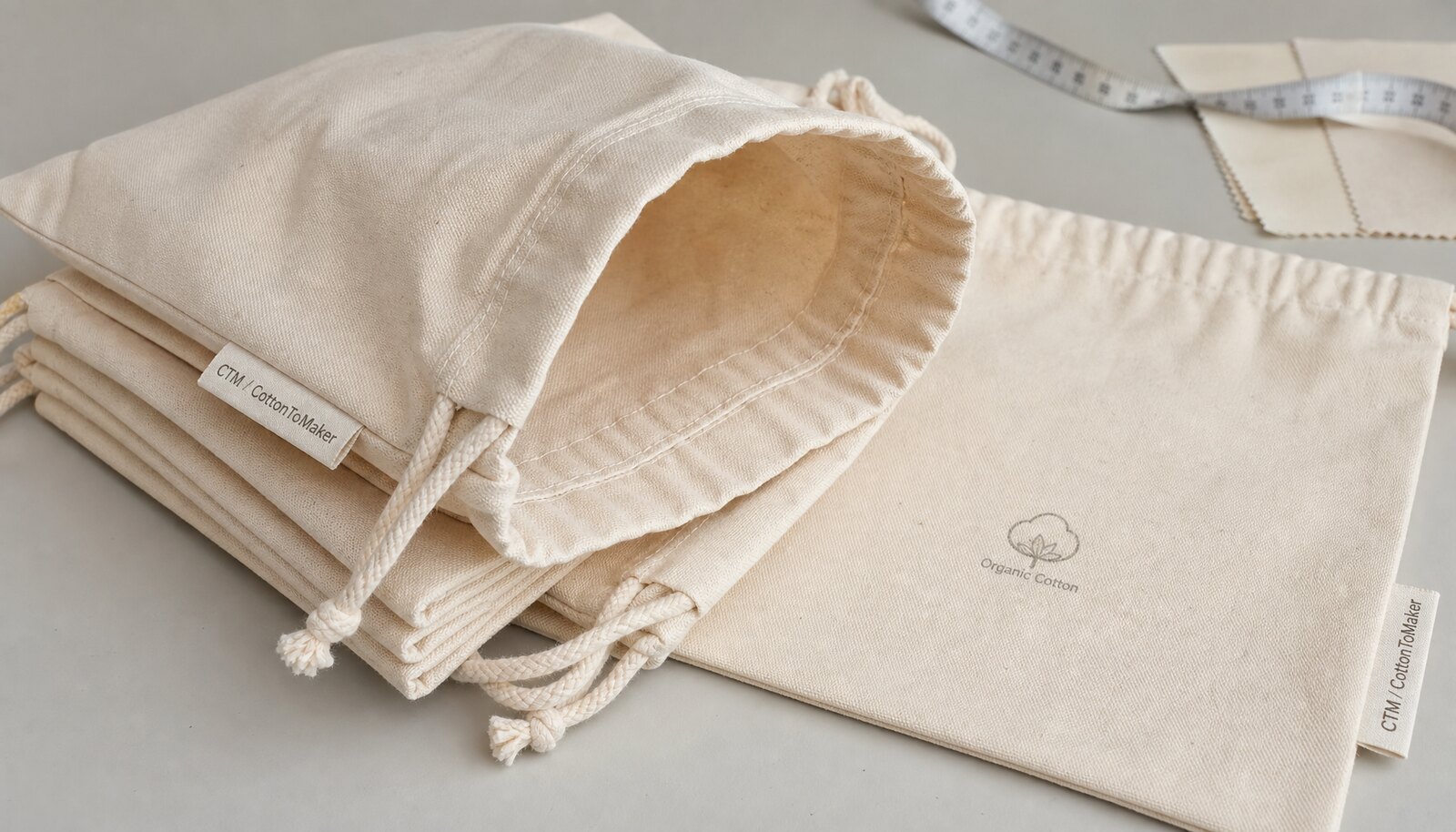
Why organic cotton gift bags fail RFQs when the spec is too vague
Most quote comparisons go wrong before the factory even prices the job. If the RFQ only says “organic cotton gift bags” without size, GSM, closure style, print method, and packing format, each supplier will fill in the blanks differently. One quote may be for a thin 100 GSM bag with a simple one-color print. Another may assume 140 GSM fabric, reinforced stitching, and retail inner packing. The prices look close, but the products are not comparable.
For procurement teams, the real buying problem is not finding a cheap bag. It is getting the same bag quoted by every supplier so you can compare unit price, freight, and quality risk on equal terms. A clean brief reduces back-and-forth, protects your margin, and prevents a sample that looks right but cannot be repeated in bulk.
- Define exact use case: gift packaging, event giveaway, brand packaging, or retail resale.
- State the finished size by internal fit requirement, not just general dimensions.
- Specify whether the bag must close with drawstring, ribbon, toggle, or open-top fold.
- Send artwork in vector format and note minimum line thickness for print.
Fabric weight and hand feel: the first cost and quality decision
For organic cotton gift bags, GSM is the first number that changes both appearance and cost. A 120 GSM bag usually works for most gift applications: it feels clean, holds shape better than lightweight promo bags, and takes simple print well. A 140 GSM option gives a more premium hand feel and less transparency, but it also raises material cost and can make small bags feel overbuilt if the item inside is lightweight.
If the buyer wants a softer, more gift-like look, a plain weave in the 120–130 GSM range is often the practical balance. If the bag carries glass, cosmetics, candles, or a premium set, move upward and add seam reinforcement. For very small sachet-style bags, avoid overspecifying heavy fabric just because it sounds “better”; the bag can become too rigid to tie neatly.
- 120 GSM: common for lightweight gifting and short-run promotions.
- 130–140 GSM: better for premium presentation, repeated use, or heavier contents.
- Heavier fabric usually needs more careful stitch control and may raise cutting waste.
- Ask for the supplier’s shrinkage allowance after washing or steam finishing if appearance matters after handling.
Print method choices: what works on organic cotton and what causes rejects
The right print method depends on artwork complexity, quantity, and required finish. For most organic cotton gift bags, screen print is the safest commercial choice because it gives consistent color and keeps costs manageable at moderate volumes. One or two solid colors are usually the sweet spot. If the logo is very small, a woven side label or sewn patch can be more durable and cleaner than forcing fine print onto textured fabric.
Digital print can be useful for detailed artwork, but it is not always the best trade-off for cotton gift bags. The fabric texture can soften fine lines, and the buyer may pay more without getting a visibly better result. For procurement, the rule is simple: if the brand mark must read clearly from arm’s length, simplify the artwork and prioritize color accuracy over complex shading.
- Use screen print for bold logos, short slogans, and repeat orders.
- Use woven labels or sewn patches when the logo must stay crisp on textured fabric.
- Avoid tiny text and thin lines unless the factory has already proven it on the same fabric.
- Approve print against daylight and factory lighting; some inks look darker or flatter after curing.
MOQ logic: why the cheapest quote is often attached to a different spec
MOQ on organic cotton gift bags is usually driven by fabric sourcing, dye lot efficiency, and print setup. A factory may quote 500 pcs for a standard natural color bag with one-color printing because the fabric and setup are already common. Once you request special dyeing, custom cord colors, unusual bag proportions, or multiple print positions, MOQ can move upward quickly because the factory needs to amortize cutting, printing, and sewing setup across more units.
Buyers should separate three MOQ layers: fabric MOQ, print MOQ, and packing MOQ. A supplier may accept a low print MOQ but require a higher fabric run, or the opposite. If you only compare total unit price, you may miss the extra charge for special yarn color, label setup, or carton configuration. For RFQ clarity, ask the factory to state the MOQ by size, color, and artwork version.
- Standard natural fabric and one-color print: often the lowest MOQ path.
- Custom dyed cotton or multiple logo versions: usually raises MOQ and lead time.
- Retail packing with barcodes or inserts should be treated as a separate labor line.
- If the order is for multiple SKUs, ask whether MOQ is per SKU or combined across the run.
How to compare supplier quotes without missing hidden cost
A useful quote comparison is not just unit price. For organic cotton gift bags, the landed cost depends on fabric weight, print setup, inner packing, carton size, and export terms. Two quotes with the same ex-works price can produce very different freight costs if one supplier packs 200 pcs per carton and another packs 500 pcs in denser master cartons. The denser carton may ship cheaper, but only if the bag shape survives compression and the finish does not crease badly.
Use the comparison table below as a sourcing route guide, not as a spec list. The supplier option matters because some factories control sewing and printing in-house, while others outsource one or both. In-house control usually gives better consistency and faster issue resolution. Trading companies can be useful for mixed-product sourcing, but they add a layer between the buyer and the production floor, which can hide the real fabric source or delay corrections.
- Compare on the same fabric weight, same print method, same size, and same packing.
- Ask for carton dimension and gross weight before you approve the quote.
- Check whether the price includes print setup, plate charges, label cost, and sample freight.
- Use the same Incoterm across all quotes or the freight comparison will be misleading.
Supplier route comparison: factory direct vs trader vs mixed sourcing
For organic cotton gift bags, supplier route affects both compliance risk and production control. A direct factory is usually the best route when you need repeat orders, stable quality, and a clear path for corrections. The factory can confirm fabric on the cutting table, inspect print alignment on the line, and adjust carton packing without a chain of intermediaries. That matters when you are buying for retail or seasonal campaigns where the bag is part of the brand presentation.
A trader or sourcing office can still be useful if your order needs multiple product categories, but they are not automatically the cheapest or safest option. If the quote is unusually low, read it against the actual fabric origin, the printing location, and who owns the sample approval. A buyer who understands the source route will spot where margin is being added and where the real production risk sits.
- Direct factory: best for repeatability, quote transparency, and QC control.
- Trader or sourcing office: useful for bundled sourcing, but verify who makes the bag.
- Mixed sourcing: only acceptable if one party owns final QC and packing responsibility.
- If organic claims matter on packaging, request supporting documents before order confirmation.
Sample approval: what the golden sample must prove before bulk starts
A good sample is not just a smaller version of the finished bag. It is proof that the factory can repeat the same fabric, stitch density, print finish, and cord tension in bulk. For organic cotton gift bags, approve a pre-production sample only when it uses the final material, the final print method, and the final packing method if those affect presentation. A sample on substitute fabric creates false confidence and is one of the fastest ways to trigger bulk rejection.
Use the sample to test real handling, not just appearance. Fill the bag with the intended gift item, tie and untie it several times, and inspect whether the opening stays neat. If the bag will be part of retail packaging, check how it sits on shelf, whether the print is centered, and whether the fabric creases in a way that hurts the brand look. Keep one sealed gold sample for factory reference and one for incoming inspection at destination.
- Inspect fabric shade, weave regularity, and any visible contamination.
- Measure finished size and cord length against the PO spec.
- Rub-test the print lightly to see whether curing is adequate for handling.
- Approve only after the factory confirms the sample matches bulk line settings.
Packing and carton design: where freight cost and damage risk hide
Packing choices affect more than warehouse convenience. For organic cotton gift bags, a polybag inner pack can protect the surface from dust and moisture, but it adds labor and material cost. Bulk packing reduces handling cost and can improve carton density, yet it raises the chance of scuffing or yarn contamination if the factory environment is not clean. The right answer depends on whether the bags are going directly into another packing line or shipping to store shelves as received.
Carton design should be sized to protect the bag shape without wasting freight space. Overly large cartons may ship air, while over-compressed cartons leave permanent folds in the fabric. Ask for carton quantity, gross weight, and carton dimensions in the quote stage so your logistics team can estimate container loading and destination handling. If the bag includes a printed logo, separate the print layers with tissue or a poly insert if rubbing is likely during transit.
- For clean retail presentation, inner polybag or tissue wrap may be worth the added labor.
- For warehouse-friendly bulk supply, master carton packing usually lowers cost.
- Avoid packing densities that crush the bag and create hard creases in natural cotton.
- Require carton marks that match PO number, size, color, and carton count.
Production timing and schedule risk: how to keep the order on track
Standard production for organic cotton gift bags is often faster than buyers expect, but only after artwork and sample approval are locked. A realistic plan for a simple spec is about 3–5 weeks from sample approval to bulk completion, with longer timelines if the factory needs to source special fabric, custom cord colors, or retail inserts. If your event date is fixed, build buffer time for lab dip approval, sample corrections, and freight booking.
The main schedule risk is not sewing speed. It is waiting on buyer decisions. Artwork changes after the sample, size changes after the quote, or packing instructions added late in the process can reset material preparation. The cleanest schedule is one where the supplier gets one final spec sheet, one approved sample, and one written packing instruction before fabric cutting begins.
- Allow extra time for special organic fabric sourcing or custom dye lots.
- Freeze artwork before sample approval to avoid print plate or screen rework.
- Treat packing inserts and hangtags as part of the production schedule, not an afterthought.
- Ask the factory which steps run in-house and which depend on outside suppliers.
QC standards that catch the expensive mistakes early
The most expensive defects on organic cotton gift bags are usually small but visible: crooked print, uneven cord length, weak top stitching, and cartons mixed with the wrong size. These problems are cheap to catch at the factory and expensive to sort at destination. A practical QC plan should focus on the features the customer will notice first: front panel appearance, closure function, seam strength, and cleanliness.
Set acceptance criteria in measurable terms rather than generic language. If the bag is intended for gifting, the front panel must look symmetrical and the logo must read cleanly from a normal viewing distance. If the bag will carry a heavier item, the seam and cord channel need to hold under real load. A good inspector will compare each lot to the sealed gold sample and reject obvious drift before the shipment leaves the factory.
- Check 100% for mixed SKU cartons if the order contains multiple sizes or colors.
- Measure a sampling of bags from each carton for size and cord consistency.
- Inspect print centering, color density, and edge blur under good lighting.
- Pull a few bags under normal fill weight to test seam and cord behavior.
Specification comparison for buyers
| Spec decision | Recommended option | When it fits | Buyer risk to check |
|---|---|---|---|
| Fabric weight | 120–140 GSM organic cotton for most gift use | Retail gifts, event handouts, cosmetic sets, and moderate-value product packaging | Too light looks weak; too heavy raises cost and makes small bags feel stiff |
| Fabric construction | Plain weave with combed yarn and clean edge finishing | When the bag needs a neat hand feel and consistent print surface | Loose weave can distort print, show transparency, or shrink unevenly after washing |
| Bag closure | Drawstring closure with cotton cord and stitched channel | Gift bags that need quick packing and repeated opening | Cord length, channel width, and knot security can vary by factory |
| Print method | 1–2 color screen print or woven side label for simple branding | Logo-led packaging with medium quantities and repeat orders | Very fine gradients or small text may blur; artwork must be simplified |
| MOQ route | 500–1,000 pcs per size/color for standard fabric and print | Most brand and distributor orders with repeat potential | Custom fabric weight, special dyeing, or complex packaging pushes MOQ higher |
| Sample route | Pre-production sample using final fabric, cord, and print method | Any order with logo approval, color matching, or retail presentation requirements | Approval on a different fabric than bulk production creates quote and QC disputes |
| Packing method | Bulk packed in polybag or master carton with carton marks | Importers optimizing freight and warehouse handling | Retail-ready inner packing, barcode labels, or hang tags add labor and carton cost |
| Supplier route | Direct factory with organic material traceability and in-house print control | When you need cost control, repeatability, and production accountability | Without a traceability file, organic claims and fabric origin can be difficult to verify |
| Lead time plan | 3–5 weeks for sample-to-bulk on standard specs; longer for custom fabric | When the bag is tied to campaign dates or seasonal gifting | Quote lead time often excludes fabric sourcing, lab dips, or artwork approval |
Buyer checklist before sampling
- Confirm final bag size, finished seam allowance, cord length, and whether the bag must fit a specific gift item or box.
- Specify fabric GSM, weave type, color, and whether you need certified organic cotton material or only organic cotton content claims supported by supplier documents.
- Define logo method, print size, Pantone target, and any artwork limits such as minimum line thickness or no halftones.
- State whether the bag must be retail-ready, gift-box-ready, or only bulk packed for internal filling.
- Request a pre-production sample built from final fabric, final cord, and final print method before bulk approval.
- Compare quotes on the same basis: same GSM, same size, same print method, same packing, same carton quantity, and same Incoterm.
- Ask for carton dimensions, gross weight, and the number of units per carton to estimate freight and warehouse costs.
- Set QC acceptance criteria for dimensions, stitching, print alignment, odor, contamination, and shrinkage after wash or steam.
Factory quote questions to send
- What fabric GSM, weave, and shrinkage allowance are included in this quote?
- Is the quoted material genuinely organic cotton fabric, and what documents can support that claim?
- Does the price include the same print method, print size, and number of colors shown in my artwork?
- How many pcs are included in the sample approval process, and will the pre-production sample use final bulk materials?
- What is the exact MOQ per size, color, and print version, and what changes the MOQ upward?
- How are the bags packed for shipment, and what is the carton quantity, carton size, and gross weight?
- What is the production lead time after sample approval, and what items can delay it?
- What QC standard or inspection point will the factory use for stitching, print placement, and fabric defects?
Quality-control points to confirm
- Bag dimensions must stay within the agreed tolerance after finishing; define the tolerance in writing before production.
- Stitching should be straight, secure, and free from skipped stitches, loose thread ends, and broken seam lines at the cord channel and side seams.
- Print placement should match the approved sample for position, size, color density, and edge clarity; check both front and reverse side show-through.
- Fabric should not show heavy slubs, holes, stains, oil marks, or mixed-tone panels beyond the agreed natural-fabric range.
- Cord length and knot security should be uniform across cartons so the closure feels consistent and does not slip under normal use.
- Packing must keep bags clean and dry, with carton marks matching the PO and artwork reference; verify no mixed lots inside one carton.
- If a retail claim is made, the supplier should provide traceability records or material documents that support the organic cotton claim used in sales copy.
- Approve one sealed gold sample and keep one copy at the factory, one with the buyer, and one with the QC inspector for bulk comparison.