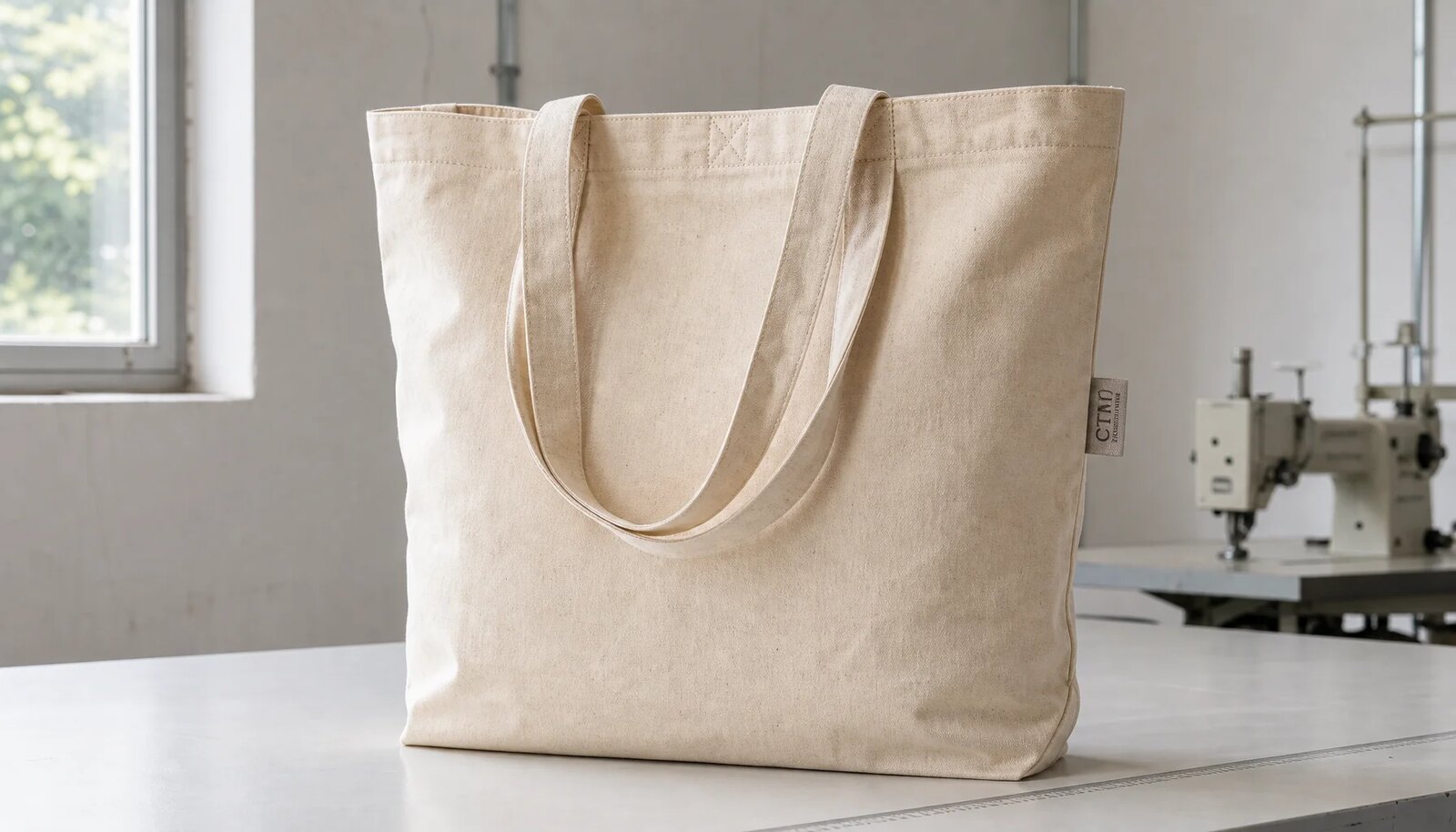
1. Start With the Event Load, Not the Bag Name
A durable organic cotton event tote is specified around use. A bag handed out with a badge and agenda has a different job from a conference tote carrying a bottle, notebook, apparel item, sponsor inserts, boxed samples, chargers, and a three-day program. Procurement should describe that job before asking suppliers for price.
Durability is operational. Weak handles slow registration. Open seams create replacement requests. Cracked logos weaken sponsor presentation. Stained cartons create sorting work before doors open. The RFQ should state the tote role, expected contents, estimated filled weight, delivery date, and whether the bags will be kitted before arrival.
Classify the order as light handout, registration pack, conference carry bag, premium sponsor kit, speaker gift, resale tote, or reusable post-event tote. Then attach the packing reality: folded flat, bulk bundled, individually packed, or kitted with inserts. Those details affect GSM, handle reinforcement, carton weight, inspection priorities, and venue labor.
- Low-load handout: paper inserts, badge, simple logo, efficient bulk packing, lighter construction requirement.
- Standard conference tote: notebook, guide, bottle, sponsor inserts, reinforced handles, practical gusset, stronger QC.
- Premium sponsor kit: cleaner finishing, controlled folds, sharper print approval, better carton protection, stronger presentation standard.
- Merchandise or resale tote: heavier fabric, clearer labeling, stricter defect sorting, reuse and shrinkage checks.
2. Specify GSM, Weave, and Tolerances Together
Fabric GSM matters, but it is not a durability guarantee by itself. A lighter organic cotton tote can work for paper inserts, while the same bag may feel strained with bottles, books, or boxed gifts. Suppliers often discuss midweight cotton around 180 GSM for general conference totes, but that is a starting point rather than a universal benchmark.
Construction changes performance. Canvas gives a firmer body. Twill can feel more refined but may drape differently. Plain weave can be cost-efficient at lighter weights, but seam allowance, top-hem quality, and handle reinforcement become more important. Fabric finish, shrinkage, yarn quality, dyeing, and market standard also affect how two totes with the same GSM behave after sewing, printing, folding, and loading.
Make tolerances measurable. A buyer might specify finished dimensions within +/-1 cm for body measurements and ask the supplier to confirm a written GSM tolerance. The exact tolerance should fit the production method and fabric source, but it must be approved before bulk production. Without a tolerance, final inspection becomes an argument about expectation rather than a check against a shared standard.
- 140 to 160 GSM: evaluate for light handouts when contents and carry time are modest.
- Around 180 GSM: a common conference tote discussion point, subject to construction and testing.
- 200 to 240 GSM: useful to evaluate for heavier contents, sponsor kits, resale use, or stronger structure.
- Measure body width, body height, gusset depth, handle drop, handle width, top-hem depth, and print placement.
- RFQ wording: "Finished bag 38 x 42 cm, 10 cm gusset, organic cotton canvas, natural color, supplier to confirm GSM and finished measurement tolerance."
3. Treat Handles as a Controlled Spec
Handles carry most event-tote failure risk. Attendees pick up one handle, add a bottle at the last minute, slide the bag over a shoulder, and set it down with contents pulling against one side. If the anchor is weak, failure usually starts where the handle meets the top hem.
The RFQ should name handle width, handle drop, handle material, reinforcement method, top-hem depth, stitch density where controlled, and minimum seam allowance. Shoulder-carry bags need enough handle drop for comfort, while heavier kits benefit from wider handles if the anchor and top hem are built to match.
The reinforcement method must appear on the approved sample and repeat in bulk. X-box stitching spreads stress and is easy to inspect. Bar tacks can be strong and compact when applied correctly. Double-row stitching can add security if thread tension and seam allowance are controlled. A folded top hem helps only when the handle end is fully captured and the fabric suits the expected load.
- Specify X-box, bar tack, double row, or another named reinforcement instead of writing "strong handles."
- Reject skipped stitches, broken threads, loose top-hem stitching, and anchors that do not fully catch the handle end.
- Ask for minimum seam allowance so stitching is not too close to the fabric edge.
- Check handle drop after sewing because a short handle can make a loaded tote uncomfortable over the shoulder.
- Inspect handle anchors after load testing for tearing, pucker, slippage, and seam opening.
4. Test Seams, Gussets, and Corners With Real Contents
A tote can pass a simple hanging-weight check and still perform poorly once packed for a real event. Hard-edged contents such as boxed gifts, product samples, tablets, hardcover programs, or thick catalogs create pressure points. Soft brochures spread weight more evenly. A practical durability review uses representative contents, not only loose weights.
Ask how side, bottom, and gusset seams are made and finished. Lockstitch, overlock, binding, and folded seam constructions can all be acceptable when matched to the bag, but the buyer needs a visible standard. Natural organic cotton makes messy finishing easy to see, so loose threads, puckered seams, and uneven top hems can damage perceived quality even when they do not create immediate breakage.
Gusset depth should match the kit. A flat tote is simple and cost-efficient, but it can bulge awkwardly with bottles, apparel, or boxed inserts. An 8 to 12 cm gusset is a common event-bag discussion range, but it adds fabric, sewing time, carton volume, and sometimes freight cost. Measure it as a finished dimension and verify it against the packing plan.
- Use representative contents for fit and stress review, including hard items when the event kit includes them.
- Check bottom corners after loading because boxed items create concentrated pressure.
- Measure gusset depth on finished bags and confirm the tote packs as intended.
- Inspect upper side seams near the opening, where stress often appears first.
- Include seam opening, skipped stitch, loose-thread, and broken-thread limits in final inspection.
5. Match Decoration to Wear Risk
Decoration turns the tote into a brand surface, but it can become the first visible defect. A logo may look sharp in a mockup and still crack after folding, feel too stiff on lightweight cotton, rub onto neighboring bags, or lose fine detail on textured fabric. The decoration method should be chosen before sampling so the quote, strike-off, and bulk production refer to the same process.
Screen printing is often efficient for larger cotton tote runs, especially one- or two-color event logos. Water-based ink can give a softer hand, while other ink systems may support opacity depending on fabric color and artwork. Heat transfer can suit short runs or complex artwork, but procurement should review adhesion, edge lift, handfeel, fold behavior, and rub resistance. Embroidery can feel premium on thicker totes or small placements, though it changes the fabric surface and may not suit all artwork.
Placement affects durability. Avoid placing the main print across a fold line, handle anchor, side seam, or heavy carton crease unless the design is built for that position. Large flood prints can stiffen the bag and crack if folded through the ink. Fine sponsor text needs minimum line and gap rules confirmed on the actual cotton fabric, not only on a digital proof.
- Require a print strike-off on the same fabric color and GSM planned for bulk.
- Define print placement tolerance from the top edge, side centerline, or another fixed reference point.
- Approve color against a physical reference or agreed color standard, not only a screen image.
- Run fold-crack checks using the final carton fold method.
- Use dry rub checks for dark ink, large logos, heavy coverage, or print-to-print packing.
6. Use a Measurable Durability Checklist
For event planners, a good durability testing checklist is simple enough to run and specific enough to prevent debate. The goal is not to overbuild every giveaway. The goal is to catch predictable failures before thousands of bags reach a venue. Put the method into the sample approval record or purchase order so the supplier knows what counts as a pass.
For static load, define the weight, hold time, load placement, sample quantity, and pass standard. Test at the expected filled event weight and add a project-approved margin when the kit includes bottles, catalogs, or boxed gifts. For example, a heavier conference tote might be screened at 8 kg for 30 minutes if that reflects the planned use, but the number should come from the actual contents and supplier capability. Pass means no handle slippage, seam opening, fabric tearing, broken thread, or distortion beyond the written limit.
Add movement and print checks. A loaded carry test creates side pull that hanging weight can miss. Define a short repeatable method, such as carrying the loaded tote for a set distance or cycle count, then inspecting handle anchors, top hem, side seams, and bottom corners. For print durability, fold the tote exactly as it will be packed, reopen it, and inspect the logo. Rub the printed area with a clean white cloth for an agreed stroke count and record transfer, dulling, cracking, flaking, or cloudy marks.
- Static load: agreed weight, hold time, sample quantity, and pass/fail standard.
- Loaded carry: agreed distance or cycle count, then inspection of handles, top hem, seams, and corners.
- Handle pull: method and force or manual stress standard defined before approval.
- Seam opening: no visible gaps, loose seam ends, broken threads, or unacceptable distortion.
- Fold-crack: final fold method used before checking printed areas.
- Dry rub: clean cloth, agreed stroke count, and written transfer limit.
- Photo record: tested approved sample photographed for final inspection comparison.
7. Freeze Production Through Sample Approval
Sample approval should approve the production method, not just appearance. Disputes often begin when a buyer approves a sample-room piece made with temporary fabric, careful handling, or a one-off decoration process, while bulk production uses a different fabric lot, thread, machine setup, fold method, or outside decorator. For event planners, that gap is risky because the event date usually cannot move.
Choose sample stages according to risk. A simple low-load tote may need a blank construction sample and a print strike-off. A larger sponsor-facing order should receive a pre-production sample made with bulk fabric, final thread, final label, final decoration method, final fold, and intended carton packing. If the order includes several artwork versions, dyed fabrics, or destination splits, approve each meaningful variation.
Tie the sample to a dated spec sheet. Include finished measurements, tolerances, GSM, weave, handle construction, stitch requirements, print method, print size, color reference, label placement, organic claim wording, packing method, and carton marks. For larger orders, keep one sealed approval sample and one working inspection sample so the factory, inspector, and buyer compare against the same standard.
- Approve construction, decoration, labeling, and packing as separate checkpoints when risk is high.
- Require the pre-production sample to use bulk fabric and final decoration process.
- Record tolerances for body size, gusset, handle drop, print position, and label placement.
- Require written approval before changing fabric source, thread, decorator, fold method, or carton plan.
- Do not release bulk production until the sample, spec sheet, and schedule match.
8. Keep Organic Cotton Claims Specific
The word organic needs careful handling in B2B sourcing. Event planners do not need to become certification auditors, but procurement should ask what claim the supplier can support for this order. Organic cotton fiber, certified organic fabric, and a finished product supported by chain-of-custody documentation are not the same claim.
Certification scope matters. A supplier may hold a scope certificate showing it is approved for certain activities, but that alone may not prove that a specific order used covered material. A transaction certificate, where applicable under the relevant standard, is usually more order-linked than a general capability document. Buyers should ask what documents apply to the exact PO, which materials and processes they cover, and what claim language is allowed on labels, invoices, cartons, or attendee-facing material.
Chain-of-custody limits matter too. A factory may sew well but manage paperwork loosely. A supplier may have strong fabric documents but outsource printing without clear segregation or traceability. The RFQ should ask for supported claim language, certificate scope where relevant, transaction certificate details where applicable, fabric lot references, invoice linkage, packing list references, supplier names, and limits on what can be printed or labeled. Conservative wording is better than a broad environmental claim that cannot be verified.
- Ask whether the claim is organic cotton fiber, certified organic fabric, certified finished product, or another documented status.
- Confirm whether documentation applies to the exact order, not only to supplier capability.
- Distinguish supplier scope certificates from order-linked transaction certificates where the certification system uses them.
- Request order-linked references where applicable, such as transaction certificate details, lot references, invoice linkage, or packing list references.
- Make label, hangtag, invoice, carton, and attendee-facing language consistent.
- Require written notice before fabric source, decorator, or sub-supplier changes.
- Avoid unsupported environmental claims that go beyond the available documentation.
9. Control Inspection, Packing, and Quote Comparison
Final inspection should be scaled to order risk. For larger event orders, buyers often use a recognized sampling approach such as ANSI/ASQ Z1.4 or ISO 2859-1 with general inspection level II and agreed AQL limits for critical, major, and minor defects. The exact plan should be written in the purchase order. Small or rush orders may use a tighter internal checklist instead, but the inspection frequency and defect categories still need to be clear.
Define what counts as critical, major, and minor. Critical defects may include safety concerns, severe contamination, wrong organic claim labeling, or unusable construction. Major defects may include broken handles, open seams, wrong artwork, unacceptable print transfer, wrong dimensions outside tolerance, or mixed versions in cartons. Minor defects may include trim issues, light wrinkles, or small cosmetic marks within the approved standard. This prevents subjective sorting at the venue.
Packing can protect a good tote or make it look damaged. Natural organic cotton shows wrinkles, stains, moisture marks, and handling dirt easily. Confirm flat, folded, bundled, paper-banded, individually packed, or kitted packing before production ends. Each option affects presentation, sustainability goals, carton dimensions, and venue labor. Outer marks should show PO number, style, color, artwork version, quantity, destination, and carton sequence.
Quote comparison should use the same commercial assumptions. Normalize Incoterm, destination, quantity, artwork versions, sample stages, packing method, inspection standard, export documents, freight, duty, and delivery. A lower unit price can disappear if it excludes setup charges, uses weaker construction, requires repacking, or creates late-arrival risk. For recurring events, keep the final spec and post-event feedback so the next order starts from evidence.
- State the inspection plan, AQL limits, defect categories, and sample size basis before production.
- Define critical, major, and minor defects for handles, seams, stains, print, dimensions, labeling, and packing.
- Set bundle counts that make registration setup faster, such as consistent inner counts per bundle.
- Confirm maximum carton weight based on venue handling, not only shipping efficiency.
- Use carton marks that match the PO, packing list, destination, and artwork version.
- Normalize quotes to the same Incoterm, destination, quantity, packing method, sample stages, and inspection standard.
Specification comparison for buyers
| Sourcing route | Best-fit event order | Spec control to request | Main procurement risk |
|---|---|---|---|
| Direct cut-and-sew factory with in-house printing | Repeat conferences, sponsor kits, multi-city events, and orders needing one accountable production owner | Finished size tolerance, GSM tolerance, handle reinforcement, print strike-off, AQL inspection, carton marking plan | Fabric, dyeing, or packing may still be outsourced unless each step is named in the RFQ |
| Cut-and-sew factory with named outside decorator | Standard tote body with specialty decoration, complex artwork, or print capacity beyond the sewing line | Decorator name, print method, ink system, artwork approval, rub test, fold test, print placement tolerance | Delay and defect responsibility can blur if sewing and decoration use separate QC standards |
| Trading company sourcing multiple factories | Early supplier comparison, mixed MOQ options, or programs needing several price and construction alternatives | Factory disclosure, organic documentation, sample source, sub-supplier change notice, inspection owner | Pricing is easy to compare, but traceability and repeat-order consistency need written controls |
| Local decorator using imported blanks | Rush events, small quantities, late logo changes, or orders where in-hand date matters more than custom construction | Blank supplier, blank lot consistency, print approval, carton count, replacement policy | Blank quality may vary by lot, and organic documentation may not apply to the exact order |
| Nearshore supplier or regional factory | Short replenishment windows, smaller drops, and lower international freight exposure | Available GSM range, standard dimensions, decoration options, carton lead time, top-up MOQ | Unit price can be higher and customization choices may be narrower than full overseas production |
| High-volume export factory with formal QC | Large campaign orders, multiple destinations, versioned artwork, and documented inspection requirements | AQL plan, measurement tables, inline and final inspection records, carton sequence, shortage rule | MOQ may apply separately by bag color, fabric color, artwork, label, and packing style |
| Boutique low-MOQ vendor | Pilot programs, VIP meetings, board events, limited sponsor drops, and proof runs before scaling | Sample cost, bulk repeatability, measurement tolerance, load check, print durability evidence | Low MOQ convenience may come with higher unit cost and lighter inspection documentation |
| Sourcing agent managing kitting or consolidation | Totes shipping with notebooks, badges, apparel, samples, inserts, apparel, or multi-supplier event kits | Supplier-by-supplier inspection records, receiving count, kit assembly tolerance, carton labeling, shortage escalation rule | A tote defect, insert delay, or packing error can affect the whole kit unless ownership is mapped before production |
Buyer checklist before sampling
- Define the event role before quoting: light handout, registration pack, conference carry bag, sponsor kit, speaker gift, resale item, or post-event reusable tote.
- List real contents and estimated filled weight in kilograms, including bottles, notebooks, catalogs, apparel, boxed gifts, samples, tablets, chargers, and sponsor inserts.
- Specify finished bag width, height, gusset depth, handle drop, handle width, fabric GSM, weave, color state, and finished-size tolerance in the RFQ.
- Set project-specific durability checks: static load weight, hold time, loaded carry distance or cycle, handle pull method, print rub method, and pass/fail limits.
- Name the handle reinforcement method, such as X-box stitching, bar tack, double row stitching, or reinforced folded top hem, and require it on the pre-production sample.
- Require minimum seam allowance, consistent stitch density, balanced thread tension, no skipped stitches at stress points, and no open seams at top corners, gussets, or bottom corners.
- Choose the decoration method before sampling and require a strike-off on the same organic cotton fabric color and GSM planned for bulk production.
- Define print placement tolerance, color reference, acceptable handfeel, rub resistance, fold-crack acceptance, and transfer limits for dark or heavy ink coverage.
- Ask whether fabric, sewing, printing, labeling, inspection, and packing are done in-house or by named sub-suppliers, and require notice before any change.
- Request a pre-production sample made with bulk fabric, bulk thread, bulk label, final print method, final fold, and intended carton packing method.
Factory quote questions to send
- What exact organic cotton fabric will be used, including GSM, weave, yarn or fabric description, color state, shrinkage allowance if applicable, and finished-weight tolerance?
- What finished dimensions and tolerances are included for body width, body height, gusset depth, handle drop, handle width, print position, and label position?
- Is the bag cut and sewn in your factory, and is decoration handled in-house or by a named decorator? If outsourced, who owns final QC and rework cost?
- What handle construction is included: handle material, width, drop length, seam allowance, reinforcement pattern, stitch density, thread type, and top-hem depth?
- What MOQ applies separately by bag color, fabric color, artwork version, label type, packing method, and shipment destination?
- Which sample stages are included in the quote: reference sample, blank construction sample, print strike-off, pre-production sample, size-set sample, or sealed approval sample?
- Will the pre-production sample be made with the same fabric, thread, print method, label, folding method, and carton plan intended for bulk production?
- What static load, loaded carry, handle pull, seam opening, print rub, fold-crack, and shrinkage checks can you perform, and how many samples are tested per lot?
- What inspection standard is quoted, such as general inspection level II with AQL limits for critical, major, and minor defects, or another agreed plan?
- What order-level organic cotton documentation can you provide, such as GOTS scope where relevant, OCS transaction certificate where applicable, invoice linkage, lot references, or chain-of-custody explanation?
Quality-control points to confirm
- Finished fabric weight is checked against the approved GSM target and written tolerance using production fabric or finished pieces from more than one carton or cutting lot.
- Body width, body height, gusset depth, handle drop, handle width, top-hem depth, label location, and print placement are measured against the approved spec sheet and sealed sample.
- Fabric surface is checked for stains, oil marks, weaving defects, slubs beyond the approved standard, color variation, odor, and visible contamination, especially on natural and light organic cotton.
- Side seams, bottom seams, gusset seams, top hem, and handle anchors show consistent stitch density, balanced thread tension, no skipped stitches, no broken threads, and no open seam ends.
- Handle reinforcement matches the approved construction, including X-box, bar tack, double row, or other written method, with the reinforcement centered and fully catching the handle and bag body.
- Static load testing uses the agreed weight and hold time, such as expected filled weight plus a buyer-approved margin, with no handle slippage, seam opening, fabric tearing, thread breakage, or distortion beyond the stated limit.
- Loaded carry or handle pull checks confirm that the anchor area does not tear, stretch excessively, pucker severely, or separate from the top hem after the agreed movement or pull method.
- Print color, registration, edge sharpness, coverage, opacity, handfeel, and placement match the approved strike-off on the same fabric base and approved artwork size.
- Dry rub, fold, and abrasion checks show no unacceptable ink transfer, cracking, flaking, cloudy marks, or damage on fold lines, especially for large logos and dark ink.
- Shrinkage, steam, or light wash simulation stays within the written tolerance when the tote is promoted as reusable, washable, or suitable for post-event retail use.