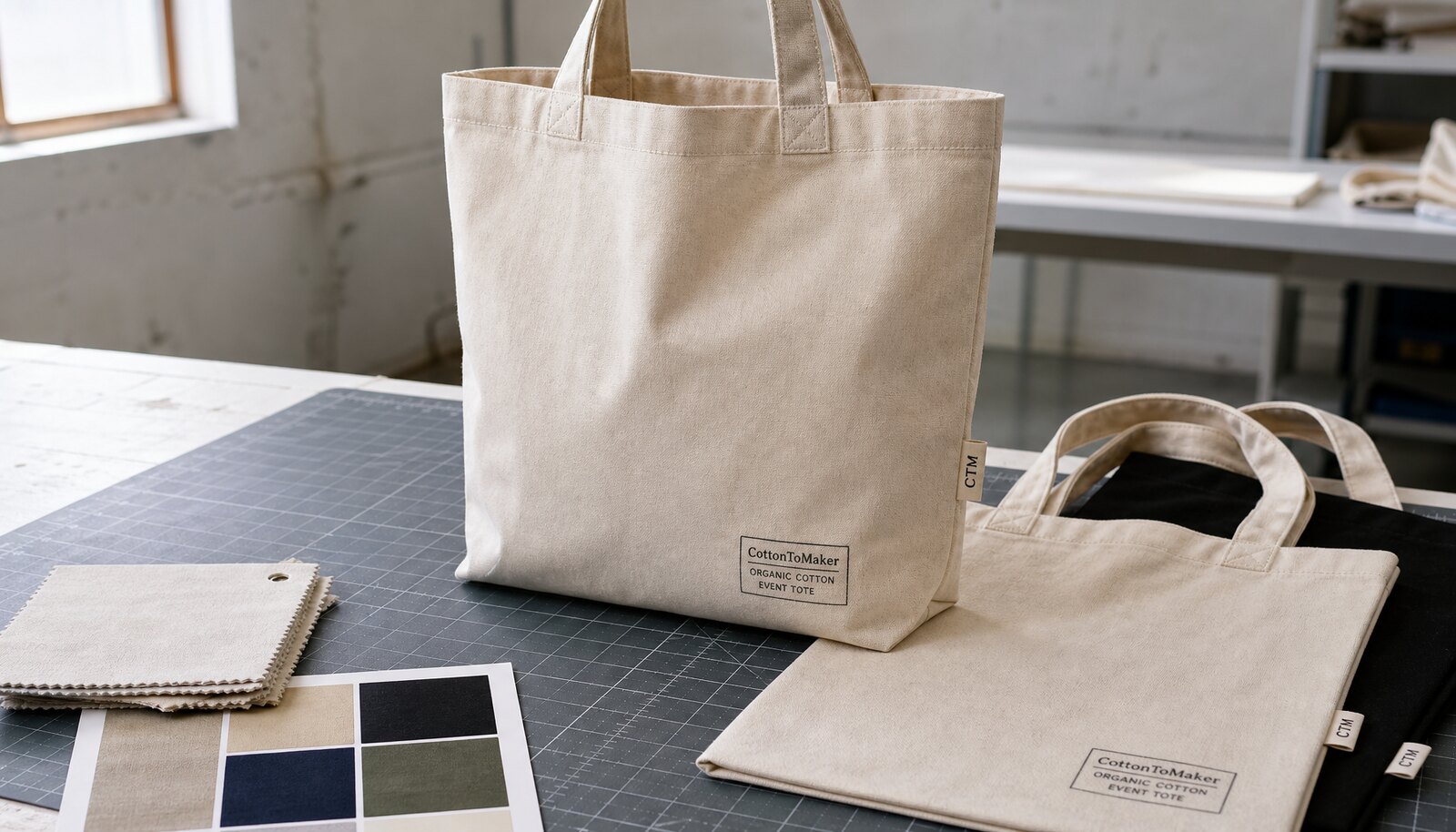
1. Start With the Procurement Risk, Not the Bag Photo
An organic cotton event bag is a simple product only when the specification is complete. For procurement buyers, the common failure is not that a supplier cannot make the bag. The failure is that the RFQ says “organic cotton tote with logo” and several suppliers quote different versions of that idea. One quote may use 5 oz natural cotton, another may use 8 oz fabric, one may include a print strike-off, and another may assume no certification documents beyond a general supplier statement. The unit prices are then impossible to compare fairly.
Event buying also has a hard deadline. Unlike stock packaging, a late event bag may have no useful recovery path after the conference, festival, product launch, or university campaign has passed. The organic cotton bag for event buyers logo printing checklist should therefore control four things at the same time: product specification, brand artwork, compliance documents, and delivery schedule. Treat the checklist as a sourcing control file, not as a design preference sheet.
Before requesting quotes, define the minimum acceptable product and the maximum commercial flexibility. For example, you may accept either 6 oz or 7 oz cotton if both pass handle testing, but you may not accept heat transfer if the brand requires a soft water-based print. You may accept bulk packing, but not unmarked cartons for a direct-to-venue shipment. These decisions make negotiation faster because the factory can quote real options instead of guessing.
- Use the RFQ to make suppliers quote the same bag, not just the same quantity.
- Separate fixed requirements from optional upgrades so pricing remains transparent.
- Protect the event date by setting approval deadlines before production starts.
- Keep the approved sample, artwork, PO, and inspection checklist in one sourcing file.
2. Define the Event Use and Bag Construction
The bag structure should come from the event contents. A flat tote that works for a brochure, badge, notebook, and pen may be poor for a sponsor kit containing a bottle, T-shirt, boxed sample, or catalog. If the contents are bulky, a bottom gusset improves capacity and presentation. If the bag will be worn over a coat or carried around a trade show for several hours, handle drop and handle width matter more than they appear on a flat drawing.
Procurement teams should give the supplier finished dimensions after sewing, not only target panel dimensions. Finished width, height, gusset depth, handle drop, handle width, seam allowance, and reinforcement method all affect fabric usage and sewing time. If the bag must hold A4 documents, a laptop sleeve, a retail box, or a sample bottle, send dimensions or photos of the items. The factory can then test whether the bag mouth, gusset, and handle length are practical.
A flat tote is usually the lowest-cost and lowest-volume option for document distribution. A gusset tote uses more fabric and may increase carton volume, but it can make a sponsor kit look more organized. Drawstring bags are useful for lightweight apparel or sport events, while pouches fit cosmetics or small promotional sets. Do not let a previous event bag become the default unless the contents and brand purpose are the same.
- Document handouts: flat tote, often around 38 x 42 cm, 5 oz to 7 oz organic cotton.
- Sponsor kits: bottom-gusset tote with 8 cm to 12 cm gusset, often 7 oz to 10 oz fabric.
- Retail or VIP events: heavier fabric, cleaner stitching, reinforced handles, and tighter logo tolerance.
- Direct-to-venue distribution: clear carton marks and packing splits may matter as much as bag style.
3. Specify Fabric Weight, Color, and Performance
Fabric weight is one of the biggest drivers of price, hand feel, durability, and freight cost. Ask for both oz and GSM because commercial cotton bag terms can vary by market. A 5 oz to 7 oz organic cotton bag is often suitable for light event handouts and keeps carton weight manageable. An 8 oz to 10 oz bag feels more substantial and supports repeat use, but the material cost, shipping weight, and sometimes production lead time increase.
Natural organic cotton is not a perfectly uniform white fabric. It may show cotton seed flecks, small shade differences, and a warmer base tone than bleached cotton. This can be desirable for an organic product, but it affects logo color. Black ink may look strong, while light colors or fine lines can be influenced by fabric texture and absorption. If the brand needs a crisp white base or a dyed body color, discuss the compliance, MOQ, and lead-time impact before pricing.
For procurement control, set measurable standards where possible. GSM can be checked from production fabric, not only from a swatch. Shrinkage should be considered if the bag is marketed for repeated use or likely to be washed. Handle strength should be matched to expected load rather than treated as a generic promise. If the event kit is heavy, ask the supplier to test a packed sample or provide a realistic pull-test method.
- State fabric weight such as 6 oz / about 180 GSM, with an agreed tolerance.
- Confirm natural, bleached, dyed, or custom color fabric before comparing quotes.
- Ask whether shade variation between fabric lots may affect repeat orders.
- Request shrinkage information when end users may wash the bag.
- For heavier contents, confirm handle reinforcement and practical load testing before approval.
4. Clarify Organic Cotton Claims and Documents
Organic cotton sourcing is not one single document level. One buyer may only need an internal material declaration from the supplier. Another may require certified organic cotton fabric and supporting transaction documentation. A retailer or public sustainability campaign may require a more formal finished product certification route. These are not the same commercial requirement, and they can affect supplier selection, MOQ, lead time, and documentation cost.
Ask what documents can be connected to the specific purchase order. Generic certificates shown during supplier introduction are useful for screening, but procurement files should link the order to the material and production route where applicable. Document names may include a scope certificate, transaction certificate, material declaration, fabric test report, and supplier invoice or packing references. Availability depends on the certification system, supplier scope, and order structure, so avoid assuming every factory can provide every document.
Be careful with printed claims. If the bag says “100% organic cotton,” “GOTS organic,” or any similar statement, the wording should be approved by your compliance or legal team before artwork release. A factory can print what is supplied, but the brand owner is responsible for the claim made to the public. If finished product certification is not part of the order, do not let artwork imply a certification level that is not supported.
- Define whether the requirement is material-level support, finished product certification, or buyer-nominated fabric.
- Ask which documents can be issued for this PO and when they will be available.
- Check certificate scope, validity date, product category, and supplier name carefully.
- Keep document requirements inside the PO, not only in email discussion.
- Approve sustainability wording internally before sending final artwork.
5. Match the Logo Artwork to the Printing Method
For most organic cotton event bags, water-based screen printing is the practical default. It is suitable for one to three solid colors, gives a softer hand feel than many heavy film prints, and works well on natural cotton. It is also efficient for medium and large event quantities. The buyer still needs to provide vector artwork, print size, Pantone references, and the desired print location. A low-resolution website logo is not enough for controlled production.
Complex artwork needs a more technical review. Gradients, photo effects, very small sponsor names, thin lines, and many colors can increase setup time or push the supplier toward heat transfer. Transfers can be useful, but they may feel less natural on cotton and should be tested for adhesion, cracking, and hand feel. Embroidery can look premium on small logos, but it can distort lighter cotton and is usually less practical for large event graphics.
The factory should state whether printing happens before or after sewing. Printing before sewing can help with flat panels and certain placements, but it requires accurate cutting and sewing afterward. Printing after sewing may be common for standard front-panel logos, but seams, handles, and gussets create position limits. Artwork near the edge, bottom, or handle area should be checked before the buyer approves the layout.
- Send AI, EPS, or editable PDF artwork with outlined fonts.
- Provide Pantone references, but approve the result on cotton fabric, not on screen.
- Avoid very small text on textured cotton unless a strike-off proves it is readable.
- Confirm one-sided or two-sided printing, print size, and number of colors.
- Ask the supplier to identify artwork risks before sample production, not after bulk printing.
6. Set Print Approval and Acceptance Standards
A logo printing checklist must define what will be accepted at inspection. “Print our logo clearly” is not a standard. The PO should include print size, position, color target, registration expectation, curing requirement, and defect limits. For many standard totes, print placement tolerance of plus or minus 5 mm is workable, but brand layouts with borders, centerlines, or seam-adjacent artwork may require tighter control or a design adjustment.
The print strike-off is the most useful control step for color and surface result. It should be made on the final fabric or a fabric that is materially the same as the production fabric. Digital mockups and paper proofs do not show cotton absorption, fabric shade, or ink spread. After the strike-off is approved, the pre-production sample should combine the final fabric, construction, logo placement, and any labels or packing fold that affect presentation.
Defects should be defined before production. Ink smears, heavy bleeding, pinholes in solid logo areas, poor curing, obvious misregistration, cracking, and major color mismatch should not be accepted. Minor cotton flecks on natural fabric may be acceptable if agreed in advance. Keep one sealed sample or signed reference at the factory and one with the buyer or inspection agency so final random inspection has a physical benchmark.
- Approve print strike-off before bulk printing, especially for brand colors.
- Measure print position from fixed edges, not from a folded or distorted bag.
- State unacceptable print defects in the PO and inspection checklist.
- Use consistent lighting for color review whenever possible.
- Do not approve a poor sample with the note “bulk must be better” unless corrections are documented.
7. Build a Realistic Sample and Lead-Time Plan
Event orders often run late because buyers compress the approval path. A controlled first order usually needs a blank fabric swatch, print strike-off, pre-production sample, production, final inspection, inland transport, export freight, customs clearance, and delivery buffer. If the product is a repeat order using the same fabric, artwork, and packing, some steps may be shortened. If the order is new, skipping the strike-off or pre-production sample can create expensive disputes after bulk goods are already made.
Work backward from the required arrival date, not the event date. If bags must be kitted, distributed to regional offices, or delivered to a venue with appointment rules, the warehouse arrival deadline may be one or two weeks before the event. Ask the supplier for the latest safe dates for artwork approval, sample approval, deposit receipt, material booking, and final inspection. These dates should be visible on the PO or production schedule.
A practical first-order timeline may include several working days for fabric swatch or available material confirmation, several days for print strike-off after artwork approval, several days for pre-production sample making, and then bulk production after written approval. Freight timing depends on air, express, rail, or ocean service. Air freight may protect a late event but can erase savings from a lower unit price, especially for heavier cotton bags.
- Set a required warehouse arrival date and a separate event date.
- Ask for sample stage durations in working days, not vague calendar promises.
- Reserve time for buyer review, internal brand approval, and possible sample correction.
- Book final inspection before goods are shipped or balance payment is released.
- Keep a buffer for customs, port delays, venue delivery appointments, and carton sorting.
8. Understand MOQ, Price Breaks, and Artwork Splits
MOQ is not only a sales rule. It comes from fabric sourcing, cutting efficiency, screen setup, labor scheduling, packing work, and document control. A standard natural cotton tote with one-color screen print can often be produced with lower complexity than a custom dyed gusset bag with four sponsor artwork versions and individual barcode labels. If one event order is split into regional logos, sponsor versions, or several delivery addresses, the operational workload increases.
When comparing quotes, ask whether MOQ is per total order, per bag size, per fabric color, per artwork, per print color, or per shipment batch. This is especially important for agencies, distributors, and brand teams managing several event stakeholders. A 5,000-piece total order may not price like one 5,000-piece artwork if it is actually ten versions of 500 pieces each. Each version may require separate screens, strike-offs, carton labels, packing lists, and inspection checks.
Request price breaks that match realistic buying decisions. Useful quantity points may be 500, 1,000, 2,500, 5,000, and 10,000 pieces, but the right breaks depend on your event program. Ask setup charges and sample charges separately so future repeat orders are easier to calculate. Also confirm overrun and underrun tolerance. If the event needs exactly 3,000 attendee bags, you need to know whether the supplier may ship a small percentage above or below the ordered quantity.
- Confirm MOQ per artwork, not only total order quantity.
- Ask whether screen charges repeat when artwork changes for the next event.
- Separate bag unit cost, setup cost, sample fee, packing upgrade, and document cost.
- Check whether color splits or destination splits change lead time.
- Define overrun or underrun tolerance when exact event counts matter.
9. Control Packing, Carton Volume, and Freight Tradeoffs
Packing looks minor until the bags reach the warehouse or venue. Bulk packing is usually the most economical method for event distribution: bags are folded, grouped by fixed quantity, protected in an inner pack or lined carton, and shipped in export cartons. Individual polybags protect each unit and support retail resale or kitting, but they add labor, plastic, carton volume, and sometimes extra packing days. Paper bands or no individual packing can reduce plastic, but the carton plan must keep bags clean and dry.
Ask for carton dimensions, pieces per carton, net weight, gross weight, and estimated total CBM in the quotation. Cotton bags can be bulky even when the unit price is low. A heavier fabric, larger gusset, individual packing, or thick transfer print can increase carton volume. For air freight, carton weight and dimensions can change landed cost quickly. For ocean freight, CBM and carton strength matter more, especially if cartons will be stacked for weeks.
Carton marking should support the actual distribution process. If all cartons look the same but contain different artwork versions, sizes, or sponsor packs, the venue team may open every carton to sort goods. Use PO number, SKU, artwork code, quantity, carton number, destination, and event name where useful. For pallet shipments, define pallet height, mixed-pallet rules, and whether cartons require barcodes or labels on specific sides.
- Compare landed cost, not only ex-factory unit price.
- Request carton size, weight, quantity per carton, and total CBM before booking freight.
- Choose individual packing only when distribution, retail, or kitting requires it.
- Use clear carton marks for direct-to-event or multi-destination deliveries.
- Check moisture protection for ocean freight, humid warehouses, and long storage periods.
10. Put PO, Payment, and Final Inspection Controls in Writing
The purchase order should turn the approved quote into a controlled production instruction. Include bag style, finished size, fabric weight and tolerance, color, logo method, print size, Pantone target, print position tolerance, label details, packing method, carton marks, certification document requirements, sample approval status, delivery term, and inspection rights. If any of these points remain in email only, they are easier to miss during production.
Payment terms should align with production checkpoints. Many suppliers require a deposit before fabric booking or sample work. Buyers should clarify what triggers bulk cutting, what triggers bulk printing, when final random inspection occurs, and when balance payment or shipment release is due. If third-party inspection is required, it should be stated before production, not introduced after goods are packed. The supplier needs to schedule inspection access and keep cartons available for sampling.
For final inspection, use the approved pre-production sample and written specification. Many buyers follow ANSI/ASQ Z1.4 or ISO 2859-1 sampling logic, often general inspection level II, with AQL limits such as Critical 0, Major 2.5, and Minor 4.0, adjusted to buyer policy. Critical defects may include wrong artwork, wrong claim, mold, severe odor, unsafe contamination, materially wrong dimensions, or missing required labels. Major defects include visible print defects, weak handles, wrong packing, and significant measurement failures.
Inspection should also include carton checks: quantity per carton, carton marks, barcode placement, carton condition, moisture signs, odor, folding, and split accuracy. If defects exceed the agreed AQL, the PO should state whether the supplier must sort, rework, replace, or accept reinspection cost. This avoids negotiation under deadline pressure when the event date is close.
- Put specifications, tolerances, documents, packing, and inspection rights on the PO.
- Define deposit, approval, inspection, balance payment, and shipment release checkpoints.
- Use an agreed AQL plan and defect classification before production starts.
- Inspect against the approved sample, strike-off, PO, and packing instruction together.
- Require corrective action and reinspection rules if the shipment fails inspection.
Specification comparison for buyers
| Spec decision | Recommended option | When it fits | MOQ / lead-time impact | Cost / freight impact |
|---|---|---|---|---|
| Light event handout bag | 5 oz to 7 oz organic cotton, usually about 150-220 GSM | Conferences, campus fairs, press packs with brochures, badge, pen, and light samples | Usually easier for standard natural fabric; lead time can be shorter if fabric is available | Lower unit cost and lower carton weight; can increase perceived thinness |
| Retail-quality or VIP event tote | 8 oz to 10 oz organic cotton, usually about 270-340 GSM | Paid merchandise, boutique activations, sponsor kits, repeat-use brand bags | May require longer fabric booking and higher MOQ, especially for dyed fabric | Higher material cost and higher freight weight, but stronger hand feel |
| One- to three-color logo | Water-based screen print on final production fabric | Most event logos, sponsor marks, and large front-panel designs on natural cotton | Screen setup required per color and artwork; efficient at medium and high quantities | Good cost balance; setup charges matter on small runs |
| Complex artwork or gradients | Tested heat transfer or separated screen print after technical review | Multi-sponsor layouts, photo-style artwork, gradients, small text, or many colors | May add sample time and higher MOQ per artwork version | Transfers can add cost and may increase carton protection needs if prints are tacky |
| Bag construction | Flat tote for documents; bottom-gusset tote for boxed items, apparel, bottles, or kits | Event contents need to sit flat, not bend documents, or carry product samples | Gusset totes use more fabric and sewing time; sample approval is more important | Higher fabric usage and carton volume than a flat tote |
| Packing method | Bulk pack by fixed count, or individual pack only when retail handling requires it | Bulk pack for venue distribution; individual pack for retail resale, kitting, or barcode control | Individual packing adds labor and may extend packing lead time | Individual polybags increase cost, plastic use, and carton volume |
| Certification document path | Material declaration, scope certificate review, and transaction certificate where applicable | Brand, retailer, or compliance team requires support for organic cotton claims | Document-controlled orders may need earlier material booking and stricter supplier scope checks | May increase administration cost or limit fabric source options |
| Inspection plan | Final random inspection using agreed AQL and approved pre-production sample | Orders with a fixed event date, multiple cartons, sponsor artwork, or retail-quality expectations | Inspection must be booked before goods are packed or released | Adds inspection cost but reduces event failure risk |
Buyer checklist before sampling
- Define the event use: document handout, sponsor kit, retail merchandise, VIP pack, staff bag, or direct-to-venue giveaway.
- Confirm the bag type: flat tote, bottom-gusset tote, drawstring bag, pouch, or custom shape, and match it to the actual contents and carrying weight.
- State the organic cotton requirement clearly: certified organic cotton material, finished product certification route, buyer-nominated fabric, or supplier material declaration only.
- Request available document types early, such as scope certificate, transaction certificate where applicable, material declaration, fabric test report, and invoice/packing references linked to the PO.
- Specify fabric weight in both oz and GSM, with tolerance, rather than words such as standard, eco, heavy, or premium.
- Provide finished bag dimensions after sewing: width, height, gusset depth, handle width, handle drop, seam allowance expectation, and measurement tolerance.
- Send logo artwork in vector format with outlined fonts, Pantone references, print size, print location, and whether artwork is one-sided or two-sided.
- Choose the intended print method and ask the factory to recommend alternatives only with reasons, cost impact, setup cost, and lead-time impact.
- Request a print strike-off on the final fabric before pre-production sample approval, especially for brand colors, fine lines, or natural cotton fabric.
- Define acceptable print position tolerance, often plus or minus 5 mm for standard totes, unless the artwork or brand standard requires tighter control.
Factory quote questions to send
- What organic cotton fabric options do you recommend for this event bag, and what are the GSM, oz weight, yarn count if available, weave, shrinkage range, and GSM tolerance?
- Is the quote based on certified organic cotton fabric only, a finished product certification route, or organic cotton material supported by supplier declaration? Which documents can be linked to this order?
- Can you provide current certification documents for review, such as scope certificate, transaction certificate where applicable, material declaration, or fabric test report, without making claims outside your certification scope?
- What is your MOQ for this bag size, fabric weight, fabric color, and print method? Does MOQ change if we split colors, artworks, delivery addresses, or packing labels?
- Which print method are you quoting, and why is it suitable for the logo size, cotton texture, number of colors, brand color requirements, and expected event use?
- What are the separate costs for screen setup, print strike-off, pre-production sample, courier sample dispatch, individual packing, labels, barcodes, and carton upgrades?
- Can you provide a blank fabric swatch, print strike-off, and pre-production sample, and how many working days will each step take after artwork and payment are confirmed?
- What is the latest safe artwork approval date and pre-production sample approval date if the goods must arrive at our warehouse or event venue by our required date?
- What are your finished bag size tolerances, print position tolerances, GSM tolerance, stitch density standard, and acceptable color variation standard?
- Is the unit price based on bulk packing or individual polybag packing, and what is the cost, lead-time, and carton volume difference?
Quality-control points to confirm
- Fabric weight should be checked by GSM test from production fabric, not only from the approved swatch. A common commercial tolerance is about plus or minus 5%, but the PO should state the agreed tolerance.
- Finished size should be measured after sewing and pressing, with separate tolerance for width, height, gusset, handle width, and handle drop. Many standard totes use plus or minus 1 cm for body dimensions unless a tighter tolerance is agreed.
- Logo color should be compared against the approved strike-off under consistent light, with reasonable allowance for cotton absorption and natural base shade.
- Print placement should be measured from fixed bag edges, seam, top fold, or centerline, not judged only by eye on a folded sample. A common standard is plus or minus 5 mm for normal front-panel placement.
- Ink curing should be checked by dry rub, wet rub where relevant, tape adhesion, and wash test when the bag is intended for repeated use or retail sale.
- Handle attachment should be checked for stitch density, reinforcement pattern, skipped stitches, loose threads, and pull strength. For event totes carrying light goods, buyers should still require a practical pull test matched to expected load.
- Stitch density should be specified by seam type and fabric weight. Many cotton tote constructions fall around 8-12 stitches per inch, but the supplier should confirm what is suitable for the chosen fabric and seam.
- Seams should be checked for broken stitches, skipped stitches, puckering, open seams, uneven folding, raw-edge fraying, and weak stress points at handle joins and gusset corners.
- Fabric appearance should be checked for stains, oil marks, holes, major slubs, shade variation outside the approved range, excessive lint, mildew odor, and unacceptable contamination.
- Carton packing should be checked for correct quantity, clean folding, moisture protection, carton strength, carton marks, barcode label placement, and whether inner packing matches the PO.