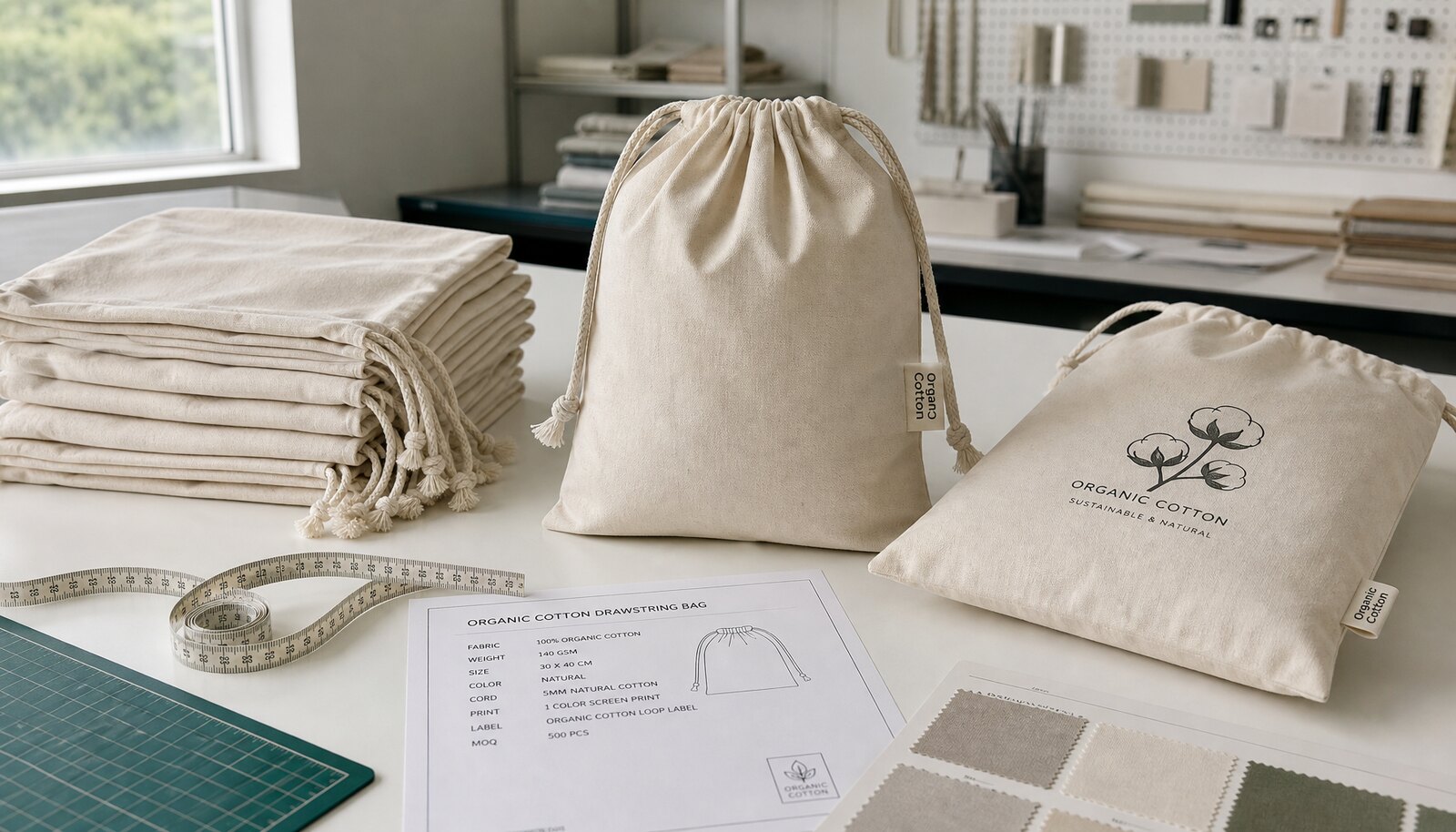
Why buyers specify organic cotton drawstring bags for corporate gifts
For procurement teams, the appeal of these bags is practical rather than decorative. They are easy to brand, simple to pack with small gift sets, and more reusable than thin promotional alternatives. In corporate gifting, the bag becomes part of the message the recipient sees first, so the decision is not just about a pouch. Fabric hand feel, stitch finish, and print clarity all influence how the gift is perceived before the contents are even opened.
The most useful way to start is to define the use case. A conference welcome kit, an employee onboarding pack, and a premium client gift all need different constructions. A bag that only carries a few stationery items can be lighter and lower cost. A bag holding cosmetics, apparel, candles, or a bottle-shaped item needs stronger seams, a better channel, and a size that closes cleanly once packed. If the brief does not include the intended contents, suppliers will quote different assumptions and the comparison will be weak from the start.
- Best-fit use cases: onboarding kits, event giveaways, holiday gifting, PR mailers, and internal recognition packs.
- Main buying goal: a reusable presentation piece with controlled branding cost.
- Main sourcing risk: under-specifying the contents and receiving a bag that looks good in a sample but fails in production or packing.
Start with a functional spec, not the artwork
The wrong buying sequence is to approve the logo before the bag structure. For organic cotton drawstring bags for corporate gifts, the right sequence is contents first, then size, then fabric weight, then decoration. The bag should fit the packed set without forcing the cords, and it should still look presentable after handling and transport. Size changes matter because the same logo can look balanced on one format and cramped on another.
A practical spec usually includes three decisions. First is the size, which should be tied to the largest item and the final packed arrangement. Second is the fabric weight, which affects drape, durability, and perceived quality. Third is the construction detail: side seams, reinforced top channel, cord thickness, and any bottom reinforcement. If the bag will be reused or handled repeatedly, the channel and seams need more attention than the print method because those are the points most likely to fail in normal use.
- 120gsm: lighter, softer, and usually adequate for lightweight gift sets and event use.
- 140gsm: the most balanced choice for general corporate gifting because it improves structure without pushing cost too far.
- 160gsm: useful only when the bag must carry more weight or when brand presentation justifies a heavier, more premium feel.
- Construction check: confirm the channel, side seams, and corners before you ask for decoration pricing.
Verify the organic cotton claim before you compare price
Procurement teams should not treat an organic claim as a wording issue. If the sustainability story matters to the program, the supplier needs to show how the claim is supported through the supply chain. Ask what certificate type applies to the product route, who holds the certificate, and whether the scope actually covers the bag, not just the raw cotton. In many cases the key question is traceability: can the supplier connect the fabric lot, the production order, and the shipment paperwork in a way that matches the claim you plan to use?
The documentation should be specific, not generic. Ask for the certificate number, issuer, expiry date, product scope, and the company name on the certificate. If the fabric is sourced through one party and sewn or printed by another, ask how the transaction trail is handled between those steps. If a supplier cannot explain that clearly, the burden shifts back to the buyer to decide whether the claim can be used at all. When in doubt, align your marketing wording with the evidence you have rather than stretching the language.
You should also ask about fabric condition. Is it greige, bleached, pre-washed, dyed, or finished with any treatment that affects feel or print behavior? Those choices influence the final result and can affect the environmental story you tell. A clean procurement brief avoids vague language and asks for documents, not promises.
- Ask for certificate number, issuer, expiry date, and scope coverage for the relevant product route.
- Confirm whether the supplier can connect the fabric source to the finished bag through transaction paperwork or other traceable records.
- Clarify whether the fabric is greige, dyed, pre-washed, or finished, because that changes both appearance and claim language.
- If the claim matters for compliance or marketing, keep legal and sustainability review in the loop before order placement.
Choose the right branding method for the artwork you actually have
Decoration choice is where many buyers create avoidable risk. Screen printing is usually the most efficient option when the logo is one solid color or a small number of flat colors. It gives a clean, familiar look and keeps the cost structure predictable. On natural cotton, however, the surface texture can affect the sharpness of thin lines, so the sample matters more than the digital proof.
Woven labels are a strong option when the brand wants a more understated or retail-style presentation. They avoid large blocks of ink and can feel more premium for smaller logos. Embroidery can look good when the design is simple, but it is not a default answer for every drawstring bag because stitching can distort lighter fabric and raise cost quickly. Heat transfer is worth considering only when the artwork genuinely needs it, such as detailed graphics or multiple shades that cannot be rendered cleanly with a simpler process.
The buyer should control the print area, not let the supplier decide it informally. Specify the maximum print width and height, whether the logo is centered or offset, and whether the same artwork must appear on both sides. For text-heavy marks, ask the supplier to confirm readability on the actual fabric texture, not only on the artwork file.
- Screen print: best for simple logos, repeat orders, and cost control.
- Woven label: best when you want subtle branding and a cleaner retail-like finish.
- Embroidery: only for simple artwork and when the fabric weight can support the stitch density.
- Heat transfer: use only when artwork complexity requires it and the sample proves the finish is acceptable.
Compare quotes on the same basis, or the numbers will mislead you
A quote comparison is only useful if every supplier is pricing the same thing. For this product, the spec sheet should normalize fabric weight, bag size, cord type, print area, label requirements, packing method, carton quantity, and Incoterm. If one supplier quotes a 120gsm bag in bulk cartons and another quotes 140gsm with individual polybags, the price difference is not a true comparison. Buyers often spend time negotiating the lowest number without noticing that the spec itself changed between quotes.
It helps to separate one-time charges from recurring cost. Setup charges for screens, labels, or print tooling should be identified clearly so they do not get hidden in the unit price. Packing also matters more than it looks. A quote that includes export cartons and clear carton marks can be more useful than a lower price that leaves the receiving team to sort out labeling and packing issues later.
The landed-cost view is the better procurement view. A slightly higher unit cost can still win if it reduces rework, lowers freight cube, or shortens receiving time. The cheapest bag is not the best buy if it creates extra handling or fails approval.
- Use one spec sheet and one Incoterm for every supplier.
- Separate setup cost, sample cost, packing cost, and recurring unit cost.
- Check whether the quote includes export cartons, carton labels, and any inner packing.
- Do not compare a bare EXW number with a fully packed quote as if they were equal.
Read MOQ and lead time as production logic, not sales promises
MOQ is a reflection of setup burden, not just a commercial preference. On standard stock fabric with one-color screen print, a common starting point is 500 to 1,000 pieces per design, but that is only a starting point. MOQ rises when the order needs custom labels, special packaging, multiple print colors, custom cord colors, or a less common bag size. It can also rise when the supplier must reserve fabric or allocate production capacity just for your order.
Lead time should be read the same way. For a straightforward project, sample approval might take 10 to 15 days and production might take 20 to 35 days after approval, but those are only starting points for a simple, standard build with available fabric. If the order needs custom fabric, additional label work, or approval rounds that start late, the schedule moves quickly. Most delay comes from incomplete artwork, slow sample feedback, or changes after sign-off rather than the sewing itself.
For procurement, the useful question is not whether a supplier can quote a short lead time. It is whether that lead time is based on stock material, what part of the schedule is already secured, and what happens if the artwork changes. Ask for a timeline broken into sample, pre-production, production, packing, and dispatch.
- Treat MOQ as a function of fabric availability, print complexity, and setup cost.
- Use the lead time quote only after confirming what is already in stock and what must be sourced.
- Ask for a schedule split: sample, approval, production, packing, and dispatch.
- Leave room for freight booking and receiving if the bags must arrive by a fixed event date.
Vetting the supplier is about proof, not presentation
A strong supplier quote should be backed by process evidence. Ask whether the factory handles weaving, cutting, sewing, printing, and packing in-house or through partners. If printing is outsourced, that is not automatically a problem, but it changes the control points and the risk of delay. The buyer should know who owns the sample revision loop and who is responsible if the print shifts or the carton count is wrong.
Request concrete evidence of similar work. Photos of current production are more useful than studio mockups. Ask for a copy of a past packaging format, a real carton label, or a sample spec sheet from a comparable bag. If the supplier uses a trader model, ask for the factory name and how the trader manages quality checks, because the quality chain matters more than the sales conversation.
If your program has a sustainability or compliance requirement, ask whether the supplier understands the claim language you plan to use. A supplier that can talk clearly about certificates, fabric source, and batch traceability usually creates fewer surprises later than one that only quotes a unit price.
- Ask who controls sewing, printing, and packing if the supplier is not the factory.
- Request real production photos, not only catalog images.
- Check whether the supplier can explain certificate handling and traceability without improvising.
- Verify that the team quoting the job understands your packing and carton requirements, not only the artwork.
Use a sample to test fit, finish, and print in the same review
A sample is only useful if it is tested against the actual use case. Put the intended gift set into the bag, close the cord, and check whether the top opening remains neat after handling. If the contents are heavy or oddly shaped, the channel should not distort and the cord should not dig into the fabric. The bag should feel easy to open and close, not tight or awkward.
The sample review should also capture print placement and visible quality. Measure the actual dimensions, compare the print position to the approved artwork, and inspect the edges of the logo under normal light. Loose threads, stains, or uneven tension around the channel are signs that the production process needs tighter control even if the bag still looks acceptable at first glance.
The safest approval process is written. Record the exact approved sample reference, the agreed fabric weight, the print method, the size, and any acceptable tolerance. If the sample is approved only by a verbal note or a photo, the production team later has too much room to argue that a deviation is acceptable.
- Test the bag with the real contents, not empty.
- Measure length and width, then compare them against the approved spec.
- Inspect logo placement, sharpness, and any color mismatch on the fabric surface.
- Keep one approved physical sample as the master reference for production.
QC should follow the risk points that matter in transit and use
Quality control for this product should focus on the points that fail in real use, not just cosmetic defects. The first check is fabric consistency. Confirm the GSM, surface feel, and visible color against the approved sample or shade reference. The second check is stitch integrity. The channel, seams, and stress points should be free of skipped stitches, loose ends, and weak anchoring. The third check is closure behavior. The cord should move smoothly and close evenly without slipping or cutting into the channel.
Carton-level control matters too. The packing list should match the carton count, carton labels should align with the purchase order, and the cartons should be packed cleanly enough to avoid dust, moisture, or cord tangling during transit. If the shipment is large or time-sensitive, a final inspection against the approved sample is worth the effort because it catches issues that are hard to correct once freight has moved.
For buyers who use third-party inspection, the inspection criteria should be written against the approved sample and the accepted spec, not left to a generic visual check. That gives the supplier a clear target and reduces back-and-forth when small deviations appear.
- Verify fabric weight, feel, and visual consistency before approving bulk production.
- Inspect seam continuity, channel reinforcement, and stress points under real handling.
- Check cord movement and closure behavior with the intended contents inside the bag.
- Use carton checks for packing count, labels, moisture protection, and cord management.
- Write inspection criteria against the approved sample so the supplier knows exactly what is acceptable.
What to put in the RFQ so the quotes are actually comparable
The fastest way to get useful supplier responses is to send a complete RFQ packet. For this product, the packet should include a dimension drawing or simple size callout, the expected contents, the target fabric weight, the organic claim requirement, the print artwork, the print method, the packing method, the carton count, and the destination commercial term. If you want side labels, care labels, or custom cord color, say so up front. Every missing detail becomes a supplier assumption, and assumptions are why quotes drift apart.
A good RFQ also tells the supplier what matters most. If price is the priority, say that the bag can use stock fabric and standard packing. If presentation is the priority, say that print sharpness, stitch finish, and carton cleanliness will be reviewed before approval. If compliance is the priority, ask for the relevant certificate trail and limit the organic claim language to the documentation available. Buyers get better answers when they define the decision rule instead of asking for a generic quote.
This is also the point where natural SEO and commercial usefulness overlap. A procurement brief written this way is what buyers actually search for when they need organic cotton drawstring bags for corporate gifts, because it turns an idea into a spec the factory can price correctly.
- Send the bag size, intended contents, fabric GSM, decoration method, and packing requirement in one file.
- State whether the organic claim must be supportable by certificate and traceability paperwork.
- Define the acceptance rule for samples and the items that will be inspected before shipment.
- Ask suppliers to quote on the same commercial basis so landed cost can be compared cleanly.
Specification comparison for buyers
| Spec decision | Recommended option | When it fits | Buyer risk to check |
|---|---|---|---|
| Fabric weight | 120gsm for lighter kits; 140gsm for the most balanced corporate-gift feel; 160gsm only when the bag must feel premium or carry heavier contents | Event giveaways, onboarding kits, holiday gifting, and reusable presentation packaging | Heavier fabric raises cost and can reduce flexibility; lighter fabric can look thin, crease easily, or lose shape after packing |
| Bag size | 20x25 cm for small items; 25x30 cm for general gift sets; 30x40 cm for apparel or bulkier kits | Choose based on the largest item and the packed set, not the logo area | A size that fits the artwork but not the contents creates a poor user experience and can stress the cord channel |
| Print method | 1-color screen print for the cleanest cost-to-branding ratio; woven label for subtle premium branding; heat transfer only when artwork complexity requires it | Simple logos, repeat programs, and controlled brand presentation | Fine type, gradients, or tight detail may blur or drop out on textured cotton; approve on a physical sample, not a mockup |
| Closure style | Standard cotton drawstring with a reinforced channel; use a wider cord or double-cord construction for heavier contents | Most corporate gift sets and welcome packs | Weak channel stitching, thin cord, or poor tension balance can lead to fraying, slipping, or seam damage |
| Supplier route | Direct factory sourcing for repeat programs and clearer process control; trading partner only when you need multi-SKU coordination or split sourcing | Annual gifting, stable specs, and controlled QC | A middleman can hide fabric origin, add delay to sample revisions, and make issue resolution harder |
| MOQ logic | 500-1,000 pcs per design as a common starting point for stock fabric and a simple print setup | Pilot campaigns, seasonal gifts, and standard corporate programs | Very low MOQ often means stock-only options, limited customization, or a higher unit price |
| Packing | Bulk pack in clean export cartons; add inner polybags only when cleanliness, storage, or reseller handling requires it | Warehouse fulfillment, event kits, and cost-sensitive orders | Overpacking adds labor and freight cost; underpacking can cause dust, creasing, and cord tangling |
| Lead time | Treat 10-15 days for samples and 20-35 days for production after approval as a starting point for standard stock fabric and one-color print | Straightforward programs with clear artwork and no custom dyeing | Custom fabric, delayed approvals, or special packaging can extend the schedule materially |
| Quote comparison | Compare only after normalizing fabric GSM, print area, cord spec, packing method, carton count, and Incoterm | When multiple suppliers quote the same project in different ways | The lowest unit price can exclude setup, packing, or export cartons and may not be the lowest landed cost |
Buyer checklist before sampling
- Confirm the gift contents, the target carry weight, and whether the bag is meant to be reused after the event or only used once.
- Specify the required fabric weight, bag size, and whether the bag must be described as organic cotton in your marketing or compliance material.
- Request proof of organic claim support where it matters: certificate numbers, scope coverage, product traceability, and transaction evidence if applicable.
- Send vector artwork and define the print method, print colors, print placement, and maximum printable area.
- State whether you need a woven label, side seam label, care label, or no label at all.
- Define the packing method, carton marks, carton count, and whether the bags must be individually polybagged.
- Approve a written sample standard that covers fabric feel, dimensions, stitching, cord strength, print sharpness, and acceptable tolerance.
- Compare all quotes on the same commercial basis: same Incoterm, same packing method, same carton quantity, and the same spec sheet.
Factory quote questions to send
- What fabric weight do you propose, and is the cotton certified, certified at the mill level, or supported by other traceable documentation?
- Which decoration method is included in the quote, what setup charges apply, and are there separate charges for screens, plates, or labels?
- What is the exact MOQ per size and colorway, and how does the MOQ change if the print has more than one color or if the label is customized?
- What is included in the price: sample fee, tooling, label stitching, inner packing, export cartons, and carton marks?
- Can you share seam construction details, cord thickness, channel reinforcement, and bottom-corner reinforcement if applicable?
- Is the fabric stock item, dyed to order, or specially finished, and which step is most likely to affect the schedule?
- What is the standard production lead time after sample approval, and what parts of the timeline depend on fabric availability or print setup?
- How do you pack the cartons for export, how many pieces go in each carton, and what are the carton dimensions and gross weight?
- What QC standard do you apply for print placement, stitching defects, fabric stains, size tolerance, and packaging accuracy?
- Which documents will you provide with shipment: packing list, invoice, certificate copies if relevant, and carton label artwork?
Quality-control points to confirm
- Fabric verification: confirm the agreed GSM, hand feel, and color against the approved sample or shade band before mass production is released.
- Organic claim support: check that the supplier can provide the correct certificate type, scope coverage, and traceable paperwork for the specific product route.
- Stitching quality: inspect seam continuity, the top channel, and all stress points for skipped stitches, loose threads, or weak anchoring.
- Cord movement: the drawcord should slide evenly, close cleanly, and not cut into the channel or slip under normal use.
- Print quality: verify logo placement, center alignment, edge sharpness, and color consistency on the natural cotton surface.
- Size tolerance: measure length and width on random samples against the agreed spec before packing release.
- Cleanliness: bags should be free from mildew smell, oil marks, fabric slubs that affect use, and visible contamination inside the carton.
- Packing integrity: cartons should hold shape, carton labels should match the PO, and cords should not be tangled or damaged during packing.
- Pre-shipment control: if the order is large or time-sensitive, use an agreed final inspection checklist or third-party inspection against the approved sample.