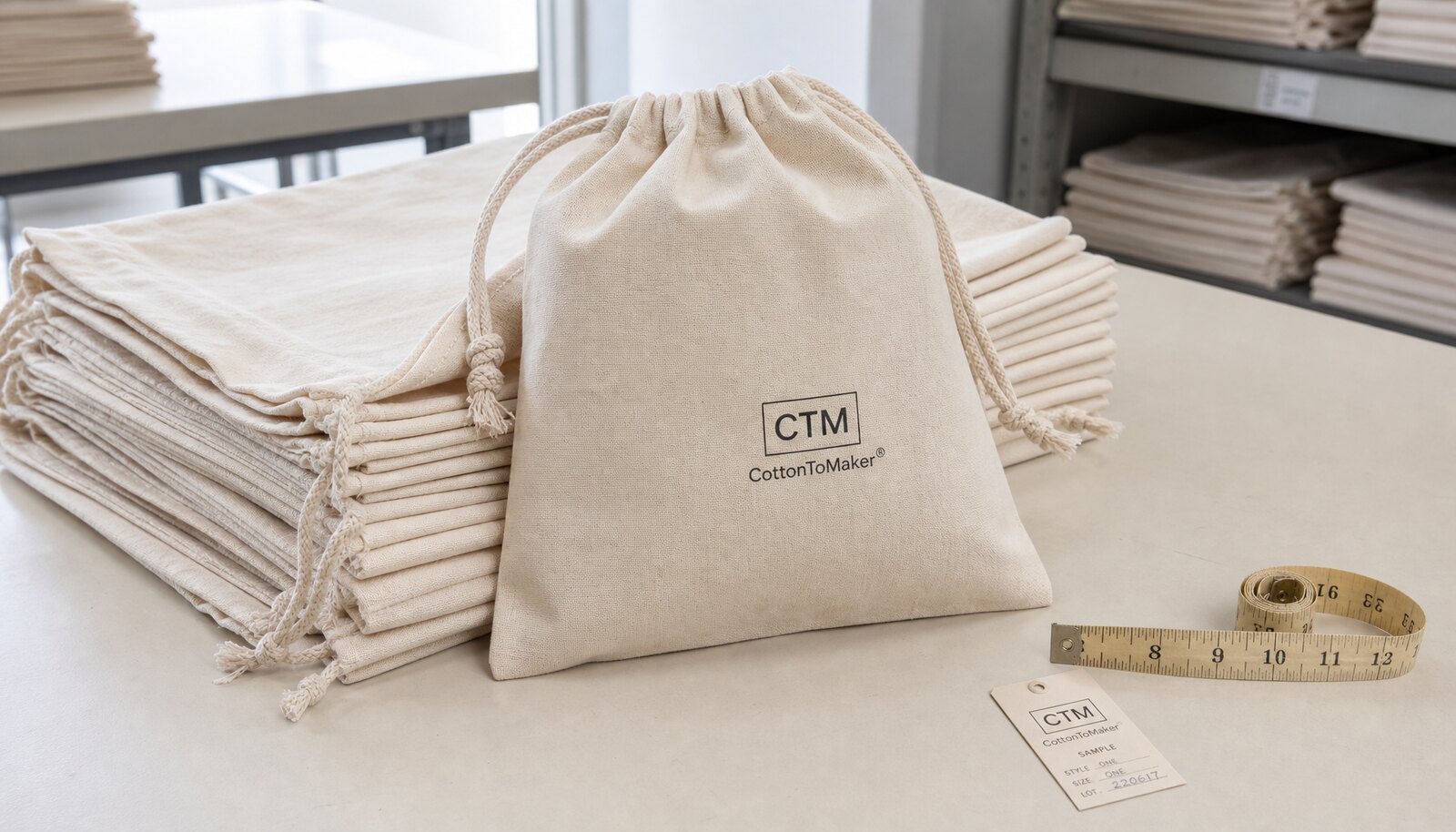
Why organic cotton drawstring bags need a tighter buyer spec than they look like
Organic cotton drawstring bags look simple, but sourcing problems usually come from vague specs rather than manufacturing difficulty. Buyers often send only a size, a logo file, and a target price. That is enough to get a quote, but not enough to keep suppliers aligned on fabric hand-feel, cord quality, print method, and packing. If you want comparable offers, the RFQ has to describe the bag in the language of the factory: fabric weight, closure construction, print area, and carton pack.
The other hidden issue is that small changes in appearance can move cost sharply. A 120 GSM natural cotton bag with one-color print is a different product from a 180 GSM premium pouch-style bag with tighter stitching and retail folding. The wrong comparison leads buyers to choose the cheapest quote and then discover the bag feels too thin, the logo bleeds through, or the pack-out is too bulky for their warehouse.
- Treat the bag as a finished retail item, not only a printed textile pouch.
- Separate the commercial decision into fabric, construction, decoration, packing, and logistics.
- Get one reference sample or a clear benchmark image before you open supplier comparison.
Start with the use case: retail insert, promo gift, or ecommerce shipment
The best size and GSM depend on what the bag carries. For jewelry cards, small cosmetics, and samples, a 120 GSM bag is often enough. For apparel, bundled gift sets, or heavier items, buyers usually move up to 140-180 GSM to improve drape, protection, and perceived value. If the bag is part of a retail brand story, the first impression matters as much as load strength. Thin fabric can make a sustainable product look cheap, even if the cotton is organic.
Do not start with artwork; start with the packed item. Measure the product, include allowance for easy insertion and drawstring closure, and decide whether the bag needs room for a hangtag, care card, or tissue paper. The bag that fits a tablet sleeve may be too narrow for a boxed product, and the bag that works for a gift set may waste fabric for small accessories. A good buyer spec always ties the bag size back to the actual packed contents.
- For small inserts: 10x14 in is a common starting point.
- For apparel or gift kits: 12x16 in is often more practical.
- For taller or premium sets: 15x18 in may reduce crowding and improve closure.
Fabric weight, weave, and finish: where most quote confusion starts
For organic cotton drawstring bags, GSM is the first cost driver buyers should lock down. A supplier may quote 120 GSM, another may quote 140 GSM, and both may call the bag “premium.” That does not help procurement. Ask for the exact GSM range, the weave style, and whether the fabric is natural, bleached, or dyed. Natural undyed fabric usually gives the cleanest eco look, while bleaching or dyeing adds process cost and can change shrinkage and print results.
The weave also matters because a looser weave can show print penetration and minor texture irregularity. A tighter weave gives a cleaner finish but usually costs more and may slow production. If the bag is sold retail, ask for fabric photos under daylight and a cut swatch in the sample. For a generic promo run, a stable midweight natural cotton is often the most efficient compromise between appearance and cost.
- 120 GSM: lighter, lower cost, suitable for simple giveaways and soft goods.
- 140-150 GSM: balanced option for most retail and brand programs.
- 180 GSM: stronger hand-feel and better premium positioning, but higher material and sewing cost.
Print method choice: the cheapest method is not always the lowest-risk method
Screen print is the default choice for most organic cotton drawstring bags because it keeps unit cost controlled at volume and gives a clean logo on a cotton base. It works best with one to two colors, bold artwork, and repeat orders. If your logo has fine lines or gradient effects, you may need digital print or transfer print, but those methods can look less natural on textured cotton and may cost more per piece.
The print decision should also reflect the fabric color. Natural cotton often shows small fiber specks and minor shade variation, which is normal and should not be treated as a defect. However, if the brand wants a very sharp logo, print placement and ink coverage need pre-production approval. The mistake is approving artwork on a white screen and then discovering the logo looks darker, smaller, or less legible on the actual bag.
- Choose one print location first: front center, lower corner, or side panel.
- Keep the artwork size realistic for the bag width and seam margins.
- If the design is detailed, request a print strike-off before full production.
MOQ and price logic: how to compare quotes without wasting time
MOQ for organic cotton drawstring bags usually changes with size, fabric weight, and print complexity. A supplier may quote one MOQ for a natural unprinted bag and a higher MOQ once you add printing or custom cord color. That is normal because sewing setup, print screens, and packing labor all scale differently. Procurement teams should look at MOQ as a production efficiency tool, not just a negotiation point.
To compare supplier quotes, ask for stepped pricing at a few volume points. For example, compare 1,000, 3,000, and 5,000 pcs for the same spec. This reveals whether the supplier is giving a real factory cost or a padded first-quote price. Also separate one-time charges such as screens, samples, labels, or artwork setup from recurring unit cost. A quote that looks cheaper may become more expensive once the setup fees are added back in.
- Use the same fabric weight and print format across all suppliers for apples-to-apples comparison.
- Separate sample fees, plate/setup fees, and packing fees from the unit price.
- If your annual volume is uncertain, avoid too many SKU splits at the first order.
Comparison table: sourcing routes for organic cotton drawstring bags
The right supplier route depends on your internal workload, not only on price. Direct factories are usually best when the spec is stable and the buyer wants tighter control over fabric, sewing, and print. Trading companies can help when the project needs coordination across multiple product types or when your team lacks bandwidth to manage sampling and packaging details. Local converters may be useful for urgent repeat runs, but their upstream cost is often higher.
The table below is useful when you need to decide which route fits your launch. Use it alongside your target lead time, artwork complexity, and tolerance for rework. If the goal is to reduce surprises, ask every supplier to quote the same spec and disclose where each part of the process happens.
Sample approval: what to approve before you release bulk production
A sample is not just for look and feel; it is the control point for dimensions, stitch behavior, and print clarity. Buyers should approve a pre-production sample or strike-off that reflects the actual fabric, actual cord, and actual print process. If the supplier sends a different cloth or uses a different print method for the sample, the approval is weak and the risk shifts back to the buyer.
When reviewing the sample, use the same practical test the end customer will use. Insert the intended product, close the bag, handle the cord, and inspect the logo from normal viewing distance. Check whether the opening feels too stiff, whether the bag collapses awkwardly, and whether the print sits cleanly away from the seam. A sample that looks good flat may fail once it is filled.
- Measure finished width and height within an agreed tolerance.
- Confirm cord length, knot security, and pull smoothness.
- Approve print placement on the actual bag, not only on artwork files.
- Record any acceptable fiber specks or shade variation for natural cotton.
Packing, carton count, and retail readiness: hidden cost drivers buyers miss
Packing has a direct effect on unit cost and freight volume. Bulk packed organic cotton drawstring bags are cheaper to produce, but retail-ready folding, polybagging, barcode application, and insert cards all add labor. If you do not specify packing clearly, one supplier may quote loose bulk packing while another includes retail folding and stickers, making the pricing look inconsistent. A good RFQ states whether bags are packed bulk, folded, polybagged, or boxed by set.
Carton count also matters for warehousing and distribution. A bag with low unit weight can still become costly if the packed volume is high. Ask suppliers for carton dimensions and pieces per carton, then estimate how that affects your pallet or container plan. For ecommerce or distributor orders, it is often worth adjusting folding method to reduce carton size, as long as the fold does not create permanent creases or damage the print.
- Specify whether each bag needs an individual polybag or not.
- Confirm barcode sticker position and whether the artwork must remain visible.
- Ask for master carton dimensions, gross weight, and units per carton before final approval.
Lead time and schedule risk: where factory delays usually happen
Organic cotton drawstring bags are not a long-lead product by textile standards, but scheduling still slips when the buyer changes artwork late or leaves sample approval open-ended. A realistic plan usually includes time for fabric booking, sample confirmation, print setup, sewing, packing, and final inspection. If the fabric is not already available in the required GSM or finish, the lead time extends quickly. This is why stable specs matter more than aggressive target dates.
The most common delay points are artwork changes, cord substitution, packing rework, and buyer-side silence after sample receipt. If your launch date is fixed, build a buffer into the schedule and define the approval deadline in writing. Also state whether the order can ship in partial lots. Some distributors prefer split dispatches, while retail buyers may need one consolidated shipment to avoid receiving mismatched dye lots or pack versions.
- Reserve extra time when the first order includes new artwork or a new bag size.
- Lock the sample approval date before production booking starts.
- Clarify whether partial shipment is acceptable if one carton batch finishes early.
Land cost comparison: why a lower factory quote can still lose
A sensible sourcing decision compares landed cost, not only EXW unit price. If one supplier has a lower quote but a higher carton volume, more labor in packing, or weaker consistency, the apparent savings can disappear after freight, damage, and rework. For organic cotton drawstring bags, the cost gap between suppliers often comes from fiber weight, print method, and packing detail more than from sewing alone.
A simple way to compare offers is to calculate what one finished, deliverable bag costs after adding setup fees, packing, inland handling, and freight allocation. Then test the risk on quality: if a cheaper quote produces 5% rejects or requires re-labeling, the landed cost changes fast. Procurement teams should compare the quote sheet with the sample, the carton spec, and the inspection standard as one package.
- Do not compare a bulk-packed factory quote with a retail-packed quote without normalizing the labor.
- Include print setup, sample courier, and carton/carton-load assumptions in the comparison.
- Watch for hidden spec downgrades such as lower GSM or thinner cord on the cheaper offer.
Specification comparison for buyers
| Spec decision | Recommended option | When it fits | Buyer risk to check |
|---|---|---|---|
| Fabric weight | 120-150 GSM for standard retail use; 180 GSM if the bag must feel premium or carry heavier inserts | Promotional kits, cosmetics, apparel inserts, gift packaging, and retail resale where hand-feel matters | Too light looks flimsy and can show print-through; too heavy can raise cost and reduce drawstring pull comfort |
| Cotton source | Organic cotton with traceable fiber claim supported by supplier documentation; use natural undyed fabric unless branding requires color | Sustainability-led brands, eco ranges, and buyers who need a cleaner marketing story on pack and online | Request evidence for the organic claim at the fabric stage; do not assume a finished bag description proves fiber origin |
| Print method | 1-2 color screen print for volume; heat transfer or digital print only when artwork changes often or runs are short | Simple logos, one-side branding, and repeat orders where unit cost matters | Overly detailed artwork can blur on coarse weave; print size and registration need approval before bulk |
| Bag size | Most buyers land on 10x14 in, 12x16 in, or 15x18 in depending on product insertion and perceived value | Accessory pouches, cosmetics, wine-style tall gifts, apparel, and event kits | Incorrect internal clearance causes product fit issues; measure the actual packed item, not the retail carton only |
| Drawstring style | Self-fabric channel with cotton cord for a cleaner retail look; polyester cord only if price pressure is severe and brand accepts mixed materials | Retail packaging, premium gifting, and eco positioning where appearance matters | Cord thickness, knot security, and sliding friction should be tested; cheap cord leads to poor closing action |
| Supplier route | Direct factory sourcing for recurring volumes; trading company only if you need faster coordination across multiple categories | Buyers with stable forecasts, artwork control, and enough time for sample review | Middleman quotes may hide the factory spec; confirm fabric mill, print subcontractor, and packing origin |
| MOQ logic | Start with 1-2 core sizes and one print setup to protect unit cost; split SKUs only after demand proof | New product launches, distributor testing, and seasonal retail runs | Too many sizes/colors at launch forces higher MOQ per SKU and increases leftover inventory risk |
| Packing method | Bulk pack by count in export cartons with size/color separation, then add retail insert or barcode only if required | Wholesale supply, ecommerce replenishment, and private label programs | Retail-ready packing adds labor and carton volume; confirm whether your quote includes folding, polybagging, and labeling |
Buyer checklist before sampling
- Final bag size with internal usable dimensions, not only flat dimensions
- Fabric GSM target and whether the fabric is bleached, natural, dyed, or pre-washed
- Cord material, cord diameter, channel construction, and knot method
- Print artwork format, print size, placement, and color count
- Packing spec, carton count, barcode requirement, and whether retail labels are needed
- Target order quantity by SKU and whether sampling cost is deductible from bulk
- Required lead time for sample approval, production, and freight booking
Factory quote questions to send
- What exact fabric GSM, weave, and finish are you quoting for this organic cotton drawstring bag?
- Is the organic cotton claim supported at fabric level, and what document can you provide with the quote?
- What is the MOQ per size, color, and print version, and how does the unit price change at 1,000 / 3,000 / 5,000 pcs?
- Which print method is included in the quote, and what are the setup charges for additional colors or artwork changes?
- What is included in packing: bulk polybag, carton count, barcode sticker, inner label, or retail insert?
- Can you share a pre-production sample timeline, mass production lead time, and production start trigger after sample approval?
- What QC standard do you use for seam strength, print alignment, size tolerance, and stain allowance?
- What assumptions are built into the quote for freight terms, carton size, and overrun/underrun allowance?
Quality-control points to confirm
- {'point': 'Fabric weight confirmation', 'acceptance_criteria': 'Measured GSM should stay within the agreed range for the approved sample, with no obvious downgrade in hand-feel or opacity.'}
- {'point': 'Finished size', 'acceptance_criteria': 'Flat dimensions should match the approved spec within an agreed tolerance, and the usable interior must fit the intended product.'}
- {'point': 'Seam quality', 'acceptance_criteria': 'No skipped stitches, open seams, loose thread bundles, or weak bottom corners after normal pull handling.'}
- {'point': 'Drawstring operation', 'acceptance_criteria': 'The cord must slide smoothly, close securely, and not jam in the channel during repeated open-close tests.'}
- {'point': 'Print quality', 'acceptance_criteria': 'Logo position, size, color density, and edge sharpness should match the approved sample under normal viewing distance.'}
- {'point': 'Stain and contamination control', 'acceptance_criteria': 'No visible oil marks, dye spots, foreign fibers, or needle damage on the face side of the bag.'}
- {'point': 'Packing accuracy', 'acceptance_criteria': 'Carton count, label position, and pack configuration should match the approved packing sheet with no mixed SKUs.'}