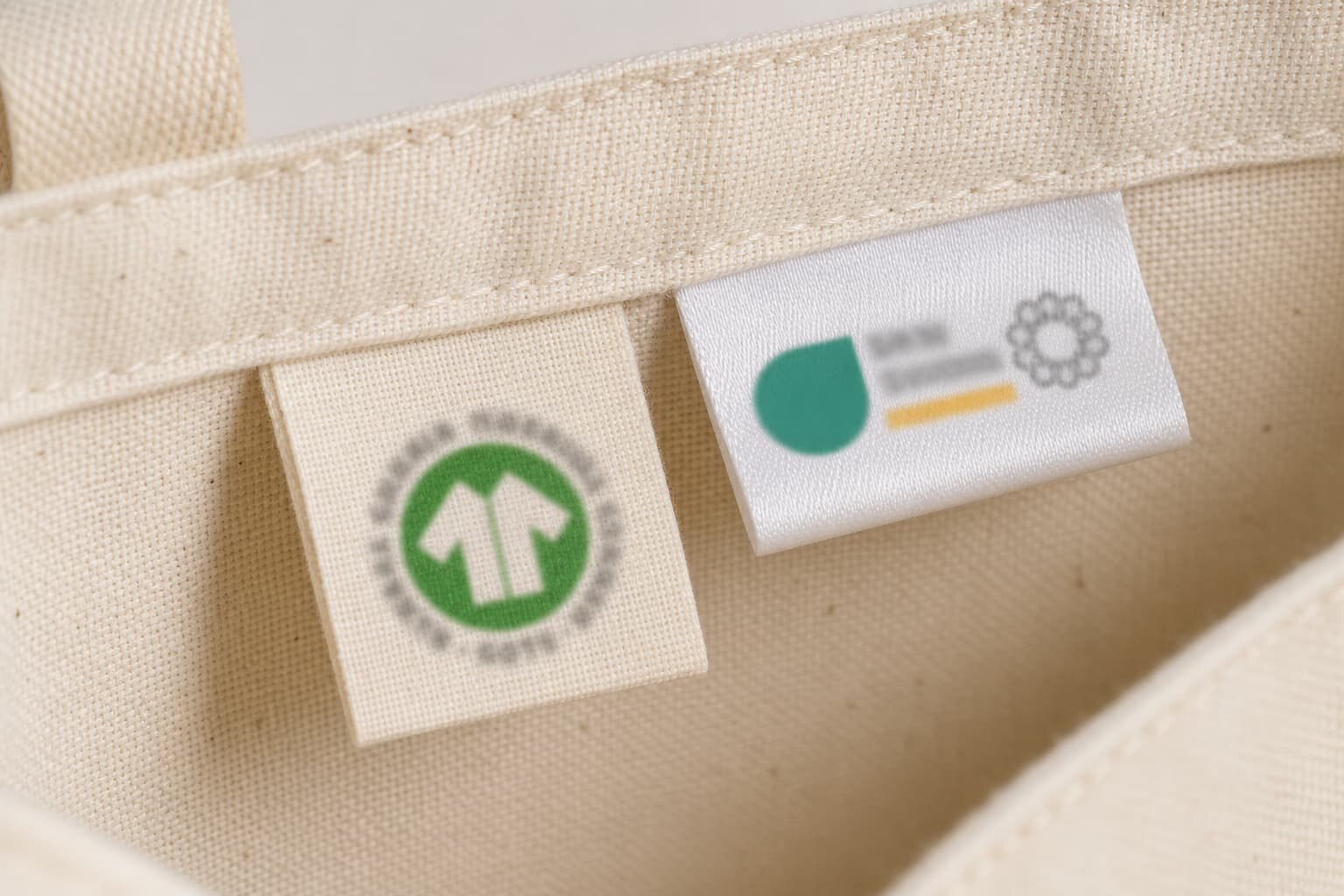
Why the woven label approval record matters
An organic cotton bag woven label approval record is not a formality. It is the document that stops small branding decisions from turning into bulk rework. A woven label can look acceptable on a flat strike-off and still fail once it is sewn into a 140 gsm tote, pressed, folded, packed, and shipped. For buyers, the record should lock the exact label artwork, size, weave density, fold, placement, and sewing method before the factory starts bulk production.
This matters even more on organic cotton bags because the body fabric is usually natural, lightly finished, and more sensitive to seam distortion than coated synthetics. If the label is too stiff, too wide, or too close to a stress point, it can pucker the fabric or twist the top hem. A good approval record gives procurement teams a clean reference when comparing suppliers, checking samples, and rejecting shortcuts that are hard to see in a quote.
- Use the record to freeze the approved version number, not just the logo file.
- Tie the label approval to the bag style, body GSM, and colorway.
- Make the supplier sign off on the same sample that will guide bulk sewing.
Lock the bag and label specs before sampling
Do not approve a woven label in isolation. Start with the bag body spec, because the fabric weight changes how the label behaves. A lightweight 140-160 gsm organic cotton tote needs a smaller, softer label than a 180-220 gsm canvas bag. If the bag is print-heavy, the approval record should also show where the label sits relative to screen print, heat transfer, embroidery, or edge stitching so the mark does not clash with the visual layout.
The record should capture practical details that sourcing teams often leave out. State the bag dimensions, seam allowance, handle width, thread color, and whether the bag will be washed, folded, or retail hung. If the bag is for supermarkets or promotional distribution, label placement may need to stay clear of the main grip area. If it is for a premium retail line, the label may need to be visible without dominating the front panel.
- Record the bag body GSM and fabric construction, such as plain weave or canvas.
- State whether the bag is printed, embroidered, or plain so the label placement stays clear.
- Confirm if the bag will be garment washed, stonewashed, or sold unwashed.
Choose the label build that fits the bag
Not every woven label suits every organic cotton bag. A high-density damask label works well when the brand needs crisp text and a detailed logo, but it can feel too dense on a soft, lightweight tote. A simpler weave may be better for plain utility bags, while a folded label can hide raw edges and look cleaner at the seam. The comparison table in this article is meant to help buyers choose the right construction before the supplier quotes the wrong option and later tries to justify a change.
The safest approval record describes both appearance and function. It should not stop at the logo artwork. It should say whether the label is center-fold, end-fold, or looped; whether it is sewn into the side seam or onto the face of the bag; and whether the thread color matches the bag or the label edge. Buyers who leave these points open often receive a quote that looks cheap on paper but creates a poor retail finish in production.
- Choose high-density weaving if small text or fine lines matter.
- Keep label size conservative on lighter bag fabrics to reduce puckering.
- Specify fold style so the factory does not decide that detail on its own.
Approve the sample on a sewn bag, not on a flat label
A flat woven label sample is useful, but it is not enough. The final approval should happen on a sewn bag made from the same fabric lot and the same construction method as bulk. That is when the real problems show up: the label may tilt after sewing, the edges may curl, the seam may pull, or the thread tension may distort the surrounding cotton. If the supplier only shows a loose label card, the buyer is still guessing.
For a proper approval, ask for a sewn pre-production sample, then inspect it under the same conditions the customer will use. Fold the bag, carry it, check the front and back, and verify that the woven label sits where the sales team expects it to sit. If the bag has a printed design, make sure the label does not interfere with the print boundary or cover key artwork. The goal is to approve a real bag, not a theoretical label.
- Check the sewn label on the same GSM and color as bulk fabric.
- Inspect the bag after folding and handling, not only when it is laid flat.
- Keep the approved sample with a version code so the factory cannot swap in a different label later.
What the RFQ should ask the factory to quote
If the woven label is not broken out in the quote, the buyer cannot compare suppliers cleanly. Ask the factory to separate setup cost, label weaving, cutting or folding, sewing labor, sample cost, and any special packing step. That matters because one supplier may include a simple one-color label in the bag unit price while another may add hidden charges for loom setup, extra colors, or a special fold. Without the line-item view, the lowest quote is often the least transparent quote.
MOQ logic should be stated in the RFQ as well. The label MOQ may be driven by loom setup and color count, while the bag MOQ may be driven by cut-and-sew capacity. A supplier might accept 500 finished bags but require 2,000 label pieces because the weave setup is amortized differently. Ask for the MOQ at each stage and ask what changes if you alter the label size, reduce the colors, or move the placement from side seam to front panel.
- Request separate line items for setup, sampling, weaving, sewing, and packing.
- Ask for MOQ at label level and finished bag level.
- Confirm whether one more label color changes both cost and lead time.
Set acceptance criteria the production line can actually follow
A useful approval record includes clear acceptance criteria. If the supplier knows exactly what is acceptable, it is easier to control the line and easier for the buyer to reject a weak batch. Set a size tolerance for the label, a placement tolerance from the seam or top edge, and a stitching standard that the factory can check inline. For example, you may accept a small size variation, but you should not accept a label that is crooked, fraying, or stitched through the visible logo area.
Do not make the criteria so strict that the line cannot meet them, but do not make them so vague that every inspection becomes a debate. On organic cotton bags, the label should remain flat, the stitch line should not damage the fabric, and the label should not create a hard ridge that annoys the end user. If the bag will be washed, folded, or retailed on hooks, the approval record should note how the label behaves after handling and whether the supplier needs a wash test or press test before bulk release.
- Example tolerance: keep placement within a few millimeters of the approved position.
- Reject visible distortion, twisting, or curled edges after sewing and pressing.
- Define what counts as a major defect versus a minor defect before production starts.
Packing and lead time: protect the label all the way out
Packing can undo a good label approval if it is ignored. A woven label may be approved perfectly on the sewing table and then arrive creased, stained, or crushed because the bags were folded over the label line or packed too tightly. The approval record should state how the bags will be folded, how many pieces go into each polybag, whether carton compression is allowed, and whether the label must stay visible or protected during transit. Small packaging choices can change how the label looks when the buyer opens the carton.
Lead time also depends on the label decision. A simple woven label may fit into a normal cut-and-sew schedule, but a new artwork revision, a different fold, or a more detailed weave can add days to sampling and approval. As a practical planning example, buyers often need extra time for artwork signoff, loom setup, pre-production sample review, and line correction before bulk. The safest schedule is the one that assumes at least one revision, then protects the ship date with a signed approval record instead of a verbal okay.
- State how the bag should be folded so the label does not crease.
- Confirm whether cartons will be strapped, overpacked, or palletized.
- Build sample and approval time into the shipment plan before you promise a customer date.
Common mistakes that turn a small label into a big claim
The most common mistake is approving artwork but not approving construction. Buyers often confirm the logo and forget the label size, fold, and seam position. The second mistake is comparing supplier quotes without separating woven label cost from bag sewing cost, which makes the apparently cheaper quote hard to police later. Another frequent problem is approving a sample on a lighter or different fabric lot, then discovering that bulk fabric changes the drape and makes the label pull or tilt.
A separate issue is over-optimizing the label for visual detail without thinking about real handling. Tiny type may look good on a digital proof, but it can become muddy on a woven label if the loom density is too low. A bold logo may look fine on a sample, but if the label is too stiff for the bag GSM, it can create a rigid corner that customers notice. Good buyers prevent these issues by tying the approval record to production behavior, not just artwork beauty.
- Do not approve from a screen proof alone.
- Do not assume the sample fabric matches bulk fabric unless it is stated in writing.
- Do not leave the fold style or sewing position open to factory discretion.
A practical buyer workflow for bulk release
A clean workflow keeps the woven label decision under control. First, send the bag style, fabric GSM, print method, and label artwork together in the RFQ so the supplier quotes the same target. Second, ask for a label strike-off or loom proof, then a sewn pre-production sample on the correct fabric. Third, sign one control sample with date, version number, and acceptance notes. Only after that should the supplier move into bulk weaving, bulk cutting, and bulk sewing.
Once the order is in production, use the approval record as the line reference. If the factory suggests a change because of material shortage or machine setup, compare it directly to the signed record. That is how procurement teams protect margin and avoid re-approving the same issue twice. For organic cotton bags, the smallest branding details often create the biggest customer complaints, so the smartest workflow is the one that treats the woven label as a controlled component, not an afterthought.
- RFQ first, sample second, signed control sample third, bulk release last.
- Keep the approval record linked to one bag style and one label version.
- Use the signed record when the factory proposes any substitution.
Specification comparison for buyers
| Spec decision | Recommended option | When it fits | Buyer risk to check |
|---|---|---|---|
| Label weave density | High-density damask | Brand name plus small logo, two to four colors, premium retail bags | Small text can blur if the loom resolution is too low |
| Label size | 20 x 50 mm to 25 x 60 mm | Most side-seam tote labels on 140-220 gsm organic cotton bags | Too large a label can pucker lighter fabric |
| Fold style | Center-fold or end-fold | When the label is sewn into a seam and you want a clean edge | Wrong fold can expose cut yarns or reduce visible area |
| Attachment method | Sewn into side seam with matching polyester thread | For washable bags and long distribution lanes | Glue or weak stitching can fail after laundering or heavy retail handling |
| Placement | Side seam near the top third | When the brand wants a visible but not intrusive mark | Too low or too close to the handle can conflict with print or grading |
Buyer checklist before sampling
- Confirm the bag body GSM, weave, and shrinkage state before approving label size.
- Lock the woven label artwork in vector format with minimum line thickness and text size.
- Approve the exact label dimensions, fold type, and cut edge finish, not just the logo artwork.
- Check the label on the same fabric lot, same color, and same bag style that will go into bulk.
- Verify label placement against seam allowance, handle stitching, and any body print area.
- Ask for separate quote lines for label setup, weaving, folding, sewing, and sample making.
- Keep one signed control sample with date, version number, and supplier stamp or signature.
- Record packing method, carton count, and whether labels must stay visible or protected in transit.
Factory quote questions to send
- What is the MOQ for the woven label only, and what is the MOQ for the finished bag with that label attached?
- Please split the quote into setup, sample, label weaving, cutting or folding, sewing, and packing.
- How many label colors are included in the quoted price, and what changes if we add one more color?
- What label size and weave density did you price, and can you hold the same quality at our target size?
- What is the standard lead time for artwork approval, woven label sampling, and bulk bag production?
- Can you show the exact placement on a sewn sample and confirm the seam allowance you will use?
- What tolerances do you allow for label size, placement, and stitch length during bulk sewing?
- How will you pack the bags so the woven labels do not crease, twist, or pick up dirt before delivery?
Quality-control points to confirm
- Check the label against the approved artwork at actual size, not only on a screen.
- Verify color match under daylight or a controlled light box, especially on natural cotton backgrounds.
- Measure label width and length against the signed control sample, including folded dimensions.
- Inspect stitch quality: no skipped stitches, no loose tails, and no needle damage to the bag fabric.
- Confirm label placement is within the agreed tolerance from the top edge, side seam, or handle line.
- Make sure the label lies flat after pressing and does not curl, buckle, or twist the seam.
- Test the bag by folding and handling it as the customer will, to catch label irritation or seam stress.
- Record any deviation by bag style, fabric lot, or production line so the supplier can correct it before bulk release.