Organic Cotton Bag Wholesale Supplier RFQ Checklist for Sample Approval in Australia
By Vincent Xi, Editorial Author
> Decision rule: For a wholesale order destined for Australia, treat sample approval as a production-release gate. Require a physical bulk-intent pre-production sample (PPS) linked to the supplier quotation, SKU, material reference, artwork revision, label layout, and pack-out. Check it against the RFQ, record actual results and accepted deviations, verify required organic-claim documents, and release bulk work only in writing after the supplier confirms which irreversible activities remained on hold.
The cited sources support the core sequence, not a universal specification. The Lucky Star sample-approval article advises buyers to confirm approval-sample capability and final sample approval before bulk production. The Initipacking manufacturer page presents PPS as part of its custom tote process. The Pamusan guide recommends physically handling the bag and checking stitching, handle strength, print clarity, and fabric weight.
Here, bulk-intent PPS is a buyer-defined RFQ term for a physical sample made to the intended production specification. It does not assume that a supplier's ordinary development sample qualifies. The scope is organic cotton bag wholesale supplier sample approval for Australia—not supplier discovery, a generic country guide, or a complete import-compliance guide.
Sample approval decision for a wholesale order to Australia
Under this buyer-defined protocol, only a bulk-intent PPS can become the physical basis for a production release.
| Sample evidence | What it can establish | Release status under this protocol |
|---|---|---|
| Digital mock or technical drawing | Proposed artwork layout and dimensional callouts | Not eligible; it cannot verify material, construction, decoration, labels, or pack-out |
| Fabric swatch or colour cutting | An identified fabric reference, finish, and shade | Not eligible; it does not represent the completed bag |
| Development sample | Early shape, workmanship, and branding decisions | Not eligible while it contains substitute material, temporary trims, draft artwork, non-final labels, or a different packing method |
| Bulk-intent PPS | Intended material, construction, decoration, labels, and sample pack-out | Eligible only after every mandatory RFQ field passes and the decision is recorded in writing |
| Retained approved PPS | Physical comparison reference for the released revision | Reference only; it does not replace written approval, change control, or bulk inspection |
After reviewing the eligible PPS, record the applicable outcome:
- Release for bulk: Every mandatory RFQ field passes, required organic-claim documents are current and relevant to the stated scope, sample commercial terms are resolved, and every accepted deviation is documented.
- Hold and resample: Material, fabric mass, dimensions, handles, seams, decoration, labels, pack-out, test evidence, or claim documents differ from the RFQ.
- Do not release: Only a mock, photograph, swatch, or substitute-material sample is available; the sample cannot be tied to the quotation and revision; or the supplier will not observe the approval hold.
Approval applies only to the identified quotation, SKU, material reference, colour, artwork revision, label layout, and packing method. Renaming a development sample in an email does not establish that it was made to the intended bulk specification. This release threshold is a buyer control, not a requirement imposed by a named standard.
Source-backed sample fee and lead-time data
Use published figures only as quote-checking context. None establishes a binding price or delivery commitment for an organic cotton bag order to Australia.
| Published data point | Source, scope, and date context | What to verify in the supplier quotation |
|---|---|---|
| USD 5–15 sample fee | Pamusan guide. Scope: its general wholesale tote sample-fee context, not an organic-cotton-only or Australia-landed quotation. Date context: the page presents itself as a 2026 guide. | Charging basis, inclusions, currency treatment, courier charges, and any fee-credit conditions |
| 3–5 business days sample lead time | Pamusan guide. Scope: general wholesale tote sampling, excluding courier transit and any Australia delivery promise. Date context: the page presents itself as a 2026 guide. | Clock-start event, working calendar, material availability, revision status, and whether dispatch time is excluded |
| 7–10 business days for PPS production | Initipacking manufacturer page. Scope: the manufacturer's stated custom tote PPS process. Date context: the page is undated and shows no publication or update date. | SKU, bulk-intent material, decoration, labels, capacity, and the event that starts the lead-time clock |
| 15–30 days for bulk manufacturing, depending on order volume | Initipacking manufacturer page. Scope: its manufacturer-stated production period, excluding sample courier and Australia door-to-door freight. The stated unit is days, but the source does not identify them as business or calendar days. Date context: the page is undated and shows no publication or update date. | Day type, production start after written approval, current capacity, order scope, and separation from freight time |
The same undated Initipacking page describes sample fees as fully refundable upon bulk order placement. Treat that as a supplier-stated condition rather than a general market rule. Require the current quotation to define whether the credit depends on the same SKU, purchase order, quantity threshold, validity period, or invoice treatment.
The sample quotation should also state:
- Fee currency and charging basis by SKU, size, colourway, artwork revision, or decoration method.
- Included materials and work, including bulk-intent fabric, decoration, labels, sample pack-out, and physical dispatch.
- Whether courier delivery to the Australian sample address is included or quoted separately.
- The fee-credit trigger, exclusions, expiry condition, and invoicing method.
- The lead-time unit, working calendar, and clock-start event, such as cleared payment, artwork lock, or confirmed material availability.
- The fee and timing rules for a rejected sample, buyer-requested revision, or supplier-caused correction.
- The bulk-production period after written approval, kept separate from bulk freight to Australia.
Measurable organic cotton bag sample approval matrix
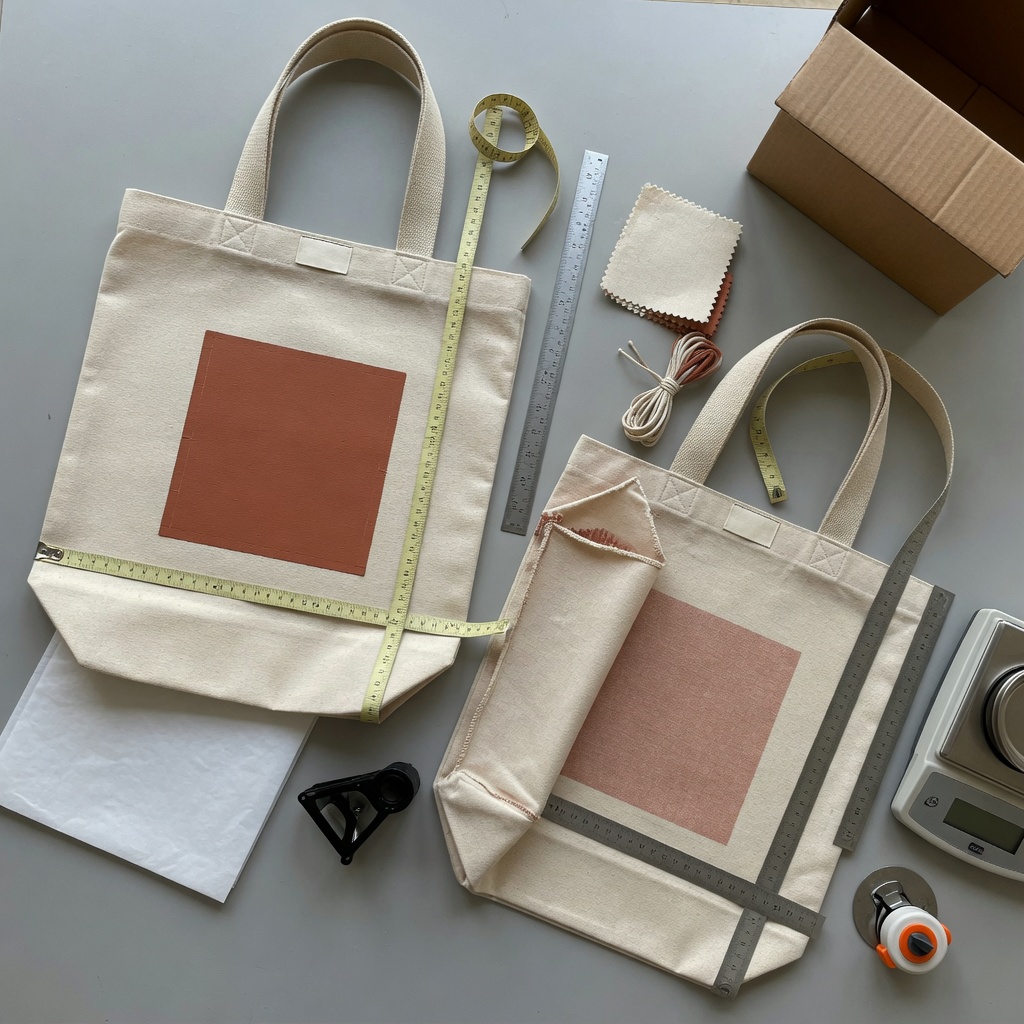
Pamusan specifically names stitching, handle strength, print clarity, and fabric weight as physical checks. The matrix translates those categories into measurable RFQ fields and adds buyer-defined traceability controls. Targets, tolerances, and test methods must be set by the buyer and confirmed in the current supplier quotation.
| Approval control | Lock into the RFQ | Record before release |
|---|---|---|
| Product and revision identity | Supplier quotation reference, SKU, sample stage, revision, material reference, artwork revision, label revision, and pack-out revision | Matching identifiers on the physical sample record and supporting documents; hold if the sample cannot be tied to the quoted revision |
| Material and organic-claim scope | Exact composition and claim wording, included and excluded components, fabric reference, weave, finish, colour, and required document scope | Physical observations plus relevant document holder, site, process, product, and validity details; hold for substitutions, unclear component scope, or mismatched documents |
| Fabric mass | Target and tolerance in grams per square metre, measurement method, specimen condition, and decoration status | Actual result, method used, and pass or hold decision; hold when no agreed method is used or the result falls outside the buyer-set tolerance |
| Finished dimensions | Targets and tolerances in millimetres for width, height, gusset depth, handle length, handle drop, and handle width, plus the measurement condition | Actual result for every required dimension; hold when a mandatory result is absent or outside tolerance |
| Handles and seams | Handle material, dimensions, placement, attachment, reinforcement, seam type, edge finish, thread requirement, workmanship criteria, and any required strength method and pass rule | Construction observations and any agreed test result tied to the sample revision; hold for missing reinforcement, changed construction, defined workmanship defects, or a failed test |
| Decoration | Decoration method, locked artwork revision, colour target, placement offsets in millimetres, print area, surface criteria, and any required performance method | Placement, clarity, appearance, colour comparison, and method result where required; hold for draft artwork or an unmet mandatory criterion |
| Labels and pack-out | Final buyer-approved artwork, label material, attachment, placement, fold method, inner protection, grouping, carton arrangement, and approved marking artwork | Physical label and pack-out evidence; hold when labels remain a paper representation or packing differs from the RFQ |
| Performance evidence | Named method, sample conditioning, load or use condition, duration or cycle basis, pass rule, report format, and destructive-test handling where required | A result or report identifying the tested construction and revision; hold when the method, construction, or pass rule does not match the RFQ |
| Approval file | Current quotation, material references, locked artwork, measured-results sheet, deviation record, and required organic-claim documents | Documents matched by holder, site, product, process, revision, and validity where applicable; hold for unavailable, expired, generic, or mismatched evidence |
Organic-claim document gate at sample approval
The cited sources do not establish certification or transaction documentation for a specific supplier, site, or SKU. Physical appearance is therefore not evidence for an organic claim.
- Put the exact organic-cotton claim intended for the purchase order, product record, and buyer-approved label artwork into the RFQ.
- State whether the claim covers the bag body, handles, thread, labels, decoration, or other components, and identify any excluded conventional components.
- If the buyer requires a named textile standard, record it as a buyer requirement and request current documents covering the relevant holder, site, process, product, and validity scope.
- Distinguish the stated scope of a standard-related document from the supplier's own description of its sourcing or production practices.
- Request lot or transaction evidence only when the buyer's specified document programme requires it.
- Do not describe the supplier, manufacturing site, sample, or bulk goods as certified unless a current document supports that wording for the relevant scope.
A PPS can pass its physical checks while the overall release remains on hold for claim documentation. Clear both the physical and document gates before authorising bulk production.
Written sample approval and change control
The release record should identify exactly what the buyer has approved. Include:
- Buyer and supplier legal names and the intended manufacturing site.
- RFQ, supplier quotation, and purchase-order references where applicable.
- SKU, physical sample identifier, sample stage, and revision.
- Material, colour, trim, artwork, label, and pack-out references.
- Completed measurement, workmanship, decoration, and performance results.
- Organic-claim documents reviewed, their stated scope, and any unresolved exclusion.
- Every accepted deviation and the RFQ field it replaces.
- Decision status: approved for bulk, held pending a revised PPS, or rejected.
- Approval date and the authorised buyer's name and role.
- Supplier acknowledgement of the production hold or release.
- Location and identifier of the retained physical reference sample.
A post-approval change affecting material, construction, dimensions, handles, decoration, labels, packing, manufacturing site, or organic-claim scope should enter written change control. Keep the affected activity on hold until the buyer decides whether document review is sufficient or a revised physical PPS is required.
Sample approval does not prove that every bulk unit conforms. The Lucky Star article separately places quality inspection after bulk production and before shipment, supporting a distinct bulk-quality gate rather than replacing it with the PPS (Lucky Star sample-approval article).
Australia sample approval: freight and label hand-off
The cited evidence does not provide Australian legal label wording, sample courier rates, import charges, freight transit times, or climate-handling requirements. This article therefore does not prescribe them. Instead, make Australia-specific hand-off details explicit in the sample quotation and approval record.
Add:
- The physical-sample delivery address and postcode in Australia.
- Courier method, account holder, payer, and charges included or excluded from the sample fee.
- Sample-making time, dispatch time, and courier transit as separate fields.
- The sample freight term and named place, kept separate from the intended bulk freight term.
- The buyer's sample-review deadline and the person authorised to issue the production release.
- Final label artwork supplied after the buyer's Australian compliance review; the supplier should not infer legal wording.
- Sample pack-out requirements needed by the Australian receiving operation.
- Separate quotation lines for sample production, sample freight, bulk production, and bulk freight.
A published manufacturing duration is not an Australia door-to-door commitment. Require the current quotation to separate PPS production, buyer review, bulk manufacturing, and freight.
Practical RFQ checklist for organic cotton bag sample approval in Australia
Use this checklist before sending the RFQ and again when reviewing the physical PPS. A blank box means the requirement remains unresolved; it is not approval by silence.
RFQ identity and scope
- [ ] State Australia as the sales market and physical PPS destination.
- [ ] Identify the buyer, supplier, intended manufacturing site, quotation reference, SKU, and revision.
- [ ] Define the required sample as a physical bulk-intent PPS rather than a mock, swatch, or substitute-material development sample.
- [ ] State that approval-stage substitutions require the buyer's written acceptance.
- [ ] Link the PPS to the intended material, colour, decoration, labels, and pack-out revisions.
Product and claim requirements
- [ ] State the composition, fabric reference, weave, finish, colour, and exact organic-claim scope.
- [ ] Identify which bag components are included in or excluded from that claim.
- [ ] Specify fabric-mass, finished-dimension, handle, seam, reinforcement, decoration, and workmanship requirements with buyer-set units and tolerances.
- [ ] Define the measurement or performance method and pass rule for every mandatory result.
- [ ] Request current organic-claim documents relevant to the stated holder, site, product, process, and validity scope.
Commercial and timing terms
- [ ] Obtain the sample fee, currency, charging basis, inclusions, courier treatment, and fee-credit conditions in writing.
- [ ] Separate PPS production time, dispatch time, courier transit, buyer review, bulk production, and bulk freight.
- [ ] Record the clock-start event, working calendar, correction rule, resample fee, and resample timing.
- [ ] Confirm the Australian delivery address, postcode, courier account holder, payer, freight term, and named place.
Physical PPS review
- [ ] Confirm that the sample identifier and revision match the quotation and supporting files.
- [ ] Record actual fabric-mass and finished-dimension results rather than visual estimates.
- [ ] Inspect stitching, handle construction, reinforcement, seam finishing, decoration clarity, placement, labels, and sample pack-out.
- [ ] Compare the physical decoration and label arrangement with the locked buyer-approved artwork.
- [ ] Record every nonconformity, missing document, and proposed deviation against its RFQ field.
Release and retention
- [ ] Mark the decision as release for bulk, hold and resample, or do not release.
- [ ] Identify every accepted deviation in the written approval record.
- [ ] Obtain supplier acknowledgement of the release decision and the activities that remained on hold.
- [ ] Retain an identified approved PPS as the physical comparison reference.
- [ ] Require written change control and, where necessary, a revised PPS for post-approval changes.
Copy-and-send organic cotton bag sample approval RFQ
The published fee and timing figures above are source context only. Leave the commercial and technical values open until the supplier provides a current quotation and the buyer verifies them.
```text Product family: organic cotton bag Primary sales market and physical PPS destination: Australia Buyer legal entity: Supplier legal entity: Intended bulk manufacturing site: Supplier quotation reference: SKU and sample revision:
Required sample status: bulk-intent pre-production sample Physical sample quantity sent to buyer: Matching sample quantity retained by supplier: Development-stage substitutions permitted: Approval-stage substitutions permitted: none unless accepted in writing
Organic-cotton claim wording: Components included in the claim: Components excluded from the claim: Required current claim documents and scope: Material reference: Composition, weave, finish, and colour reference: Fabric-mass target and tolerance, grams per square metre: Fabric-mass verification method and condition:
Finished width target and tolerance, millimetres: Finished height target and tolerance, millimetres: Gusset-depth target and tolerance, millimetres: Handle-length target and tolerance, millimetres: Handle-drop target and tolerance, millimetres: Handle-width target and tolerance, millimetres: Measurement condition: Handle attachment and reinforcement: Seam, edge-finish, thread, and stitch requirements: Buyer-defined performance method and pass rule, if required:
Decoration method and locked artwork revision: Placement offsets and print area, millimetres: Colour target and decoration acceptance criteria: Label artwork, material, attachment, and placement: Required sample pack-out:
Sample fee, currency, charging basis, and scope: Courier included or excluded: Fee-credit trigger, exclusions, and validity: Sample lead-time unit and clock-start event: Working calendar: Correction, revision, and resample fee rule: Correction, revision, and resample timing rule:
Australian delivery address and postcode: Courier method, account holder, and payer: Quoted dispatch and courier transit: Sample freight term and named place: Buyer review deadline: Authorised buyer signatory:
Required approval record and supporting evidence: Supplier acknowledgement required: Bulk-production hold activities: Bulk-production period after written approval: Bulk freight quoted separately: Approved physical sample retained as the comparison reference: Written change-control and revised-PPS rule: ```
Evidence method, source contexts, and limitations
Method. Sampling statements were extracted from the cited pages and classified as process guidance, buyer-guide inspection advice, or supplier-stated commercial claims. Numeric ranges were transcribed without averaging, currency conversion, extrapolation, or treatment as Australia quotation promises. The decision rules, measurement fields, document gate, checklist, and RFQ are buyer controls derived from the cited sampling guidance; they are not source-imposed specifications or named-standard requirements. No factory visit, laboratory test, customer outcome, or independent supplier audit is used as evidence.
Source contexts.
- The Lucky Star sample-approval article supports checking approval-sample capability, obtaining final sample approval before bulk production, and keeping post-production quality inspection as a separate step. It is not used as Australian legal, label, or freight guidance.
- The Pamusan guide supports handling the actual bag, checking stitching, handle strength, print clarity, and fabric weight, and the page-labeled fee and timing figures in the benchmark table. Its cited scope is wholesale tote bags rather than a current organic-cotton-only Australian quotation.
- The Initipacking manufacturer page supplies undated manufacturer statements about PPS timing, sample-fee refund treatment, and bulk-manufacturing timing. These are supplier-stated examples, not independent verification or a current quotation.
Limitations and what to verify. The cited evidence does not establish a current supplier quotation, certification for a specific SKU, Australian legal label wording, courier price, freight transit, fixed bag dimensions, fabric-mass target, tolerance, test method, or bulk conformity. The manufacturer page is undated, and its statements are self-reported. Before release, obtain the physical bulk-intent PPS, current quotation, completed measurement sheet, locked artwork, approved label layout, relevant current claim documents, written deviation record, and supplier acknowledgement of the production hold or release.
Author basis. The Vincent Xi author profile identifies Vincent Xi as Editorial Author. The profile does not support personal claims of factory visits, product tests, certification audits, client work, or customer outcomes, and this article makes none.
Discuss Your Requirements
Review our manufacturing capabilities, then share your specifications for a supplier-fit review.