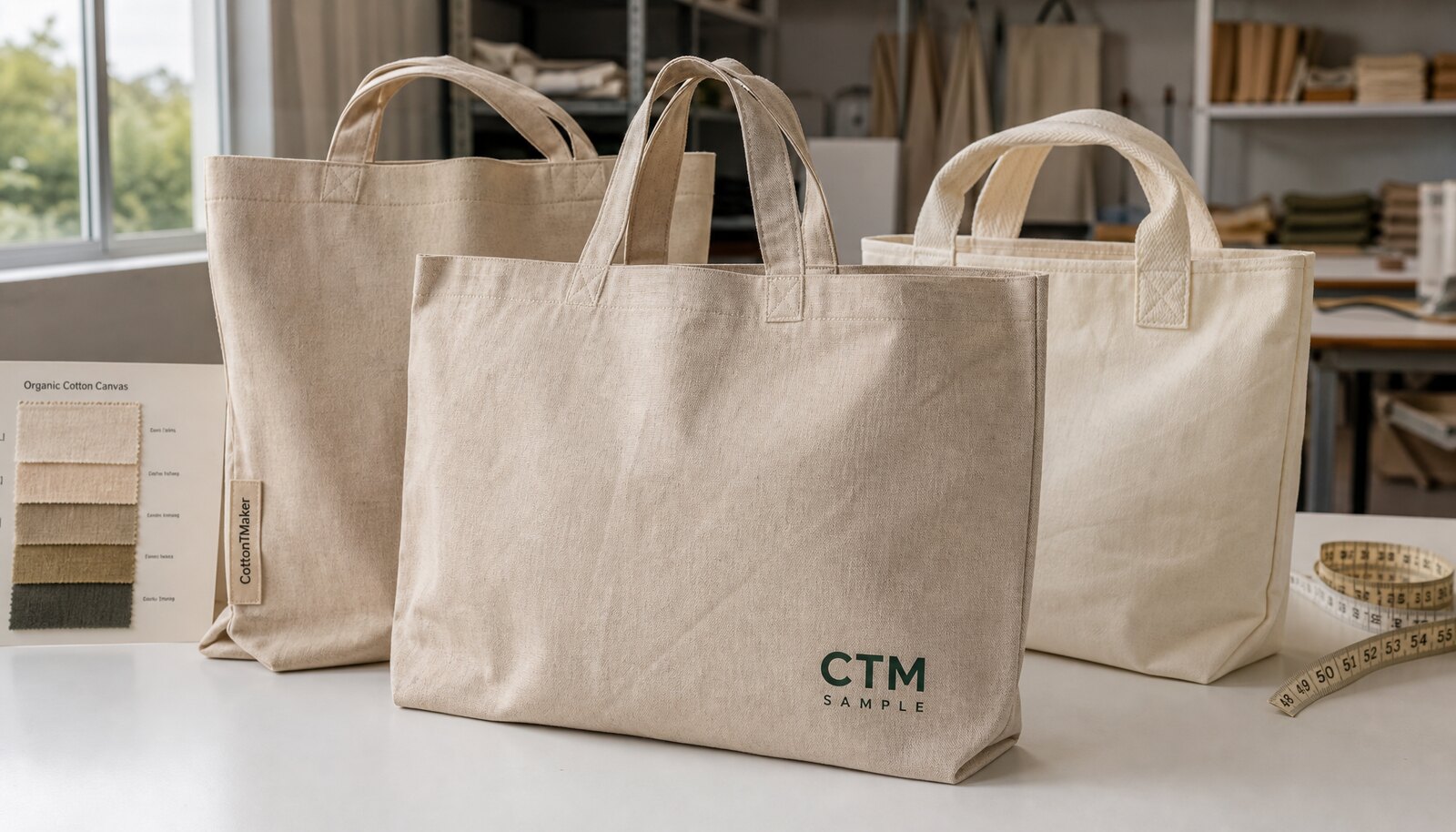
1. Start the quote with the buying purpose, not only the bag name
Many RFQs for an organic cotton bag start with a photo and a quantity. That is not enough for a reliable wholesale quote. The same photo can be produced as a thin 5 oz promotional tote, an 8 oz daily-use tote, or a 10 oz retail canvas bag. Each version changes fabric cost, print quality, sewing time, carton volume, and shipping weight.
Before asking for prices, state how the bag will be used. A corporate conference bag may only carry brochures for one day, while an employee onboarding bag may carry a laptop, bottle, notebook, and gift items. A retail buyer needs better shape control, cleaner finishing, and packaging suitable for shelf or ecommerce dispatch. The factory can quote more accurately when the use case is clear.
- Event giveaway: prioritize cost control, fast production, bulk packing, and acceptable logo visibility.
- Corporate gift: prioritize hand feel, stronger handles, better sewing, and cleaner print edges.
- Retail resale: prioritize consistent sizing, hangtags, labels, individual packing, carton markings, and barcode requirements.
- Packaging replacement: prioritize repeat orders, fixed dimensions, print consistency, and packing efficiency.
2. Convert fabric descriptions into GSM and construction details
Organic cotton bags are often quoted using terms like natural cotton, canvas, muslin, heavy cotton, or eco tote. These words are not precise enough for procurement comparison. Ask for fabric weight in both ounces and GSM where possible. A 5 oz fabric is usually around 170 GSM, 6 oz around 200 GSM, 8 oz around 270 GSM, and 10 oz around 340 GSM, though actual values depend on weave and finishing.
The fabric also needs a construction description. Plain weave cotton feels different from canvas. Brushed cotton feels softer but may show more lint during printing. Natural unbleached fabric usually has cotton seeds and small specks; this is normal, but buyers should define the acceptable appearance. Dyed organic cotton adds more control issues because shade variation and color fastness must be checked.
- 5 oz to 6 oz: suitable for lightweight event bags, mailer inserts, and simple giveaways.
- 7 oz to 8 oz: a balanced option for corporate gifts and repeated daily use.
- 10 oz and above: stronger retail-style bag, but higher unit cost and freight weight.
- Natural unbleached: lower processing and common for sustainability programs, but specks and shade variation are visible.
- Dyed organic cotton: better brand matching, but confirm fabric MOQ, dye lead time, and shade tolerance.
3. Specify finished dimensions and carrying capacity before comparing prices
A small change in size can create a real cost difference. Increasing a tote from 38 x 42 cm to 42 x 45 cm may look minor on paper, but it can increase fabric consumption enough to affect the quote. Adding a 10 cm gusset changes the cutting layout, sewing process, carton volume, and final capacity. If suppliers are quoting different measurement methods, the comparison becomes misleading.
Use finished dimensions, not only cutting dimensions. Finished size means the bag after sewing and pressing, measured flat unless otherwise stated. For corporate buyers, handle drop is especially important. A 25 cm handle drop may allow shoulder carry for many users, while a short handle may only work as a hand-carry bag. If the bag will hold folders, catalogs, wine bottles, or gift boxes, provide the insert size and expected weight.
- Quote format example: finished size 38 W x 42 H cm, no gusset, handle 2.5 W x 60 L cm, shoulder carry.
- Boxed bottom example: finished size 36 W x 40 H x 10 D cm, suitable for employee kit packing.
- Tolerance suggestion: size plus or minus 1 cm for standard totes, tighter only if the packing purpose requires it.
- Load expectation: state whether the bag should carry 3 kg, 5 kg, or only paper materials.
- Reinforcement: ask for cross-stitch, bar tack, or double stitching at handle joints when carrying weight matters.
4. Choose the logo method based on fabric, artwork, and order use
For most organic cotton corporate bag orders, water-based screen printing is the practical first choice. It works well on natural cotton, gives a softer hand feel than heavy plastisol, and is efficient for simple one-color or two-color logos. However, organic cotton has absorbency and surface texture. Fine lines, small text, and large solid ink areas should be tested on the actual fabric before bulk production.
Other branding methods may be better depending on the buyer’s goal. Heat transfer can reproduce gradients but may feel less natural and can create durability concerns if the bag is folded tightly. Embroidery adds perceived value but may pucker lightweight fabric. Woven labels and side labels are useful when the buyer wants subtle branding or retail labeling. The quote should identify the exact method, number of colors, print size, and print positions.
- Screen print: best for flat logos, slogans, simple artwork, and medium to large quantities.
- Water-based ink: softer finish and common for cotton bags; confirm rub resistance and curing.
- Heat transfer: useful for complex full-color artwork; confirm washing, cracking, and folding performance.
- Embroidery: premium look; use stronger fabric and avoid oversized dense stitch areas.
- Woven label or sewn label: good for brand detail, but placement must be fixed in the sample.
5. Understand MOQ logic so a low price does not hide a spec change
MOQ is not only a sales rule. It is linked to fabric sourcing, dyeing, printing setup, cutting efficiency, label production, and packing labor. A supplier may accept 500 pieces if using available natural organic cotton fabric and one-color screen print. The MOQ can rise when the buyer requires custom dyed fabric, custom woven labels, several print positions, or individual retail packing.
When comparing wholesale quotes, ask what the MOQ is based on. A very low MOQ may be using stock fabric that is close to the requested fabric but not identical. That may be acceptable for a trial order, but it is risky for a brand program that will reorder. For repeat corporate programs, the buyer should know whether the factory can reserve fabric, match future lots, or maintain a technical file for reorders.
- Stock natural fabric usually gives the lowest MOQ and fastest sampling.
- Custom dyed organic cotton often requires higher fabric MOQ and shade approval.
- Multi-color printing increases screen setup and may affect minimum charge.
- Custom woven labels, hangtags, and barcode stickers may have their own MOQs.
- Individual packing increases labor time and can raise the practical MOQ for efficient production.
6. Ask for a quote breakdown instead of one unexplained unit price
A single unit price is not enough for serious procurement. It does not show whether the supplier included the same fabric, print method, sample, labeling, packing, carton standard, or trade term. One quote may include individual polybags and export cartons, while another may be bulk packed in weak cartons. One quote may include screen setup; another may charge it later.
You do not need the factory to reveal every internal cost, but you should ask for a commercial breakdown that makes comparison possible. At minimum, separate the bag unit cost, logo cost if variable, sample charges, packing charges, testing or documentation charges if applicable, and freight or trade term. Also check quote validity, because cotton fabric and freight costs can change.
- Bag base: fabric weight, size, gusset, handles, stitching, and natural or dyed fabric.
- Branding: print method, color count, print size, print positions, screens, and labels.
- Sampling: blank sample, print strike-off, pre-production sample, courier charge, and approval lead time.
- Packing: bulk pack, individual bag, paper band, hangtag, barcode sticker, carton quality, and carton marks.
- Commercial terms: MOQ, unit price, currency, trade term, port, payment terms, production lead time, and quote validity.
7. Treat samples as engineering approval, not a sales formality
For an organic cotton bag order, the sample is where many future problems can be prevented. A photo approval may show the general logo position, but it cannot confirm fabric thickness, hand feel, handle comfort, seam strength, print texture, or folding marks. If the order is for a corporate launch, retail program, or distributor catalog, approve a physical pre-production sample before mass production.
Sample evaluation should be structured. Measure the size, check handle drop, compare fabric to the quoted GSM, inspect stitch quality, rub the print surface, fold the bag as it will be packed, and place the intended contents inside. If the sample fails, do not only say “improve quality.” Mark exact revisions: increase handle length to 60 cm, move logo down 3 cm, change print color to Pantone reference, use cross-stitch reinforcement, or reduce seam puckering.
- Blank sample: confirms fabric, size, shape, handle, and sewing construction.
- Print strike-off: confirms logo color, ink coverage, edge sharpness, and print hand feel.
- Pre-production sample: confirms the full final specification before bulk cutting.
- Packing sample: confirms folding method, label position, polybag or paper band, and carton presentation.
- Approval record: keep signed sample photos, measurement sheet, artwork file, and packing file together.
8. Build realistic lead time around approvals, not only sewing days
Lead time should be counted from confirmed artwork, approved sample, deposit, and available materials—not from the first email. For a simple stock natural organic cotton tote with one-color printing, production can be straightforward after approval. For dyed organic cotton, custom labels, multiple print positions, or retail packing, the schedule needs more steps and more checkpoints.
Corporate buyers often work backwards from an event date or product launch. That is risky if the schedule ignores sample revision, print strike-off approval, inspection booking, export customs, vessel space, or air freight contingency. Ask the factory to provide a timeline with dates for material preparation, cutting, printing, sewing, trimming, inspection, packing, and shipment handover.
- Artwork confirmation: vector file, Pantone references, print size, and placement approved.
- Sample stage: blank sample or pre-production sample made, shipped, reviewed, and revised if needed.
- Material stage: fabric stock confirmed or custom fabric woven/dyed and inspected.
- Production stage: cutting, printing, curing, sewing, trimming, pressing, and packing.
- Shipment stage: inspection, final packing list, booking, customs documents, and cargo handover.
9. Define packing early because it affects cost, appearance, and freight
Packing is often discussed too late. For event distribution, bulk packing may be enough: folded bags packed by fixed quantity into export cartons. For retail or ecommerce, the buyer may need individual packing, hangtags, barcodes, warning labels, carton labels, and a cleaner folding method. These requirements increase labor and carton volume, so they should be included in the first RFQ.
Organic cotton fabric can crease, especially heavier canvas. If bags are folded across the printed logo, the print may show pressure marks after long shipping. If bags are packed too tightly, the shape may look poor when opened at the event or store. Ask for a packing photo or packing sample showing fold direction, pieces per inner pack if any, carton quantity, carton dimensions, gross weight, and carton marks.
- Bulk pack: lowest packing cost, suitable for internal distribution and events.
- Individual recycled polybag: protects each bag, useful for ecommerce or warehouse handling.
- Paper band: plastic-reduction option, but offers less dust and moisture protection.
- Hangtag and barcode: required for retail resale; confirm placement and scanning readability.
- Carton planning: carton weight should remain practical for warehouse handling and export transport.
10. Set acceptance criteria before production starts
Quality disputes usually happen when the purchase order says “good quality” but does not define what good quality means. Organic cotton has natural variation, and printed fabric goods have normal production tolerances. The buyer and factory should agree on what is acceptable before cutting bulk fabric. This protects both sides and reduces argument at inspection.
Acceptance criteria should cover measurements, fabric weight, color shade, print result, stitching, stains, odors, packing, and quantity. For larger wholesale orders, use an inspection standard such as AQL if your company already applies one, and define critical, major, and minor defects. For example, a wrong logo color or broken handle is major or critical, while a small loose thread may be minor if it can be trimmed.
- Dimension tolerance: define acceptable variation for width, height, gusset, and handle drop.
- Print tolerance: define logo position tolerance, color standard, and acceptable ink coverage.
- Sewing defects: reject broken stitches, open seams, twisted handles, and weak reinforcement.
- Appearance defects: define rules for stains, oil marks, severe slubs, shade panels, and odor.
- Packing defects: reject wrong carton marks, incorrect quantities, missing labels, and damaged cartons.
Specification comparison for buyers
| Spec decision | Recommended option | When it fits | Buyer risk to check |
|---|---|---|---|
| Fabric weight for basic corporate giveaway | 5 oz to 6 oz organic cotton, natural color | Large event quantities, lightweight inserts, budget-controlled campaigns | Too thin for heavy catalogs; confirm shrinkage and seam strength before approving bulk |
| Fabric weight for retail or employee welcome kit | 8 oz to 10 oz organic cotton canvas | Merchandise programs, HR kits, reusable office bags, distributor resale | Higher unit cost and freight weight; check handle reinforcement and print hand feel |
| Fabric color | Natural unbleached or dyed organic cotton | Natural works for sustainability messaging; dyed fabric fits strict brand color programs | Dyed organic cotton may need higher MOQ and longer lead time; confirm dye fastness and shade tolerance |
| Logo printing | Water-based screen print for simple 1 to 3 color artwork | Corporate logos, campaign slogans, flat solid graphics | Ink absorption varies by fabric texture; request strike-off on actual fabric before mass production |
| Premium branding | Embroidery, woven label, or inside care label plus screen print | Retail packs, membership gifts, premium corporate merchandise | Embroidery can pucker lightweight fabric; label placement must be approved in sample |
| Bag construction | Boxed bottom or flat tote depending on load and display need | Flat tote for documents; boxed bottom for kits, bottles, and retail products | Incorrect gusset width changes capacity and carton volume; confirm finished dimensions, not only cut size |
| Handle type | Self-fabric handles with cross-stitch reinforcement | Most corporate and retail use cases requiring repeated carrying | Handle drop too short for shoulder carry; specify handle length and stitch pattern |
| Packing method | Bulk pack or individual recycled polybag/paper band by sales channel | Bulk pack for events; individual pack for retail, ecommerce, or kitting | Individual packing adds labor, material, carton volume, and inspection time |
| MOQ logic | Base MOQ by fabric, dyeing, print colors, and packing complexity | Useful when comparing suppliers that quote different minimums | A low MOQ may use stock fabric; confirm organic claim documentation and fabric lot consistency |
Buyer checklist before sampling
- Define the bag purpose first: event handout, retail resale, employee gift, membership kit, or packaging replacement.
- Specify finished bag size, gusset, handle drop, seam allowance expectations, and whether dimensions are measured flat or filled.
- State the target fabric weight in oz or GSM and whether the fabric must be certified organic, undyed natural, dyed, brushed, or canvas texture.
- Send vector artwork and Pantone references, then ask the factory to recommend screen print, transfer, embroidery, woven label, or mixed branding.
- Confirm whether the quote includes fabric testing, organic cotton documentation, print strike-off, pre-production sample, and courier cost.
- Ask for MOQ by exact specification, not only a catalog MOQ, especially when using dyed fabric, custom labels, or individual packing.
- Request carton packing details: pieces per carton, carton size, gross weight, net weight, and whether bags are folded once or multiple times.
- Check whether the supplier quoted FOB, EXW, CIF, DDP, or another trade term, and compare freight cost separately from bag cost.
- Require written tolerances for size, fabric weight, print position, color shade, and carton quantity before deposit.
- Plan approval dates backwards from the in-hands date, including artwork confirmation, sampling, mass production, inspection, vessel or air booking, and customs clearance.
Factory quote questions to send
- Is the quoted fabric made from organic cotton, and what documentation can be supplied with the shipment or sample approval?
- What is the exact fabric weight in oz and GSM, and is it measured before or after washing/finishing?
- Is the fabric stock fabric or made-to-order fabric? If made-to-order, what is the fabric MOQ and fabric lead time?
- What are the finished bag dimensions, gusset size, handle length, and acceptable production tolerance?
- Which print method are you quoting, and is the ink water-based, plastisol, discharge, pigment, transfer, or another process?
- How many artwork colors are included in the quote, and what is the extra charge or MOQ impact for additional colors?
- Does the unit price include a pre-production sample, print strike-off, woven label, care label, hangtag, or individual packing?
- What is the sample lead time after artwork approval, and what is the mass production lead time after sample approval and deposit?
- How many bags are packed per carton, what are the carton dimensions and weights, and can the carton pass normal export handling?
- What inspection standard do you use, and what defects are considered critical, major, or minor for this bag order?
Quality-control points to confirm
- Measure finished size from bulk production and compare against approved sample, allowing only the agreed tolerance.
- Weigh fabric or verify GSM/oz using fabric swatch records; do not rely only on catalog descriptions.
- Check handle drop, handle width, reinforcement stitch, and load-bearing seams because corporate users often carry laptops, catalogs, or bottles.
- Inspect print registration, ink coverage, color consistency, edge sharpness, curing, rubbing resistance, and print placement.
- Confirm label content, logo orientation, care label position, barcode sticker, and carton marks against the approved packing file.
- Review needle holes, skipped stitches, loose threads, seam puckering, stains, shade variation, and fabric slubs beyond the agreed natural cotton appearance.
- Test folding and packing method to make sure heavy creases do not damage the print or distort the bag shape.
- Check carton count, inner packing count, gross weight, carton strength, moisture protection, and palletization requirements if applicable.
- Keep one signed pre-production sample, one print strike-off, and one approved packing sample as inspection references.
- Do not release balance payment or shipment until inspection photos, quantity report, and packing list match the purchase order.