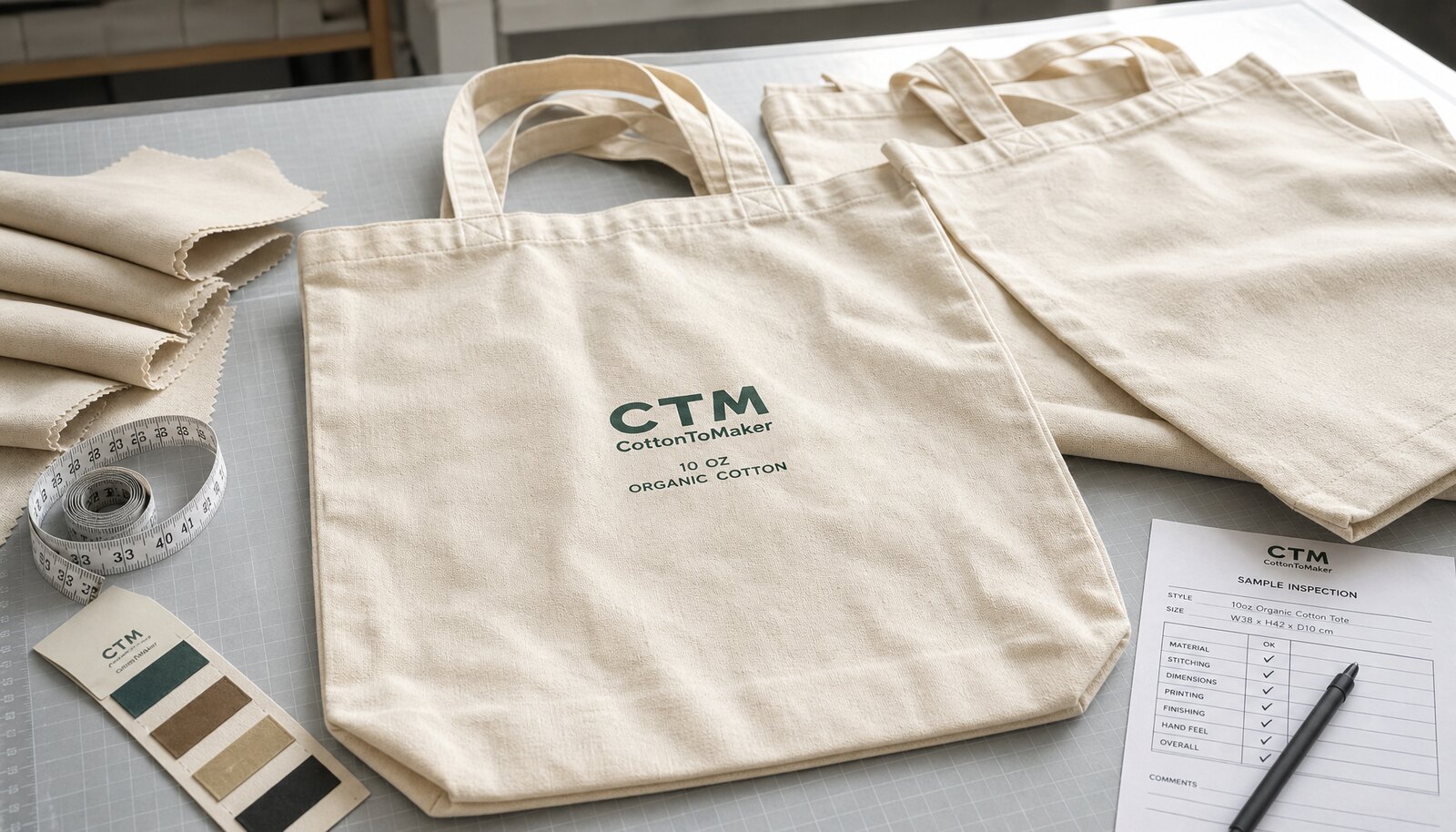
1. Define the organic claim before you ask for price
The first audit question is not whether a supplier can sew a cotton tote bag. Many factories can. The first question is whether the supplier can support the exact claim your business intends to make. “Natural,” “unbleached,” “eco,” and “organic cotton” are not the same claim. A bag may look natural and still have no auditable organic cotton evidence.
Procurement should define the claim before issuing the RFQ. Some buyers need only an internal material note for a corporate giveaway. Others need customer-facing wording on a product page, hangtag, label, carton, invoice, tender response, or retailer compliance portal. The evidence required for those uses can differ significantly. If the claim will be public, involve compliance, sustainability, legal, or the retailer contact before artwork and labels are approved.
Recognized document frameworks may include GOTS, OCS, OEKO-TEX Organic Cotton, or another program accepted by your customer or market. Do not assume that any certificate presented by a supplier covers the finished bag. A scope certificate may show that a company is certified for certain activities, while a transaction certificate or order-linked document may be needed to connect material to a specific purchase. The audit should identify what document exists, whose name is on it, what material it covers, when it expires, and whether it links to your fabric lot.
- Write the exact claim you want to use before requesting quotations.
- Confirm whether the claim appears on the bag, label, packaging, invoice, website, or customer compliance file.
- Check certificate holder name, validity date, scope, material description, and issuing body.
- Match documents to fabric lot, purchase order, supplier invoice, and production records where possible.
- If evidence is weak, change the wording to a supportable material description rather than forcing an organic claim.
2. Trace documents to the material route, not just to a PDF
A common sourcing failure is accepting a generic certificate because it contains the word “organic.” Procurement teams need to verify whether the document actually supports the order. The certified party name should make sense in the supply chain. The certificate should be valid during the relevant production period. The material description should match cotton fabric or cotton products, not an unrelated category. If a transaction certificate is required by your customer, confirm whether the supplier can provide it after shipment or before release.
Document mismatch can happen in several ways. A certificate may belong to a fabric mill but not to the bag maker. The document may be expired. The company name may differ from the invoice name without explanation. The certificate may cover yarn or greige fabric but not dyeing, printing, or sewing. A supplier may also show a certificate for one fabric while quoting another stock fabric. These gaps do not always prove misconduct, but they do require clarification before your company prints a claim.
Ask for a simple chain record: cotton or yarn source if available, fabric supplier, fabric lot number, incoming fabric inspection, cutting batch, production order, and finished carton list. For small promotional orders, the chain may be simpler. For retailer or ESG-sensitive programs, it should be more formal. The key procurement rule is consistency: names, dates, lot references, quantities, and descriptions should not contradict each other.
- Compare the certificate name with the supplier, mill, invoice, and quotation name.
- Check that validity dates cover the planned production period.
- Confirm whether the document covers raw material, fabric, processing, or finished bags.
- Ask for fabric lot references before cutting and carton traceability after packing.
- Flag mismatched company names, impossible dates, vague material descriptions, and quantities that do not reconcile.
3. Specify fabric weight, construction, and use case together
Fabric weight is one of the easiest areas for quotations to become misleading. One supplier may quote 6 oz cotton, another may quote 180 GSM, and another may write “heavy canvas.” These are not comparable unless the buyer knows how and when the fabric weight is measured. Greige fabric, finished fabric, dyed fabric, washed fabric, printed fabric, and sewn bag panels can produce different readings.
Organic cotton does not automatically mean stronger. Strength comes from yarn quality, weave density, finishing, seam construction, handle design, and reinforcement. A lightweight event giveaway may be acceptable at 5 oz to 6 oz. A reusable retail tote may need 8 oz to 10 oz. A heavier merchandise or grocery program may require 10 oz to 12 oz or more, depending on size and load. Heavier fabric may improve structure, but it also increases unit price, carton weight, and freight cost.
Set measurable tolerances early. A practical starting point is to agree GSM tolerance, finished size tolerance, handle drop tolerance, and print placement tolerance before deposit. Common commercial tolerances might be around +/-5% for fabric weight and +/-0.5 cm to +/-1.0 cm for many finished dimensions, but the final tolerance should be agreed with the supplier and suited to the product. Tighter tolerances may increase cost or reject rate.
- Request fabric weight in both oz and GSM.
- State whether the target weight is finished fabric, dyed fabric, washed fabric, or bulk production fabric.
- Record weave type, canvas feel, shrinkage concerns, and expected stiffness.
- Link fabric weight to intended load, print method, packing method, and freight budget.
- Approve a swatch and pre-production sample from the same material route planned for bulk.
4. Map production control and subcontracting risk
An organic cotton bag order can include fabric sourcing, incoming inspection, cutting, screen printing, digital printing, transfer application, embroidery, sewing, trimming, pressing, needle control, final inspection, packing, export documentation, and freight handover. Few buyers benefit from assuming that the sales contact controls every step. The audit should make the process visible.
Subcontracting is not automatically unacceptable. Many capable suppliers use specialist printers, dye houses, embroidery workshops, or packing partners. The risk is hidden subcontracting, especially when an organic claim, tight lead time, or retailer packing requirement is involved. If an outside workshop handles printed panels without lot separation, organic traceability and artwork control can weaken. If sewing is moved to a second workshop during peak season, handle length, stitch density, and reinforcement can vary.
Ask the supplier to map the order in writing and provide evidence for critical steps. Current, order-relevant photos or short videos are useful when they show fabric roll labels, cutting tickets, print strike-offs, sewing line setup, inspection tables, and packing cartons. Showroom images or old marketing videos are less useful. For document-sensitive orders, ask how fabric lots are separated from conventional stock and how cut panels are identified before sewing.
- List each step as in-house, subcontracted, or supplier-managed.
- Identify who controls fabric storage, cutting, printing, sewing, final inspection, and packing.
- Ask how organic fabric lots are labeled and separated.
- Confirm who pays for rework caused by outsourced printing, dyeing, sewing, or packing.
- Require notification before any subcontractor or production location changes.
5. Match decoration method to artwork, fabric, and durability
Most organic cotton tote bags use screen printing because it is practical for solid logos, cost-effective at volume, and compatible with cotton texture. Water-based screen print is often chosen when buyers want a softer hand feel. However, water-based ink may appear less bright on natural cotton than on coated white material. If corporate color accuracy matters, approve a strike-off on actual fabric, not a digital proof on a screen.
Heat transfer can reproduce detailed or full-color artwork, but it changes hand feel and may not match every sustainability brief. Embroidery can look premium on heavier fabrics, but it may pucker lightweight cotton and adds cost. Digital printing can work for complex graphics, although buyers should test edge clarity, color consistency, rubbing, and wash or moisture behavior if relevant. The best method depends on artwork, quantity, bag weight, end use, and presentation requirements.
Define print inspection before mass production. Include artwork version, Pantone or physical color target, print size, position tolerance, print side, acceptable hand feel, curing requirements, odor acceptance, and rub resistance. Where a formal standard is needed, discuss ISO 105-X12 or AATCC 8 for rubbing fastness. For a lower-risk promotional order, agree a practical dry and damp white-cloth rub test and document the method.
- Use a strike-off on actual bulk fabric for color and hand-feel approval.
- Set print position tolerance, such as +/-0.5 cm or another agreed value, before production.
- Check dry rub, damp rub, odor, cracking, ink coverage, and edge sharpness.
- For folded packing, test whether printed surfaces transfer or mark after compression.
- Do not approve bulk printing from digital artwork alone when color, texture, or curing matters.
6. Use MOQ and price breaks to expose real constraints
MOQ is not only a sales number. For organic cotton bags, the minimum order quantity may be driven by fabric roll length, stock availability, dye lot size, print setup, label production, carton printing, packing labor, and line efficiency. A low MOQ may be possible with stock natural fabric and standard master carton packing. It may also mean higher unit cost, limited customization, mixed fabric lots, or weaker document support.
Ask for price breaks at practical volumes, such as 500, 1,000, 3,000, and 5,000 pieces if those quantities match your program. Then ask what changes at each level. A competent supplier can explain whether the savings come from fabric purchasing, print setup allocation, cutting efficiency, packing labor, or freight carton utilization. A weak quote often shows only a low unit price with no explanation of assumptions.
Procurement should also separate MOQ by element. The bag body may have one MOQ, while custom fabric color, woven labels, paper bands, printed cartons, barcode labels, or individual packaging have separate minimums. Confirm whether MOQ is per design, per artwork, per fabric color, per size, per delivery, or per shipment. This prevents a surprise when the supplier later says the quoted unit price does not apply to split deliveries or mixed designs.
- Ask what is standard stock and what is custom-made.
- Request price breaks and lead-time impact by quantity.
- Separate MOQ for fabric, print, labels, packing, carton marks, and custom color.
- Confirm whether document support changes at lower quantities.
- Reject a low MOQ offer if it depends on unclear fabric substitution or unapproved construction.
7. Treat sample approval as a production rehearsal
A strong sample is not just a visual mockup. It should rehearse the same production route planned for bulk: correct fabric weight, correct handle drop, correct seam construction, correct thread color, correct print method, correct label, and correct packing fold. A showroom tote or substitute fabric sample may help with style discussion, but it is not a reliable inspection standard.
Turn the sample into measurable acceptance criteria. Record finished width, height, gusset, handle drop, handle width, print size, print position, label placement, stitch density, seam type, reinforcement method, and packing method. Keep one signed or sealed approved sample internally and require the supplier to keep a matching reference. If fabric, artwork, label, handle, or packing changes, update the approval record rather than relying on old emails.
Do not rely only on photo approval for fabric shade, hand feel, print texture, or handle strength. Photos are useful for communication but weak for tactile and dimensional decisions. For a first order, order a physical pre-production sample before bulk cutting. If the schedule does not allow this, treat the program as higher risk and increase inspection controls.
- Measure and record all key dimensions from the pre-production sample.
- Check handle drop by hanging the bag naturally and by measuring flat.
- Perform a simple load test using intended carrying weight plus a safety margin.
- Pack the sample as bulk goods will be packed and inspect creasing after 24 hours.
- Use the approved sample as the inspection reference, not a marketing photo.
8. Normalize quotations before comparing unit price
The lowest unit price often excludes something procurement will pay for later. Organic cotton bag quotes can differ in fabric source, GSM, print method, handle reinforcement, label type, sample cost, packing, testing, inspection support, document support, carton requirements, and shipment terms. One supplier may include individual packing and barcode labels while another includes only loose bulk packing. One quote may be FOB port and another EXW factory.
A useful RFQ format forces comparable assumptions. The supplier does not need to reveal every internal cost, but the quotation should state what is included, what is optional, and what triggers extra charges. Ask for fabric specification, size, print method, number of print colors, label type, packing method, carton quantity, carton dimensions if available, sample fee, setup fee, testing fee, documentation fee, inspection support, quote validity, Incoterm, and lead-time basis.
Commercial clarity is also a quality control tool. If the quote does not state when lead time begins, the supplier may count from deposit while procurement assumes it starts after sample approval. If inspection timing is not agreed, goods may be packed, paid, or handed to a forwarder before defects are discovered. Confirm payment milestones and preserve leverage until inspection and document review are complete.
- State Incoterms clearly: EXW, FOB, CIF, DDP, or delivered warehouse.
- Separate product cost from samples, setup, labels, testing, inspection, packing upgrades, and freight.
- Confirm quote validity, currency, tax assumptions, payment terms, and lead-time start point.
- Ask whether certificates, transaction documents, or claim support documents are included or charged separately.
- Do not compare prices until fabric, print, packing, and shipment terms are normalized.
9. Build QC around measurable defects and AQL inspection
Quality control should not be left until the final carton is sealed. The QC standard should shape the specification, sample approval, production monitoring, and pre-shipment inspection. Organic cotton bags may naturally show small slubs, seed marks, or shade variation. Those can be acceptable if they match the approved sample and agreed fabric character. Oil stains, broken stitches, weak handles, wrong labels, wrong dimensions, print transfer, and mixed cartons are defects.
Define defect classes before production. Critical defects are safety, legal, or usability issues, such as broken needle contamination, incorrect required labeling, or a major construction failure that makes the bag unusable. Major defects affect function, saleability, or brand presentation, such as weak handles, wrong size outside tolerance, serious stains, shifted print, wrong artwork, or incorrect carton count. Minor defects are small appearance issues that do not affect function and remain within the agreed fabric standard.
For many B2B orders, procurement can use ANSI/ASQ Z1.4 or ISO 2859-1 sampling as a reference, often with General Inspection Level II and agreed AQL limits. The exact AQL should match buyer risk and market requirement; typical consumer goods programs may use separate critical, major, and minor limits, but these should be written into the purchase order. The inspection report should include sample size, defect photos, measurement data, carton checks, and a clear pass, hold, rework, or reject recommendation.
- Set AQL or sampling method before production, not after defects are found.
- Agree critical, major, and minor defect definitions for this product.
- Measure width, height, gusset, handle drop, handle width, and print placement.
- Check fabric GSM, seam strength, stitch density, reinforcement, print rub, odor, labels, and packing.
- Require re-inspection after major rework when defects are repeated or functional.
10. Audit packing, shipment, and final supplier decision
Packing directly affects received quality. Natural cotton can absorb moisture, pick up dust, and show pressure marks. Screen printed areas can transfer if packed before proper curing or compressed under heavy cartons. Heavier canvas can retain fold lines. Retail programs may require clean presentation, barcode accuracy, carton sequencing, and warehouse-readable marks, not just low freight volume.
Specify whether bags are flat packed, folded once, folded multiple times, bundled, individually packed, paper banded, or packed loose in master cartons. Flat packing improves presentation but increases volume. Folded packing saves freight but increases crease risk. Individual polybags protect against dirt and moisture but may conflict with plastic reduction targets. Paper bands can support a cleaner low-plastic presentation but offer less protection during humid storage.
The finished audit should lead to a decision. Score documentation strength, production control, sample accuracy, QC readiness, packing discipline, lead-time credibility, communication, and commercial clarity. Pass means the supplier can proceed under the agreed specification and inspection plan. Hold means specific gaps must be corrected before deposit, bulk cutting, final payment, or shipment. Reject means the supplier is not suitable for this program, even if the price is attractive. For strategic or high-volume programs, consider dual sourcing until repeat orders prove stable.
- Approve packing method, carton quantity, carton weight, carton marks, barcode placement, and pallet plan before mass packing.
- Set maximum carton weight to reduce crushing and warehouse handling problems.
- Confirm printed panels are fully cured before folding and packing.
- Review commercial invoice, packing list, certificate documents, and country of origin information for consistency.
- Use a supplier scorecard and record pass, hold, corrective action, or reject decisions for future orders.
Specification comparison for buyers
| Audit area | Evidence to request | Practical pass or hold threshold | Procurement decision impact |
|---|---|---|---|
| Organic cotton claim control | Scope certificate or transaction certificate where applicable, material composition statement, fabric lot number, purchase record, supplier invoice, and intended claim wording for label, website, carton, or invoice | Pass if documents connect the material route to the fabric lot used for the order and support the exact claim; hold if scope is unclear or certificates cover only an upstream party; reject organic wording if documents cannot be linked to the order | Determines whether the bag can be marketed as organic cotton or should be described only as cotton, unbleached cotton, or natural cotton |
| Fabric weight and construction | Finished fabric GSM/oz statement, swatch, approved sample, weave description, yarn or canvas type if available, shrinkage notes, and agreed tolerance | Pass if bulk fabric matches approved sample within agreed tolerance, commonly +/-5% for GSM unless tighter standard is agreed; hold if weight is quoted only as greige or estimated; reject if bulk is visibly lighter or structurally different | Affects durability, unit cost, freight weight, load capacity, print appearance, and buyer complaints |
| Finished dimensions | Size chart for width, height, gusset, handle length, handle width, seam allowance, and approved sample | Pass if finished measurements are within agreed tolerance, commonly +/-0.5 cm for small dimensions and +/-1.0 cm for bag body unless the buyer sets another tolerance; hold if supplier refuses measurable tolerances | Prevents carton mismatch, retailer rejection, poor presentation, and disputes during pre-shipment inspection |
| Factory process control | Production flow chart showing fabric storage, cutting, printing, sewing, trimming, inspection, packing, and outsourced steps with responsible party named | Pass if the supplier identifies who controls each step and how lots are separated; hold if subcontracting is unclear; reject hidden subcontracting for claim-sensitive, urgent, or retail-compliance orders | Shows how much direct control the supplier has over quality, lead time, traceability, and corrective actions |
| Print and decoration control | Strike-off on actual fabric, Pantone or physical color target, ink or transfer method, curing conditions, rub-test method, print position tolerance, and approved artwork file | Pass if strike-off meets color, hand feel, odor, edge, and position requirements; for rub fastness, use agreed dry/wet rub checks or reference ISO 105-X12/AATCC 8 where applicable; hold if only digital proof is available | Prevents logo disputes, print transfer, cracking, poor curing, and retail presentation failures |
| Seam and load performance | Handle reinforcement method, stitch density target, seam type, thread specification if available, and load-test requirement tied to intended use | Pass if handles and seams survive agreed load test, such as intended carrying weight plus safety margin for a defined duration; hold if supplier offers only visual approval; reject if handles tear, seams open, or reinforcement is inconsistent | Protects user function, brand reputation, and repeat-use durability |
| Sample approval discipline | Pre-production sample using correct fabric, size, handle, seam, print, label, and packing method, with signed approval record and retained sealed sample | Pass if sample represents bulk production; hold if sample uses substitute fabric or showroom construction; reject bulk start until a representative sample is approved | Locks the standard for inspection and reduces arguments over shade, stitching, print feel, and packing appearance |
| Pre-shipment inspection readiness | Final inspection checklist, AQL or agreed sampling plan, defect classification, sealed sample, packing list, carton marks, and photo report format | Pass if inspection can occur before final payment and shipment; use ANSI/ASQ Z1.4 or ISO 2859-1 sampling if appropriate, with typical General Inspection Level II and AQLs agreed in advance; hold if goods are packed without buyer criteria | Gives procurement a clear pass, rework, hold, or reject decision before goods leave the supplier |
| Packing and carton specification | Packing method, bundle count, individual packaging, carton dimensions, carton weight, liner or moisture protection, carton marks, barcodes, pallet plan, and mixed-SKU rules | Pass if packing protects fabric and print while meeting warehouse or retailer rules; hold if carton count or marks are missing; reject if packing risks moisture, contamination, or print transfer | Controls landed presentation quality, receiving accuracy, freight efficiency, and warehouse compliance |
Buyer checklist before sampling
- Define the exact organic claim before RFQ: internal material description, customer-facing product claim, label claim, packaging claim, or retailer compliance claim.
- Ask whether available documentation follows recognized frameworks such as GOTS, OCS, OEKO-TEX Organic Cotton, or other customer-accepted material traceability programs, and confirm the scope covers your required stage.
- Match certificates, transaction documents, invoices, fabric lot numbers, and production records; do not accept a certificate that names an unrelated mill, expired scope, or different material route.
- Request fabric weight in both oz and GSM, and confirm whether the quoted weight is greige, finished, dyed, washed, printed, or cut-and-sewn fabric.
- Confirm whether the supplier manufactures bags in-house or subcontracts fabric sourcing, dyeing, printing, embroidery, sewing, washing, inspection, packing, or export handling.
- Request current production evidence for relevant processes, including timestamped photos or short videos showing order-specific fabric rolls, cutting tickets, print strike-offs, sewing line, inspection table, and packing area where practical.
- Require a pre-production sample made with the correct fabric, handle size, thread color, seam type, label, print method, and packing method.
- Define tolerances for finished bag size, handle length, fabric weight, print position, print color, carton quantity, and carton weight before deposit or bulk cutting.
- Verify load-bearing requirement based on real use; grocery, retail, and merchandise bags need stronger handle reinforcement than low-load event giveaways.
- Confirm print curing, odor, dry/wet rub resistance, and moisture behavior if bags may be reused, folded tightly, shipped through humid routes, or packed with printed surfaces touching fabric.
Factory quote questions to send
- Is the quoted organic cotton fabric in stock, reserved after deposit, or produced to order?
- What documentation supports the organic cotton claim, and does it cover yarn, fabric, processing, finished product, or only an upstream supplier?
- Can you share document numbers, validity dates, issuing body, certified party name, and fabric lot references before bulk cutting?
- What is the fabric weight in GSM and oz, and what tolerance do you apply in bulk production?
- Is the quoted weight measured before or after dyeing, washing, finishing, printing, and sewing?
- What are the finished size tolerances for width, height, gusset, handle drop, handle width, and print placement?
- Which production steps are in-house and which are subcontracted, including dyeing, printing, embroidery, washing, sewing, inspection, and packing?
- Is printing done in your own workshop or by an outside print house, and who controls ink mixing, curing, and print inspection?
- Which print method do you recommend for this artwork, and what are the setup cost, color limit, minimum print area charge, hand feel, and expected durability?
- What handle reinforcement method is included in the quote: bar tack, cross-stitch, box-stitch, X-stitch, or simple straight stitch?
Quality-control points to confirm
- Fabric weight verification by cutting a measured fabric area and weighing it, not only checking the supplier datasheet.
- Finished bag size measurement after sewing and pressing, with tolerance agreed before production.
- Handle length, handle width, stitch density, seam type, seam allowance, and reinforcement check against approved sample.
- Seam strength and load test using realistic product weight for the intended use plus an agreed safety margin and duration.
- Print color, print position, edge sharpness, ink coverage, curing, odor, cracking, and dry/wet rub resistance.
- Reference recognized rub or colorfastness methods where relevant, such as ISO 105-X12 or AATCC 8, or agree a practical in-house cloth rub method in writing.
- Needle holes, broken stitches, loose threads, skipped stitches, contamination, oil marks, fabric slubs beyond agreed range, visible shade panels, and mixed fabric lots.
- Label content, side label placement, care label, organic claim wording, barcode, country of origin, and retailer-specific label requirements if applicable.
- Document review for certificate scope, validity dates, certified party name, material description, lot references, purchase records, invoice consistency, and spelling of claim wording.
- Carton quantity, carton strength, moisture protection, carton marks, carton weight, pallet configuration, and packing method.