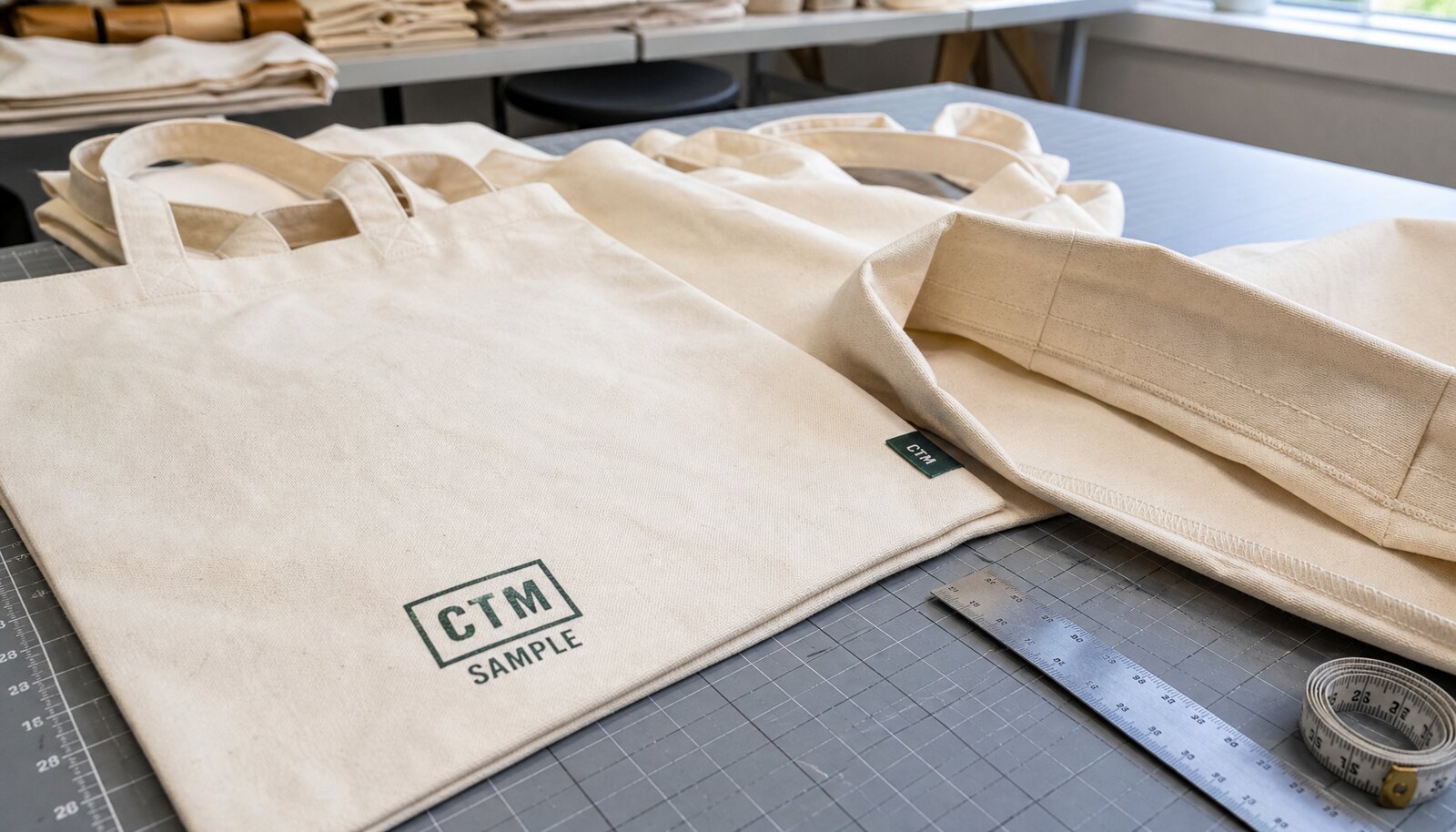
Why the side seam allowance signoff file matters
A side seam allowance signoff file is the buyer-approved record that shows how much fabric is captured inside the side seam of an organic cotton bag after sewing. It should not be treated as an internal factory detail only. For tote bags, shopping bags, flat gift bags, and cotton promotional bags, the side seam allowance affects finished width, seam strength, print centering, inside appearance, folding, and repeat order consistency.
Many disputes start because the buyer approves a front-view sample photo but never approves the inside seam. The first shipment may look acceptable, then the reorder comes from another sewing line with a narrower seam bite or a different seam construction. The bag may still measure close to the finished size tolerance, but the side seam frays, twists, or pulls open during use. A signoff file gives procurement teams a practical reference when comparing supplier quotes and checking bulk production.
- Use the file to lock the approved seam width, seam type, stitch line, and tolerance before bulk cutting.
- Keep it attached to the PO, technical sheet, artwork approval, and PP sample approval.
- Require the same file format for every factory quoting the order so the comparison is fair.
- Update the file only when fabric weight, dyeing, washing, or seam construction changes.
The buying problem: finished size can pass while seam strength fails
A common buyer mistake is to specify only finished bag size, for example 380 x 420 mm, without defining how the side seams are built. A factory can hit the outside width by adjusting the cut panel, but still use a narrow seam allowance that leaves too little fabric caught under the stitch. This may reduce sewing time and fabric consumption slightly, but it increases fraying risk, especially on open-weave organic cotton or bags expected to carry catalogues, groceries, or boxed products.
The issue becomes more serious when a buyer compares quotations from two suppliers. One quote may include 12 mm seam allowance with overlock finishing; another may include 7 mm allowance with only a single lockstitch. The lower price may not be a real saving. It may simply be a lower construction standard hidden behind the same finished size and fabric GSM. Asking for a side seam allowance signoff file makes the quote technically comparable.
- Do not accept “standard seam” as a complete specification for retail or branded packaging bags.
- Ask suppliers to quote the seam construction in writing, not only in sample comments.
- Separate finished size tolerance from seam allowance tolerance in the QC instruction.
- Check seam allowance after reversing the bag; outside photos alone are not enough.
What the signoff file should contain
The signoff file should be simple enough for a merchandiser, factory sample room, and third-party inspector to use. It does not need to be a complicated engineering document, but it must remove ambiguity. The best version includes one approved sample code, the fabric specification, the seam construction, ruler photos, tolerance notes, print placement reference, and any packing impact. For repeat orders, this file is often more useful than a general product photo.
For organic cotton bags, the file should also identify the fabric state. Organic cotton fabric may be quoted as greige, bleached, dyed, washed, or finished. Shrinkage and hand feel can change after processing. If the allowance was approved on an unwashed PP sample but bulk fabric is washed or garment dyed, the seam may tighten, pucker, or change finished dimensions. The signoff file should state whether the measurement is before or after pressing and washing.
- Approved sample reference: sample number, date, fabric batch, color, size, and logo version.
- Measurement photos: inside side seam with ruler at top, middle, and bottom.
- Seam type: lockstitch, overlock, French seam, bound seam, or folded seam construction.
- Tolerance: target allowance, acceptable range, and action if bulk falls outside the range.
- Artwork reference: distance from finished side seam to print edge or print centerline.
- Packing note: whether side seams are pressed flat, folded inward, or left naturally relaxed.
Fabric weight and seam allowance should be decided together
Organic cotton bag fabric is commonly discussed in oz, GSM, or both. A light 4 oz to 5 oz cotton bag behaves differently from a heavy 10 oz to 12 oz canvas bag. Lightweight fabric frays more easily and may need secure overlock coverage even if the bag carries only light products. Heavy canvas needs enough seam bite and needle control so the seam does not become bulky, puckered, or difficult to fold at carton packing.
When sending an RFQ, buyers should avoid writing only “organic cotton bag, 10 oz” without explaining the finished use. A 5 oz conference giveaway bag, an 8 oz retail shopping tote, and a 12 oz premium canvas bag may all require different seam logic. The signoff file should show that the factory has matched fabric weight, seam allowance, thread, needle size, and stitch density to the bag’s expected load and appearance standard.
- 4-5 oz / around 135-170 GSM: often used for lightweight promotional bags; control fraying and see-through seam appearance.
- 6-8 oz / around 200-270 GSM: common for retail totes; balance soft hand feel with stronger side seam finishing.
- 10-12 oz / around 340-407 GSM: used for premium canvas bags; check bulk at side seams and bottom corners.
- Dyed or washed fabric: confirm shrinkage before locking the allowance and finished size.
- Natural unbleached fabric: inspect seam cleanliness because dark cotton seed flecks can make puckering more visible.
Print method affects seam and artwork approval
Side seam allowance is not only a sewing issue. It can affect logo placement and how the bag looks when displayed flat. If the artwork is printed on panels before sewing, the factory must compensate for the seam allowance so the final logo sits centered between finished side seams. If the artwork is printed after sewing, the bag must be positioned consistently under the screen, heat press, or digital printer using finished edges as references.
Different print methods create different risks near side seams. Screen printing is common for organic cotton bags because it is economical for bulk orders and works well with simple logos. Heat transfer may be used for detailed artwork but can feel less natural on cotton. Digital printing may suit smaller runs or multicolor artwork, depending on fabric surface and buyer requirements. Embroidery is possible but may distort lighter fabric and should be kept away from side seam stress areas unless reinforced.
- Screen print: confirm logo centerline after sewing; ink thickness should not crack at fold lines.
- Water-based print: check shrinkage and hand feel after curing or washing.
- Heat transfer: keep enough distance from side seams to avoid edge lifting during folding.
- Digital print: confirm fabric pre-treatment does not change side seam puckering or panel size.
- Embroidery or woven label: define placement from finished seam, not raw panel edge.
MOQ logic when changing seam construction
Buyers sometimes ask why a small seam change affects MOQ or price. The reason is not always fabric consumption. It can involve production routing, operator skill, machine setup, and inspection time. A plain lockstitch side seam is faster than a French seam or a double-folded clean finish. Overlock plus lockstitch may require a different operation sequence. Wider seam allowance may also increase fabric usage when the panel width must grow to keep the same finished bag size.
For procurement teams, the practical approach is to ask the factory to separate the effect of fabric MOQ from sewing MOQ. Organic cotton fabric may have its own minimum dye lot or weaving lot, while seam construction may have a different minimum for efficient line setup. This matters when a buyer requests multiple colors, sizes, or logo versions. The signoff file helps confirm whether all variants share the same seam construction or need separate approval.
- Ask whether the MOQ is driven by fabric sourcing, dyeing, printing setup, or sewing line efficiency.
- If changing from plain seam to French seam, request a revised sample and revised labor quote.
- For small trial orders, decide whether the brand can accept standard seam construction to reduce cost.
- For retail programs, approve the stronger construction before scaling into repeat orders.
- For multi-color orders, confirm whether each color has the same shrinkage and seam behavior.
Sample checks before you approve the file
A good pre-production sample should be checked like a production control sample, not like a sales photo. Turn the organic cotton bag inside out and measure the side seam allowance at several points. Check whether the seam line is straight, whether fabric edges are fully caught, and whether the overlock covers the raw edge. Then turn the bag right side out and check for puckering, twisting, uneven panels, and logo centering.
Buyers should also perform basic handling checks before approval. Load the bag with a realistic weight for the intended use, not an extreme test unless specified. Pull lightly across the side seam and bottom corner. Fold the bag the way it will be packed and open it again. If the side seam creates a hard ridge, distorted fold, or visible pucker line, address it before bulk production. Once fabric is cut, correction becomes expensive.
- Measure at top opening, mid-body, and lower side seam near the bottom corner.
- Compare left and right side seam allowance; large differences can twist the finished bag.
- Check stitch density against the approved standard, especially on thicker canvas.
- Inspect the inside seam under good light because loose threads are easier to miss on natural cotton.
- Photograph the same measurement positions that inspectors will use in bulk QC.
- Do not approve a sample if the factory cannot confirm whether it was made by production-line method.
Packing and lead time implications
Packing can expose side seam problems that were not obvious at the sample stage. Organic cotton bags are usually folded, bundled, polybagged if required, then carton packed. If the side seam is bulky or puckered, the fold line may not sit flat. For retail buyers, this can affect shelf presentation and bundle appearance. For distributors, it may increase carton volume or cause uneven stacks that look untidy when unpacked.
Lead time should include time for sample revision if the seam construction is not yet approved. A realistic sourcing workflow includes RFQ clarification, fabric sourcing or fabric reservation, sample making, print strike-off if needed, PP sample approval, bulk cutting, printing, sewing, inspection, packing, and export preparation. If the side seam allowance is discussed only after the PP sample, the schedule can slip because cutting patterns, print placement, and sewing instructions may all need adjustment.
- Ask for lead time by stage, not only one total production time.
- Confirm whether print happens before or after sewing because this affects seam allowance planning.
- Approve packing fold method together with side seam appearance if the bag is sold folded.
- Check carton quantity after final folded size is confirmed, not before sample approval.
- For urgent orders, use a factory standard seam only if it meets the buyer’s load and appearance needs.
Quote data buyers should request for fair comparison
A clear quote should do more than list unit price and lead time. It should tell the buyer what construction is included. For organic cotton bags, request fabric weight, fabric finish, size tolerance, seam construction, side seam allowance target, print method, print size, handle details, packing method, carton quantity, inspection standard, sample cost if any, and MOQ by color or design. Without this data, a low quote may hide changes that appear later as production problems.
Procurement teams should also ask what happens if the buyer’s required allowance differs from the factory’s standard. Some suppliers quote very competitively because they run one standard tote construction every day. That can be efficient and acceptable if the standard matches the brand requirement. If not, the quote should show the adjustment. This avoids a common argument where the supplier later says the buyer requested a special seam after price confirmation.
- Finished size and tolerance, including whether measured flat, pressed, washed, or relaxed.
- Cut panel size if relevant, especially where print placement is applied before sewing.
- Side seam allowance target and tolerance in millimeters.
- Thread type, stitch density, seam finish, and reinforcement at stress points.
- Print method, ink type, number of colors, print area, and curing requirement.
- Packing method, units per inner pack, carton size, gross weight, and carton marks.
How to use the signoff file during bulk QC and reorders
During bulk inspection, the signoff file should be treated as the control reference. Inspectors should not only measure finished bag width and height. They should reverse selected samples and compare the side seam allowance against the approved photos. A useful inspection plan checks early production, mid-line output, and packed cartons. If a deviation appears, it should be traced by sewing line, operator, fabric roll, or color batch before the whole order is packed.
For reorders, the file prevents silent specification drift. A supplier may change sewing operators, move production to another workshop, use a different fabric roll, or adjust cutting to save fabric. If the buyer provides the previous signoff file with the new PO, the factory has less room to reinterpret the construction. The buyer also has a stronger basis for rejecting bulk production that does not match the approved standard.
- Attach the signoff file to the PO and final artwork approval, not only to email comments.
- Ask the factory to confirm the file again before bulk cutting.
- Require inline photos from first bulk output showing the same ruler positions as the PP sample.
- Record deviations with photos and measurements, not general comments such as “seam not good.”
- For reorders, compare current PP sample against the old approved file before releasing production.
Specification comparison for buyers
| Spec decision | Recommended option | When it fits | Buyer risk to check |
|---|---|---|---|
| Side seam allowance width | 10-12 mm finished allowance after sewing | Most 5-10 oz organic cotton tote bags where strength and clean inside finish are both required | If allowance is too narrow, the seam may fray after washing or load testing; if too wide, the finished bag width can become smaller than approved |
| Seam construction | Plain lockstitch with overlock or French seam where the inside finish is visible | Retail bags, gift-with-purchase bags, and premium brand packaging | Quote must state whether the factory includes overlock, double folding, or hidden seam work because labor cost and appearance differ |
| Fabric shrinkage basis | Approve allowance after fabric wash/shrink test, not only before cutting | Organic cotton bags that may be washed, dyed, or printed with water-based ink | Uncontrolled shrinkage can pull the side seam inward and make the bag look twisted or narrower than the spec sheet |
| Print position reference | Measure print from finished side seam and top edge, not from raw fabric cut edge | Logo totes, event bags, and retail shopping bags with centered artwork | If print is aligned before sewing without seam allowance adjustment, the logo may shift off center after assembly |
| Tolerance in bulk QC | Finished width tolerance plus seam allowance tolerance stated separately | Orders where the buyer compares multiple suppliers or runs repeat production | A bag can pass finished size tolerance but still have weak seam bite if the allowance is inconsistent |
| Signoff evidence | Photo file showing inside seam, ruler, seam type, stitch line, and approved sample code | Any PO where the buyer cannot inspect the pre-production sample in person | A vague approval photo may not prove which allowance was approved, causing disputes during final inspection |
Buyer checklist before sampling
- Confirm the organic cotton fabric weight in GSM or oz and whether the value is greige, washed, dyed, or finished fabric weight.
- State the finished bag size and the side seam allowance separately; do not rely on one overall flat size drawing.
- Ask the factory to show the inside side seam with a ruler before PP sample approval.
- Define whether the side seam is overlocked, French seamed, bound, or simply lockstitched.
- Measure print position from the finished edge after sewing, not from the cutting edge.
- Check whether the side seam allowance changes after washing, garment dyeing, steaming, or pressing.
- Approve one signoff file that includes sample code, fabric batch, seam photos, measurement photos, and tolerance notes.
- Require bulk inline inspection to cut open or reverse one sample per size/color to confirm seam allowance consistency.
- Confirm whether packing compression will expose side seam puckering or twisting after cartons are opened.
- Keep the signoff file with the PO so reorder production follows the same seam construction and allowance.
Factory quote questions to send
- What side seam allowance will you use after sewing, and what tolerance do you control in bulk production?
- Is the quoted seam a plain lockstitch, overlock plus lockstitch, French seam, or another construction?
- Will the finished bag width be measured after pressing, after washing, or directly after sewing?
- What fabric GSM or oz is quoted, and is that the finished organic cotton fabric weight?
- How do you adjust the cutting pattern if fabric shrinkage changes after washing, dyeing, or printing?
- Will logo print placement be referenced from the finished side seam or from the cut panel edge?
- Can you provide a PP sample signoff file with ruler photos of the side seam inside and outside?
- What MOQ applies if we require a different seam construction from your standard production line?
- How many pieces per carton will you pack, and will the side seams be folded, pressed flat, or left relaxed?
- Which quote line items change if we request wider seam allowance, French seam construction, or extra seam inspection?
Quality-control points to confirm
- Measure the side seam allowance on reversed samples from the top, middle, and bottom of the bag, not only at one point.
- Check that the finished width matches the approved sample after accounting for seam allowance and fabric shrinkage.
- Confirm stitch density, seam bite, and overlock coverage are consistent through thick areas such as the bottom corner.
- Verify printed artwork is centered from finished side seams and not visually pulled toward one side.
- Inspect for seam puckering, roping, needle holes, loose threads, and fraying after light pull testing.
- Compare bulk samples against the approved signoff file photos before final carton sealing.
- Check inside seam cleanliness because organic cotton bags are often unlined and buyers may inspect the interior.
- Record any side seam deviation by production lot, operator line, fabric roll, and colorway.