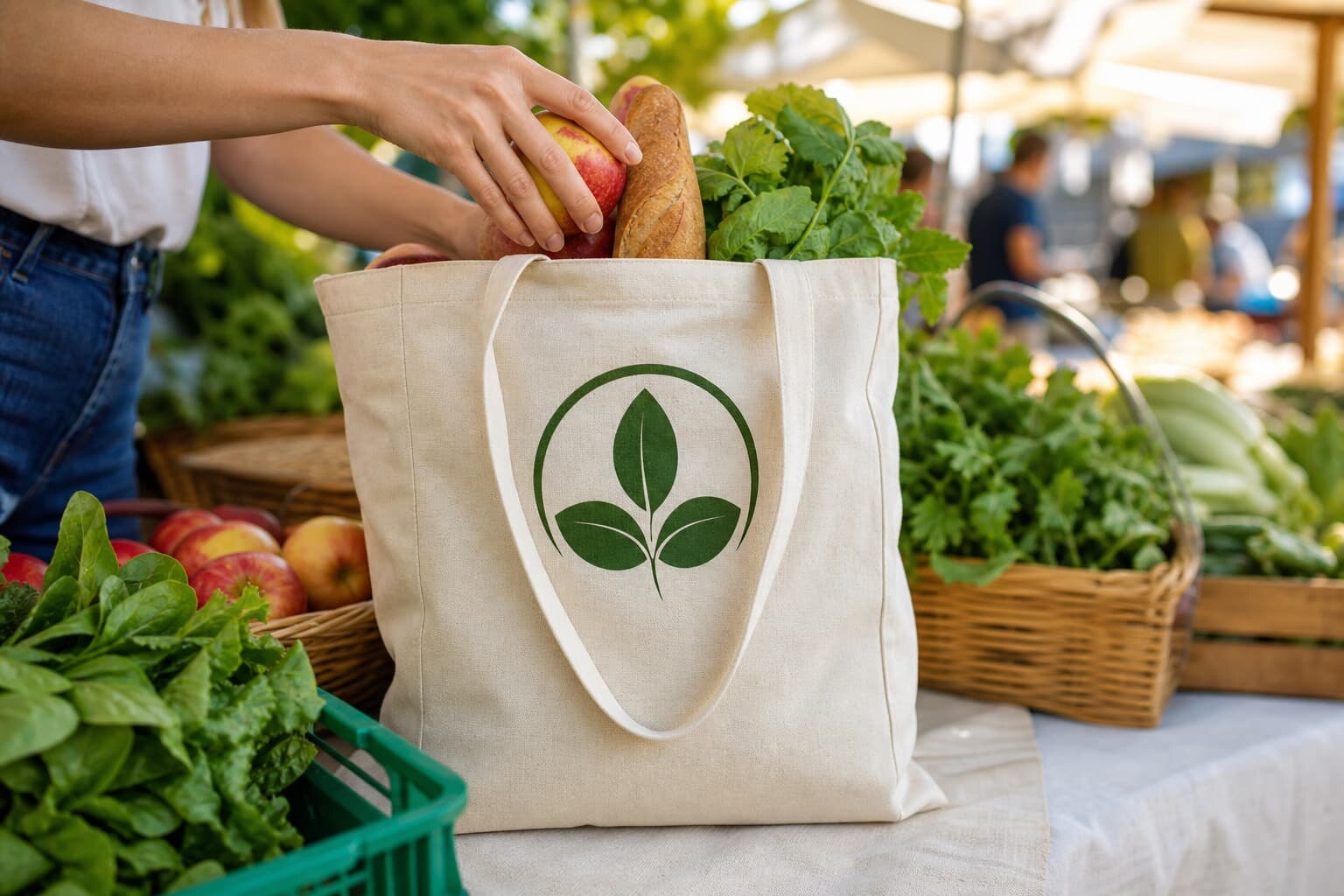
Why print proof approval matters on organic cotton bags
An organic cotton bag print proof is not a decorative formality. It is the buyer's last practical chance to confirm how artwork, ink, fabric weight, sewing, and packing work together before bulk production starts. On organic cotton, the base fabric is often unbleached or lightly processed, so the ground shade is warmer and less uniform than bright white polyester or coated paper. A logo that looks sharp in a PDF can look softer, duller, or slightly uneven once ink settles into cotton yarns.
For procurement teams and importers, the main issue is not whether the supplier can print a logo. The issue is whether the approved proof gives enough evidence to protect the purchase order. A useful proof should answer commercial questions: Is this the correct bag size and fabric GSM? Is the logo positioned where retail buyers expect it? Is the ink color close enough for brand approval? Will the printing method survive packing, handling, and normal consumer use? If the proof does not answer these points, the buyer is approving risk rather than approving production.
- Approve print proof only after bag construction, fabric GSM, and artwork version are locked.
- Treat natural cotton shade as part of the visual result, not as a neutral background.
- Use one signed master proof as the production reference for factory, buyer, and inspection team.
- Do not release bulk production from a screen screenshot, low-resolution photo, or verbal color confirmation.
Define the bag spec before discussing logo color
Many print disputes start because the buyer approves a logo without confirming the bag itself. Organic cotton bags can be made from lightweight 120-140 GSM fabric, common 160-180 GSM retail tote fabric, or heavier 220-280 GSM canvas. Each weight receives ink differently. A 140 GSM plain weave may allow slight ink show-through and softer print edges. A 10 oz or 12 oz canvas may hold more ink on the surface but can make fine lines break over the raised yarn texture.
Before the supplier prepares a proof, your RFQ should define finished width, height, bottom or side gusset, handle length, handle width, seam type, fabric color, GSM tolerance, and whether the bag is washed, pre-shrunk, or unwashed. If these are undecided, the factory may use sampling fabric that is convenient rather than representative. That makes the proof attractive but commercially weak, because bulk fabric may absorb ink differently.
- For economy event bags, specify 140-160 GSM and avoid very small reversed text.
- For retail reusable totes, specify 180-220 GSM if the bag must feel durable but still fold flat.
- For premium organic cotton canvas bags, specify 240-280 GSM and test ink coverage on the actual weave.
- For gusseted bags, confirm whether logo placement is measured from the finished seam or flat cut panel.
- For long handles, confirm whether handles cross or cover the logo after folding and packing.
Choose the print method according to artwork and MOQ
Screen printing is usually the most stable choice for organic cotton bags when the artwork has solid colors, simple logos, large brand marks, or one to four spot colors. It gives good coverage, predictable production speed, and reasonable unit cost once the setup is spread across enough pieces. For buyers, the key is to confirm ink type, mesh choice, curing, and whether the factory can keep registration consistent on both light and heavier cotton fabrics.
Digital print and heat transfer can be useful for low MOQ orders, multi-color graphics, gradients, or frequent artwork changes. They are not automatically better. Digital print may look softer on natural cotton, and transfer films can create a different hand feel from direct ink. If the bag is marketed as organic, natural, or plastic-reduced, a heavy transfer patch may also conflict with the product story. The proof should show the actual print hand, edge definition, and color density, not only the graphic accuracy.
- Use screen print for repeat orders, solid logos, and stable brand colors.
- Use digital direct print for complex artwork when the buyer accepts softer color on cotton.
- Use heat transfer only after checking film edge, flexibility, and appearance after folding.
- Ask if each artwork color requires a separate screen, and whether screen charges apply to reorders.
- For MOQ planning, group orders by bag size and fabric first, then split by print version where possible.
What a proper print proof should include
A practical proof package should include more than one clean photo of a sample bag. It should include the physical sample, the approved artwork file name, print method, ink reference, fabric GSM, bag dimensions, logo dimensions, placement measurements, and date. If you are approving remotely, ask the factory to photograph the proof beside a ruler, Pantone reference, and full bag view. Photos are not a perfect color standard, but they help catch wrong scale, wrong placement, wrong bag style, and obvious artwork version errors.
The best proof is printed on the same fabric construction planned for bulk production. If the exact bulk fabric lot is not yet available, the supplier should state that clearly. Sampling on available organic cotton fabric can be acceptable for early development, but final approval for mass production should be based on actual or production-equivalent fabric. This distinction matters when the buyer is comparing two supplier quotes. One quote may include a meaningful production proof while another only includes a quick mock sample.
- Proof sheet should list bag style, fabric GSM, print method, ink type, and artwork version.
- Front photo should show the entire bag, not only a cropped logo close-up.
- Close-up photo should show edge sharpness, fabric texture, and ink coverage.
- Measurement photo should show logo width, logo height, and distance from top or side seam.
- Approval record should state whether the proof is final, conditional, or rejected for revision.
Set measurable acceptance criteria before production
Buyers often write 'print must match approved sample' in the PO. That is useful but not enough. A factory still needs measurable tolerance limits, and an inspection company needs criteria that can be applied to cartons of finished goods. Organic cotton has natural slubs, seed specks, and small shade variation. If the buyer expects medical-white uniformity, the specification is wrong for the product. If the factory uses natural variation as an excuse for poor printing, the acceptance criteria are too loose.
For most cotton tote and pouch orders, practical logo placement tolerance is usually around plus or minus 5 mm for small to medium bags and plus or minus 8 mm for larger totes, depending on construction. Print size tolerance may be around plus or minus 2 percent if the artwork is not distorted. Color tolerance should be judged against the approved physical proof because Pantone ink on paper is not the same as pigment on cotton. Critical brand programs may need a lab dip or strike-off stage before the finished proof.
- Major defect: wrong artwork, wrong logo color family, missing print, upside-down print, or severe off-center placement.
- Major defect: ink cracking, sticky surface, set-off mark, or print bleeding that affects brand appearance.
- Minor defect: small cotton slub visible through ink when overall logo remains acceptable.
- Minor defect: slight shade difference within approved tolerance compared with signed master proof.
- Critical issue: unsafe odor, uncured ink transfer, or packing moisture that can damage printed goods.
Check sample handling, curing, and packing impact
A print proof can look acceptable when it leaves the printing table but fail after folding, stacking, or carton compression. Organic cotton bags are often packed flat in bundles, folded into retail cartons, or individually polybagged with barcode labels. If fresh ink is not fully cured before stacking, the printed face may transfer onto another bag. If heavy bags are compressed too tightly, fold lines can cross the logo and create permanent pressure marks.
During proof approval, ask the factory to fold the sample in the same way planned for bulk packing. If the bag will be packed with a belly band, hang tag, side label, care label, or retail barcode, check that these do not hide important logo areas. For natural and organic product lines, some buyers request plastic-free packing, but cartons still need moisture protection. The packing plan must balance sustainability claims with real transport risks.
- Confirm whether bags are packed flat, half-folded, quarter-folded, rolled, or individually polybagged.
- Keep printed faces aligned in the same direction for faster incoming inspection.
- Use inner bundles of 25-50 pieces when it helps control counting and prevents carton abrasion.
- Avoid tight straps or bands crossing fresh ink or raised transfer areas.
- Ask for carton dimensions and gross weight because heavy compression can damage print appearance.
Understand how proof approval affects lead time
Print proof approval is a real step in the production calendar. A supplier may need time for artwork checking, screen making, fabric sourcing, proof printing, curing, internal review, and courier delivery if a physical sample is required. If the buyer sends artwork late or changes logo size after proofing, the production schedule resets more often than buyers expect. For seasonal retail orders, the proof approval date is more important than the PO date.
A realistic workflow is to approve digital artwork first, then approve a physical print proof, then release bulk fabric cutting and printing. Some factories may cut fabric before print proof approval to save time, but this increases risk if logo size or placement changes. If the order is urgent, ask which steps can safely overlap and which cannot. A professional supplier should explain the trade-off instead of simply saying the order is 'no problem'.
- Artwork checking may take 1-2 working days when files are complete and editable.
- Screen or print setup may take several working days depending on color count and workload.
- Physical proof delivery adds courier time if the buyer requires the sample in hand.
- Bulk printing should not start until proof approval is documented in writing.
- Revised proofs add time, especially when the change requires new screens or new fabric.
Compare supplier quotes using proof-related cost lines
When two organic cotton bag quotes look far apart, the difference is often hidden in proofing and setup assumptions. One supplier may quote only the bag unit price and add screen charges later. Another may include one print proof, one set of screens, inner packing, carton marks, and pre-shipment inspection support. Procurement teams should ask for a quote breakdown that separates fabric, cutting and sewing, printing, labels, packing, testing, sample charges, screen charges, and export carton details.
MOQ logic also affects quote comparison. A factory may accept 500 pieces for a simple one-color print but require higher MOQ for custom dyed fabric, heavier canvas, multiple print versions, or special packing. If a distributor wants five logo versions of 300 pieces each, the fabric MOQ may be fine but print setup cost per version may be high. A better RFQ groups shared specs and then lists artwork versions separately, so the supplier can price the real production structure.
- Ask whether the quote includes one physical proof or only a digital artwork layout.
- List every logo version and colorway, including left/right side or front/back print differences.
- Separate one-time screen charges from repeat order unit price.
- Confirm if the supplier keeps screens for reorders and for how long.
- Ask whether failed proof revisions are charged when the cause is factory error versus buyer artwork change.
Common approval mistakes that cause bulk disputes
The most expensive mistakes are usually simple. A buyer approves a photo taken under warm factory light and later rejects the bulk color under cool retail lighting. A merchandiser approves a logo centered on a flat panel, but the finished gusset changes the visual center. A supplier prints on a lighter sampling fabric because it is available, then bulk production on heavier organic cotton looks darker and less sharp. These are preventable when the RFQ and proof approval form require the right evidence.
Another common mistake is approving artwork without considering legal or retail packaging details. If the bag also needs a sewn organic cotton label, care label, country of origin label, hang tag, barcode sticker, or recycling statement, these items can affect the final appearance and packing. The print proof should be reviewed as part of the full product presentation, especially for retail buyers who will place the bag on shelf or sell it as branded merchandise.
- Do not approve a cropped logo photo without full bag context.
- Do not compare cotton print color to a paper Pantone chip as the only standard.
- Do not ignore fabric slubs if the artwork has fine lines or small text.
- Do not change bag GSM after proof approval unless a new print proof is made.
- Do not let bulk printing start while the buyer and factory use different artwork file names.
Build a clean approval record for the PO file
A strong approval record protects both buyer and factory. It should show what was approved, who approved it, when it was approved, and under which conditions. For importers and distributors, this file is also useful when the end customer questions a shade or placement issue months later. Without a clear record, the discussion becomes subjective and usually damages margin.
Keep the approved physical proof, signed approval sheet, artwork file, supplier quotation, PO specification, packing instruction, and inspection criteria in one order folder. If the order repeats, send the previous approved proof reference but still ask the factory to confirm fabric availability and ink system. Organic cotton supply can vary by lot, and repeat orders should not assume that last year's base fabric and this year's base fabric will look identical.
- Mark the master proof with order number, artwork version, date, and approval status.
- Keep one approved sample with the buyer and one with the factory production team.
- Send inspectors photos of the master proof and clear tolerance notes before inspection.
- For repeat orders, confirm whether fabric GSM, shade, and print method remain unchanged.
- If approval is conditional, write the condition clearly, such as 'move logo 10 mm lower before bulk'.
Specification comparison for buyers
| Spec decision | Recommended option | When it fits | Buyer risk to check |
|---|---|---|---|
| Fabric weight for printed organic cotton tote | 140-180 GSM for lightweight retail giveaways; 220-280 GSM for premium reusable shopping bags | Use lighter GSM when freight cost and event distribution matter; use heavier GSM when the bag must hold shape on shelf | Thin fabric can show ink strike-through, seam puckering, and poor print opacity, especially with dark logos |
| Print method for simple logo | Screen print with water-based or low-odor pigment ink | Best for 1-4 solid colors, medium to large quantities, and clean brand marks | Require a physical strike-off because ink absorption changes on unbleached organic cotton |
| Print method for detailed artwork | Digital direct print or heat transfer after testing | Useful for gradients, photos, or low MOQ artwork with many colors | Check hand feel, wash rub, edge sharpness, and whether transfer film looks cheap on natural cotton |
| Proof approval format | Physical print proof on actual bulk fabric or approved sample fabric | Needed before bulk cutting when logo color, placement, and hand feel affect acceptance | PDF artwork approval alone does not confirm ink color, fabric absorption, or print distortion after sewing |
| Logo placement tolerance | Center position with +/-5 mm for small bags and +/-8 mm for large totes | Practical for cut-and-sew cotton bags where panels may shift slightly during sewing | Over-tight tolerance increases inspection disputes and may require higher cost production controls |
| MOQ planning | Bundle same fabric and bag size, then separate artwork runs by color or logo | Helps distributors combine several customer logos while keeping fabric procurement efficient | Small split orders may trigger extra screen charges, setup fees, shade variation, and longer sampling time |
| Packing for printed bags | Flat packed by print direction, 25-50 pcs per inner bundle, export carton with moisture protection | Reduces creasing across the logo and helps warehouse teams inspect print face quickly | Over-compression can mark fresh ink, distort handles, and create fold lines through the logo |
Buyer checklist before sampling
- Confirm the approved bag style, finished size, gusset, handle length, and fabric GSM before reviewing print color.
- Ask whether the proof is printed on actual organic cotton bulk fabric, substitute fabric, or only a lab swatch.
- Check logo size in millimeters, not only percentage scaling from the artwork file.
- Measure print placement from the finished bag edges after sewing, not only from the cut panel before sewing.
- Compare the proof under neutral daylight and office light because natural cotton ground color affects perceived ink shade.
- Rub the printed area by hand after curing to check powdering, cracking, tackiness, and heavy ink hand feel.
- Check whether dark ink bleeds into the cotton weave or creates fuzzy edges around fine text.
- Approve one signed master proof and require the factory to keep a matching production reference sample.
- Define allowed tolerances for shade, placement, print size, and minor cotton slub visibility before mass production.
- Record whether folding, polybagging, belly band, carton packing, and barcode placement may touch or cover the logo.
Factory quote questions to send
- Which organic cotton fabric weight, weave, yarn count, and shrinkage allowance are included in your quote?
- Will the print proof be made on the same fabric lot planned for bulk production, or on available sampling fabric?
- Which print method and ink type are quoted, and what curing process will be used for organic cotton bags?
- What is the MOQ by bag size, fabric GSM, print color count, and artwork version?
- Are screen charges, digital setup charges, print proof charges, and revised proof charges included or listed separately?
- What are your normal tolerances for print placement, print size, logo color, finished bag size, and handle length?
- How many days do you need for artwork checking, first print proof, revised proof, fabric cutting, printing, sewing, packing, and final inspection?
- Can you provide photos or a short video showing the approved proof beside the Pantone reference and measuring ruler?
- How will printed panels be dried, stacked, and protected before sewing to avoid ink transfer or set-off marks?
- What carton size, pieces per carton, gross weight, and packing method are assumed in the freight-ready quote?
Quality-control points to confirm
- Artwork file version must match the approved purchase order and proof sheet.
- Organic cotton fabric GSM should be checked by cutting and weighing a sample, not judged by touch only.
- Print color should be compared against the approved proof, not only against a Pantone book on different fabric.
- Logo position should be measured on finished sewn bags from side seams, top edge, and bottom fold or gusset line.
- Ink curing should be checked for dry hand feel, no blocking, no powdering, and acceptable rub resistance.
- Fine text, QR codes, and small registration marks should be inspected at production speed, not only on the best sample.
- Cartons should protect the printed face from moisture, pressure marks, and friction during sea or air shipment.
- Inspection reports should separate fabric defects, sewing defects, print defects, packing defects, and barcode defects.