Organic Cotton Bag OEM Packing Requirements for United States Manufacturing RFQs
By Vincent Xi, Editorial Author
For United States B2B buyers, organic cotton bag OEM packing requirements should be issued as a controlled attachment to the manufacturing RFQ, supplier quotation, purchase order, and shipment-release file. Standard export packing is not sufficient for quote comparison. Require proposed and then measured data for the fold, unit-pack material and dimensions, closure, inner grouping, labels, carton construction, pieces per carton, external dimensions, net and gross weight, carton marks, packing charges, component dependencies, and approval evidence. Mark each field as buyer-fixed, supplier-proposed, or pre-shipment actual. Do not release freight booking or shipment until the approved schedule and measured shipping data agree.
The supplied custom-packing page lists polybags, cotton dust bags, FNSKU labels, corrugated cartons, and shipping marks as customization categories source. The supplied cotton-bag page refers to bulk or individual packing, paper bands, carton marks, size, quantity, labels, and destination as purchasing-brief fields source. These sources support the RFQ fields used below. They do not establish current supplier capability, availability, compliance, certification, price, or delivery for a specific order. The recycled-cotton page covers a different material route and is used only to define that scope boundary source.
United States organic cotton bag packing requirements: RFQ control table
Use consistent status labels throughout the quotation and approval record:
- Buyer-fixed: The supplier cannot change the requirement without written approval.
- Supplier-proposed: The value is offered at quotation stage and remains subject to commercial and sample approval.
- Pre-shipment actual: The supplier replaces the proposal with measured or counted shipment data before booking and release.
| Control | Buyer-fixed input | Supplier return | Release evidence |
|---|---|---|---|
| Product linkage and fold | SKU, product-specification revision, approved sample reference, decoration orientation, handle position, fold reference, and permitted crease condition | Fold method, sequence, packed-unit evidence, and any requested exception | Folded unit matches the approved product and packing references |
| Unit pack | Permitted pack type, material and closure restrictions, prohibited substitutions, and claim restrictions | Material description, composition, dimensions with units, relevant thickness or basis-weight unit, closure, tolerance, application method, and separate charge | Actual pack material, fit, closure, and presentation are approved |
| Inner grouping | Bundle method, separator or liner restrictions, and permitted secondary materials | Bags per bundle, bundle arrangement, separator or liner details, and bags per master carton | Grouping, component count, and carton ratio match the approved schedule |
| Labels and marks | Purpose, artwork owner, revision, encoded data, dimensions, placement reference, tolerance, and validation method | Proof, substrate, application method, applied-label evidence, and scan result when encoded data are used | Correct file is applied to the correct SKU and packing level |
| Master carton | Required construction or performance criteria, closure, buyer-set handling limits, carton marks, and receiving-label location | External length × width × height with units, net weight, gross weight, carton count, construction details, closure method, and mark proof | Proposed data are replaced by measured pre-shipment data before booking |
| Claims and certification marks | Permitted wording, required documents, document-review owner, and artwork approver | Current document references covering the relevant party, material, scope, and proposed wording | No claim or certification mark is applied without document and artwork approval |
| Commercial basis | Currency, comparison-date record, cost breakdown, delivery term, named place, and quotation-validity requirement | Recurring charges, non-recurring charges, sample costs, packing-component minimums, exclusions, and validity end date | Competing quotations use the same packing scope and identify exclusions |
| Delivery and QC | Required approval sequence, evidence format, receiving route, defect definitions, and document format | Packing completion date, inspection date, proposed cargo-ready date, QC evidence, packing list, and required commercial documents | Dates, quantities, carton marks, measured packing data, and documents agree |
An incomplete field should identify the responsible party, required evidence, and due date. Product-sample approval does not approve the packing configuration unless the pack is included in the signed approval record.
Choosing the unit pack for the OEM order
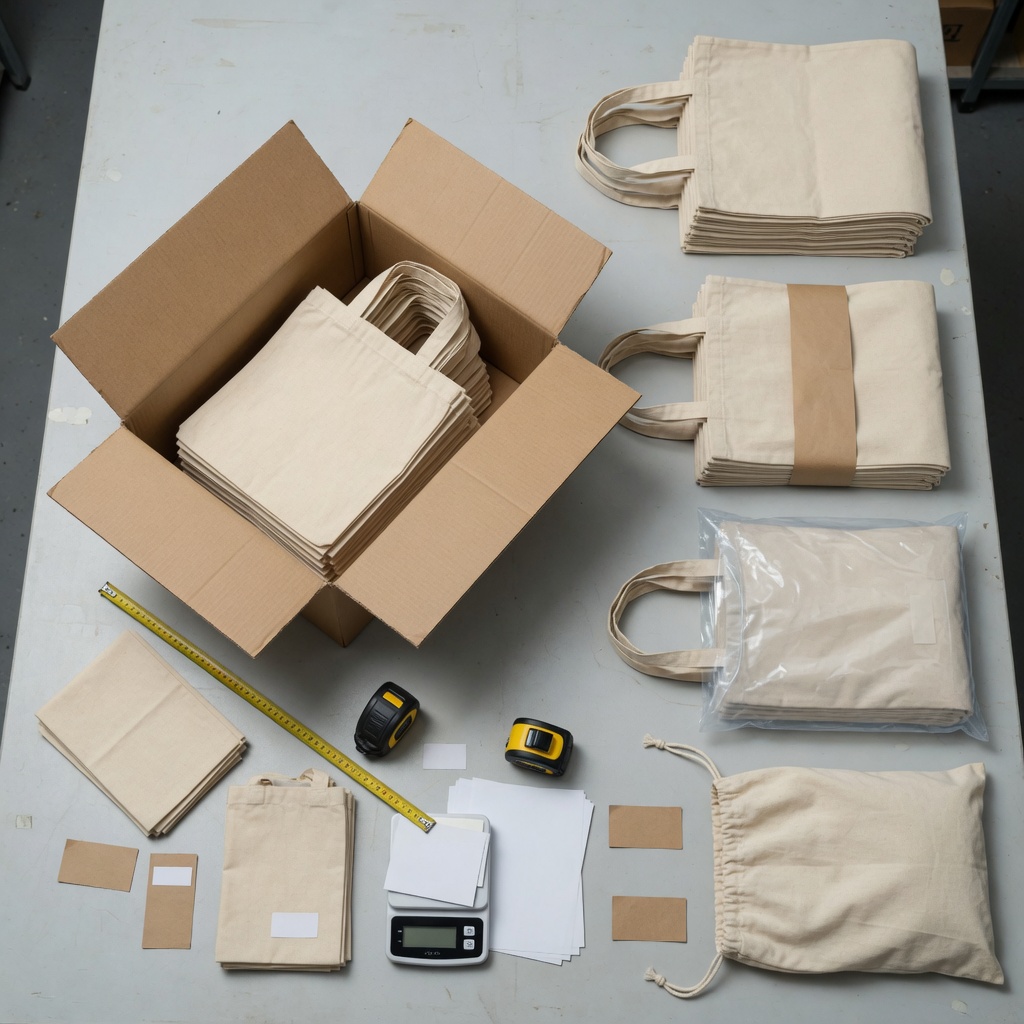
Select the unit pack from receiving, presentation, labeling, and claim requirements rather than accepting an undocumented default. The custom-packing source identifies polybags and cotton dust bags as possible categories source. The cotton-bag source refers to bulk or individual packing and paper bands source.
| Packing option | Appropriate RFQ condition | Controls to request | Approval evidence |
|---|---|---|---|
| Bulk flat-fold | The receiving specification permits unenclosed bags | Fold direction, handle position, decoration direction, contact restrictions, bundle method, separator material, and carton ratio | Packed stack, unpacked condition, carton-fit evidence, and quantity record |
| Kraft paper band or sleeve | Unit presentation or identification is required without a fully enclosed pack | Paper composition or grade, dimensions, closure, label location, claim wording, fit criteria, and restrictions on secondary liners | Approved proof or physical sample, packed-unit sample, and applied-label evidence |
| Individual sleeve or polybag | The approved specification requires an enclosed unit or an external label surface | Material composition, dimensions, thickness unit, closure, buyer-required warning artwork, environmental wording, and substitution limits | Packed-unit sample, closure check, label proof, and scan evidence when applicable |
| Cotton dust bag | A separate textile presentation pack is part of the approved configuration | Dust-bag material, dimensions, closure, decoration, nesting method, unit charge, and support for any organic or certification wording | Complete nested sample, artwork approval, and current claim documents |
| Buyer-supplied component | The buyer controls proprietary or preprinted packing materials | Delivery location, required arrival date, accepted quantity variance, incoming inspection, storage, loss, damage, unused-material disposition, and reconciliation | Incoming count, production sample, usage record, and final material balance |
Do not let a component name establish a broader environmental claim. A paper band does not by itself prove that the complete shipment is plastic-free. A cotton dust bag does not establish organic status or certification. Review sleeves, bundles, liners, tape, labels, document pouches, and other included materials against the exact approved wording.
United States labeling controls within the packing requirements
Keep the bag label, unit-pack label, carton mark, and receiving label in a consolidated approval matrix. For each item, record:
- Packing level and purpose.
- Artwork owner and file revision.
- Finished dimensions and measurement unit.
- Substrate, adhesive, and application method when relevant.
- Placement reference and placement tolerance.
- Human-readable or encoded value supplied by the buyer.
- Visual, dimensional, or scan-validation method.
- Approval authority, approval date, and required evidence file.
The custom-packing source lists FNSKU label application as an option source. That listing does not establish compliance with a buyer's current marketplace account or receiving program. When an FNSKU is required, the buyer should provide account-confirmed artwork and placement instructions. The supplier should return an applied-label proof and scan result before mass application.
Route any proposed country-of-origin, fiber-content, care, or warning wording to the buyer's United States compliance owner. This article does not determine whether particular wording is legally required for a given bag, pack material, sales channel, or destination. Do not allow the supplier to copy wording from an earlier order without current written approval.
The same source uses the option descriptions FSC paper and GOTS cotton dust bags source. Those webpage descriptions are not current certificates for the proposed order. Withhold FSC or GOTS wording and marks until the buyer has reviewed current documents covering the relevant party, material, scope, and intended claim. The document and artwork release gates described here are buyer controls; they are not presented as requirements issued by FSC or GOTS. The organic claim for the bag must be supported by the product evidence file and cannot be inferred from the packing method.
Carton data and landed-cost inputs
Require each supplier to separate packing charges and return the freight inputs created by the selected pack. The quotation schedule should include:
- Bag price before optional packing changes.
- Unit-pack material and application charge per bag.
- Label, hangtag, barcode, or receiving-label printing and application charges.
- Bundle, separator, liner, tissue, or document-pouch charges.
- Master-carton material, closure, printing, and marking charges.
- Sample, artwork, setup, tooling, or other non-recurring packing charges.
- Product minimums and separate packing-component minimums.
- Bags per carton and total carton count.
- External dimensions in a stated length × width × height order.
- Net and gross weight with units.
- Currency, quotation validity, delivery term, named place, and included or excluded origin charges.
- Cost and delivery effect of every packing alternative.
Use a consistent calculation structure:
Packing subtotal = unit-pack charge × ordered bags + carton charge × carton count + other recurring packing charges + non-recurring packing charges
Comparable landed cost = product cost + packing subtotal + inspection + origin charges + freight + insurance + applicable import charges + broker or terminal charges + domestic delivery + expected storage or rework
Do not insert unsupported freight, duty, tax, or delivery rates. Obtain dated inputs from the responsible supplier, logistics, customs, tax, and receiving parties, and record what each quote includes.
Illustrative data set: Every figure below is an example assumption for the United States RFQ scope as of the date recorded on the buyer's RFQ comparison sheet. The figures are not supplier, market, freight, customs, or legal data. Verify or replace each figure in the current supplier quote, approved sample, and measured packing record before making an award or shipment decision.
| Input or output | Illustrative value | Source and evidence status |
|---|---|---|
| Bag body dimensions | 38 cm body width × 42 cm body height per example bag | Example assumption for the United States RFQ as of the buyer-dated comparison sheet; verify in the approved specification and current supplier quote |
| Handle drop | 30 cm per example bag | Example assumption for the United States RFQ as of the buyer-dated comparison sheet; verify in the approved specification and current supplier quote |
| Order quantity | 1,000 bags per example order | Example assumption for the United States RFQ as of the buyer-dated comparison sheet; verify in the current supplier quote |
| Packing ratio | 50 bags per master carton | Example assumption for the United States RFQ as of the buyer-dated comparison sheet; verify through the packed sample and current supplier quote |
| Master-carton count | 20 master cartons per example order, calculated from 1,000 bags ÷ 50 bags per carton | Example calculation for the United States RFQ as of the buyer-dated comparison sheet; verify against the supplier's actual carton plan |
| Proposed carton exterior | 55 cm length × 40 cm width × 35 cm height per example master carton | Example assumption for the United States RFQ as of the buyer-dated comparison sheet; replace with measured pre-shipment data |
| Proposed carton gross weight | 13.0 kg per example master carton | Example assumption for the United States RFQ as of the buyer-dated comparison sheet; replace with measured pre-shipment data |
| Unit-pack charge | USD 0.10 per bag | Example cost assumption for the United States RFQ as of the buyer-dated comparison sheet; verify in the current supplier quote |
| Unit-pack total | USD 100.00 per example order, calculated from 1,000 bags × USD 0.10 per bag | Example calculation for the United States RFQ as of the buyer-dated comparison sheet; verify against the current supplier quote |
| Master-carton charge | USD 2.50 per master carton | Example cost assumption for the United States RFQ as of the buyer-dated comparison sheet; verify in the current supplier quote |
| Master-carton total | USD 50.00 per example order, calculated from 20 cartons × USD 2.50 per carton | Example calculation for the United States RFQ as of the buyer-dated comparison sheet; verify against the current supplier quote |
| Packing subtotal | USD 150.00 per example order | Example calculation for the United States RFQ as of the buyer-dated comparison sheet; excludes inspection, freight, import, storage, rework, and delivery costs and must be verified |
| Allocated packing subtotal | USD 0.15 per bag, calculated from USD 150.00 ÷ 1,000 bags | Example calculation for the United States RFQ as of the buyer-dated comparison sheet; verify against the final order quantity and current quote |
A lower unit-pack charge does not establish a lower landed cost if the alternative changes carton count, external dimensions, gross weight, damage exposure, labeling work, receiving labor, or delivery timing. Require the complete carton plan and delivery effect for each alternative rather than comparing only the packing charge per bag.
Delivery evidence and packing change control
Connect packing approval to dated deliverables instead of relying on a general shipment estimate.
| Stage | Supplier return | Buyer release action |
|---|---|---|
| Quotation | Proposed packing schedule, estimated carton data, separated option costs, component procurement dependencies, and proposed cargo-ready date | Confirm that quotations use the same product and packing scope |
| Packed-sample approval | Folded bag, unit pack, applied labels, inner grouping, proposed carton arrangement, and measurement record | Approve, revise, or reject the physical packing method and evidence |
| Pre-production release | Final label files, carton-mark layout, claim documents, approved component list, and substitution restrictions | Authorize component procurement and mass packing only after required evidence is complete |
| Pre-shipment review | Actual carton count, external dimensions, net and gross weight, carton images, mark images, QC result, discrepancy status, and proposed booking data | Approve booking only when measured data meet receiving and commercial controls |
| Cargo handoff | Final packing list, required commercial documents, shipment labels, carton sequence, transport references, and delivery information | Reconcile the packed goods, purchase order, shipment documents, and booking data |
Require the supplier to identify dates as proposed or committed and to name packing components with separate procurement dependencies. An approved material, label, fold, carton ratio, or carton construction cannot be changed through silence or shipment urgency. The supplier should submit a written deviation request with the revised charge, packed sample, carton plan, delivery effect, and supporting evidence.
Packing QC and shipment approval
Define packing defects before inspection or final supplier review. The approval file should cover:
- Correct SKU, color, decoration, and quantity in each carton.
- Approved fold direction, handle position, and decoration orientation.
- Correct unit-pack material, dimensions, closure, and grouping method.
- Correct label revision, encoded value, placement, and scan result when required.
- Correct carton construction, closure, marks, receiving labels, and sequence.
- No unapproved material, liner, tape, label, carton, or quantity-ratio substitution.
- No soil, abrasion, transfer, moisture exposure, tearing, crushing, or other condition outside the buyer's approved criteria.
- Actual carton count, external dimensions, net weight, and gross weight recorded with units.
- Shipment documents reconciled to the purchase order and measured packing data.
If the buyer uses statistical sampling, the instruction should name the applicable sampling document and edition, lot definition, inspection level, sample size, acceptance and rejection rules, and critical, major, and minor defect definitions. The supplied recycled-cotton page covers a different material route, so no MOQ, AQL, test, packing, certification, or QC value from that page is transferred to this organic cotton bag RFQ source.
The shipment-release record should name the approver, evidence reviewed, unresolved exceptions, corrective action, reinspection responsibility, and approval date. A passed product inspection should not override an unresolved label, carton, quantity, claim-document, or shipping-document discrepancy.
Practical RFQ checklist for organic cotton bag packing requirements
Before issuing the RFQ, comparing quotations, approving the packed sample, or releasing shipment, confirm:
- [ ] The SKU, product-specification revision, approved sample, dimensions, decoration orientation, fold, and handle position are linked to the packing schedule.
- [ ] Unit-pack material, composition, dimensions, closure, grouping, substitution limits, claim restrictions, and recurring charge are defined.
- [ ] Label files, revisions, encoded data, placement tolerances, approval owners, proofs, and validation methods are assigned.
- [ ] Carton ratio, construction, closure, external dimensions, net and gross weight, count, marks, and measured-data deadline are requested.
- [ ] Currency, delivery term, named place, quote validity, minimums, exclusions, recurring charges, and non-recurring charges are comparable.
- [ ] Dated landed-cost inputs are assigned to the responsible supplier, logistics, customs, tax, and receiving parties.
- [ ] Packed-sample, claim-document, QC, delivery, and shipment-document release gates have named owners and due dates.
- [ ] Proposed values are separated from measured pre-shipment actuals, and written approval is required for every deviation or substitution.
- [ ] Booking and shipment remain blocked while packing, labeling, carton, quantity, claim, inspection, cost, or document discrepancies are unresolved.
Use the detailed fields below as the copy-ready RFQ, approval, and shipment-release attachment:
```text ORDER AND QUOTATION BASIS Buyer sales market: United States RFQ or purchase-order reference: RFQ comparison date: Quotation validity end date: SKU and color breakdown: Order quantity by SKU: Receiving channel and destination: Currency: Delivery term and named place: Required cargo-ready basis:
PRODUCT AND FOLD LINKAGE Approved organic cotton bag specification revision: Approved sample reference: Bag body and handle dimensions with units: Decoration and orientation reference: Fold diagram or reference: Handle position after folding: Decoration-facing direction: Permitted crease condition:
UNIT PACK Permitted packing option: Pack material and composition: Thickness, basis weight, or grade with unit if applicable: Pack length × width × height with units: Closure method: Dimensional or placement tolerance: Prohibited materials and substitutions: Recurring charge per bag: Alternative configurations and separate charges:
INNER GROUPING AND MASTER CARTON Bags per bundle: Bundle arrangement: Separator, liner, tissue, or other inner material: Bags per master carton: Carton construction or performance criteria: Closure and tape specification: External length × width × height with units: Net weight per carton with unit: Gross weight per carton with unit: Buyer-set handling limit if applicable: Total carton count: Carton-mark fields and artwork revision: Receiving-label location: Carton-sequence format: Carton, closure, printing, and marking charges:
LABEL AND CLAIM MATRIX Bag label or hangtag purpose: Unit-pack label purpose: Barcode or FNSKU file and encoded data: United States compliance artwork if required by current review: Artwork owner and revision: Finished dimensions and substrate: Application method: Placement reference and tolerance: Scan or visual-validation method: Permitted organic or environmental wording: Permitted certification wording or marks: Required current documents and applicable scope: Document-review owner: Artwork approval authority and date:
COST AND LANDED-COST INPUTS Base bag price before optional packing: Recurring packing charges by component: Non-recurring packing charges: Product minimum: Packing-component minimums: Included origin charges: Excluded origin charges: Estimated carton data used for quotation: Cost and delivery effect of each alternative:
QC AND RELEASE EVIDENCE Packed-sample requirement: Applied-label proof: Barcode scan evidence if applicable: Carton-mark proof: Pre-shipment images: Inspection method and defect definitions: Sampling instruction if applicable: Corrective-action and reinspection responsibility: Deadline for measured carton data: Shipment-release approver:
DELIVERY DOCUMENTS Packing-completion date: Inspection date: Proposed or committed cargo-ready date: Packing-list format: Required commercial-document format: Shipment-label files: Document-handoff date: Responsible supplier contact:
SUPPLIER DECLARATION Every field is identified as buyer-fixed, supplier-proposed, or pre-shipment actual. No packing material, label, carton, quantity ratio, claim wording, or packing method may be substituted without written buyer approval. Estimated carton data will be replaced by measured pre-shipment data before booking and shipment release. ```
Methodology, source boundaries, and what to verify
| Supplied source context | Supported use | Explicitly excluded use |
|---|---|---|
| Vincent Xi author profile | Author name, role, and profile URL | Factory experience, testing, credentials, certifications, client outcomes, or years of experience |
| Custom-packing page | Source-stated examples of polybags, cotton dust bags, FNSKU labels, corrugated cartons, shipping marks, and FSC- or GOTS-related option wording | Current capability, availability, order-specific specification, certification, legal compliance, price, or delivery commitment |
| Cotton-bag comparison page | Source-stated references to bulk or individual packing, paper bands, carton marks, size, quantity, labels, and destination | Current supplier capability, certified organic status, order-specific performance, price, or legal determination |
| Recycled-cotton route page | Scope boundary showing that recycled cotton is not the material route evaluated here | Transfer of MOQ, AQL, QC, packing, certification, material, or performance values to the organic cotton bag RFQ |
Methodology: Only the supplied URLs were used as factual source contexts. Source-stated packing options and purchasing fields were converted into buyer-controlled RFQ questions, supplier-return fields, and shipment-release evidence. Recommendations were separated into buyer-fixed requirements, supplier proposals, and measured pre-shipment actuals. Every numerical value is expressly labeled as an example assumption or calculation to verify. Marketing-page wording was not treated as proof of certification, current manufacturing capability, United States compliance, price, or order-specific performance.
Limitations and items to verify: The cited pages do not replace a current organic cotton bag specification, supplier quotation, packed sample, organic-claim evidence, certification document, inspection instruction, freight quotation, customs or legal review, marketplace-account rule, tax input, or receiving-warehouse instruction. Before purchase-order or shipment release, verify the bag construction, dimensions, packing materials, artwork, product and component minimums, carton ratio, measured external dimensions, net and gross weight, charges, claim documents, delivery dates, inspection evidence, and shipment documents. No company manufacturing capability or certification claim is made from the supplied evidence.
Author basis: The supplied profile identifies Vincent Xi as Editorial Author. It does not support a first-person factory, product-testing, certification, client, or customer-outcome statement, so no such experience claim is included.
Discuss Your Requirements
Review our manufacturing capabilities, then share your specifications for a supplier-fit review.