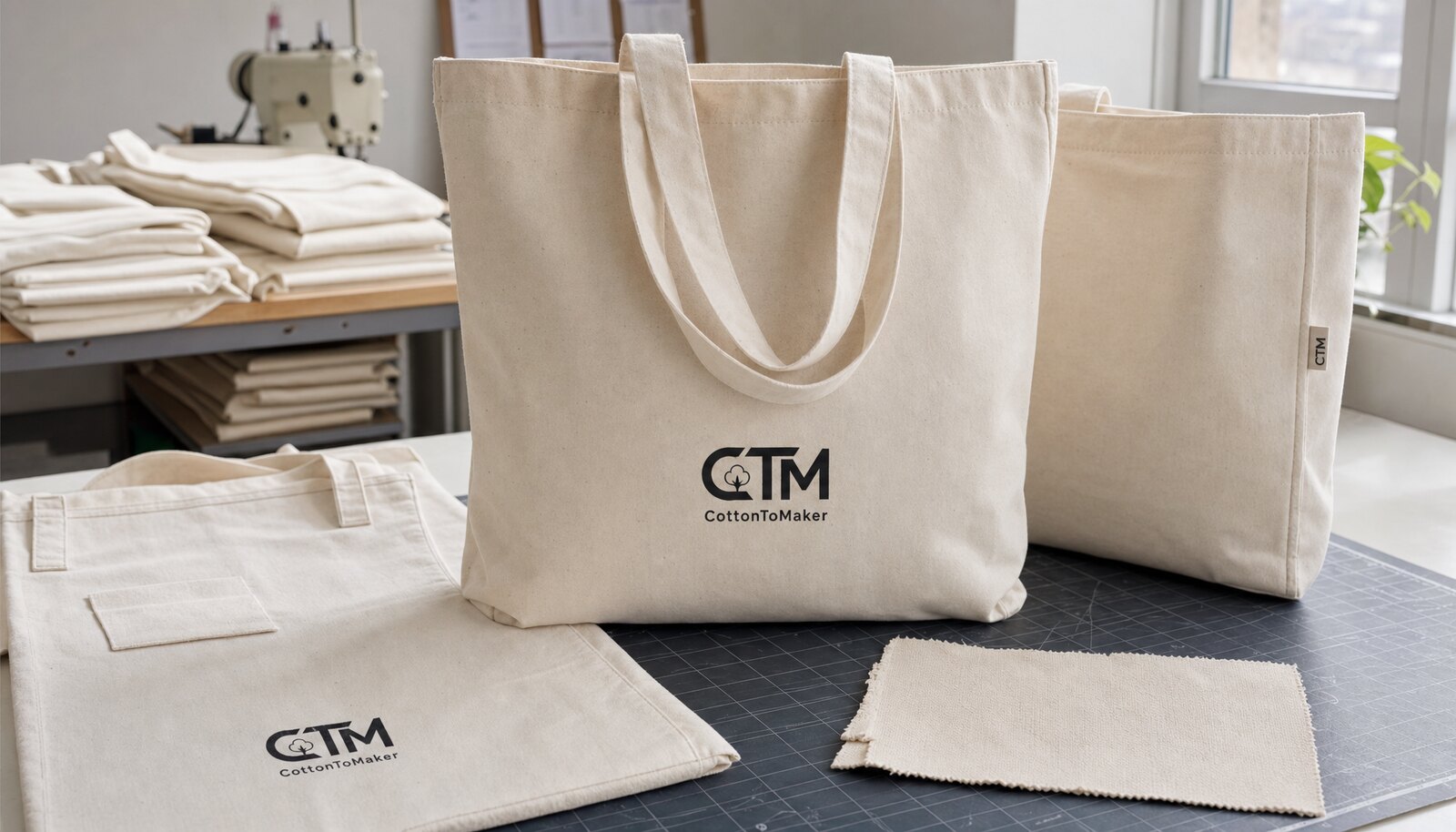
Why Logo Placement Needs Its Own Buying Spec
Logo placement on an organic cotton bag looks simple until a bulk shipment arrives with the artwork 25 mm too high, partly hidden under the handle stitch box, or distorted by the bottom gusset. The buyer usually supplied the logo file, the factory printed it, and both sides assumed the position was obvious. For organic cotton bags, that assumption is expensive because the fabric is soft, the weave can move during cutting and sewing, and the bag is normally inspected as a flexible product, not a rigid panel.
A useful organic cotton bag logo placement guide should help the buyer convert visual preference into measurable production instructions. The goal is not to over-control every handmade tolerance. The goal is to define a safe print zone, select a logo method that fits the fabric and order quantity, and approve a sample that represents bulk production. If your RFQ only says "logo on front" or "center print," you are leaving too much interpretation to the sample room.
- Use fixed reference points: top opening, bottom seam, side seam, handle stitch box, zipper edge, drawstring channel, or gusset fold.
- State logo size in width and height, such as 200 mm wide x 80 mm high, rather than "medium size."
- Define position using distances, such as 120 mm below top opening and centered between side seams.
- Ask the factory to mark the printable area on the technical proof before making the physical sample.
Start With Bag Construction Before Choosing Placement
The correct logo position depends on the bag construction more than the artwork. A flat 38 x 42 cm organic cotton tote has a wide front panel and can accept a large centered logo. A 30 x 40 cm drawstring pouch has a cord channel at the top, so the logo must sit lower to avoid puckering. A zipper business bag has a zipper seam and possible lining, so printing after sewing may create uneven pressure near the zipper. A wine bag has a narrow panel, so tall logos often look better than wide horizontal artwork.
Procurement teams should ask the supplier to confirm the usable branding area for the exact product, not for a generic bag. Factories often have standard cutting patterns, handle lengths, boxed corners, and gusset widths. These details change how the bag hangs and how the logo appears during real use. A tote displayed flat on a table may look balanced, but once filled with groceries or catalogues, the upper section opens and the logo visually shifts downward.
- Tote bags: keep the main logo clear of handle stitch boxes and upper opening tension.
- Drawstring pouches: avoid the top 50-80 mm on medium pouches because the cord channel gathers fabric.
- Zipper bags: avoid placing artwork too close to zipper tape, pullers, and boxed corners.
- Wine bags: confirm whether the logo is viewed on the broad face or narrow side panel.
- Messenger bags: decide whether the logo sits on the flap, body panel, strap, or side label before costing.
Match Fabric Weight and Surface to Logo Detail
Organic cotton fabric weight affects both appearance and placement accuracy. Lightweight muslin, often around 120-150 GSM, is flexible and economical for pouches, but it can shift during printing and sewing. Midweight plain weave or canvas, around 180-240 GSM, is common for promotional and retail totes because it balances cost, strength, and printability. Heavier canvas, around 280-340 GSM, gives a premium hand feel and more structure, but thick seams and gussets can reduce the usable print area near edges.
Logo detail should be matched to the fabric surface. Organic cotton may show natural specks, seed particles, slubs, and minor shade variation. These are part of the material character, but they also affect fine lines and small text. If the logo includes tiny registration marks, fine serif lettering, QR codes, or multiple small color separations, the buyer should request a print test on the actual fabric GSM. A paper proof cannot show how ink sits on open cotton weave.
- 120-150 GSM muslin: suitable for simple one-color logos, small pouches, and lower-cost packaging.
- 180-240 GSM cotton or canvas: strong choice for screen printed tote logos and standard retail giveaways.
- 280-340 GSM canvas: better structure for premium bags, but check print pressure near thick seams.
- Natural undyed organic cotton: expect visible flecks; avoid very small reversed-out text.
- Washed cotton: softer look, but shrinkage can move final logo position if printing happens before washing.
Choose a Placement Method That Fits the Print Process
Logo placement cannot be separated from print method. Screen printing is the most common choice for bulk organic cotton tote bags because it handles solid brand marks well and is cost-efficient when the artwork is simple. Heat transfer can reproduce gradients and small details, but the hand feel and wash performance depend on transfer quality and temperature control. Embroidery gives a premium texture, but it can pull lightweight fabric and is usually better for smaller logos or reinforced areas.
Labels are often a better solution when the buyer wants subtle branding or when the artwork is too small for clean direct printing. A side seam woven label, an inside neck label, or a small cotton patch can carry brand identity without dominating the bag. However, labels add sewing steps, orientation checks, and sometimes higher MOQs. The RFQ should ask the factory to quote both the visible decoration and the hidden compliance labels if the bag will be sold through retail.
- Screen print: good for bold logos, solid colors, and repeat orders with stable artwork.
- Heat transfer: useful for full color or gradients, but check feel, cracking, and edge adhesion.
- Embroidery: suitable for small premium marks, not large dense logos on light muslin.
- Woven label: good for side seams, straps, and subtle retail branding.
- Cotton patch: good for natural positioning, but needs seam allowance and edge finishing.
- Inside printed label: useful when exterior branding must stay minimal.
Set Safe Zones and Placement Tolerances
A safe zone is the area where the factory can place the logo without fighting seams, folds, handles, drawstrings, zippers, or gussets. For a standard tote, the safe zone normally starts below the handle stitch box and ends above the bottom seam or gusset fold. For a pouch, the safe zone starts below the drawstring channel and ends above the bottom seam. For a zipper bag, the safe zone should avoid the zipper tape, boxed corners, and any internal padding that creates height differences during printing.
Tolerance must be realistic. Organic cotton bags are cut and sewn soft goods, so exact millimeter placement across thousands of pieces is not practical. For a large front logo on a tote, plus or minus 10 mm may be a reasonable production tolerance if the factory has stable jigs. For a small woven side label, plus or minus 3-5 mm may be expected if the seam operation is controlled. The key is to agree before sampling. If the inspection team has no approved tolerance, they may reject normal variation or miss a true production issue.
- Large front print on tote: commonly specify center alignment with plus or minus 10 mm tolerance.
- Small pouch print: use plus or minus 5-8 mm depending on pouch size and fabric weight.
- Side seam label: ask for label exposure width, label height, and straightness tolerance.
- Bottom placement: keep at least 50-70 mm above the finished bottom seam on standard totes unless the design intentionally sits low.
- Top placement: keep the logo below handle stitch boxes and away from drawstring channels.
Cost and MOQ Logic Behind Logo Placement Choices
Logo placement affects cost because it changes handling time, setup, reject risk, and sometimes production sequence. A centered one-color screen print on a flat tote panel before sewing is efficient. Printing after sewing near a gusset, zipper, or narrow side panel is slower and may need a special platen. A side seam label looks small, but it adds label production, label cutting, storage control, and sewing alignment checks. Embroidery may require backing material and slower machine time.
MOQ logic also changes by method. Screen printing may have a practical MOQ because the factory must prepare screens and ink, even if the bag sewing MOQ is lower. Woven labels usually have their own MOQ from the label supplier. Heat transfer may support smaller batches, but the unit cost can stay higher and the hand feel may not match a natural organic cotton brand position. When comparing quotes, do not only compare bag unit price. Separate the base bag, logo setup, decoration unit cost, label cost, sampling cost, and packing cost.
- Ask for base bag price without logo, then decoration price by method.
- Request setup charges separately so repeat order pricing is clear.
- Confirm whether screen charges apply per color, per artwork size, or per logo position.
- Ask if label MOQ exceeds bag MOQ and whether unused labels can be stored for repeat orders.
- Check if difficult placement increases defect allowance or inspection cost.
- Clarify whether sample cost includes one revision or each remake is charged separately.
Artwork Files and Proofs Buyers Should Provide
Factories can make a better sample when the buyer provides production-ready artwork and measurable placement instructions. Vector files such as AI, EPS, or PDF are preferred for screen printing, embroidery digitizing, and label weaving. If the logo is supplied as a low-resolution PNG from a presentation deck, the factory may redraw it, and small differences in line weight or spacing can appear. For brand owners, this is a common source of approval delay.
A good proof should show the bag outline, finished size, logo size, logo position, seam lines, handle stitch boxes, and any label locations. The proof should use millimeters or centimeters, not only a visual mockup. If there are multiple bag sizes in the same program, each size needs its own placement proof. Scaling one logo across all sizes may not look balanced, especially when moving from a small pouch to a large tote.
- Provide vector logo artwork with outlined fonts.
- Include Pantone references for spot color printing or approved CMYK values for digital work.
- State if the logo color must match on natural cotton, dyed cotton, and paper packaging.
- Mark the exact logo width and height in centimeters.
- Provide separate artwork for exterior logo, side label, inside label, and care label.
- Ask the factory to return a measured layout proof before sample production.
Sample Checks Before Bulk Approval
The pre-production sample is where logo placement problems should be caught. Do not approve only from a photo taken at an angle. Ask for flat measurements, close-up photos of the print edge, and photos of the bag filled or hanging if that is how the end user will see it. For retail buyers, also check how the logo appears after folding because shelf presentation may be different from use presentation.
The best sample uses the actual fabric, actual GSM, actual dye or natural color, actual sewing construction, and actual decoration method. If the factory sends a quick sample on substitute fabric, treat it only as a layout reference, not as final approval. For organic cotton bags, the print color can look different on natural greige cotton, bleached cotton, and dyed cotton. Approving placement on one material and then switching fabric later is a common reason for re-sampling.
- Measure from top opening to logo top edge and from side seams to logo edges.
- Check whether the logo is visually centered when the bag is flat and when hanging.
- Rub the printed area lightly after curing to check obvious ink transfer.
- Inspect small text, registered symbols, and thin lines on the actual fabric texture.
- Confirm label direction before bulk sewing; side labels are often rotated incorrectly if not marked.
- Keep one signed or sealed approval sample for factory reference and one for buyer QC.
Packing Decisions That Protect the Logo
Packing can damage a good logo placement plan. If a tote is folded sharply through the printed area, the shipment may arrive with crease lines across the brand mark. If freshly printed bags are packed before full curing, ink blocking or pressure marks can occur. If side labels are folded inside the seam and pressed flat, the visible label may look uneven when unpacked. Packing should be part of the RFQ, not an afterthought after production.
Buyers should tell the factory whether the bags will be bulk packed, individually polybagged, paper banded, folded for retail cartons, or shipped flat. Each option affects carton size, freight efficiency, and logo presentation. Organic cotton brands often want reduced plastic packaging, but the alternative must still protect the printed surface from moisture, abrasion, and dust. If plastic-free packing is required, ask for a packing sample or photo proof showing exactly where the fold line crosses.
- Avoid fold lines through large center logos when retail appearance is important.
- Use tissue, glassine, or paper bands only after checking ink rub and moisture risk.
- Confirm the number of pieces per inner pack and master carton.
- Ask whether bags are pressed before packing and whether pressing changes label shape.
- Check carton compression if heavy canvas bags are stacked for long transit.
- Include barcode, hangtag, or retail label placement if the bag is sold individually.
Lead Time and Quote Data for a Cleaner RFQ
Logo placement decisions influence lead time because they affect sampling, artwork proofing, screen preparation, label production, and inspection planning. A simple one-color front print may move quickly after artwork approval. A program with exterior print, woven side label, inside care label, hangtag, and plastic-free retail packing needs more coordination. Importers should build in time for artwork correction and one sample revision instead of assuming the first sample will be approved.
A clean RFQ helps the factory quote accurately and reduces later price changes. Include bag style, finished size, fabric GSM, organic cotton color, handle or drawstring details, logo method, logo size, logo position, number of colors, packing method, inspection standard, target quantity, and delivery terms. If you want alternatives, ask for them in a structured way: quote option A for one-color screen print, option B for woven side label, and option C for screen print plus inside label. This makes supplier comparison much easier.
- Quote line 1: base organic cotton bag specification and quantity.
- Quote line 2: decoration method, logo size, color count, and position.
- Quote line 3: setup charges, screen charges, label charges, or digitizing charges.
- Quote line 4: sample cost, sample lead time, and bulk lead time after approval.
- Quote line 5: packing method, carton quantity, carton size, and gross weight estimate.
- Quote line 6: tolerance, inspection checkpoints, and required approval sample process.
Specification comparison for buyers
| Spec decision | Recommended option | When it fits | Buyer risk to check |
|---|---|---|---|
| Front center logo on tote body | Logo width 18-24 cm, positioned 10-14 cm below top opening | Retail giveaways, grocery totes, brand merchandise, event bags | Logo may look too high after handles pull the bag open; approve on a filled sample, not only flat artwork |
| Lower front logo placement | Logo width 14-20 cm, placed 6-9 cm above bottom seam | Premium minimal branding, fashion retail, organic product packaging | Bottom seam bulk and corner folds can distort printing if placed too low |
| Side seam woven label | Small organic cotton or recycled polyester label, 2.5-4 cm exposed width | Brands needing subtle identity, compliance labels, retail reusable bags | Label orientation, wash shrinkage, and seam catching must be checked before bulk stitching |
| Inside neck label or care label | Printed cotton label or sewn care label near upper inside seam | Bags sold through retail channels or used as packaged merchandise | Incorrect fiber claims or missing importer details can create relabeling cost |
| Drawstring pouch logo | Centered on front panel, 4-8 cm below cord channel depending on pouch size | Cosmetic pouches, gift packaging, jewelry bags, tea or food accessories | Cord channel creates uneven fabric tension; keep print away from the gathered top area |
| Handle logo or strap branding | Woven-in strap, heat transfer on flat webbing, or small side label | Higher perceived value or co-branded promotional programs | Printing on narrow handles increases reject risk if artwork has small text |
| Full-area graphic | Screen print or digital print with at least 2 cm clearance from seams | Retail artwork bags, museum shops, brand campaigns | Organic cotton slubs and seam folds make full bleed alignment difficult; define acceptable variation |
Buyer checklist before sampling
- Confirm bag style first: tote, drawstring pouch, zipper bag, backpack, wine bag, or messenger bag, because each has different printable zones.
- Specify fabric weight in GSM and whether the fabric is plain weave, canvas, twill, or muslin; logo clarity depends on surface texture.
- Provide logo size in centimeters, not only percentage scale, and include distance from top opening, bottom seam, side seam, and handle stitch box.
- State print method preference or ask the factory to quote screen print, heat transfer, embroidery, woven label, and inside label separately when relevant.
- Send vector artwork with Pantone or CMYK references, minimum line thickness, and negative space requirements.
- Ask for a pre-production sample made with the actual fabric, actual bag size, actual logo position, and actual packing method.
- Define placement tolerance before sampling, such as plus or minus 5 mm for small labels or plus or minus 10 mm for large tote prints.
- Check logo position with the bag both flat and filled, especially for totes that will hang from handles in retail or event use.
- Confirm whether logo printing happens before sewing or after sewing, because this changes alignment risk near seams and pockets.
- Approve carton packing method so printed panels are not sharply folded through the logo area unless fold marks are acceptable.
Factory quote questions to send
- For this organic cotton bag style and GSM, which logo placements are low risk, medium risk, and not recommended?
- Will the logo be printed before sewing or after sewing, and how does that affect placement tolerance?
- What is the maximum print area for the selected bag size after allowing seam clearance and handle stitch clearance?
- Can you quote the same artwork in screen print, heat transfer, embroidery, woven label, and sewn side label where suitable?
- What is the MOQ for each logo method, and does the MOQ change by color count, label construction, or bag size?
- What setup charges, screen charges, label mold charges, or sample remake charges should be separated from unit price?
- What fabric shrinkage or washing behavior should we expect if the buyer requires washed organic cotton bags?
- Can you provide a digital proof with measurement marks and then a physical pre-production sample for final approval?
- What placement tolerance can your line hold in bulk production for this bag style?
- How will printed bags be folded and packed, and will the fold line cross the logo?
Quality-control points to confirm
- Measure logo distance from fixed construction points, not from soft fabric edges only.
- Check at least the first-line sample, mid-line sample, and packed random samples for placement drift.
- Compare print color on the approved organic cotton fabric, not only against a paper Pantone book.
- Inspect ink coverage over cotton slubs, seed flecks, and weave irregularities before approving bulk production.
- Check handle stitch boxes and side seams do not cut into the logo safe zone.
- Confirm woven labels are straight, securely caught in the seam, and readable after pressing or folding.
- Review carton folding marks and pressure marks across the printed area after 24 hours in packed condition.
- Record accepted tolerances in the inspection sheet so the QC team does not reject normal handmade variation or pass true misplacement.