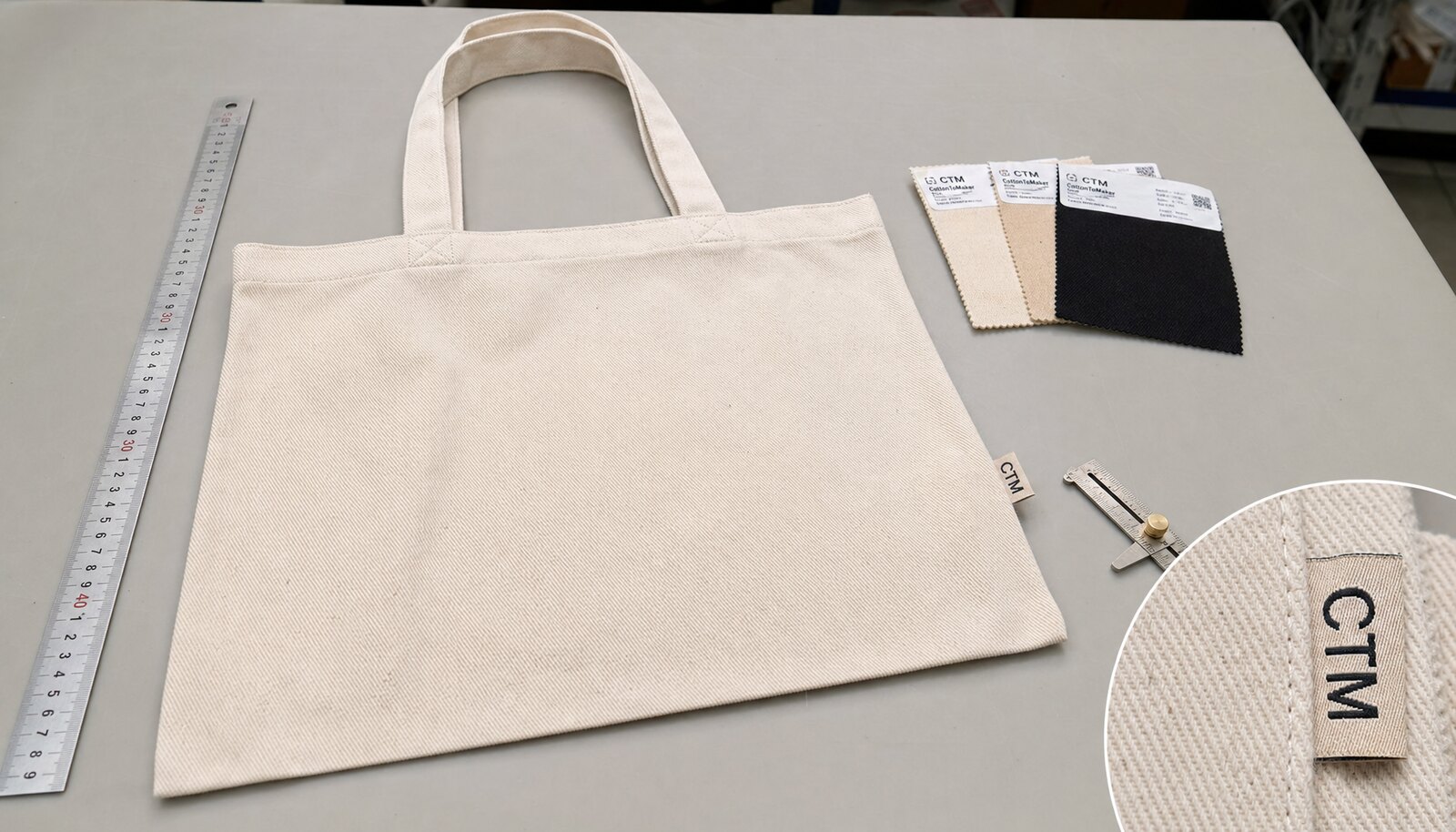
Why the Handle Spec Sheet Drives Quote Accuracy
A handle spec sheet is the fastest way to separate a real factory quote from a vague one. For an organic cotton bag, the handle is often the first failure point in daily use, and it is also the place where suppliers quietly make cost-saving substitutions. If you only ask for a cotton tote, one factory may use 25 mm tape, another may use 38 mm tape, and a third may change the reinforcement without flagging it. The quote can look lower, but you are not comparing the same bag.
A good organic cotton bag handle spec sheet turns the buying conversation into measurable decisions: what the bag will carry, how the handle will feel in hand, where the print sits, and how the seam should be reinforced. That matters even more when one supplier quotes 120 gsm body fabric and another quotes 180 gsm. Once the handle is written down clearly, the rest of the RFQ becomes easier to verify and harder to misread.
- Lock the bag body GSM before you compare handles.
- Define whether the bag is hand carry, shoulder carry, or both.
- State the reinforcement method, not just the handle material.
- Ask suppliers to quote the same print method and packing method.
Start From the Load, Not the Bag Name
The right handle depends on what the buyer expects the bag to do in the real world. A promo tote used for catalogs and a retail tote used for groceries cannot share the same handle spec just because both are organic cotton. If the intended load is light, a 25 mm cotton tape handle on 120 to 140 gsm body fabric may be enough. If the bag must carry heavier retail goods, a wider handle and stronger reinforcement are worth the extra sewing time.
Write the use case into the spec sheet in plain commercial language. Note whether the bag will carry paper goods, clothing, bottles, or mixed merchandise; whether the user will hold it by hand or over the shoulder; and whether the bag needs to survive repeated washing. These details change the handle width, the stitch density, and the acceptable shrink allowance after production. If you skip them, every quote will reflect a different assumption.
- Light retail or giveaway tote: 120 to 140 gsm body, narrower handle, lower stitch burden.
- Daily retail tote: 140 to 180 gsm body, broader handle, stronger reinforcement.
- Heavier carry or reusable grocery use: 180 to 220 gsm body, wider tape, stricter pull test.
- If the bag must be washable, include post-wash shape and shrink limits.
Choose Handle Material That Matches Cost and Feel
For organic cotton bags, the most common handle choices are cotton webbing and self-fabric handles cut from the bag cloth. Cotton webbing gives more consistent width and a cleaner assembly process, while self-fabric handles can create a more unified look and reduce separate material sourcing. The tradeoff is that self-fabric handles can feel softer but may stretch more, and they usually take more cutting and sewing labor. The handle spec sheet should name the construction, not just say cotton handle.
If the buyer wants a premium retail look, a thicker woven tape with a neat edge can improve shelf appeal and reduce fraying. If the program is price-sensitive, a standard cotton tape in natural shade is often easier to source and easier to compare across factories. Custom dyed tape, branded jacquard tape, or special finishing increases MOQ pressure and may extend the lead time. That is fine if the margin supports it, but the spec sheet should make that cost visible before sampling.
- Cotton webbing: best for consistency and strong handling.
- Self-fabric: best for a softer, all-cloth appearance.
- Custom dyed or branded tape: best when the handle is part of the brand story.
- Ask whether the tape is pre-shrunk, washed, or raw cut.
Set Dimensions Precisely, Not Approximately
Handle dimensions should be written in finished terms, not in casual language. A supplier needs to know the finished width, cut length, fold allowance, and finished drop. A 25 mm handle is common for light to medium use, while 38 mm is usually more comfortable for heavier loads. Finished length matters more than cut length because buyers may receive the same bag with very different carry comfort if the loop is shortened during sewing.
The spec should also record where the handle starts and ends relative to the bag opening. That distance affects both usability and print placement. A shoulder-carry tote typically needs more drop than a hand-carry tote, and a bag with a narrow opening can look crowded if the handle is too wide. Use a tolerance range so the factory knows what is acceptable: for example, a width tolerance of plus or minus 0.5 cm and a finished length tolerance of plus or minus 1 cm is more useful than a vague 'as per sample'.
- State finished width and cut width separately if the factory needs both.
- Define handle drop if the bag is meant for shoulder carry.
- Keep enough clearance between print and the handle stitch line.
- If the bag is gusseted, confirm the handle placement on the side panel.
Stitching and Reinforcement Decide Real Durability
The handle is only as strong as its attachment. For a reusable organic cotton bag, a single line of stitching is usually not enough if the bag is expected to carry meaningful weight or be used repeatedly. X-box stitching with a bar tack is a common commercial solution because it spreads load across a wider area and reduces the chance of seam tear-out. Double-row topstitching can also work, but the buyer should define the pattern instead of leaving it to factory preference.
Reinforcement details should include patch size, stitch count, and thread type. A small reinforcement patch at the top edge can stabilize the load point and reduce puckering. Most factories will use polyester or poly-core thread for strength unless you ask for a fully natural thread spec, which changes cost and performance. If you want a natural-thread appearance or a fully cotton program, write that requirement clearly so the quote reflects it instead of surprising you during production.
- Ask for X-box plus bar tack when the tote is meant for repeated use.
- Specify the stitch pattern on both sides if the handle is visible from the inside.
- Confirm the thread color and whether contrast thread is acceptable.
- Check for seam puckering after the first sample, not after bulk.
Treat Print and Branding as Part of the Handle Spec
On many buyer programs, the handle affects print quality even if the logo is printed on the body. Thick seams near the top edge can distort the print area, and a wide handle can force the artwork lower than planned. The spec sheet should note the print method, print size, print colors, and the distance between print and stitch line. Screen print is often the most practical choice for a simple one- or two-color logo on cotton. If the artwork is more complex, the buyer should still ask how the factory will control registration on the production fabric.
If the handle itself carries the brand, the quote has to reflect that separately. Branded woven tape, jacquard handle tape, or printed handle tape adds cost, and the MOQ often rises because the factory must source a custom material run. The same is true if the handle color is not natural cotton. A clear spec sheet protects you from receiving a quote that looks cheap only because the supplier assumed a plain unbranded natural handle.
- Name the print method: screen print, heat transfer, embroidery, woven tape, or label.
- State how many print colors are included.
- Require a sample proof for print near the top seam.
- If the handle is branded, ask whether the logo is woven, stitched, or printed.
How to Compare Factory Quotes Line by Line
The easiest way to lose money is to compare supplier prices without comparing construction. A good handle quote should separate the bag body fabric, handle material, reinforcement, thread, print, and packing. Two quotes can both say organic cotton tote, but one may be based on 140 gsm fabric with a plain cotton tape handle and the other on 180 gsm fabric with a wider reinforced handle. That is not a price difference; it is a different product.
Ask each factory to list the same data: body GSM, handle width, handle length, attachment method, print method, packing method, and whether the quote includes samples and pre-production revisions. MOQ logic should also be transparent. Custom dyed tape, custom width, or a special reinforcement can move the MOQ higher because the factory has to buy or cut a separate component run. Typical planning ranges for standard programs are often 30 to 45 days after sample approval, but custom materials or busy seasons can extend that.
- Request a line item for body fabric GSM and weave.
- Ask whether the handle is standard stock or custom made.
- Make the factory separate sample cost from bulk cost.
- Confirm whether the MOQ changes if the handle color or width changes.
Sample Approval Should Test the Handle, Not Just the Look
The sample stage is where a handle spec sheet proves its value. Do not approve a tote only because the color looks right. Measure the finished handle width, the loop length, the drop, the seam position, and the distance from the print to the stitch line. Then do a simple load test based on how the bag will actually be used. The point is not to create a laboratory standard; the point is to catch a handle that stretches, twists, or tears before the bulk order is cut.
If the bag is washable, check the sample after a wash or at least after damp handling if the program requires it. Cotton fabric and cotton tape can change shape slightly after finishing, and that is one reason buyers should confirm shrink behavior before approving production. It is also smart to compare the first sample against the quote line by line. If the sample has wider tape, extra reinforcement, or a different print method, the quote is not yet validated.
- Measure at least three samples from the same lot.
- Record actual finished dimensions next to target dimensions.
- Test carry comfort by hand and on shoulder if both are intended.
- Reject samples that change shape after a light load or short wash.
Packing, Lead Time, and Factory Workflow Affect the Handle
Handle quality can be damaged after sewing if the packing method is sloppy. Long handles should be folded consistently so they do not crease at the same point every carton. If the bag is packed flat, decide whether the handles are tucked inside the body, folded over the front, or left in a specific orientation. That matters for retail presentation and for how quickly the bag can be packed at the factory. A spec sheet that ignores packing often creates a clean sample and a rough bulk delivery.
Lead time is also tied to the handle specification. Standard natural tape in a common width is easier to schedule than custom dyed tape or a special weave. If the factory needs to source a custom handle component, sampling can move quickly but bulk can slow down. Tell the supplier whether the order needs carton labeling, inner polybags, moisture protection, or retail folding instructions. Those items do not just affect logistics; they also affect the final look of the handle when the bag reaches the buyer.
- Specify folded packing, loose packing, or retail-ready packing.
- Ask for carton count per size and carton mark details.
- State whether the handles must be tucked, rolled, or taped.
- Add a packing photo request to the pre-shipment approval.
Common Handle Spec Mistakes and How to Prevent Them
The most common mistake is treating the handle as a generic detail. Buyers often specify body fabric and logo art carefully, then leave the handle to the factory, which leads to quote drift and weak comparisons. Another frequent issue is comparing one sample with natural tape and another with dyed or custom tape, even though the costs and lead times are not the same. A third mistake is ignoring thread, stitch density, and reinforcement because those items sound small until the first claim arrives.
The fix is simple: write the handle spec as a short acceptance standard. If the factory cannot meet the exact width, finished length, reinforcement pattern, print placement, or packing method, it should flag the difference before the quote is accepted. That approach gives procurement teams a cleaner comparison set and gives design teams fewer surprises at pre-production. In practice, a tight organic cotton bag handle spec sheet saves more time than a dozen email clarifications after sampling.
- Do not approve quotes that omit handle width or finished length.
- Do not compare natural tape against custom tape as if they cost the same.
- Do not skip stitch pattern and thread type.
- Do not accept a sample that looks right but measures wrong.
Specification comparison for buyers
| Spec decision | Recommended option | When it fits | Buyer risk to check |
|---|---|---|---|
| Handle width | 25 mm cotton webbing | Light to medium carry with a clean retail look | Too narrow can cut into the hand and feel cheap |
| Handle width | 38 mm cotton webbing | Heavier loads or premium reusable totes | More sewing bulk and higher material cost |
| Handle material | Cotton webbing | Standard retail programs that need consistent width | Check shrinkage, shade consistency, and weave quality |
| Handle material | Self-fabric handle from body cloth | Softer look and fewer separate material inputs | Check stretching, edge stability, and seam bulk |
| Reinforcement | X-box plus bar tack | Daily-carry bags and stronger load targets | If only a simple tack is used, tear-out risk rises |
| Handle length | 60 cm finished loop | Shoulder carry or mixed hand-and-shoulder use | Confirm finished length, not just cut length |
| Thread and stitch | Poly-core thread with 7 to 9 stitches per cm | Most bulk production where durability matters | If all-cotton thread is required, cost and shrink behavior change |
Buyer checklist before sampling
- Confirm the bag body GSM, weave, and any wash finish before you discuss handles.
- State the handle material, finished width, cut width if needed, and finished length.
- Define the intended carry mode: hand carry, shoulder carry, or both.
- Specify the reinforcement method at the handle attachment point.
- Name the thread type, stitch pattern, and any contrast-stitch allowance.
- Set acceptable tolerances for handle length, width, and print placement.
- Require a sample approval round that includes measurement, load, and visual checks.
- Ask whether custom handle color, width, or tape style changes MOQ.
- Confirm packing method, carton count, and how the handles are folded or tucked.
- Request a line-item quote that separates body fabric, handle, print, and packing.
Factory quote questions to send
- What exact body fabric GSM and weave are included in your quote?
- Is the handle cotton webbing or self-fabric, and what is the finished width?
- What is the finished handle length, and how do you define the drop?
- How is the handle attached, and what reinforcement method will you use?
- What thread type and stitch pattern are included in the quoted construction?
- Is the print method screen print, heat transfer, embroidery, woven tape, or label?
- What MOQ applies if we change the handle width, color, or tape style?
- What are the sample lead time and bulk lead time after approval?
- What packing method is included in the unit price?
- Can you send a dimensioned spec sheet before we approve sampling?
Quality-control points to confirm
- Measure handle width, cut length, and finished length on at least five pieces.
- Check handle placement symmetry from left to right and from bag to bag.
- Inspect bartack or X-box placement and confirm the stitch density matches the spec.
- Pull the sample to the intended load and look for seam creep, twist, or deformation.
- Verify print registration and clearance from the handle stitch line.
- Check body fabric GSM and handle tape consistency against the approved sample.
- Review wash or damp-handling response if the program requires a washable tote.
- Inspect folded or packed handles for creasing, snagging, and carton damage risk.