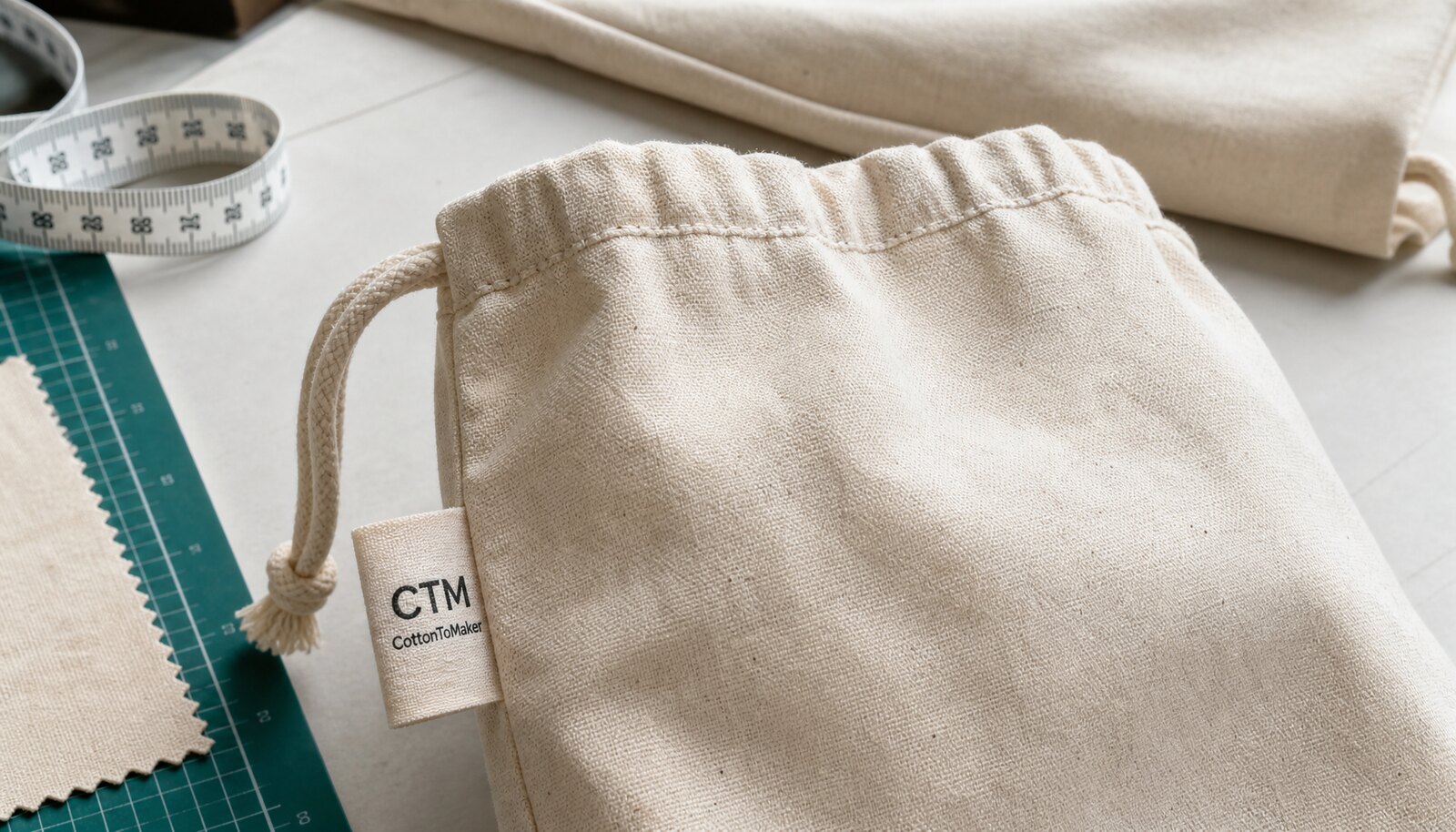
Why the Drawstring Channel Seam Decides Bag Quality
The drawstring channel seam is a small construction detail that decides how the bag opens, closes, and survives repeated use. On an organic cotton bag, the channel is not just a folded edge; it is the tunnel that carries the cord, controls the top opening, and gives the whole product its shape. If the seam line drifts, the channel narrows on one side, or the fold is not consistent, the bag starts to look cheap even if the body panels and logo are correct.
Buyers often miss this problem because the bag can pass a quick visual check. The logo prints well, the size looks right, and the cord seems fine in the sample photo. The failure only appears when someone pulls the cord several times, fills the bag, or receives cartons packed too tightly. That is why the channel seam deserves its own inspection checklist instead of being treated as a normal sewing detail.
- Inspect the channel seam with the bag flat, partially filled, and after a pull test.
- Check both sides of the top edge, not just the front view shown in a sample photo.
- Treat any twist, puckering, or cord drag as a real production risk, not a cosmetic issue.
Lock the RFQ Details Before You Ask for a Sample
A strong RFQ starts with the exact bag structure the factory must quote. For an organic cotton bag with a drawstring channel, the buyer should state fabric GSM, weave type, finished size, channel width, seam allowance, cord diameter, label style, print method, and end use. A 140 GSM promotional pouch, a 180 GSM retail bag, and a heavier reusable bag can look similar on paper, but they do not sew the same way and they will not price the same way.
The most useful quote data is specific enough to remove guesswork but not so rigid that it blocks reasonable factory advice. Ask the supplier to quote the same sample spec across all suppliers, then allow them to flag risks if your fabric weight, print placement, or cord choice will create sewing trouble. If the logo crosses the channel seam, say so. If you want the logo kept away from the fold, say that too. A clear RFQ reduces quote spread and cuts down on sample revisions.
- State the target GSM range instead of saying only "organic cotton".
- Specify whether the channel seam is folded, bound, or topstitched.
- Tell the factory if the print will sit near the top edge or across the seam.
Sample-Room Inspection Checklist for the Channel
When the first sample arrives, inspect the channel with a ruler, not only with your eye. Measure the finished width on both sides, check the distance from the top edge to the stitch line, and compare the left and right cord exits. A buyer can usually tolerate a small variance, but the seam should still look balanced. For many programs, a 2-3 mm deviation is enough to trigger a correction request, especially on a small bag where the top edge is very visible.
Then test the function. Pull the cord 10-20 times, close the opening fully, reopen it, and repeat the cycle after a light steam or hand press. The cord should move without snagging, the stitch line should not ripple, and the opening should return to a clean shape. If the sample includes a woven label, print, or embroidery near the top edge, confirm that none of those details block the channel or add stiffness where the fabric needs to fold.
- Measure finished channel width on the left and right sides of the bag.
- Test cord movement for snagging, uneven tension, and rethreading ease.
- Inspect the seam after folding, pulling, and light steaming to see if it stays flat.
Common Channel Seam Defects and What Usually Causes Them
The most common failures are not random. A twisted channel usually means uneven feeding, poor folding control, or inconsistent stitch tension. Puckering often comes from a fabric that is too light for the construction, too much thread tension, or a channel that was sewn too fast without enough control at the edge. If the cord exit frays quickly, the bar-tack may be too short, the allowance may be too small, or the cut edge inside the tunnel was not fully enclosed.
Printing can create a different set of problems. A heavy ink deposit near the fold can stiffen the top edge and make the channel resist the cord. Large embroidered artwork placed too close to the seam can distort the fabric and pull the opening out of shape. Buyers should ask the factory which step controls each defect, because a seam issue is often really a cutting, folding, printing, or packing issue that happens before the final stitch.
- Twist usually points to uneven folding or sewing tension.
- Puckering usually points to light fabric, high tension, or poor feed control.
- Cord-exit fray usually points to weak reinforcement or an exposed raw edge.
Material and Construction Choices That Change the Quote
Fabric weight drives more than handfeel; it also changes how the channel seam behaves. Many buyers find that 140-180 GSM organic cotton is a practical range for reusable retail bags and higher-quality promo bags. Below that range, the channel can look soft but may pucker and collapse more easily. Above that range, the bag can feel stronger, but the top edge gets stiffer and the sewing load increases, which may affect the price and the appearance of the fold.
Construction choices also change cost. A simple one-color water-based screen print is usually the cleanest cost-to-finish option because it keeps the handfeel soft. Embroidery, puff effects, or heavy print coverage near the channel require more care and more labor. A cotton cord with a consistent diameter and clean end finish is easier for the user and easier for the factory than a loose, frayed cord. The same logic applies to reinforcement: a proper bar-tack at the cord exit costs more than a basic seam, but it prevents claims later.
- Match cord diameter to finished channel width before approving the sample.
- Keep dense decoration away from the fold unless you have tested it.
- Use reinforcement on bags that will be pulled open often or shipped in retail channels.
How to Compare Supplier Quotes Without Missing Hidden Downgrades
A fair quote comparison needs line items, not a single lump sum. Ask each factory to separate fabric, cutting, sewing, print setup, cord, label, packing, and any testing or inspection work. If one supplier is cheaper, find out whether they reduced the channel seam allowance, removed bar-tacks, changed the cord, or packed the bags more tightly. A low number is not useful if it hides a construction shortcut that creates a problem at delivery.
MOQ logic matters as much as price. One color, one size, and one print position usually create the lowest MOQ because the factory has fewer setup changes and less leftover risk. Multiple artwork versions, mixed label types, or different cord colors usually raise the MOQ or the unit cost. Ask the factory to quote the exact same construction across all colorways so you can compare like for like instead of comparing one quote that includes extra labor and another that quietly leaves it out.
- Compare quotes on the same GSM, same print method, and same cord spec.
- Check whether the price includes reinforcement and packing or excludes them.
- Ask for MOQ by color, size, and artwork variation before you decide the assortment.
Lead Time, Sampling, and Approval Gates That Protect the Order
For a simple order using stock fabric and a single print color, sample turnaround may be relatively fast, and bulk lead time may fall in a normal factory window after approval. A practical planning example is 5-10 working days for samples and 25-45 working days for bulk after the approved sample is signed off, but the real schedule depends on fabric availability, print complexity, cord sourcing, and how many revisions the buyer requests. If the bag needs custom-dyed cotton, special cord, or multiple logo placements, expect extra time.
Do not start bulk cutting until the pre-production sample matches the approved spec. For this product, the PP sample should use the same fabric weight, same cord, same print method, and same seam construction that will appear in production. Ask for inline photos from the first production lot, then review a pre-shipment set that shows the channel seam close-up, the cord exits, and the packed carton condition. That sequence gives you a chance to catch a twist, tension issue, or print interference before the order ships.
- Freeze the channel seam on the pre-production sample, not on a sales sample made by hand.
- Ask for first-article photos from the first production batch.
- Review the lead time impact of custom fabric, special labels, and multiple print colors.
Packing and Carton Control So the Seam Stays Clean
Packing can ruin a good seam if the factory over-compresses the cartons or folds the top edge too tightly. A drawstring channel set under pressure can take a permanent crease, and that crease can make the cord feel rough or make the opening look uneven when the buyer opens the carton. Flat folding with a light tissue sheet or insert is usually safer than aggressive compression, especially on retail-ready bags where presentation matters.
If the order is going to distributors or store shelves, confirm the inner polybag, carton count, and master carton marking before production starts. Ask for random carton photos that show the top edge after packing, not just a neat loose sample on the sewing table. The best packing spec is the one that protects the seam and still lets the buyer count, inspect, and redistribute the product without reshaping every bag.
- Avoid tight folds that press a crease into the channel tunnel.
- Use carton pack counts that do not crush the cord exits.
- Request packed-condition photos before shipment, especially for retail programs.
Write Acceptance Criteria Into the PO and Close the Loop
The cleanest way to avoid a dispute is to turn the approved sample into a written acceptance standard. Attach the signed sample, measurement sheet, print placement diagram, and a small defect photo reference to the purchase order. State what is acceptable and what is not: seam wander, loose thread tails, cord drag, broken bar-tacks, or pack count errors. If the buyer and factory agree on the definition before production starts, you remove a lot of subjectivity from the final inspection.
This is especially important for repeat programs. A reorder can drift if the factory substitutes fabric, changes the sewing line, or packs faster than the first lot. Keep the approved sample and the QC notes with the PO so the next order uses the same channel seam reference. That gives procurement teams a practical way to compare quotes, handle claims, and maintain the same product standard across seasons.
- Attach the approved sample photo set to the PO or order memo.
- Define defect limits for seam wander, snagging, puckering, and cord-exit damage.
- Keep a reorder record so later lots do not quietly move away from the approved construction.
Document the Approved Sample Before Bulk Production Starts
A simple photo record can save hours of back-and-forth if a production lot later drifts from the approved bag. Take clear shots of the front, back, top edge, cord exits, label area, and packed carton. Include one close-up of the drawstring channel seam from each side so the factory knows exactly which stitch line, fold depth, and reinforcement detail was accepted. This is not a marketing packet; it is a production control file that helps both sides stay aligned.
If the buyer later needs to review a claim or place a reorder, those images become the baseline. The best documentation shows the product in the same condition the customer will receive it: finished, folded, packed, and labeled. The goal is not to create a fancy presentation. The goal is to make the seam specification visible enough that a sewing line supervisor, a QC team, and a procurement manager all read it the same way.
- Photograph both sides of the channel seam and both cord exits.
- Capture one image of the product fully packed in its final carton format.
- Store the approved sample photos with the quote and PO for easy reorder reference.
Specification comparison for buyers
| Spec decision | Recommended option | When it fits | Buyer risk to check |
|---|---|---|---|
| Channel width | 10-12 mm finished with a clean folded tunnel | 4-5 mm cotton cord and light-to-midweight bags | Too narrow causes snagging; too wide lets the channel twist |
| Fabric GSM | 140-180 GSM organic cotton | Reusable retail pouches, promo bags, and lighter carry bags | Underweight fabric puckers; over-heavy fabric makes the top edge stiff |
| Reinforcement | Double-row topstitch plus bar-tack at cord exits | Bags that will be opened and closed often | Missing reinforcement leads to tearing at the stress point |
| Print method | 1-color water-based screen print | Natural handfeel and simple branding near the body panel | Heavy ink near the seam can crack or stiffen the channel |
| Cord type | Cotton cord with consistent diameter and sealed or knotted ends | Natural-looking bags that need easy rethreading | Frayed ends and uneven length hurt use and appearance |
| Packing | Flat fold with tissue or a light insert, not over-compressed | Retail-ready or distributor cartons | Crushed folding marks can set into the seam and cord path |
Buyer checklist before sampling
- Confirm the approved sample shows the exact finished channel width, seam allowance, and cord clearance you want in bulk.
- Measure left and right channel symmetry and make sure the top edge stays straight after repeated pull cycles.
- Check that the cord slides smoothly without snagging at the exit points, label area, or printed area.
- Verify the fabric GSM, weave, and shrinkage allowance match the intended use, not just the catalog description.
- Confirm the print method, print placement, and ink coverage do not stiffen or distort the channel seam.
- Inspect reinforcement at cord exits, side seams, and any points where the bag is pulled open by hand.
- Ask for the sample-room photo set, pre-production sample, and first-article inspection before bulk cutting continues.
- Compare carton pack count, polybag spec, and folding method so shipment pressure does not crush the seam.
- Make sure the quote separates fabric, sewing, print, cord, label, and packing so you can compare suppliers fairly.
- Put defect limits in writing for puckering, twist, loose threads, missed stitches, and broken bar-tacks.
Factory quote questions to send
- What finished channel width, seam allowance, and stitch style are you pricing for this bag?
- Which fabric GSM, weave, and shrinkage allowance are included in the quote?
- Is the fabric stock, greige, or custom-made for this order, and does that change lead time?
- Which print method, ink type, number of colors, and print placement are included?
- What cord diameter, cord material, and cord-end finish are included in the price?
- Are bar-tacks or other reinforcements included at the cord exits and stress points?
- What is the MOQ by color, size, and artwork variation?
- What sample stages do you offer before bulk production, and how long does each stage take?
- What carton pack count, inner bag spec, and master carton details are included?
- Can you provide measurement photos, seam close-ups, and pre-shipment QC images for the approved sample?
Quality-control points to confirm
- Finished channel width matches the approved sample and keeps the cord moving freely.
- Stitch line stays parallel to the top edge and does not wander across the fold.
- Cord exits are reinforced and do not fray after repeated pull testing.
- No puckering, tunneling, or twisting appears along the channel seam.
- Print, embroidery, or label placement does not block the cord path or stiffen the fold.
- Thread tension is balanced, with no skipped stitches, loose loops, or broken thread tails.
- The inside edge of the channel is fully enclosed, with no raw cut fabric exposed.
- The seam still lies flat after a light steam test or shrink test on the approved sample.
- Carton-packed bags do not show crushed folds, cord dents, or crease memory at the top edge.
- Random carton checks match the signed sample on size, seam quality, and pack count.