Why Barcode Placement Becomes a Production Problem
Barcode placement looks like a small artwork detail, but for organic cotton bags it affects sewing, folding, retail receiving, and final inspection. A barcode that scans well on a flat proof can fail after it is sewn into a side seam, folded inside the bag, covered by a handle, or wrinkled inside a polybag. The buyer then has a commercial problem: relabeling at destination, delayed retailer intake, marketplace rejection, or mixed SKU inventory.
For procurement teams, the correct question is not simply "where can we put the barcode?" The better question is "who needs to scan it, at which stage, while the bag is in what condition?" A cashier scanning a retail tote, a warehouse clerk receiving cartons, and an ecommerce team checking unit inventory all need different access. If the RFQ does not define that use case, the factory may choose a convenient sewing position rather than a scan-safe position.
- Retail POS scan usually needs a visible barcode on a hangtag, belly band, outer sticker, or accessible sewn label.
- Warehouse receiving may need carton labels and unit labels that can be scanned without opening every master carton.
- Marketplace fulfillment often needs an outer polybag barcode because the product is scanned as a packed unit.
- Brand traceability can use an internal sewn label, but this is not always suitable for retail checkout.
- Repeat orders need a fixed placement standard, otherwise the same SKU may arrive with different scan locations.
Start With the Scan Moment, Not the Label Type
The scan moment decides the placement. If the barcode is scanned at retail checkout, it must be easy for store staff to find within two or three seconds. A barcode hidden inside a tote may be acceptable for brand traceability, but it can slow checkout if the bag is sold loose. If the bag is sold folded in a belly band, the barcode should be on the belly band or on the folded face visible to the cashier.
If the barcode is mainly for importer receiving or distributor stock control, the best position may be outside the product, not on the bag itself. A carton barcode, inner pack label, or polybag sticker may be more reliable than a sewn label. For organic cotton bags, this distinction matters because buyers often prefer plastic-free packaging, but retail systems may still require unit-level scanning. That trade-off must be settled before the sample is approved.
- Define the scanner user: cashier, warehouse receiver, distributor, marketplace operator, or brand QC team.
- Define the packed condition: loose bag, folded bag, bundled set, polybagged unit, belly-banded unit, or carton-only scan.
- Define whether the barcode is permanent, removable, recyclable, or only used before store display.
- Define whether the barcode must remain readable after compression in cartons.
- Define whether the barcode must match retail UPC, EAN, FNSKU, internal SKU, batch number, or carton SSCC label.
Best Placement Options for Organic Cotton Tote Bags
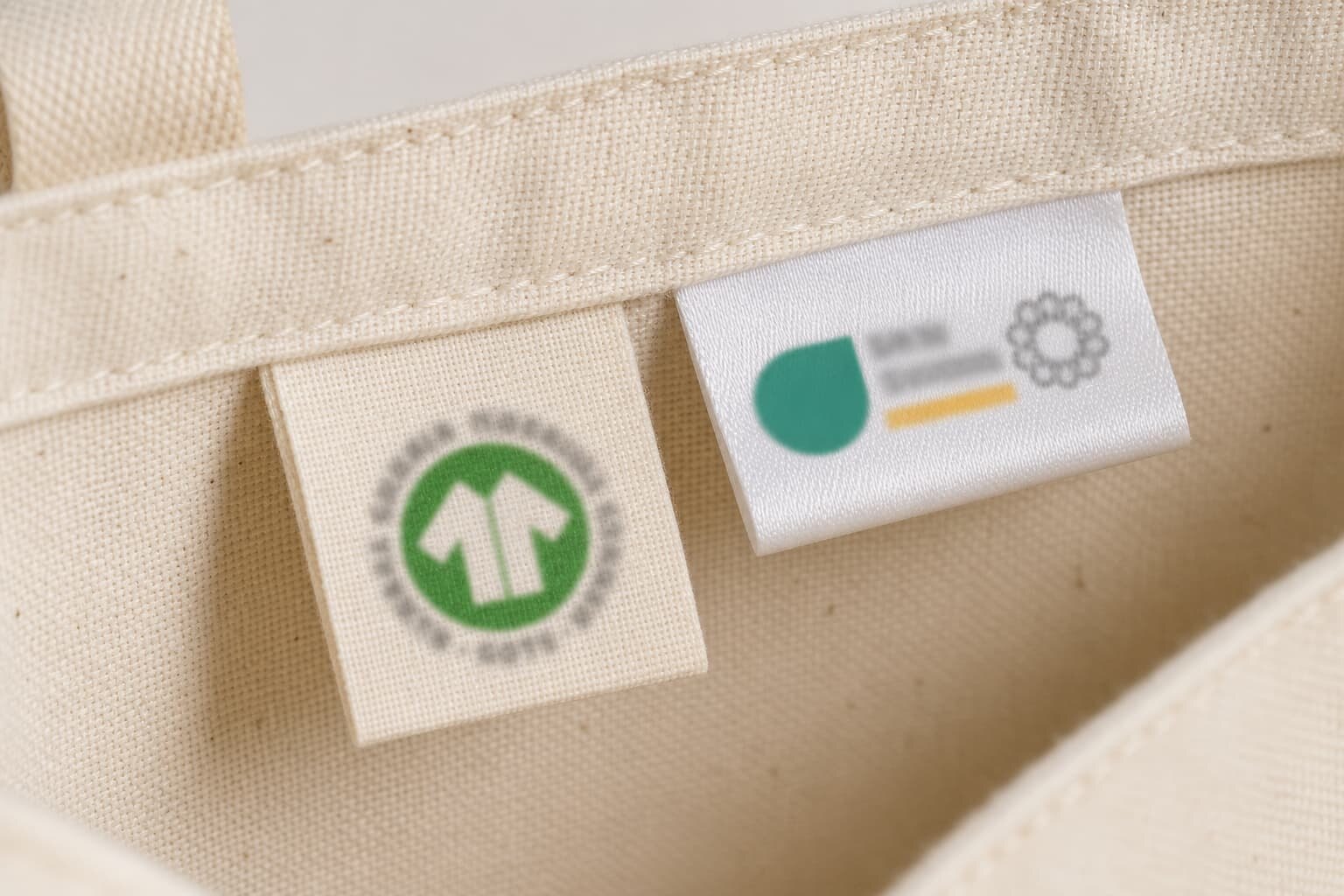
For standard organic cotton tote bags, the most stable permanent placement is a sewn label in the inside side seam, usually 25-40 mm below the top opening. This keeps the label neat, avoids damaging the front logo area, and works well for care content or brand identification. However, it is not automatically the best retail barcode position. If the tote is folded with the label inside, the scanner cannot reach it without opening the pack.
For retail-ready units, a hangtag, kraft belly band, or polybag sticker often gives better scan access. A hangtag attached to the handle can work for premium bags, but it adds material, labor, and a risk of detachment. A belly band is suitable for folded organic cotton bags and can carry barcode, product name, material claim, and care information. A polybag sticker is efficient for warehouse scanning, but buyers focused on reduced plastic packaging may prefer glassine bags, paper bands, or carton-level scanning.
- Inside side seam label: clean permanent solution, good for brand and care data, weaker for fast retail scanning.
- Outside side seam flag label: visible and durable, but may not suit minimalist organic product styling.
- Hangtag barcode: flexible and retail-friendly, but needs string, pin, or loop attachment control.
- Belly band barcode: strong for folded display, but factory must follow the same folding direction every time.
- Polybag sticker: efficient for receiving and marketplace prep, but must not be stuck directly onto cotton fabric.
Fabric GSM and Construction Effects on Barcode Accuracy
Organic cotton bag fabric weight changes how labels sit and how printed marks behave. A 140-180 GSM lightweight cotton pouch has less structure, so a sewn label can wrinkle if the seam tension is too high. A 280-340 GSM tote usually handles a side seam label well. A 10-12 oz canvas tote, roughly 340-410 GSM depending on weave, may create thick seam stacks near side gussets and boxed bottoms; sewing a barcode label through those areas can distort the label or make it curl.
Direct barcode printing onto fabric is usually the highest-risk option. Cotton fibers, slubs, and weave texture can break the clean edge of barcode bars. Water-based screen printing is good for logos on organic cotton, but fine barcode modules may spread, especially on unbleached fabric. Heat transfer can produce sharper lines, but it may not match the buyer's sustainability or hand-feel requirements. For reliable retail scanning, printed paper hangtags, thermal-transfer stickers, or high-quality printed fabric labels are safer than direct printing on a textured panel.
- 140-180 GSM: keep labels small and light; avoid heavy woven labels that pull the seam.
- 180-280 GSM: suitable for drawstring pouches and light totes; test seam puckering around sewn labels.
- 280-340 GSM: common for standard organic cotton totes; good balance for side seam labels and folded packing.
- 340-450 GSM: stable front panels but thick seams; avoid placing labels across gusset folds or boxed corners.
- Dyed fabric: check contrast between label, print color, and barcode bars; dark bags usually need white labels.
Barcode Format, Size, and Print Method Choices
Buyers should not send only a screenshot of a barcode. The factory needs the barcode number, barcode type, final printed size, and artwork file. UPC-A, EAN-13, Code 128, QR codes, and marketplace-specific labels have different size and quiet-zone needs. If the artwork is reduced to fit a narrow side label, the bars may become too tight for reliable scanning. The human-readable digits also need enough contrast and height for manual checking when a scanner fails.
For sewn labels, printed cotton labels and satin labels can hold fine detail better than coarse woven labels. Woven labels look premium, but small barcode bars may merge if the weave count is not high enough. For hangtags, offset or digital printing on matte card is common. For polybag or carton labels, thermal transfer is practical because it supports variable SKU and carton data. The RFQ should ask the supplier which method they will use, because "barcode label included" is not enough information for quote comparison.
- Send vector artwork when possible and avoid low-resolution barcode images copied from a spreadsheet.
- Keep a clear quiet zone on both sides of the barcode; do not let stitching, die-cut edges, or artwork enter this area.
- Ask for a scan test using the final label material, not a temporary office printout.
- Use black bars on a white or very light background for the safest read rate.
- Do not shrink barcodes only to make the label look cleaner; readability is more important than visual minimalism.
Sample Approval: What to Check Before Bulk Production
A barcode placement sample should be a real sewn or packed sample, not only a digital mockup. The buyer should check the bag unfolded, folded, and packed exactly as it will ship. If the barcode is on a belly band, confirm the band position after carton compression. If the barcode is on a hangtag, pull lightly on the string or loop to check whether it detaches too easily. If the barcode is sewn into a seam, inspect whether the label corners are secured and whether the seam puckers around it.
The approved sample should record measurements from fixed reference points. For example, specify "inside right side seam, label top edge 30 mm below top opening, barcode facing inward, label centered in seam allowance." Avoid vague approvals such as "barcode inside bag." On repeat orders, different sewing teams may interpret that instruction differently. A measured sample standard protects both buyer and factory.
- Scan the barcode with the buyer's own device or retailer-approved scanner if available.
- Compare the human-readable digits with the purchase order SKU list.
- Photograph the barcode position on the open bag, folded bag, and packed unit.
- Check whether the barcode can be scanned without unfolding the bag if retail requires quick access.
- Approve label material, print sharpness, sewing thread color, label orientation, and placement tolerance together.
Packing and Folding Rules That Decide Barcode Visibility
Many barcode problems happen after the bag passes sewing QC. The sewing line may place the label correctly, but the packing team folds the bag in a way that hides it. Organic cotton totes are often folded into thirds, folded handle-in, rolled with a paper sleeve, or stacked flat in inner cartons. Each method changes which surface is visible. If the barcode must be scanned before the unit is opened, the folding diagram is as important as the artwork file.
For importers and distributors, carton logic also matters. If each master carton contains only one SKU, a carton barcode may be enough for receiving. If one carton contains mixed colors or mixed artwork, carton labels must state the assortment clearly, and unit barcodes must be controlled carefully. Mixed cartons create a higher risk of barcode mismatch because packers handle several versions at the same table. Use physical segregation, color-coded work orders, and line-clearance checks when multiple barcode versions are packed in one production run.
- Provide a simple folding drawing with top, bottom, front, back, handle direction, and barcode face marked.
- State inner pack quantity, master carton quantity, and whether units are loose, banded, or individually packed.
- Require packed sample photos before bulk packing begins if the barcode must remain visible.
- Use carton labels that match the final packing list and SKU count.
- Avoid placing temporary stickers directly on organic cotton fabric because adhesive residue can cause complaints.
MOQ, Lead Time, and Cost Factors Buyers Should Expect
Barcode placement can affect MOQ even when the bag body is the same. A factory may quote one MOQ for the organic cotton bag, but label suppliers may have separate minimums for woven labels, printed cotton labels, hangtags, belly bands, or variable stickers. If one order has five colors and each color has a different retail barcode, the label MOQ and changeover labor become part of the real order cost. Buyers should ask whether MOQ is calculated per bag style, per fabric color, per print artwork, per barcode, or per packing version.
Lead time also depends on label type. Printed stickers and hangtags are usually faster than custom woven labels. Printed cotton labels may require strike-off approval before bulk production. If the buyer changes barcode numbers after fabric cutting or after label printing, production can stop while new labels are made. A clean RFQ prevents delay by locking the barcode data before the pre-production sample stage.
- Cost drivers include label material, label printing method, sewing labor, hangtag attachment, sticker application, and SKU segregation.
- Variable barcode orders need more checking time than one-code orders.
- Custom woven labels often need longer setup than printed paper or thermal-transfer labels.
- Plastic-free packaging may shift barcode cost from a polybag sticker to a belly band or hangtag.
- Late barcode changes can create scrap labels, repacking labor, and shipping schedule pressure.
Quote Data to Put in the RFQ
A strong RFQ gives the supplier enough detail to quote the real job. If the buyer asks only for "organic cotton tote with barcode," suppliers will make different assumptions. One may include a printed hangtag, another may include a sewn label, and another may assume carton labels only. The unit prices will not be comparable. The RFQ should identify the bag specification and the barcode system as two connected parts of the same product.
For the bag itself, include size, fabric GSM or oz, organic cotton requirement, color, handle length, gusset, print method, print size, and packing. For the barcode, include barcode type, number list, label material, placement, final size, scan requirement, and whether the supplier must generate the barcode artwork. If retailer compliance is involved, attach the retailer packaging guide instead of summarizing it from memory.
- Bag body: dimensions, fabric GSM, weave, natural or dyed color, handle style, seam construction, and gusset details.
- Branding: logo artwork, print method such as screen print, heat transfer, embroidery, or woven label, and print position.
- Barcode: type, number, final size, quiet zone, label material, orientation, and placement tolerance.
- Packing: folded size, unit pack method, inner carton quantity, master carton quantity, carton mark, and scan access.
- Inspection: scan test requirement, AQL level if used, placement tolerance, photo records, and retained sample standard.
Common Mistakes and Practical Acceptance Criteria
The most common mistake is approving a barcode visually instead of functionally. A barcode can look neat but fail in the warehouse. Another mistake is treating barcode placement as an artwork department issue when it also belongs to sewing, packing, and QC. On cotton bags, a small change in fold direction or label seam position can make a previously approved barcode hard to scan.
Acceptance criteria should be simple, measurable, and usable by factory QC. For example: "Barcode must scan on first or second attempt from packed unit using standard mobile warehouse scanner; label top edge 30 mm plus or minus 5 mm below top opening; no stitch line crossing barcode or quiet zone; digits must match SKU list." This type of standard is clearer than saying "barcode must be good quality."
- Reject if the barcode number does not match the SKU, even if the label is sewn neatly.
- Reject if stitching, folds, or wrinkles cross the barcode bars or quiet zone.
- Reject if the barcode is hidden after the approved folding method.
- Reject if direct fabric printing shows broken bars, heavy ink spread, or low contrast.
- Reject if mixed SKUs are found in cartons marked for one barcode version.
Specification comparison for buyers
| Spec decision | Recommended option | When it fits | Buyer risk to check |
|---|---|---|---|
| Retail barcode location | Sewn inner side seam label, 25-40 mm below top opening | Best for reusable organic cotton totes sold folded, hung, or packed in polybags | Scanner access may be poor if the bag is folded with the label facing inward |
| Warehouse receiving label | Temporary removable sticker on outer polybag or master carton | Best when distributors need carton-level or unit-level receiving scans before retail display | Adhesive can transfer to cotton if stickers are placed directly on undyed fabric |
| Permanent product identifier | Woven or printed cotton label sewn into side seam | Best for brand SKUs, care info, batch tracking, and repeat orders | Small barcode modules may blur on textured woven labels or low-resolution print |
| Direct barcode printing | Avoid unless the artwork area is smooth and tested at final size | May work on flat 10-12 oz canvas panels for internal codes, not premium retail barcodes | Fabric texture, ink gain, and wash shrinkage can reduce scan grade |
| Folded retail pack | Barcode label positioned on the visible folded face or outer belly band | Best for ecommerce prep, retail shelf bins, and mixed-color SKUs | Factory must receive folding diagram, otherwise the barcode may be hidden after packing |
| Bag GSM decision | 180-280 GSM for light pouches; 280-340 GSM for standard totes; 340-450 GSM for structured canvas totes | Helps choose label sewing tension, needle size, and print stability | Heavy seams can distort labels if sewn through multiple fabric layers |
| MOQ logic | Align MOQ by label type, barcode variation, and packing version, not only bag style | Important when each color, size, or market needs a different UPC/EAN | Many small barcode versions increase label changeover and packing error risk |
Buyer checklist before sampling
- Confirm whether the barcode is for retail POS scan, warehouse receiving, marketplace fulfillment, or internal batch control.
- Specify barcode type, final size, quiet zone, human-readable digits, and required scan grade if your retailer has a standard.
- Decide if the barcode should be permanent on the bag, temporary on the polybag, printed on a hangtag, or printed on a carton label.
- Provide a folding diagram showing which surface must remain visible after packing.
- Approve the barcode location on a physical pre-production sample, not only on a flat artwork proof.
- Check that the label does not scratch, curl, bleed, or distort after sewing, folding, pressing, and packing.
- Separate SKUs clearly by color, size, fabric GSM, handle length, print artwork, barcode number, and packing method.
- Ask the factory to scan labels after sewing and again after final packing because both steps can change readability.
- Confirm carton markings, inner pack quantity, and master carton barcode logic before production starts.
- Keep one approved sealed sample and one open reference sample for inspection and repeat order comparison.
Factory quote questions to send
- Where do you recommend placing the barcode for this bag construction, and will it remain visible after our required folding method?
- Can you sew a barcode label into the side seam without puckering on the selected organic cotton GSM?
- What is your minimum readable barcode size for printed cotton labels, woven labels, hangtags, and polybag stickers?
- Will the barcode be printed by thermal transfer, digital label printing, offset hangtag printing, or woven label production?
- What barcode file format do you need: vector PDF, AI, EPS, high-resolution PNG, or generated barcode numbers in Excel?
- Does your quote include barcode label setup, label sampling, scan testing, SKU separation, and carton label printing?
- How do you control mixed barcodes when one order has multiple bag colors, sizes, or retailer destinations?
- Can you provide photos of the barcode location before bulk sewing and packed photos showing the visible scan position?
- What additional lead time is needed for custom woven labels, organic cotton labels, printed hangtags, or variable barcode stickers?
- How will barcode placement be inspected during inline QC and final random inspection?
Quality-control points to confirm
- Barcode scans successfully from the final packed state expected by the buyer, not only from an unfolded sample.
- Quiet zone around the barcode is not cut, stitched over, creased, or hidden by a seam.
- Human-readable numbers match the buyer's SKU list, carton label, purchase order, and packing list.
- Label position tolerance is agreed in millimeters from a fixed reference point such as top opening, side seam, or bottom fold.
- Label is not sewn upside down unless the folding diagram intentionally requires that orientation.
- Direct fabric print does not show broken bars, ink bleeding, fabric slubs crossing bars, or distortion after heat setting.
- Temporary stickers do not leave adhesive marks on organic cotton fabric or recycled paper belly bands.
- All barcode versions are segregated during sewing, trimming, packing, and carton loading.
- Packed cartons contain only the barcode version stated on the carton mark and packing list.
- Approved sample, bulk production, and retained factory sample use the same label material, size, and placement.