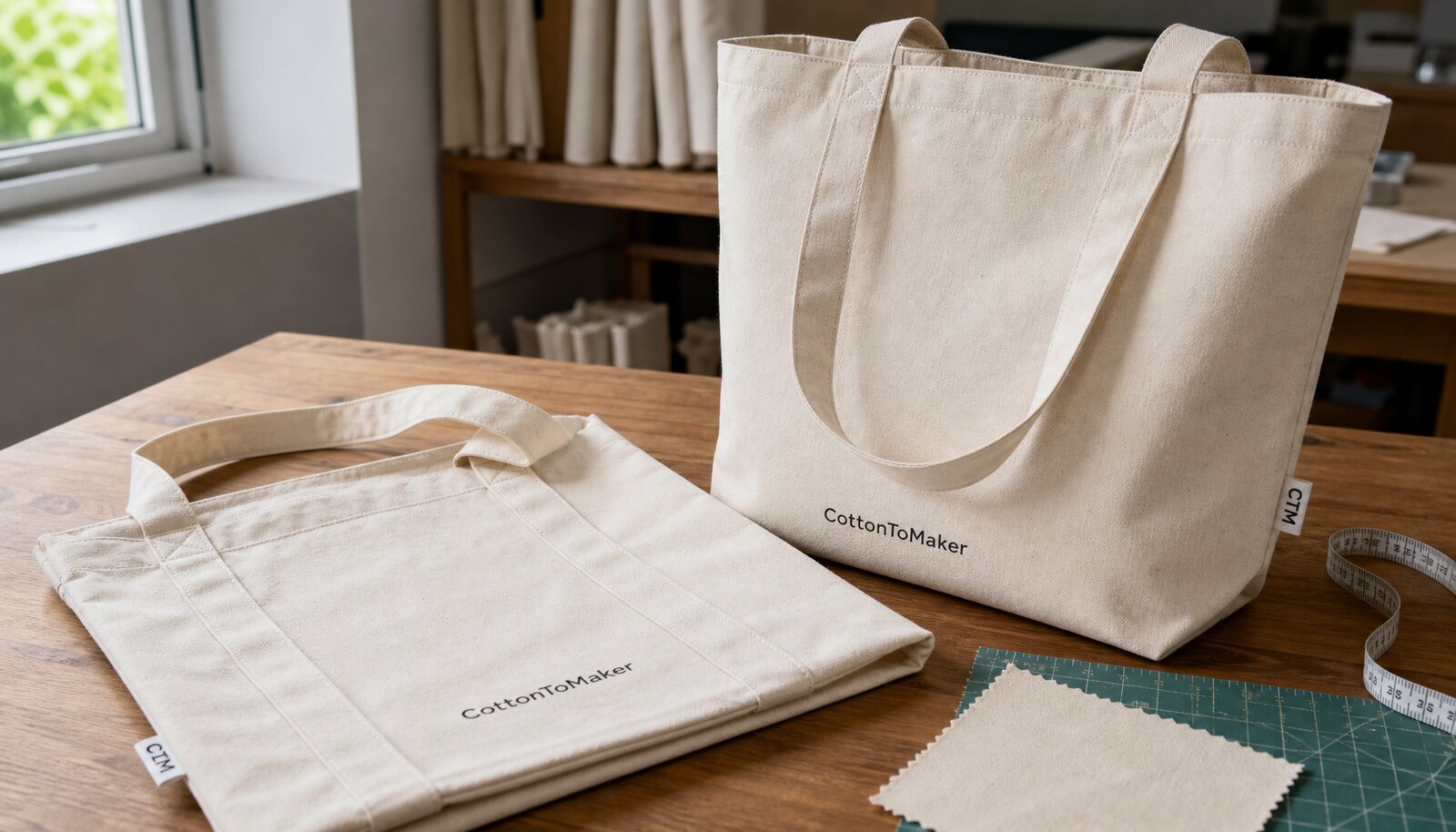
1. Start the audit with the buying risk, not the factory brochure
An organic canvas tote looks simple, but the common procurement failures are not simple. Buyers usually get into trouble because the RFQ says “organic canvas tote, natural color, logo printed” and leaves the factory to decide the fabric weight, handle construction, print chemistry, packing, and tolerance. Two quotes can look similar while one supplier is pricing 8 oz fabric and another is pricing 12 oz. One may include a pre-production sample and export cartons; another may quote only the bag.
For procurement teams, the supplier audit should answer one main question: can this factory repeatedly produce the exact tote your brand intends to sell, gift, or distribute, with evidence behind the organic claim and controls behind the finished quality? The audit is not only about whether the supplier owns sewing machines. It is about whether the commercial quote, sample room, material sourcing, print workshop, sewing line, QC process, and packing plan all match the product specification.
- Audit the specification and quotation together; do not evaluate price without knowing the fabric and packing assumptions.
- Ask the supplier to explain where organic material control starts and ends in their supply chain.
- Check whether printing, washing, dyeing, and packing are in-house or subcontracted.
- Request one clear responsible contact for sampling, bulk production, QC, and export documentation.
2. Define the organic canvas tote before asking for price
The most useful audit checklist starts with a controlled product definition. “Canvas” can mean a plain weave cotton fabric in many weights and finishes. “Organic” can refer to fiber, yarn, fabric, or a certified finished product program, depending on the claim you plan to make. If your RFQ is vague, the supplier may quote the lowest workable interpretation to win the inquiry, then raise the price after sampling.
Procurement teams should lock the basic tote geometry before comparing suppliers. Finished size matters more than cut size. A 38 x 42 cm tote with no gusset is not the same item as a 38 x 42 x 10 cm gusseted shopping bag. Handle drop changes usability and material consumption. A short hand-carry handle can reduce fabric, while a shoulder-length handle increases cost and may require stronger reinforcement.
- Finished size: width, height, gusset depth, and measuring method.
- Fabric: organic canvas weight in oz and GSM, natural or dyed, washed or unwashed.
- Handle: self-fabric or webbing, width, total length, drop length, reinforcement method.
- Construction: inside seams, bottom shaping, gusset type, top hem width, thread color.
- Branding: print size, print location, color count, Pantone reference if applicable.
- Packing: bulk pack, individual paper band, polybag, hangtag, barcode, carton marks.
3. Fabric weight and GSM: the number that changes the whole quote
Fabric weight is one of the largest cost drivers in an organic canvas tote. A buyer who asks for “heavy canvas” without a target may receive quotes ranging from 8 oz to 16 oz. That gap affects fabric cost, sewing difficulty, carton weight, shipping cost, and perceived quality. For many retail and brand programs, 10 oz to 12 oz organic canvas is a practical middle range. It has enough body for a reusable tote while remaining efficient to sew and ship.
When auditing a supplier, ask how they state fabric weight. Some mills and factories use ounces per square yard; others use GSM. Some quote greige fabric before finishing, while the final washed or dyed fabric may change weight and hand-feel. If the bag will be washed, dyed, or softened, shrinkage and fabric distortion should be considered before approving dimensions.
- 8 oz, around 270 GSM: lightweight, economical, good for giveaways but less structured.
- 10 oz, around 340 GSM: common for promotional and retail totes with moderate durability.
- 12 oz, around 407 GSM: stronger hand-feel, better for resale or premium programs.
- 14 oz to 16 oz, around 475 to 540 GSM: premium but heavier, costlier, and less compressible.
- Always ask whether the quoted GSM is nominal, tested, greige, or finished fabric weight.
4. Organic claim audit: what evidence should procurement request?
Organic material claims require more than a supplier saying “we can do organic cotton.” The level of evidence needed depends on how your company will market the product, your destination market, and your retailer compliance requirements. Some buyers only need material traceability documents for internal procurement. Others need certificate numbers, scope certificates, transaction certificates, or other chain-of-custody documents. The audit should clarify this before the price is compared.
Do not assume that every organic canvas supplier can support every claim on the finished tote. A factory may buy organic fabric from a certified mill but may not have certification for cutting, sewing, printing, or trading under a particular standard. That may be acceptable for some programs and unacceptable for others. The procurement team should state the intended claim clearly: organic cotton fiber, organic cotton fabric, certified organic cotton bag, or retailer-specific responsible sourcing requirement.
- Ask which entity in the supply chain holds the relevant certificate and what product scope it covers.
- Check whether printing, dyeing, washing, and sewing are included or subcontracted outside the certified scope.
- Request document samples before order placement if your sales team needs them for customer approval.
- Confirm whether certificates or transaction documents create extra lead time or administrative fees.
- Avoid printing a certification logo or claim on the tote until your compliance team approves the evidence.
5. Print method audit: match the logo to the canvas surface
Organic canvas is textured, absorbent, and sometimes uneven in shade. A print that looks sharp on paper may lose detail on natural canvas. For most procurement programs, water-based screen printing is the practical option for one to three solid colors. It gives a softer hand-feel and works well on flat panels when the artwork is not too fine. Plastisol-style effects, transfers, DTG, or embroidery may be suitable, but each changes the look, cost, and QC risk.
During the supplier audit, review real printed samples on similar organic canvas weight, not only photos. Ask how the factory controls ink mixing, screen tension, curing temperature, and registration. Poor curing can cause ink rubbing, odor, cracking, or color transfer during packing. If the tote will be folded for shipment, the printed area should be checked after folding pressure, because thick ink can mark the opposite panel.
- Screen print: best for solid logos, repeat orders, and stable unit cost after setup.
- Heat transfer: useful for detailed artwork, but check hand-feel, edge lifting, and heat marks.
- DTG: flexible for short runs, but natural canvas may mute colors and absorb ink unevenly.
- Embroidery: premium look but may pucker lighter canvas and increases production time.
- Ask for a rub test, folding test, and print position tolerance on the approved sample.
6. MOQ logic: find out what really controls the minimum
MOQ is often misunderstood in tote bag sourcing. A factory’s published MOQ may not reflect your real product. Organic fabric availability, fabric dye lot, print setup, logo color count, label sourcing, packing accessories, and line scheduling can all control the minimum. A plain natural tote with one-color print may have a lower MOQ than a dyed heavy canvas tote with custom webbing handles and individual barcode labels.
Procurement teams should ask the supplier to separate the MOQ drivers. This helps you negotiate intelligently. If the MOQ is caused by fabric purchase, you may be able to use standard stock organic canvas. If it is caused by dyeing, you may accept natural canvas or a standard color. If it is caused by printing setup, you may group artwork versions or reduce color count. A clear MOQ explanation also helps distributors plan mixed orders and reorder cycles.
- Fabric MOQ: controlled by mill roll quantity, organic fabric availability, and fabric width.
- Dyeing MOQ: controlled by dye vat, shade approval, lab dip, and color consistency.
- Printing MOQ: controlled by screen setup, ink mixing, artwork versions, and print size.
- Sewing MOQ: controlled by line efficiency, changeover time, and construction complexity.
- Packing MOQ: controlled by custom hangtags, barcode labels, paper bands, or printed cartons.
7. Sample approval: what the pre-production sample must prove
A photo sample is not enough for an organic canvas tote program. Procurement should approve a physical pre-production sample made as close as possible to bulk production. The sample should use the same canvas weight, same handle material, same thread, same print method, same logo size, and same packing direction. If the supplier uses substitute fabric for the sample, mark it clearly and require a second sample or fabric swatch before production.
The sample review should be practical. Put the tote on a table and measure it. Load it with the expected contents. Fold it the way it will be packed. Rub the print. Check the top hem and handle reinforcement. Review whether the natural canvas has acceptable specks, slubs, and shade variation. Organic natural canvas is not a plastic-smooth material; the approval standard must allow normal fabric character while rejecting stains, oil marks, weaving defects, and obvious color mismatch.
- Check finished dimensions against the spec sheet, not only visual appearance.
- Confirm handle drop is comfortable for the intended use: hand carry, shoulder carry, or grocery use.
- Inspect stitch density, skipped stitches, loose threads, and reinforcement location.
- Fold the sample for 24 hours if bulk goods will ship folded, then inspect print cracking or transfer.
- Sign and date the approved sample, then keep it as the golden sample for QC comparison.
8. Packing and logistics: do not let a good tote arrive damaged
Packing is not only a presentation decision. Canvas absorbs moisture and can crease under pressure. Overpacked cartons may create hard fold lines, print transfer, distorted handles, or crushed hangtags. Underpacked cartons waste freight volume. For organic canvas totes, bulk packing is often the best choice for wholesale and distributor orders, but retail programs may require individual packing, paper bands, hangtags, barcode stickers, or shelf-ready cartons.
Ask for carton data before you compare supplier quotations. Pieces per carton, carton dimensions, gross weight, and loading quantity can change landed cost. A heavy 12 oz or 16 oz canvas tote may look affordable at unit price but become expensive in air freight or courier shipment. If the tote will be sent to a retailer distribution center, packing must match compliance requirements, including carton labels, PO numbers, SKU markings, and pallet height limits.
- Confirm whether bags are folded once, folded twice, or shipped flat.
- Use moisture protection where shipping route or season creates humidity risk.
- Avoid direct print-to-print contact if ink transfer is possible.
- Check master carton strength for heavy canvas orders.
- Request carton size, gross weight, net weight, and quantity per carton in the quotation.
- If individual polybags conflict with sustainability policy, ask about paper bands or bulk inner packs.
9. Lead time audit: separate material, sampling, production, and inspection
A useful lead time is not one number. Procurement should break it into sampling, material preparation, printing, sewing, finishing, QC, packing, and shipment booking. Organic canvas may need extra time if the selected weight is not in stock. Dyed fabric requires lab dip approval and bulk shade control. Custom labels, hangtags, and barcode stickers can also delay a simple tote order if they are not approved early.
When auditing the supplier, ask what must be completed before the clock starts. Many factories count lead time after deposit, artwork approval, sample approval, and material confirmation. If your internal approval takes two weeks, the supplier’s production lead time has not actually started. A clear timeline prevents false escalation later and helps importers coordinate vessel booking, retail launch dates, and seasonal promotion windows.
- Sample lead time: includes artwork file check, material availability, printing, and courier shipment.
- Material lead time: depends on stock canvas, custom GSM, dyeing, washing, or organic document requirements.
- Production lead time: includes cutting, printing, sewing, trimming, ironing if required, and packing.
- Inspection window: reserve time for final random inspection and possible rework.
- Shipping preparation: includes export carton marks, booking, customs documents, and warehouse handover.
10. Quote comparison: make suppliers price the same tote
The fastest way to get a misleading low quote is to send a vague RFQ to several factories. Procurement teams should create a quote comparison sheet that forces each supplier to state the same assumptions. The lowest unit price is not always the lowest landed cost if it excludes sample charges, packing, labels, document fees, inland freight, or realistic carton data. It may also reflect lighter fabric or weaker stitching.
Ask each factory to quote in a structured format. Include fabric weight, bag size, handle details, print method, color count, MOQ, sample cost, production lead time, packing method, carton data, Incoterm, payment terms, quote validity, and known exclusions. If one supplier cannot provide these details, that is an audit result. A good organic canvas tote supplier should be able to explain both the technical product and the commercial price basis.
- Unit price without fabric GSM is not a complete quote.
- Unit price without packing details is not ready for freight comparison.
- Unit price without print method can hide quality differences.
- Lead time without sample approval conditions is not reliable.
- Organic claim without document scope should be treated as unverified.
- A quote that is clear but slightly higher may reduce rework, delay, and compliance risk.
Specification comparison for buyers
| Spec decision | Recommended option | When it fits | Buyer risk to check |
|---|---|---|---|
| Fabric weight | 10 oz to 12 oz organic canvas, usually around 340 to 407 GSM depending on weave | Retail merchandise, bookstore bags, event resale, brand packaging where structure matters | Confirm whether supplier quotes finished GSM, greige GSM, or nominal oz; weigh a cut sample if needed |
| Budget fabric option | 8 oz organic canvas, approximately 270 GSM | Giveaway totes, lightweight retail packaging, lower freight weight | May look thin with dark prints or heavy contents; check shrinkage and handle strength |
| Premium heavy option | 14 oz to 16 oz organic canvas, approximately 475 to 540 GSM | Reusable grocery totes, premium brand bags, high perceived value programs | Higher sewing needle wear, thicker seams, higher carton weight, longer production time |
| Print method | Water-based screen print for 1 to 3 solid colors | Most organic canvas tote programs with flat logos and repeat orders | Ask for curing test, rub test, and print hand-feel approval on actual fabric |
| Fine artwork | Heat transfer or DTG only after wash and rub testing | Gradients, small text, photographic artwork, short runs | Transfers can feel plastic-like; DTG may look muted on natural canvas |
| Handle construction | Self-fabric handles with cross-stitch reinforcement or box-X stitching | Retail and distributor programs where carrying strength is part of the quality claim | Check handle width, drop length, and reinforcement thread density against the approved sample |
| Packaging | Bulk pack with moisture control unless retail presentation is required | Wholesale, B2B distribution, ecommerce fulfillment centers that repack later | Avoid unnecessary individual polybags if sustainability messaging is important; confirm carton strength |
Buyer checklist before sampling
- Confirm the supplier can quote the exact organic canvas fabric weight in oz and GSM, not only a general fabric name.
- Request evidence of organic material traceability that matches the order scope, fabric supplier, and invoice chain.
- Ask whether the quoted fabric is natural, bleached, dyed, or pre-shrunk, because each option changes color, shrinkage, and price.
- Approve one physical pre-production sample made with bulk fabric, bulk handles, bulk thread, and the selected print method.
- Check bag size after sewing, not only cut panel size; canvas shrinkage and seam allowance can change final dimensions.
- Specify handle width, handle drop, reinforcement method, and load expectation in the RFQ.
- Confirm whether MOQ is driven by fabric sourcing, dyeing, printing setup, or sewing line efficiency.
- Ask for carton dimensions, pieces per carton, gross weight, and packing method before comparing freight cost.
- Require print fastness checks for rubbing, folding, and light abrasion on the actual canvas surface.
- List all quote assumptions: fabric GSM, logo size, print colors, packing, sample fee, lead time, Incoterm, and validity date.
Factory quote questions to send
- What exact organic canvas fabric weight are you quoting in oz and GSM, and is the weight before or after finishing?
- Is the fabric natural, bleached, dyed, washed, or pre-shrunk, and what shrinkage tolerance should we expect?
- What is your MOQ for this tote and which factor controls it: fabric MOQ, printing setup, dye lot, or sewing efficiency?
- Can you produce a pre-production sample using bulk fabric and the final print method before mass production?
- Which print method do you recommend for our artwork, and what is the maximum print size on the front panel?
- What testing can you provide for print adhesion, crocking, fabric strength, seam strength, and handle pull?
- What are the finished bag size tolerances for width, height, gusset, handle width, and handle drop?
- How many pieces are packed per carton, what is the carton size, and what gross weight should we use for freight calculation?
- What is the production lead time after sample approval and deposit, and what items could extend it?
- Does the quote include inner packing, hangtags, barcode labels, master carton marks, and palletization if required?
Quality-control points to confirm
- Measure finished bag dimensions on a statistically useful sample size, including width, height, gusset, handle drop, and handle width.
- Weigh fabric or check lab report to confirm the ordered GSM and canvas construction are consistent with the approved sample.
- Inspect handle reinforcement stitching for skipped stitches, broken thread, loose ends, and correct box-X or cross-stitch placement.
- Perform a basic load test using the buyer's expected carrying weight plus safety margin, especially for grocery or retail resale totes.
- Check print position, color, coverage, curing, edge sharpness, pinholes, smudges, and ink cracking after folding.
- Rub the printed area with dry and slightly damp cloth to check for poor curing or pigment transfer.
- Check shade variation between panels, handles, and gussets, especially on dyed or bleached organic canvas.
- Confirm inside seams are clean, overlocked where specified, and free from raw fraying that could worsen during use.
- Verify packing count per carton, carton markings, moisture protection, hangtags, barcodes, and any retailer-specific labeling.
- Compare production goods against the signed pre-production sample before shipment release.