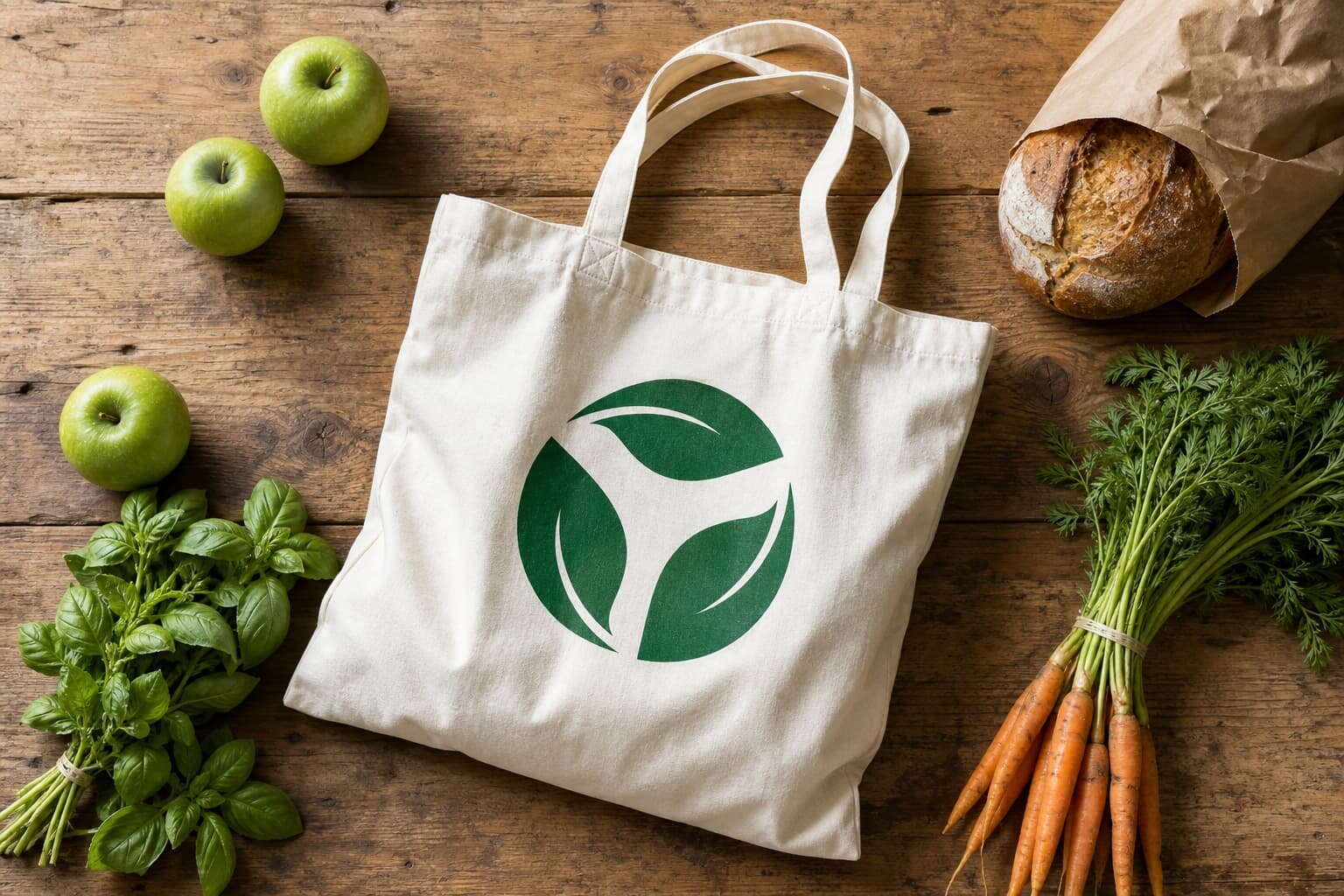
1. Start With the Retail Use, Not the Bag Photo
An organic canvas tote can be a low-cost promotional carrier, a paid merchandise item, a grocery shopping bag, or a premium gift-with-purchase. The outside shape may look similar, but the factory specification should not be the same. Retail buyers often send a photo and a target price, then receive quotes that are impossible to compare because every supplier has assumed a different fabric weight, handle style, print method, and packing method.
Before requesting pricing, define the selling environment and expected use. A tote sold at checkout needs a cleaner finish, better shape retention, and more consistent print than a giveaway bag. A grocery tote needs stronger handle attachment and a more useful gusset. A folded ecommerce insert may need compact packing more than heavy fabric. The RFQ should tell the factory what problem the bag must solve.
- For paid retail resale, prioritize fabric hand feel, print quality, seam finish, label accuracy, and consistent folding.
- For grocery or market use, prioritize load capacity, handle comfort, bottom gusset size, and reinforced stress points.
- For brand campaign distribution, prioritize MOQ, unit cost, simple print, carton efficiency, and fast repeatability.
- For boutique merchandise, prioritize heavier canvas, premium trims, inside label, hangtag, and retail-ready packing.
2. Choose Organic Canvas Weight by Function and Price Target
Fabric weight is the first cost driver and the first quality signal. For organic canvas totes, most retail programs sit between 8 oz and 12 oz. An 8 oz canvas is usually soft and economical, but it may not feel substantial enough for a paid retail tote. A 10 oz canvas is a practical middle choice for many retail buyers because it has better body without becoming too bulky. A 12 oz canvas gives a more premium feel but increases material cost, sewing difficulty, carton weight, and freight cost.
Ask suppliers to quote by both ounce and GSM. Ounce descriptions are common in bag merchandising, while mills and inspectors often work in GSM. One supplier's 10 oz may not match another supplier's 10 oz if the value is rounded, measured before finishing, or converted loosely. For serious comparison, state a GSM range such as 280-300 GSM for a 10 oz canvas and require the quote to confirm whether the GSM is for finished fabric.
- 8 oz / about 230-240 GSM: suitable for budget retail campaigns, lighter books, small goods, and folded giveaways.
- 10 oz / about 280-300 GSM: suitable for standard retail shopping totes and most brand merchandise programs.
- 12 oz / about 340-360 GSM: suitable for premium stores, bookstores, durable market bags, and higher perceived value.
- 14 oz and above: possible for heavy-duty bags, but often unnecessary for normal retail totes and may create bulky seams.
3. Confirm What “Organic” Means in the Quote
The word organic is not a full specification. A buyer should confirm whether the organic claim applies to the cotton fiber, yarn, fabric, dyeing process, printing process, or finished bag. Some orders only need organic cotton fabric for brand positioning. Other orders require transaction documents or certificates for retailer compliance. If your retail customer needs documentation, this must be stated before quotation because it can affect fabric sourcing, MOQ, lead time, and available colors.
Do not ask a factory to “include certification” without explaining the document requirement. Certificates are not the same as a finished product claim, and not every printing or dyeing route is covered in the same way. If the bag carries a claim on the label or packaging, your compliance team should approve the wording. From the factory side, the safe RFQ approach is to separate material requirement, document requirement, and labeling claim.
- State whether natural unbleached organic canvas is acceptable or whether bleached or dyed canvas is required.
- Ask whether the organic fabric is stock available or must be woven or booked specially.
- Clarify if certificate copies, transaction records, fabric test reports, or supplier declarations are needed.
- Do not approve hangtag or printed claims until compliance wording is checked by the brand or retailer.
4. Specify Size, Gusset, Handle, and Load Requirement Together
A tote size cannot be judged only by width and height. Gusset size changes usable volume, fabric consumption, folding thickness, sewing time, and carton dimensions. A flat 38 x 42 cm tote and a 38 x 42 x 10 cm bottom-gusset tote may look close in a product photo, but they are different factory orders. If the buyer does not state gusset construction clearly, suppliers may quote the cheaper flat version and the final comparison becomes misleading.
Handles are another common source of production mistakes. Handle length affects how the bag is carried: hand carry, shoulder carry, or both. Handle width affects comfort and perceived quality. Attachment method affects strength. For retail totes, a 2.5 cm to 3.8 cm handle width is common, but the correct choice depends on fabric weight and expected load. A heavy organic canvas tote with weak handle reinforcement is worse than a lighter tote engineered correctly.
- Common flat tote size: 38 x 42 cm with 60-70 cm shoulder handles for general retail use.
- Common bottom-gusset size: 38 x 40 x 10 cm or similar for grocery, books, apparel, or boxed items.
- Handle options: self-fabric canvas handles for matching look; cotton webbing handles for clean production and strength.
- Reinforcement options: cross stitch, box stitch, bartack, or combined reinforcement depending on load target.
- Useful tolerance examples: bag size +/-1 cm, handle length +/-1.5 cm, print position +/-0.5 cm to +/-1 cm depending on artwork.
5. Match Print Method to Artwork and Organic Canvas Texture
Most retail organic canvas totes use screen printing because it is stable, economical at volume, and works well for bold logos. Water-based screen print is often preferred for a softer hand feel on natural canvas, but color brightness depends on the fabric shade. A white logo on natural canvas may need more ink coverage than expected. Fine lines and small text can also break up on coarse canvas texture, especially with heavier weaves.
Digital printing can support multi-color artwork and gradients, but it may not be the best choice for every organic canvas order. Embroidery gives a premium look but can pucker on lighter canvas and is not ideal for very large filled areas. Woven labels and side labels are useful for private label retail programs because they keep the main panel clean and avoid print color arguments, but placement must be engineered into the seam.
- Use screen print for solid logos, simple slogans, one to three spot colors, and repeat bulk production.
- Use digital print only after testing color accuracy, wash/rub performance, and artwork sharpness on actual canvas.
- Use embroidery for small premium logos, but test puckering and backside finish before bulk approval.
- Use woven labels for brand identity, size information, collection names, or cleaner retail presentation.
- Always approve a strike-off on the actual production fabric, not only a PDF layout or paper color proof.
6. Understand MOQ Logic Before Negotiating Price
MOQ is not only a factory preference. It is usually built from fabric minimums, dyeing minimums, cutting efficiency, print setup, label production, packing labor, and production line scheduling. Natural organic canvas may have a lower MOQ if the factory or mill keeps fabric in stock. Dyed organic canvas usually needs a higher MOQ because the dye lot must be processed together. Custom woven labels, embroidery, or retail barcode packing can also increase the practical MOQ.
When buyers push for a low MOQ without adjusting specifications, suppliers may quote high unit prices or quietly change materials. A better approach is to ask for MOQ by version. For example, ask for natural fabric with one-color print, dyed fabric with one-color print, and natural fabric with woven label as separate options. This helps procurement see which requirement is driving MOQ and which can be changed without damaging the retail concept.
- Lowest MOQ path: natural organic canvas, standard size, one-color screen print, factory standard bulk packing.
- Higher MOQ path: custom dyed organic canvas, multi-color print, custom woven label, individual retail packing.
- Price break drivers: fabric roll utilization, print setup spread over more units, sewing line efficiency, and carton packing stability.
- Repeat order advantage: approved cutting pattern, screens, labels, and packing method reduce sampling risk and admin time.
7. Build a Quote Sheet That Suppliers Cannot Interpret Differently
A useful quote sheet should make competing offers comparable. If one factory quotes 8 oz canvas with bulk packing and another quotes 12 oz canvas with individual barcode polybags, the lower price does not tell procurement anything. A retail buyer should request one base specification and, if needed, controlled alternatives. The quote should also separate optional costs such as sample fee, screen charge, embroidery digitizing, label cost, testing, and special packing.
Incoterm and packing data matter early because canvas totes are bulky relative to unit value. A slightly heavier fabric or a thicker fold can change carton CBM and freight cost. For importers and distributors, landed cost can be affected as much by carton efficiency as by sewing price. Ask for estimated carton quantity, carton size, gross weight, net weight, and CBM with the first formal quote, not after purchase order approval.
- Minimum quote fields: bag size, gusset, fabric GSM, fabric color, handle style, print method, print size, label, packing, MOQ, unit price, Incoterm, lead time, and validity.
- Cost items to separate: sample, screen setup, embroidery digitizing, woven label setup, hangtag, barcode sticker, testing, and inspection support.
- Logistics fields: units per carton, carton dimensions, gross weight, net weight, estimated CBM, export carton marks, and pallet requirement if any.
- Commercial fields: payment terms, price validity, port, production start condition, artwork approval condition, and sample approval condition.
8. Use Samples to Lock Production, Not to Collect Pretty Photos
Sampling should prove the construction and printing method before bulk cutting. A photo sample can show shape, but a physical sample shows fabric hand feel, shade, seam thickness, handle comfort, and print behavior. For an organic canvas tote, the most important samples are fabric swatch, blank construction sample, printed strike-off, and pre-production sample. Depending on timeline, these can sometimes be combined, but the buyer should know which risk each sample controls.
The approved pre-production sample should become the production standard. Keep one sample with the buyer and one at the factory. Mark it with date, version, fabric GSM, print method, and approved changes. Many production disputes happen because the buyer approved a photo but not the actual shade, print thickness, seam finish, or folding style. Written approval notes are as important as the sample itself.
- Fabric swatch: confirms shade, texture, GSM range, and organic canvas hand feel.
- Blank sample: confirms size, gusset, handle length, stitching, reinforcement, and sewing tolerance.
- Print strike-off: confirms ink color, opacity, registration, curing, and print edge quality.
- Pre-production sample: confirms final material, print, labels, packing method, and production workmanship.
- Sealed approval sample: should be referenced during inline inspection and final inspection.
9. Prevent the Most Common Organic Canvas Tote Defects
Organic canvas often has a natural look, but natural does not mean any defect is acceptable. Retail customers may accept small cotton seed flecks or mild slub texture if it is part of the agreed fabric character. They usually will not accept oil stains, dirty handling marks, large weaving defects, misaligned prints, broken stitches, or strong shade inconsistency within the same shipment. Define acceptable fabric character before bulk production, especially for natural unbleached canvas.
Printing defects are also common because canvas is textured and absorbent. Fine artwork can lose sharpness, and ink coverage may look uneven if the mesh, ink viscosity, or curing process is not controlled. For totes with large prints, the factory should check print panel stability before sewing or use a jig to control position on finished bags. If retail buyers need consistent shelf appearance, print position tolerance must be written into the order.
- Fabric defects to control: dark stains, oil marks, heavy slubs, holes, loose yarns, large shade patches, and damp odor.
- Sewing defects to control: skipped stitches, broken threads, uneven handle length, weak bartacks, crooked gusset, and raw seam exposure.
- Print defects to control: smudging, poor opacity, pinholes, registration shift, wrong Pantone direction, cracking, and off-position artwork.
- Packing defects to control: wrong folding, crushed handles, mixed colors, missing labels, incorrect carton marks, and wrong unit count.
- Inspection advice: inspect both loose units and packed cartons because some issues only appear after folding and compression.
10. Plan Lead Time by Production Stage, Not One Promise Date
A realistic production schedule for organic canvas totes depends on material availability and approval speed. If natural organic canvas is in stock and the artwork is simple, sampling and production can move faster. If fabric must be woven, dyed, certified documentation collected, labels produced, and retail packing prepared, the timeline becomes longer. Buyers should ask for a stage-by-stage schedule and then protect the critical approvals: artwork, fabric, strike-off, and pre-production sample.
The biggest avoidable delay is late approval after the factory has already held material or production space. Another common delay is changing packing after price approval. Individual polybags, hangtags, barcode labels, master carton marks, and retailer routing labels all take time to prepare and verify. A good purchase order should freeze packing instructions before bulk packing starts, not at the final inspection stage.
- Typical schedule stages to request: fabric booking, sample production, strike-off approval, bulk cutting, printing, sewing, trimming, packing, inspection, and export handover.
- Approval gates: fabric shade, logo artwork, print color, pre-production sample, label copy, barcode data, and carton mark layout.
- Schedule risks: custom dyed fabric, missing vector artwork, unclear certification documents, repeated sample changes, late packing instruction, and failed print approval.
- Repeat order control: confirm whether the factory will use the same fabric mill, same GSM range, same print formula, and same packing method.
Specification comparison for buyers
| Spec decision | Recommended option | When it fits | Buyer risk to check |
|---|---|---|---|
| Fabric weight | 10 oz / 280-300 GSM organic canvas | Mainstream retail shopping tote with enough structure but still foldable | Some mills quote by ounce and some by GSM; confirm finished fabric GSM after washing or finishing |
| Heavier fabric | 12 oz / 340-360 GSM organic canvas | Premium retail gift bag, bookstore tote, boutique merchandise, or repeated-use grocery bag | Higher freight weight, thicker seams, and higher needle breakage risk if the factory is not set up correctly |
| Light fabric | 8 oz / 230-240 GSM organic canvas | Budget retail campaign tote or lighter giveaway with smaller print area | May feel too soft for paid retail; logo show-through and deformation are more likely |
| Handle construction | Self-fabric canvas handle or 2.5-3.8 cm cotton webbing | Self-fabric for a matching premium look; webbing for cleaner production and better load stability | Handle length and reinforcement method must be confirmed, not assumed from a reference photo |
| Printing method | Water-based screen print for 1-3 spot colors | Most retail logos, organic positioning, natural hand feel, stable unit cost at bulk quantity | Pantone color shifts on natural canvas; approve actual strike-off on production fabric |
| Premium branding | Embroidery, woven label, or inside brand label | Higher perceived value, limited-edition retail lines, private label resale | Embroidery can pucker on lighter canvas; woven label placement must not interfere with seam allowance |
| Bag structure | Flat tote or bottom-gusset tote | Flat tote for events and folded retail display; bottom gusset for shopping and higher usable volume | Gusset dimension changes cutting consumption and carton size; include it in RFQ drawing |
| Packing | Bulk packed with paper band or individual recycled polybag if retail shelf requires it | Bulk for lower cost and less plastic; individual bag for barcode, dust control, or store distribution | Retailers may require suffocation warning, barcode position, carton marks, or polybag thickness |
Buyer checklist before sampling
- Define the end use: paid retail item, gift-with-purchase, grocery tote, bookstore bag, or merchandise resale.
- State whether the canvas must be certified organic and whether certificate documents are required for the fabric, dyeing, printing, or finished bag.
- Confirm fabric weight in GSM and ounce, and specify whether the value is before or after washing or finishing.
- Provide finished bag dimensions, gusset dimensions, handle length, handle width, and tolerance expectations.
- State the maximum loaded weight the bag should carry and whether the factory should run a load test.
- Send logo files in vector format and list Pantone colors, print size, print position, and print method preference.
- Request a printed strike-off on actual organic canvas, not only a digital mockup.
- Clarify whether natural cotton shade variation is acceptable or whether a tighter shade range is required.
- Specify packing: bulk, folded, paper band, individual polybag, barcode label, hangtag, inner carton, or master carton.
- Ask for carton dimensions, gross weight, net weight, units per carton, and estimated CBM before approving the order.
Factory quote questions to send
- What organic canvas weights are currently available from your mill, and can you quote 8 oz, 10 oz, and 12 oz options separately?
- Is the quoted fabric certified organic at fabric level, yarn level, or finished product level, and what documents can be supplied with the shipment?
- Is the quoted GSM based on greige fabric, finished fabric, or washed fabric?
- What is your MOQ for natural organic canvas, dyed organic canvas, custom print, and custom label separately?
- Can you provide a cost difference between flat tote, bottom-gusset tote, and side-plus-bottom-gusset tote in the same size range?
- Which print method do you recommend for our artwork, and what is the maximum print size you can hold cleanly on this fabric?
- Do you charge screen setup, digital file handling, embroidery digitizing, label mold, or sample fees separately?
- What are your standard tolerances for bag size, handle length, print position, and GSM?
- What load test can you perform for the proposed handle and seam construction?
- How many days are needed for material booking, sample making, printed strike-off, bulk production, inspection, and packing?
Quality-control points to confirm
- Check finished fabric GSM against the approved specification using a proper GSM cutter or agreed sampling method.
- Compare fabric shade under consistent lighting against the approved fabric swatch and pre-production sample.
- Measure finished bag width, height, gusset, handle width, and handle drop against the approved tolerance.
- Inspect handle attachment reinforcement, bartack quality, X-stitch size, and stitch density at stress points.
- Run a practical load test based on the buyer's expected use, not only a visual seam inspection.
- Check screen print registration, opacity, edge sharpness, curing, rubbing resistance, and print position.
- Inspect natural canvas for oil marks, weaving slubs beyond agreed limit, dark stains, needle holes, and dirt from handling.
- Confirm labels, hangtags, barcode labels, and carton marks match the purchase order and packing instruction.
- Open packed cartons to verify folding direction, unit count, polybag or paper band use, and moisture protection.
- Record defects by critical, major, and minor categories so acceptance is not decided by general appearance only.