1. What this cost review memo is meant to solve
An organic canvas tote for an event gets judged in two very different ways. Procurement looks at price, lead time, and document risk. The event team looks at whether the bag feels sturdy, looks on-brand, and survives the day without turning into disposable clutter. A useful organic canvas tote cost review memo has to satisfy both sides, which means it cannot stop at a unit price and a vague canvas description.
The common failure is comparing quotes that are not actually comparable. One supplier may quote 8 oz canvas with bulk packing and a simple one-color print. Another may quote 10 oz or 12 oz fabric, individual polybags, and a more expensive print process. Both can call the product an organic canvas tote, but the landed cost and user experience are very different. The memo should expose those differences before the purchase order is approved.
- Use the memo to normalize quotes, not just summarize them.
- Separate essential event requirements from optional upgrades.
- Treat fabric weight, print method, packing, and certification as commercial variables.
- Make the approval path visible so the team knows what must be signed off before bulk production.
2. Start with the event brief, not the product name
The phrase organic canvas tote can describe a lot of different bags. A conference tote for badges, brochures, and a notebook does not need the same construction as a sponsor kit bag holding a bottle, apparel, and boxed samples. Before quoting, define the actual use case. The right specification starts with the load, the handout method, the presentation standard, and the life span you expect from the bag.
This is where procurement gets more useful than a generic RFQ template. If the tote will be pre-packed in a warehouse, handle strength and carton packing matter more. If the tote is handed out flat at registration, fold shape, carton count, and delivery sequencing matter more. If the tote is meant to be reused after the event, fabric body, print durability, and stitching detail deserve a higher price ceiling.
- Light insert use: badge, flyer, pen, or thin notebook.
- Medium insert use: catalog, T-shirt, brochure pack, or sample set.
- Heavy insert use: bottle, apparel, books, or boxed gifts.
- Display use: staff kit, sponsor kit, retail presentation, or booth hanging.
- Distribution use: flat handout, warehouse pick-and-pack, direct-to-venue shipment, or regional fulfillment.
3. Write the fabric spec in a way suppliers can price honestly
Fabric weight is usually the first big price lever. For canvas totes, vendors may quote in ounces per square yard or in GSM. As a working buying reference, 8 oz is often around 230-240 GSM, 10 oz around 270-300 GSM, and 12 oz around 340-360 GSM. Those ranges are not exact conversions, so the useful move is to require both the commercial description and the measured fabric weight. That closes the gap between sales language and actual production reality.
For many event buyers, 10 oz organic cotton canvas is the practical middle ground. It usually gives enough body for a clean print, feels more substantial than light sheeting, and keeps shipping weight manageable. 8 oz can work when the budget is tight and the inserts are light. 12 oz can feel more premium and hold heavy contents better, but the extra body can add fabric cost, labor, carton weight, and freight expense.
- Ask whether the fabric is true canvas, plain woven cotton, or a lighter cotton sheeting that is being described as canvas.
- Request the measured GSM tolerance and make the supplier state it plainly in the quote.
- Confirm whether the sample fabric is the same construction, finishing, and shade as the bulk fabric.
- For natural canvas, ask whether lot-to-lot shade variation is acceptable or whether the buyer wants tighter shade control.
- If the tote is dyed, ask how colorfastness and wash or rub performance will be controlled.
4. Define the organic claim before anyone prices the bag
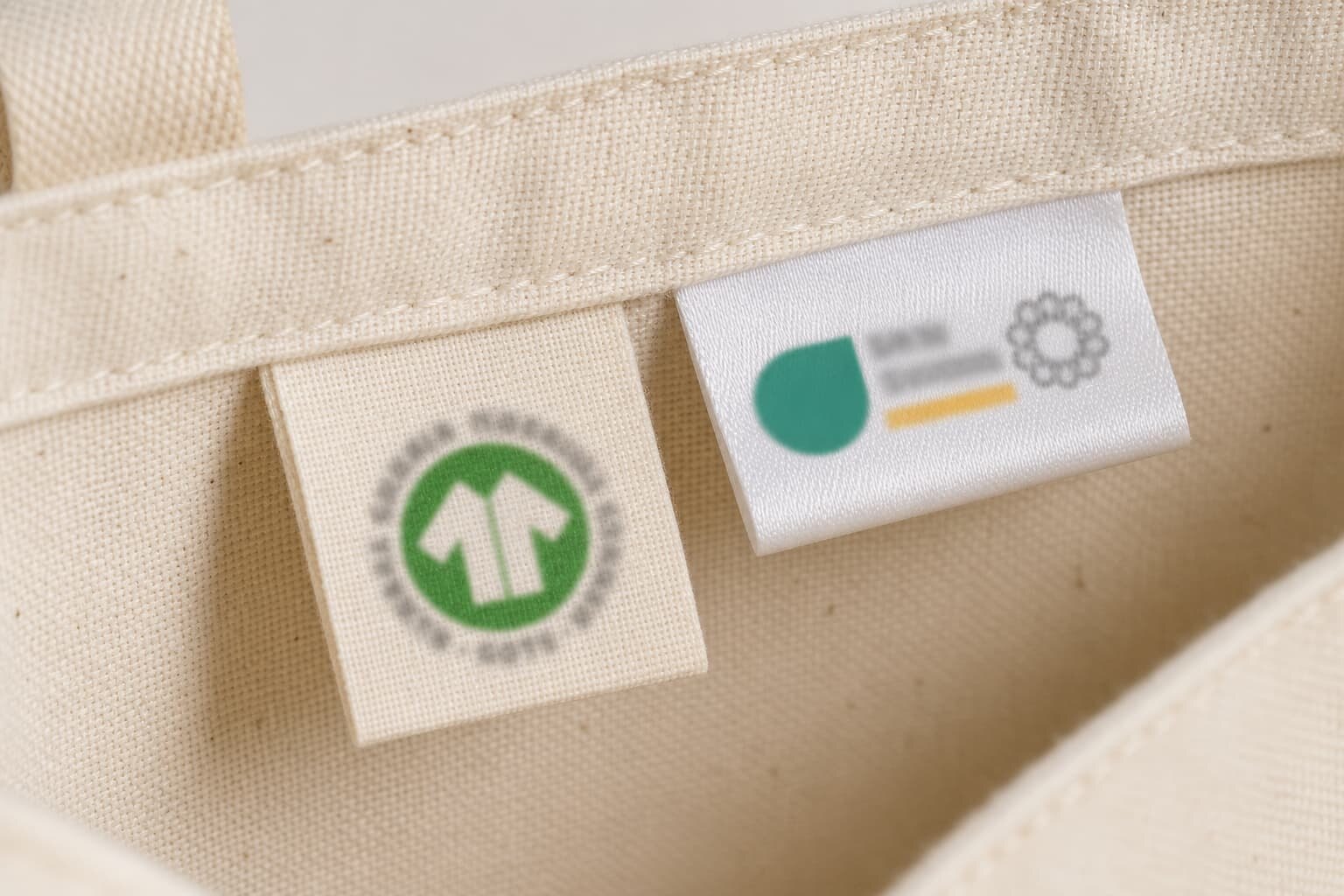
Many procurement teams ask for organic canvas but do not pin down what proof is required. That creates problems later, because an internal marketing preference is not the same as a compliance requirement. Some buyers need a formal certificate path. Others only need supplier declaration and supporting documents. Those are different sourcing tracks, and they can change MOQ, timing, and document cost.
The safest approach is to decide in advance what the claim needs to support. If the brand owner, retailer, or sponsor wants a specific certificate, list that document in the RFQ. If the business only needs to say made with organic cotton, make sure legal, compliance, or the brand team has already accepted the wording. The quote should include the cost of the proof, not leave it to be discovered after production starts.
- State whether certification is mandatory, preferred, or not needed.
- Name the reviewer of the certificate set: procurement, compliance, legal, or the brand owner.
- Ask whether the documentation must cover the fiber, the fabric, the finished bag, or the printer as well.
- Do not print the organic claim until the documentation path is approved internally.
- Ask whether the supplier has stock fabric available or must weave, dye, or source it to order.
5. Compare landed cost, not just unit price
The phrase landed cost matters more than the factory quote because event buyers pay for more than sewing. A low unit price can become the expensive option once you add setup charges, sample costs, packing labor, inland freight, export documents, customs brokerage, duties, and destination delivery. An RFQ that does not separate those pieces is almost guaranteed to mislead the buyer.
A simple internal comparison sheet helps. Use one row per supplier and one column per cost driver. Put the base tote price beside the print charge, sample fee, freight term, packing method, and document cost. If a supplier leaves a line item blank, treat that as a risk rather than assuming it is free. A quote is only comparable when the same commercial assumptions are visible on both sides.
- Compare unit price by quantity break and by freight term, not by price alone.
- Add sample cost and sample shipping into the review so the real acquisition cost is visible.
- Include inland trucking, customs brokerage, VAT or GST, and destination receiving if those costs fall to the buyer.
- Watch for hidden cost shifts such as individual polybags, barcode labels, or carton rework.
- If two quotes differ by a few cents, check whether one includes a lighter fabric or a weaker packing standard.
6. Use the right print method for the artwork, not the cheapest method on paper
Most event tote orders are simplest with one-color or two-color screen printing. On natural organic canvas, water-based screen print is common because it has a softer hand and fits the sustainability story better than a plastic-feeling transfer. That said, rough canvas texture can blur tiny text or thin lines. QR codes, reversed lettering, and detailed sponsor marks should be tested on the actual fabric before bulk approval.
Full-color artwork can justify a different process, such as DTF transfer or digital print, especially for smaller quantities or many artwork versions. The decision should be driven by the artwork and the event timeline, not by habit. A lower quote is not useful if the artwork edges crack, the colors shift on natural fabric, or the logo looks fine in a photo and weak in real light.
- Screen print works best for bold spot colors and larger quantities.
- Water-based ink often feels better on organic cotton but may need stronger coverage on natural shades.
- Digital or transfer methods are useful when the artwork has gradients, photo detail, or many logo versions.
- Embroidery can look premium, but it adds cost and can pucker lighter canvas if the stitch density is too high.
- Ask for a strike-off or print proof on the same fabric, not on a substitute swatch.
7. Build the quantity logic around the real event program
MOQ is rarely just one number. For organic canvas totes, quantity can be driven by fabric sourcing, print setup, artwork version count, carton packing, and even whether the bag is natural, dyed, or individually labeled. A supplier may be comfortable with one logo and one size at a lower quantity, but need a much larger run if the order is split into several sponsor versions or several colors.
This is where procurement can save money by organizing the order correctly. If the event uses multiple sponsor logos, ask for the incremental cost per extra artwork rather than trying to force all the costs into one unit price. If the organization expects a reorder later, ask whether the same screens, templates, or cutting markers can be reused. A quote that supports a repeat order can be more valuable than a slightly cheaper first run.
- Ask for price breaks at realistic quantities such as 1,000 / 3,000 / 5,000 / 10,000 pcs.
- Request separate pricing for extra colors, extra artwork versions, and extra packing styles.
- Check whether custom color canvas creates a separate MOQ from natural canvas.
- Confirm whether the sample fee is a one-time cost, a deductible cost, or a separate charge.
- For multi-sponsor events, ask whether each logo version carries its own setup cost.
8. Treat handles, seams, and reinforcement as commercial risks
A tote can look acceptable on a spec sheet and still fail on the event floor if the handles are weak. For buyers, handle construction is not decorative. It is a load-bearing decision. Cotton webbing and self-fabric handles both work, but the actual performance depends on width, stitch pattern, seam allowance, and reinforcement. A weak handle attachment creates the kind of visible failure that procurement remembers long after the invoice is closed.
Handle length matters too. A short handle can be awkward over outerwear, while an overly long handle can drag when the bag is held by hand. The buyer should state the intended carry style, not leave it to the factory to guess. If the bags will hold bottles, catalogs, or apparel, the seam and reinforcement standard should be stricter than for a light brochure bag.
- State handle length as total length or handle drop, and do not let the supplier choose the unit silently.
- Use cross-stitch or box-stitch reinforcement for medium and heavy insert loads.
- Confirm whether the handle material is the same organic cotton family if the claim matters to the buyer.
- Ask for a simple load test that reflects the actual contents, not a generic strength statement.
- Check seam finish, corner reinforcement, and loose thread cleanup in the sample stage.
9. Packing and freight often move the quote more than the bag itself
Packing is one of the quietest places where cost hides. Bulk packing is usually the cheapest and cleanest choice for event buyers. Bags are folded and packed flat in export cartons, often 50 to 100 pieces per carton depending on the bag size and fabric weight. Individual polybags, tissue wrap, paper bands, or retail sleeves may be needed for presentation, but each one adds material, labor, and shipping volume.
Freight planning should also be part of the quote review, especially for international event programs. The same tote can look inexpensive at the factory and expensive after cartons, CBM, duty, and destination delivery are added. Buyers in the US, EU, UK, and other import-heavy regions should look closely at brokerage, tax, origin documents, and warehouse receiving rules. A quote that works for domestic fulfillment may not be right for a cross-border event with a fixed venue date.
- Define whether packing will be bulk, polybagged, paper-banded, or retail-ready before the quote is accepted.
- Ask for carton dimensions, gross weight, net weight, and estimated CBM.
- Check whether palletization, carton labeling, or master carton marks are needed for warehouse receiving.
- If the order crosses borders, confirm who pays import duty, brokerage, VAT or GST, and destination delivery.
- Make sure the delivery term matches the buyer's receiving setup, not just the supplier's default shipping habit.
10. Use samples and QC thresholds to protect the approval date
A fast event timeline is not an excuse to skip sample control. The safest process is to approve the construction sample and the print strike-off before bulk production. If time is tight, those approvals can happen in parallel, but the buyer still needs evidence that the fabric, print method, and finished dimensions match the order. A generic showroom tote is not enough to sign off a bulk run.
The QC plan should be measurable. Write down the size tolerance, the print position tolerance, the allowed shade variation, and the defect types that are not acceptable. If the tote is being used in a visible event or sponsor program, a weak approval process can create a bigger brand problem than a modest price difference ever saved.
- Approve a pre-production sample made from bulk fabric and bulk print method.
- Keep a sealed or signed golden sample for final inspection comparison.
- Set a size tolerance before production, such as plus or minus 0.5 in or about 1 cm if the event can accept that range.
- Set a print placement tolerance so logos do not drift from the approved location.
- Reject obvious holes, tears, oil marks, severe shade mismatches, print smears, or missing reinforcements.
- Confirm that the finished bag still meets the load expectation after sewing, folding, and packing.
Specification comparison for buyers
| Spec decision | Recommended option | When it fits | Buyer risk to check |
|---|---|---|---|
| Fabric weight | 10 oz / about 270-300 GSM organic cotton canvas | Balanced event tote with enough body for logo print, brochures, and general giveaway use | Request both the quoted oz and measured GSM; some vendors call lighter fabric canvas without proving the weight |
| Premium fabric option | 12 oz / about 340-360 GSM organic canvas | Retail gift bag, sponsor kit, heavier inserts, or a reuse-forward campaign | Higher fabric cost, greater carton weight, and more freight spend if you ship by air |
| Budget fabric option | 8 oz / about 230-240 GSM organic canvas | Light handouts, strict cost caps, and short-lived event use | May show contents, wrinkle more, and need a cautious print design with bolder lines |
| Certification proof | Documented organic cotton claim with the right certificate path for your buyer | Brands, sponsors, or retailers that require proof before release | Do not assume a verbal organic claim is enough; define the document set before quoting |
| Print method | Water-based screen print for simple one- or two-color art | Most conference, campus, and sponsor event orders | Fine text, QR codes, and thin reversed lines can fill in on rough canvas |
| Artwork complexity | Simple spot-color logo with a large clear area | Fast approval cycles and large quantities | Multi-color gradients, small type, and photographic detail can push the order toward transfer or digital methods |
| Handle construction | Cotton webbing or self-fabric with reinforcement stitching | Bags carrying catalogs, bottles, apparel, or sample kits | Weak handle attachment is a common event failure point; ask for a pull or load test target |
| Packing method | Bulk pack 50-100 pcs per export carton unless retail presentation is required | Warehouse distribution, booth handout, or direct event delivery | Individual polybags quietly add labor, plastic, carton volume, and receiving time |
| Freight term | Quote the most realistic Incoterm for the buyer's receiving model | Orders with import, brokerage, or cross-border delivery needs | A cheap factory quote can become the expensive option after inland freight, duty, and carton handling |
Buyer checklist before sampling
- Confirm whether the tote must be certified organic cotton, made with organic cotton, or only sourced from organic fiber with supplier declaration.
- Specify fabric as organic cotton canvas with a target weight in GSM and oz, not just a generic canvas bag.
- Lock the finished bag size, gusset, handle length, handle width, seam allowance, and acceptable measurement tolerance before requesting quotes.
- Attach the final artwork in vector form and name the print method, print size, color count, and exact placement on the bag.
- Ask suppliers to break out fabric, sewing, printing, sample charges, packing labor, carton materials, inland freight, and document fees wherever possible.
- Compare MOQ by bag color, artwork version, print method, and packing style instead of assuming one MOQ applies to the entire order.
- Require a pre-production sample made from bulk fabric and bulk print method, not a generic showroom sample.
- Ask for carton quantity, carton dimensions, gross weight, net weight, and estimated CBM so logistics can confirm receiving capacity.
- Set an internal approval calendar that includes sample review, revisions, PO release, and buffer time for shipping or customs delays.
- Write acceptance thresholds for GSM, size, print registration, color shade, stitch quality, handle strength, odor, stains, and carton marking.
Factory quote questions to send
- What exact organic canvas weight are you quoting in GSM and oz, and what production tolerance do you hold for bulk fabric?
- Is the fabric greige, dyed, washed, or bleached, and will shrinkage change the finished bag dimensions after sewing?
- What proof do you provide for the organic claim, and is that proof tied to the fiber, fabric, or finished bag level?
- Does your MOQ apply per size, per color, per artwork, per print method, or per shipment?
- Which print method is included in the quote, how many colors are covered, and what setup or screen charges are extra?
- Can you provide a print strike-off on the same canvas that will be used in bulk production?
- What handle material, handle length, handle width, and reinforcement stitching are included in the base price?
- Are individual polybags, tissue, paper bands, hangtags, barcode labels, or carton marks included or charged separately?
- What is the sample cost, sample lead time, bulk lead time after approval, and latest artwork approval date?
- What carton size, quantity per carton, gross weight, and estimated CBM do you expect for the quoted order?
Quality-control points to confirm
- Measure bulk fabric GSM from approved production yardage and compare it to the written target, using the buyer's own tolerance.
- Check finished bag width, height, gusset, and handle length against the sealed sample; many buyers set an internal tolerance of plus or minus 0.5 in or about 1 cm.
- Verify print placement from seam to artwork edge so the logo does not drift during sewing or folding.
- Inspect print color, registration, edge sharpness, and rub resistance before packing; reject obvious smears, pinholes, or ghosting.
- Set a pull or load test that reflects the real event insert weight, then check handle stitching and reinforcement after that load is applied.
- Review seam allowance, lock stitching, skipped stitches, loose threads, and weak corners on a random sample from each carton lot.
- Check odor, stains, oil marks, woven slubs, broken yarns, and shade variation before approving shipment.
- Verify carton count, carton marks, SKU labels, and packing method match the commercial invoice and packing list.
- Keep one approved pre-production sample and one golden bulk sample for final inspection comparison.
- Record any buyer-furnished threshold for rejection, such as zero tolerance for holes, tears, severe print misplacement, or incorrect certification documents.