Start With the Reorder Problem, Not the Bag
A subscription brand does not really buy an organic canvas tote once. It buys the same tote again and again, under different demand conditions, with one goal: every shipment should look and pack like the last one. That is where tote programs usually drift. The first order is treated like a launch, while the second order becomes a refill. In practice, the second order is the real test. If the fabric weight changes, the print shifts, or the fold method changes, your warehouse sees it immediately and your customer probably does too.
Before you request a quote, define the use case in business terms. Is the tote a paid retail item, a gift with purchase, a subscription insert, or a reusable shipping accessory? Each one changes the cost target, the acceptable hand-feel, the print durability, and the packaging burden. A tote that rides inside a monthly box needs different control than a tote meant to sit on a shelf and sell on its own. The more recurring the use, the more the reorder plan has to be written like a production system instead of a one-time sourcing project.
- State the commercial role of the tote in the box or order flow.
- Define the reorder cadence you expect: monthly, quarterly, or seasonal.
- Call out whether the tote must feel premium, lightweight, or utilitarian.
- Build the reorder plan around consistency first, then cost.
Lock the Spec Before You Compare Quotes
A supplier quote is only comparable when the spec is fixed. For an organic canvas tote, the buyer should lock bag dimensions, fabric weight, handle type, handle length, print size, and packing format before sending the RFQ. If one factory is quoting a 10 oz bag and another is quoting 12 oz, the unit price gap is not a real comparison. The same problem appears when one quote includes a side label, a retail polybag, or a custom insert and another does not.
Write the spec in production language. Use finished dimensions, not approximate size. Use fabric weight in oz and GSM if possible. Send the artwork as a file plus a clean placement note. If the bag must be sold as organic, say exactly what claim you need and what market it has to support. Ambiguity here does not just create quote noise. It creates rework later, and rework is where small tote programs quietly lose margin.
- Bag size with finished tolerance
- Fabric weight in oz and GSM
- Handle width, handle length, and attachment method
- Print placement, print size, and number of colors
- Packing method and carton count
Verify Organic Sourcing With the Right Paperwork
If the tote is going to be sold or marketed as organic, do not stop at a supplier saying the fabric is organic. Procurement needs the traceability chain. The exact documents depend on the standard and the market, but the usual set includes a scope certificate for the supplier, a scope certificate for the mill or converter when the fabric is sourced separately, and a transaction certificate or shipment-level certificate tied to the specific lot if your certification path uses one. Ask who owns each piece of the chain before production begins.
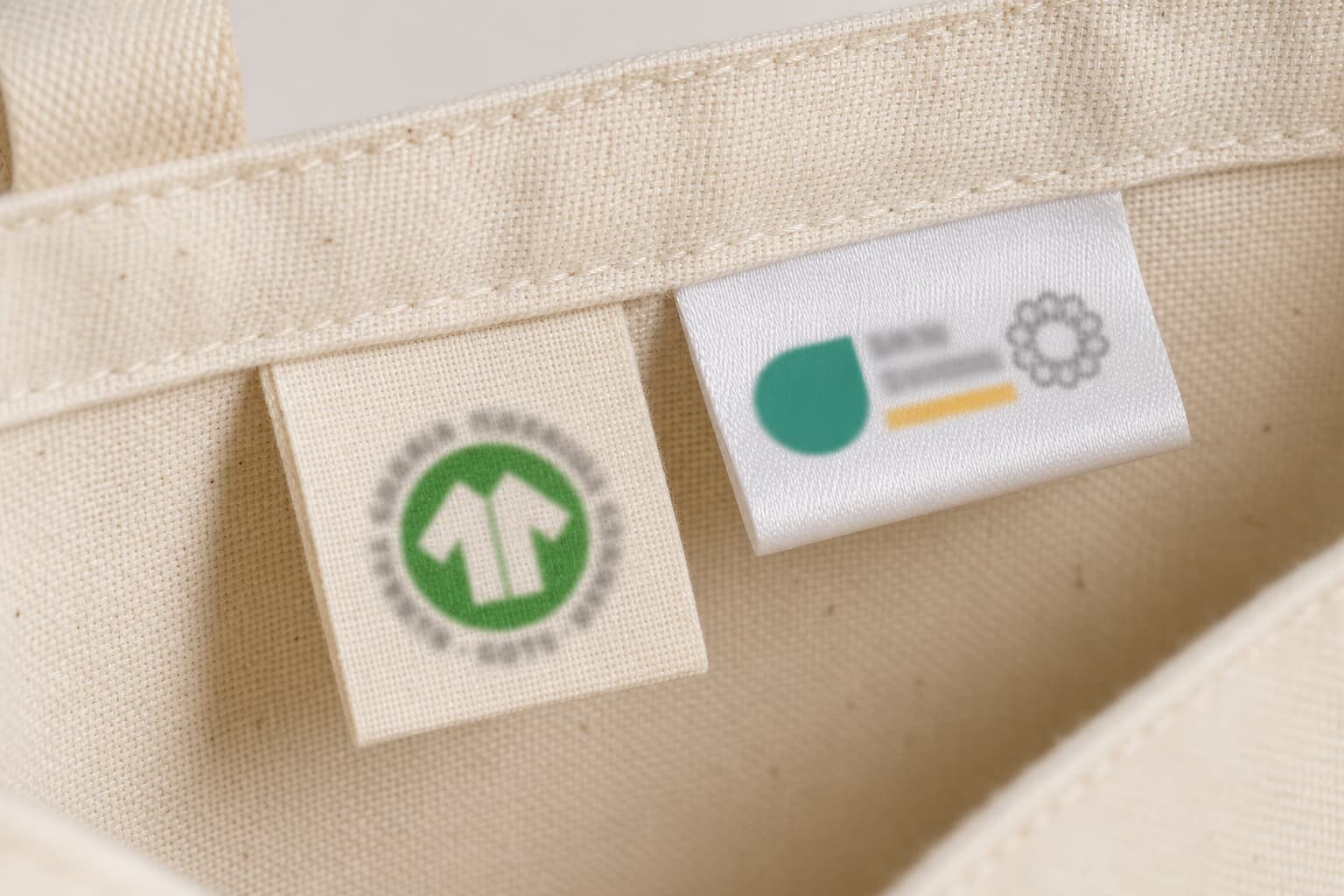
For many buyers, GOTS is the first standard that comes to mind, but the real rule is simpler: confirm the standard you need, then make the supplier show the paperwork that supports that claim from fiber to finished bag. Keep the purchase order, invoice, packing list, fiber content declaration, and batch or lot traceability together. If your compliance team needs local labeling review, bring them in before the order is placed, not after the cartons are on a vessel. A tote can be physically perfect and still be commercially unusable if the organic claim is not defensible.
- Ask which organic standard applies to the order and the target market.
- Request the supplier's scope certificate and any mill or converter certificate tied to the fabric source.
- Ask whether the lot will ship with a transaction certificate, shipment certificate, or equivalent traceability document.
- Match the lot number, invoice, packing list, and label language before approval.
- Confirm whether the claim is for certified organic cotton, organic content, or another claim your market accepts.
Compare Suppliers on Repeatability, Not Just Price
A low unit price is not useful if the factory cannot repeat the same tote six months later. When you compare suppliers, look at how they control fabric lots, print setup, sewing consistency, and packing discipline. Two quotes can look similar on paper and still lead to very different reorder outcomes. One supplier may quote from stock canvas and give you a fast price, while another reserves mill yardage and gives you a better path to repeatability. The cheap quote is not always the expensive one, but the cheapest-looking quote often hides the least stability.
The comparison should also include the supplier's willingness to document the order. Do they record mesh count, ink formula, cure settings, and sewing notes? Can they tell you how they separate shade lots, how they manage minor fabric variation, and whether a reorder will be run from reserved stock or a new mill batch? Good procurement is not only price discovery. It is risk discovery. The supplier that answers those questions cleanly is often the safer partner, even if the initial unit price is a little higher.
- Ask how the supplier controls fabric lot consistency across repeat orders.
- Compare what is included in unit price versus listed as an extra charge.
- Check whether the factory keeps print settings, stitch notes, and packing specs on file.
- Ask if the reorder will come from reserved stock, stock canvas, or a fresh mill lot.
- Weight the supplier's documentation discipline, not only the headline price.
Choose Fabric Weight, Stitching, and Handle Construction for the Channel
For most subscription programs, 12 oz organic canvas is the safest middle ground. It is heavy enough to feel structured, usually prints well, and tolerates normal warehouse handling without looking thin. In GSM terms, that is roughly 405 GSM, though mills and suppliers can vary. Always ask whether the quoted number is finished weight or nominal cloth weight. If the tote is going into a box as a branded insert, 10 oz may be enough. If it is being sold at retail or used as a premium gift, 14 oz may justify the extra cost.
Construction matters as much as fabric weight. Reinforced handles, clean top stitching, and symmetrical attachment points matter if the bag will be reused often or carry heavier contents. A thin handle on heavy canvas can look mismatched and wear faster than the body of the bag. If the tote is meant to survive repeated folding and shipping, ask the factory how they finish inside seams, how they trim thread, and how they prevent puckering near the handle base. These are small details with large reorder consequences because they are hard to fix after a pattern is approved.
- 10 oz / about 340 GSM: lower cost, lighter shipping, weaker structure.
- 12 oz / about 405 GSM: balanced option for most subscription and retail programs.
- 14 oz / about 470 GSM: premium feel, better shelf presence, higher freight weight.
- Ask whether the fabric is pre-shrunk or whether shrinkage must be allowed for in the pattern.
- Confirm stitch density and handle reinforcement before the first production run.
Pick Decoration That Survives Repeat Fulfillment
For recurring bulk orders, screen printing is usually the most predictable decoration method. It handles simple logos well, gives solid color density on canvas, and is easier to repeat than many alternative methods when the factory controls the same mesh, ink, and curing process. If the artwork is one or two solid colors, screen print usually gives the best balance of cost, durability, and reorder consistency. Ask the supplier to confirm whether the print position is fixed for every run, because left-right drift is common when a line is under pressure.
Heat transfer or digital transfer can work for more complex art, but they often behave differently from run to run if the film, heat, or pressure changes. Embroidery can look strong and premium, but on soft canvas it can distort the panel, change the hand of the bag, and add cost quickly. Woven labels and sewn patches are durable branding tools, but they change the pack method and may not substitute for the front-panel visibility some brands want. The right decoration is the one the factory can repeat with the least variation and the least surprise to your warehouse.
- Screen print: best for recurring simple logos and stable cost.
- Heat transfer: useful for short runs or multi-color art, but check durability.
- Embroidery: premium look, but heavier and more sensitive to panel distortion.
- Woven or sewn label: durable brand mark, but confirm size and stitch clean-up.
- Ask for cure method, ink type, and print location control in the spec.
Size the Order Around Burn Rate and Safety Stock
The cleanest reorder plan is built from consumption rate plus buffer. If the tote is used in monthly boxes, calculate the weekly burn rate, add production time, add transit time, and then add a safety stock that reflects your sales volatility. Do not wait until inventory is close to zero before placing the next order. Organic canvas totes are simple products, but they still depend on fabric availability, print scheduling, and carton lead time. A reorder that starts too late usually forces rush production or a spec compromise.
For subscription brands, the practical question is when to trigger the next PO. A sensible rule is to reorder when on-hand stock drops to the level needed for one production cycle plus one transit cycle, with a buffer for sampling, quality issues, or a slower-than-expected factory calendar. If your run rate changes often, ask the factory for a reserve capacity plan or a fabric reservation plan. That way the next buy is not rebuilt from scratch. Reorder planning is less about forecasting perfectly and more about removing avoidable variation from the supply chain.
- Track weekly burn rate, not just monthly totals.
- Include sample approval time in your reorder calendar.
- Add production time and transit time before stock reaches a critical point.
- Reserve fabric or capacity if the program is expected to repeat.
- Keep the same spec version number on every reorder PO.
Treat Samples Like a Production Control Loop
The sample should be judged as the first page of a repeatable production standard, not as a one-off object. That means the approved sample must match the bulk fabric, bulk print method, and final packing method as closely as possible. A showroom sample on different cloth is not enough. Ask the supplier for a pre-production sample or production reference sample once the real fabric and print setup are confirmed. Keep that sample as the golden reference for the next reorder.
Your acceptance criteria should be concrete. Check finished dimensions, handle length, handle symmetry, seam density, thread trimming, print registration, and the carton pack. If the tote is going into subscription shipments, test the fold method in your own receiving flow and make sure the bag opens cleanly after being compressed in carton. If your market is sensitive to color variation, approve the shade under daylight and under your warehouse light. The goal is not perfection. The goal is repeatability that your team can live with on the third and fourth order, not just the first one.
- Compare the bulk sample against the approved reference sample.
- Measure body size and handle length after stitching.
- Check print placement, edge sharpness, and ink curing.
- Verify the fold method and inner pack count.
- Record the sample revision date, order number, and packing reference.
Pack for Warehouse Receiving, Not Just for the Factory
Subscription brands often underestimate how much packaging affects tote quality. A canvas bag can leave the factory looking correct and still arrive with bent corners, pressed seams, or shifted print if the fold and carton pack are not controlled. Decide early whether the tote should be folded flat, folded with handles tucked, or packed with a separator sheet. Then lock that method in the PO and the sample approval. If the bag is a monthly insert, a clean and repeatable fold usually matters more than decorative packing.
Carton planning matters as much as the bag itself. Ask for master carton dimensions, gross weight, and carton markings so your warehouse can receive goods efficiently. If the route is humid or the transit time is long, consider an inner polybag, liner, or desiccant if the fabric and print system call for it. If the bags are printed, avoid tight packing that creates hard fold lines across the ink area. The best pack spec is the one your warehouse can open quickly, count accurately, and store without rework or relabeling.
- Fix the fold direction and handle placement inside the bag.
- Confirm inner pack count and master carton count.
- Request carton dimensions before production starts.
- Check whether the route needs a polybag, liner, or desiccant.
- Make sure carton markings match your warehouse label rules.
Prepare Contingencies for Drift, Delay, and Reorders
A good reorder plan assumes something will change. Maybe the exact fabric lot is unavailable. Maybe the printer has a shade shift. Maybe a port delay changes your receiving date. The question is not whether variation will happen. The question is whether you have a defined response. Set a backup rule for acceptable fabric substitution, print tolerance, and pack adjustment before the order is placed. If the factory needs to change anything, ask for written approval against the golden sample and the revision-controlled spec sheet.
This is where procurement earns its keep. A strong buyer knows when to hold the line and when to accept a controlled deviation. For example, a small change in carton dimensions may be acceptable if the warehouse can still receive the goods efficiently, while a fabric change that alters hand-feel or print behavior may not be. Build a simple escalation path: who approves a material change, who signs off on a shade variance, and who can delay shipment if the lot does not match. That keeps the reorder from becoming a series of rushed, undocumented compromises.
- Define acceptable and unacceptable deviations before production starts.
- Require written approval for any fabric, print, or pack change.
- Use a revision-controlled spec sheet on every repeat order.
- Ask the supplier what happens if the original fabric lot is unavailable.
- Set an internal approval path for shade, size, and packing exceptions.
Specification comparison for buyers
| Spec decision | Recommended option | When it fits | Buyer risk to check |
|---|---|---|---|
| Fabric weight | 12 oz / about 405 GSM | Most subscription brands need a bag that feels substantial, prints cleanly, and ships without looking flimsy | Confirm whether the supplier is quoting finished GSM or only nominal fabric weight |
| Fabric weight | 10 oz / about 340 GSM | Works for light inserts, lower-cost merch, or programs where shipping weight matters more than structure | Thin canvas can show print bleed, wrinkle more, and lose shape after folding |
| Fabric weight | 14 oz / about 470 GSM | Fits premium retail programs, heavier contents, or bags that need a stiffer hand and stronger shelf presence | Higher cost, heavier cartons, and a greater chance of rough hand-feel if sewing quality is weak |
| Decoration | One- or two-color screen print | Best for recurring bulk reorders and stable artwork placement | Watch for ink cracking, poor curing, and color drift between runs |
| Decoration | Woven label or sewn patch | Useful when the brand wants a durable logo with minimal print wear | Check size, stitch density, edge finish, and whether it changes the pack method |
| Construction | Reinforced handles with clean top stitching | Important when the tote will be reused often or carry heavier inserts | Verify stitch count, attachment points, and whether the handle span is symmetrical |
| Packing format | Flat-folded with fixed carton count | Best for warehouse receiving and repeat subscription fulfillment | Check fold direction, carton dimensions, and whether handles create unwanted bulk |
Buyer checklist before sampling
- Confirm exact bag size, handle length, handle drop, seam allowance, and tolerances before requesting quotes.
- Lock the fabric spec as finished weight in GSM or oz, not just the marketing name of the cloth.
- State whether the tote must be sold as organic cotton, made with organic cotton, or only described as organic canvas in your market, then confirm the documentation needed to support that claim.
- If you need a certified organic claim, ask for the applicable certification path up front, such as GOTS or another accepted standard, plus the supplier's scope certificate and any shipment-level transaction certificate available for the order.
- Choose one primary decoration method and one backup option before sampling starts.
- Ask for the same folding and packing method on the sample, pre-production sample, and bulk order.
- Request unit price by quantity tier, setup cost, sample cost, carton details, and any extra charge for special packing or labeling.
- Set a reorder trigger based on weekly burn rate plus safety stock, not on the factory's lead time alone.
- Keep one approved golden sample with date, revision number, print reference, and packing reference.
- Check carton count, inner pack count, and master carton dimensions against your warehouse receiving rules.
Factory quote questions to send
- What is the exact fabric construction, finished GSM, weave type, and shrinkage expectation of the quoted canvas?
- Is the fabric stock item, mill reserved, or custom woven for this order, and what changes if we reorder the same spec later?
- Which organic standard applies to this order, if any, and can you provide the supplier's scope certificate, mill certificate, and transaction certificate or shipment paperwork tied to this lot?
- What are the pricing tiers by quantity, and which costs are included in the unit price versus listed separately?
- Does the quote include screen setup, embroidery digitizing, woven label setup, or other tooling fees?
- Which print method is included in the quote, how many colors are allowed, and what is the cost for extra placements?
- What are the sample lead time, bulk production lead time, and estimated transit window from ex-factory to port or warehouse?
- How many pieces are packed per inner polybag and per master carton, and what is the carton size and gross weight?
- What overrun or underrun tolerance applies to the production order?
- What inspection standard or AQL level does the factory use, and can they share photo evidence from bulk production?
Quality-control points to confirm
- Finished bag size matches the approved sample within your agreed tolerance.
- Canvas weight matches the ordered spec and feels consistent across the lot.
- Handle length, handle drop, and reinforcement stitching are uniform on both sides.
- Seams are straight, thread trimming is clean, and no raw edges are exposed.
- Print placement is centered, aligned, fully cured, and free of pinholes, smudging, or edge break.
- Color matches the approved swatch or sample under daylight comparison.
- No major shade split appears between fabric panels, handles, or different cartons.
- The fold method matches the approved packing reference and does not crush the print area.
- Carton count, inner pack count, and master carton labels match the purchase order.
- Lot codes, batch references, and any organic traceability references are present on the packing docs.