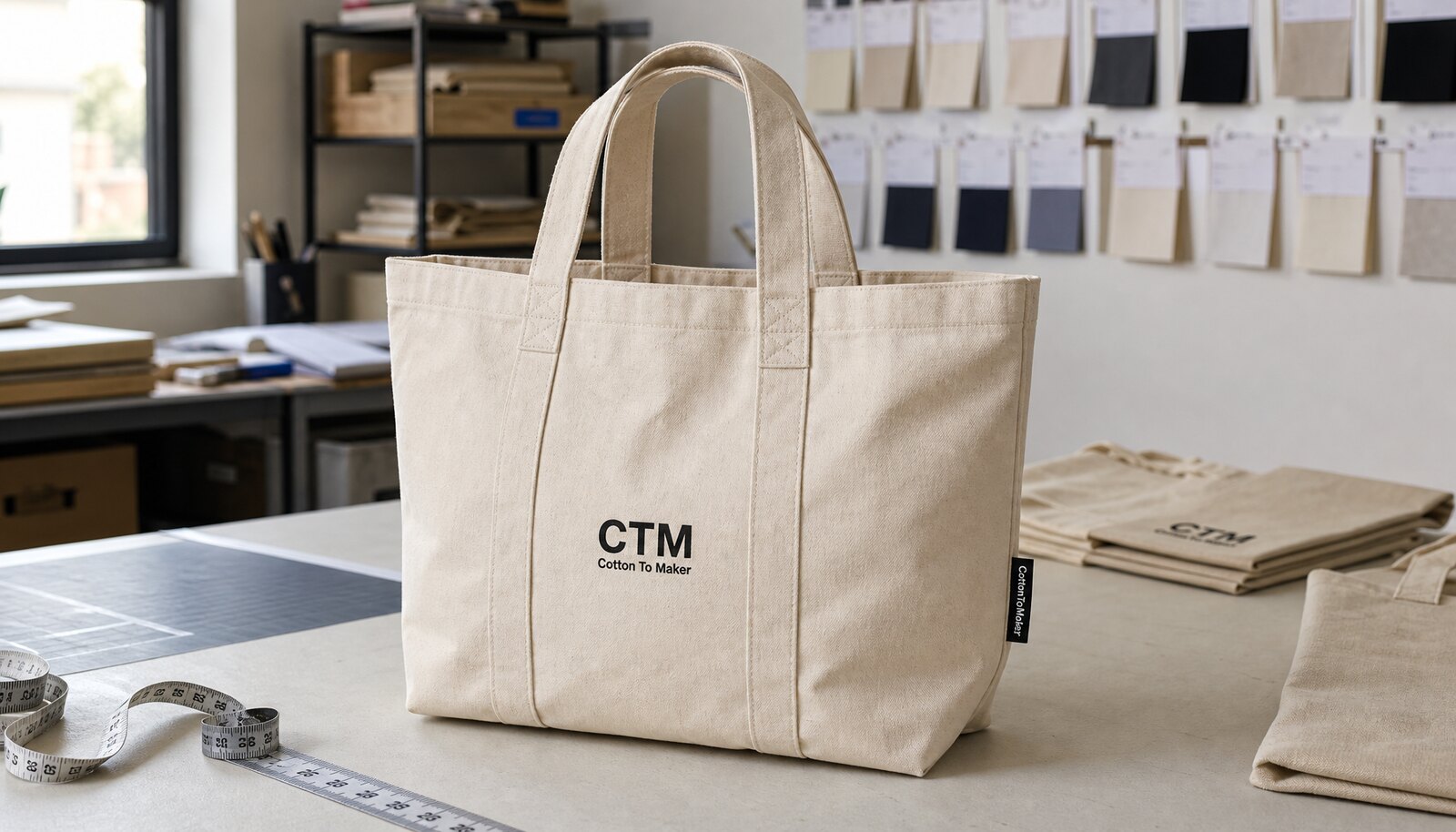
Why Organic Canvas Tote Bag MOQ Is a Procurement Specification
When buyers ask for organic canvas tote bag MOQ, the useful answer is not one fixed number. MOQ changes with certified fabric availability, fabric weight, color, print setup, sewing construction, label components, packing method, and document requirements. A supplier may offer a lower pilot quantity when natural certified organic canvas is already in stock, but the same bag can require a higher MOQ when the order needs custom dyeing, special fabric weight, or certification documents for the finished goods.
Procurement teams should treat MOQ as a production condition rather than a simple sales threshold. If the RFQ does not define certification scope, fabric source, color, artwork, construction, and packing, two factories can quote the same quantity while building different products. That makes price comparison unreliable and increases the risk of later change charges.
- Stock natural certified canvas can support lower planning quantities than custom woven or custom dyed fabric.
- One fabric color and one logo design is easier to consolidate than many colorways, artworks, and barcode SKUs.
- MOQ may be counted per style, per certified fabric lot, per color, per artwork, per label, or per delivery batch.
- Labels, hangtags, barcode stickers, and printed cartons may each have separate supplier minimums.
- Certification documents can affect supplier selection because not every sewing factory can support chain-of-custody claims.
Use Scenario-Based MOQ Ranges Carefully
Realistic MOQ planning should be scenario based. The figures below are not universal promises because each supplier, mill, dye house, and certification route can set different minimums. They are useful planning ranges for buyers preparing an RFQ and deciding whether to simplify the order before asking for a formal quotation.
For a stock natural organic canvas tote with standard size, one-color screen print, and bulk flat packing, some suppliers may consider pilot orders in the several-hundred-piece range. If the order requires custom dyed certified fabric, unusual fabric weight, multiple artworks, individual retail packing, or transaction certificate support, procurement should plan for higher quantities and longer confirmation time.
- Stock natural canvas, standard construction, one-color logo: ask whether 300 to 1,000 pcs is possible for a pilot order.
- Stock fabric with several logo designs or SKUs: plan around 1,000 to 3,000 pcs total and confirm minimum per artwork.
- Custom Pantone dyed organic canvas: expect the fabric or dye-house minimum to push planning quantities toward 2,000 to 5,000 pcs or more.
- Custom woven fabric weight, custom finish, or nominated certified mill: discuss 3,000 to 10,000 pcs depending on fabric consumption and mill terms.
- Retail-ready packing with hangtags, barcode labels, and SKU cartons: confirm both bag MOQ and component MOQ before approving the range.
Set the MOQ Basis Before Comparing Quotes
A useful RFQ tells the supplier exactly how MOQ should be calculated. For example, 2,000 pieces total across four colors is not the same as 2,000 pieces per color. If each color needs separate dyeing, separate print setup, separate barcode labels, and separate carton marks, the factory cost structure changes immediately.
For importers, distributors, and brand procurement teams, tier pricing is more useful than a single quote. Ask the supplier to quote the same specification at several quantities and show which costs are fixed setup charges and which costs decrease with volume. This helps the buyer decide whether to reduce colorways, combine shipments, or approve a larger first order.
- Request price tiers at 500, 1,000, 3,000, 5,000, and 10,000 pcs for the same technical specification.
- Separate MOQ for blank bags, printed bags, dyed bags, certified-finished bags, and private-label packing.
- Confirm whether sample quantity, inspection samples, or retained sealed samples count toward the final bulk quantity.
- Ask if leftover certified fabric can be reserved for repeat orders and who pays for unused fabric balance.
- Require the supplier to identify any MOQ driven by fabric mill, dye house, print workshop, label supplier, or packing supplier.
Organic Certification and Chain-of-Custody Checks
Organic sourcing needs more than the word organic on a quote sheet. Buyers should confirm which certification standard applies, who holds the valid scope certificate, which production steps are covered, and whether transaction certificates are available for the shipment. GOTS and OCS are common standards in organic textile sourcing, but their claims, processing coverage, and document requirements are not identical.
The safest procurement approach is to verify certification before printing labels, hangtags, packaging claims, or product pages. A fabric may be certified while the finished bag sewing or printing stage is not covered by the same chain of custody. If your retailer requires a transaction certificate for finished goods, ask this question before deposit, not after production.
- Request the supplier's current scope certificate and check company name, address, standard, product category, process coverage, and expiry date.
- Confirm whether the certificate covers fabric trading only, fabric processing, dyeing, printing, sewing, or finished bag manufacturing.
- Ask whether a transaction certificate can be issued for your shipment and what documents are needed to support it.
- Match label claims to verified certification scope, such as organic cotton fabric, OCS-certified product, or GOTS-certified product where applicable.
- Avoid approving hangtags or packaging that imply a broader certified claim than the supplier can document.
Fabric Weight and Organic Canvas Specification
Organic canvas tote bags should be specified by measurable fabric weight, not by words such as heavy, premium, or eco. A 280 GSM canvas and a 380 GSM canvas may both be called heavy by different suppliers, but they create different cost, structure, carton weight, and printing results. Ask for both oz and GSM when possible, and confirm whether the weight is measured before or after dyeing, washing, or finishing.
For many retail and brand merchandise totes, 10 oz to 12 oz organic canvas is a practical starting point. Lighter fabric can reduce cost and shipping weight but may feel more promotional. Heavier canvas can improve structure but may increase MOQ if that certified weight is not in stock.
- 8 oz to 10 oz: suitable for lighter promotional totes, event bags, and cost-sensitive programs.
- 10 oz to 12 oz: practical for retail merchandise, reusable shopping bags, and brand giveaways with better handfeel.
- 14 oz and above: stronger structure and premium feel, with higher material cost and possible fabric minimums.
- Natural undyed canvas may show cotton seed flecks; confirm whether the appearance matches the brand standard.
- Dyed or washed canvas should be approved by swatch or lab dip before bulk cutting.
Printing Choices That Affect MOQ and Defect Risk
The print method can change setup cost, sample route, and defect risk. Screen printing is often efficient for simple logos, bold typography, and one to three solid colors on canvas. However, very fine lines, small reversed text, and large areas of heavy ink can behave differently on textured fabric than on a smooth digital mockup.
Heat transfer can handle gradients or detailed artwork, but procurement buyers should check film handfeel, edge bonding, cracking risk, and rub performance. Embroidery creates a premium mark for small logos, but large embroidery areas can stiffen the panel and distort the fabric. For certified organic claims, also confirm whether inks, dyes, and processing steps affect the claim you intend to make.
- Screen print: efficient for solid logos, simple artwork, and repeat bulk production.
- Heat transfer: useful for gradients and complex artwork; approve surface feel and bonding before bulk.
- Embroidery: suitable for small premium marks; avoid oversized dense embroidery unless tested.
- Digital print: useful for detailed or lower-volume artwork; confirm color stability and fabric pretreatment requirements.
- Strike-off approval should include print size, color target, position, handfeel, and edge sharpness.
Construction Details Buyers Should Lock in the RFQ
MOQ discussions often focus on fabric and logo, but sewing details create major quote differences. A tote with reinforced cross-stitch handles, an 8 cm bottom gusset, and bound inner seams is not the same product as a flat tote with simple lockstitch seams. If those details are not specified, a low quote may remove construction value rather than improve sourcing efficiency.
For organic canvas tote bags used in retail, grocery, or merchandise programs, handle strength and size tolerance should be written into the RFQ. The handle drop also affects user experience: a short drop suits hand carry, while a longer drop supports shoulder carry.
- Bag size: provide width, height, and gusset in centimeters or inches.
- Handle drop: define hand-carry or shoulder-carry use and measure from bag top edge to handle apex.
- Handle reinforcement: request cross-stitch, box stitch, or bar tack when load strength matters.
- Seams: confirm open seam, overlock seam, French seam, bound seam, or inner tape finish.
- Tolerance: set practical size tolerance, often around plus or minus 0.5 to 1 cm depending on construction and washing.
- Stitching: define thread color, stitch density target, and whether loose threads must be trimmed before packing.
Sampling Plan Before Bulk Production
Buyers should not approve bulk production from a digital artwork file only. Organic canvas texture, natural shade, print absorption, sewing shape, and label placement must be checked on physical samples. At minimum, request a fabric swatch and print strike-off before confirming a large printed order.
If the order includes custom dyeing, approve a lab dip or dyed fabric swatch before cutting. If the tote includes custom labels, hangtags, barcodes, retail bands, or individual packing, review those components with the pre-production sample. The approved sample should become the sealed reference for factory production and inspection.
- Fabric swatch: checks weight, weave, shade, handfeel, and certification source.
- Lab dip: checks custom color before bulk dyeing and should include agreed light source if color is critical.
- Blank sample: checks bag size, gusset, handle drop, seam type, reinforcement, and general shape.
- Print strike-off: checks ink color, coverage, artwork scale, position, edge sharpness, and handfeel.
- Pre-production sample: confirms complete production standard before bulk cutting and sewing.
- Sealed sample: should be kept by both buyer and supplier for QC and dispute reference.
Specification comparison for buyers
| Procurement decision | Recommended specification | Indicative MOQ impact | Buyer risk to verify |
|---|---|---|---|
| Certified fabric source | Use stock certified organic greige or natural canvas when possible | Lower MOQ than custom weaving because fabric may already be available | Confirm certification type, scope certificate holder, fabric lot traceability, and whether transaction certificates can be provided |
| MOQ basis | Quote by style, fabric color, print design, and packing SKU | A 1,000 pcs total order may not qualify if split into many colorways or artworks | Ask whether MOQ is per order, per color, per artwork, per label, per carton mark, or per shipment |
| Planning MOQ scenarios | Stock natural canvas with one-color print may fit a lower pilot MOQ; custom dyed, custom woven, or multi-SKU retail orders require higher planning quantities | Supplier-dependent ranges may move from several hundred pieces for stock programs to several thousand pieces for custom fabric or color programs | Do not treat ranges as guarantees; confirm fabric stock, dye-house minimum, print setup, and label MOQ in writing |
| Fabric weight | 10 oz to 12 oz organic canvas for retail totes; 8 oz to 10 oz for lighter promotional use; 14 oz and above for premium structure | Heavier or less common weights can raise MOQ if the mill does not hold certified stock | Confirm whether weight is measured before or after dyeing, washing, coating, or finishing |
| Print method | Screen print for solid logos, digital or heat transfer for detailed artwork, embroidery for small premium marks | More colors, larger print areas, and specialty inks can increase setup cost even if bag MOQ is unchanged | Request a strike-off and define print size, ink type, Pantone target, placement tolerance, and rub or wash expectations |
| Construction | Reinforced handles, 8 to 10 cm gusset, defined seam type, and agreed stitch density | More complex sewing may reduce line speed and affect price tiers | Low quotes may omit reinforcement, use narrower handles, reduce seam allowance, or lower stitch density |
| Organic branding claim | Use claims that match the certification and chain-of-custody documents available for the order | Labeling requirements may add documentation time and separate label MOQ | Verify GOTS, OCS, or other claim wording before printing hangtags, care labels, or packaging |
| Packing and carton data | Flat pack 25 or 50 pcs per inner pack, export carton with moisture protection, SKU-separated marks | Individual packing, barcode stickers, hangtags, and retail prep can add labor and component minimums | Confirm carton dimensions, gross weight, net weight, carton strength, inner pack method, and mixed-SKU rules |
Buyer checklist before sampling
- Define the MOQ basis: total quantity, quantity per style, quantity per fabric color, quantity per artwork, and quantity per packing SKU.
- Ask for tier pricing at the same specification, such as 500, 1,000, 3,000, 5,000, and 10,000 pcs, so price breaks are visible.
- State whether the fabric must be GOTS, OCS 100, OCS Blended, or another recognized organic certification, and request valid scope certificate details.
- Confirm whether the supplier can issue or support transaction certificates for the shipment if your brand, retailer, or importer requires chain-of-custody proof.
- Specify fabric weight in both oz and GSM where possible, plus natural, bleached, dyed, washed, or undyed appearance requirements.
- Define bag dimensions, gusset, handle length, handle width, seam type, reinforcement method, stitch density target, and accepted measurement tolerance.
- Send final artwork with vector files, print size, print position, Pantone references, number of colors, and acceptable logo placement tolerance.
- Request the sample route in writing: fabric swatch, lab dip if dyed, print strike-off, blank sample, pre-production sample, and sealed approval sample.
- Separate quote lines for bag cost, print cost, labels, hangtags, packing materials, sample fees, mold or screen charges, inland freight, and export charges where applicable.
- Confirm packing method, inner pack quantity, carton quantity, carton dimensions, gross weight, carton marks, barcode labels, pallet rules, and moisture protection.
Factory quote questions to send
- What is the MOQ basis for this organic canvas tote bag: per style, per fabric color, per artwork, per label, per packing SKU, or per shipment?
- Is the organic canvas from current stock, new weaving, custom dyeing, or a nominated certified mill?
- Which certification can you support for this order: GOTS, OCS 100, OCS Blended, or another standard, and who is the certified scope certificate holder?
- Can you share the valid scope certificate number and product category coverage before order confirmation?
- Can you provide or support a transaction certificate for the finished bags if required by our retailer or import market?
- Does the quoted organic claim apply to the fabric only, the finished bag production, the dyeing, the printing, or the complete chain of custody?
- Can you quote the exact same tote at 500, 1,000, 3,000, 5,000, and 10,000 pcs, with separate lines for blank bag, print, labels, packing, and sample charges?
- What realistic MOQ range applies to our scenario if we use stock natural canvas, custom dyed canvas, multiple prints, or private-label retail packing?
- What is the exact fabric weight in GSM and oz, and is the weight measured before or after dyeing, washing, or finishing?
- What fabric shrinkage, shade variation, and weight tolerance should we allow for the selected organic canvas lot?
Quality-control points to confirm
- Verify organic certification documents before production: valid scope certificate, correct company name, product category coverage, certification standard, expiry date, and chain-of-custody responsibility.
- If transaction certificates are required, confirm the process, responsible party, timing, and whether the certificate covers fabric, finished bags, or both.
- Check fabric weight with an agreed GSM cutter or measurement method instead of approving by handfeel only.
- Compare fabric shade against approved swatch or lab dip under consistent lighting, because natural and dyed organic cotton lots can vary.
- Measure bag width, height, gusset, handle drop, handle width, seam allowance, and print placement against the sealed sample and written tolerance.
- Inspect handle reinforcement method, stitch density, seam strength, loose threads, skipped stitches, needle holes, and raw edge exposure.
- Review print adhesion, edge sharpness, ink coverage on canvas texture, registration, color match, cracking risk, and rub resistance for the selected print method.
- Confirm labels and hangtags match the approved claim wording and are sewn or attached in the correct position and direction.
- Check packing quantity, inner pack method, carton marks, barcode scanability, SKU separation, moisture protection, and carton condition before shipment release.
- Run a simple agreed load test for retail or shopping use, and record weight, duration, handle performance, and seam condition after the test.