Why subscription brands need tighter tote specs
A natural cotton tote inside a subscription box gets judged differently from a tote sold off a shelf. It is opened alongside other items, packed into a fixed kit, and seen repeatedly in the same program, so a small defect can echo through many shipments. The bag has to look consistent, fold cleanly, and survive handling without turning into a quiet source of complaints.
The QC target should reflect the job the tote is doing. If it is a monthly insert, the main risks are inconsistent size, weak seams, rough print, and poor folding. If it is a premium paid add-on, buyers usually need heavier cloth, cleaner stitching, and a more controlled branded finish.
- Decide whether the tote is an insert, gift-with-purchase, or paid retail item.
- Write down the one or two defects that would make the order unacceptable.
- Treat size, fold, and print placement as part of the product, not as packaging afterthoughts.
Start with the fabric, not the logo
For most natural cotton tote programs, 200-240 gsm is the practical middle ground. It usually gives enough body for daily handling without pushing freight, sewing time, and unit cost too far. A lighter 150-170 gsm cloth can work for very cost-sensitive subscription inserts, but it tends to show contents and feels less durable in hand.
Heavier 270-340 gsm cloth creates a stronger retail impression, but it also changes the quote, the stitching load, and the carton weight. When you ask for price, ask for the exact GSM, weave type, and whether the cotton is stock fabric or custom woven for your order.
- Ask for fabric weight in GSM or ounce weight, not a vague light/medium/heavy label.
- Request a fabric swatch or roll photo before sampling.
- Note whether the cotton is unbleached natural, bleached white, or finished with a wash.
Lock construction details before sampling
A tote that looks fine in a photo can still fail at the handle or side seam if the construction is loose. For subscription brands, the most common practical build is a clean side seam, a reinforced bottom, and a handle attachment that uses bar-tack or X-box reinforcement. That is the part of the bag that prevents a simple carry from becoming a return or a complaint.
State the finished dimensions, handle width, handle drop, and where reinforcement is required. If the bag will hold books, bottles, or mixed box contents, ask the factory to show how it reinforces stress points and what stitch density it uses at the load zones.
- Specify finished size in centimeters or inches and define tolerance.
- Confirm the handle material: self-fabric, cotton webbing, or another approved tape.
- Ask for stitch style at handle points, side seams, and bottom seam.
Choose branding for the way the bag will be handled
Screen print is still the default for simple logos on natural cotton, especially when the artwork is one or two colors. It is usually easier to control than more decorative decoration methods, but it still needs clear rules on placement, ink thickness, and curing. If the logo includes fine lines or tiny text, ask for a strike-off on the actual fabric, not only an artwork proof.
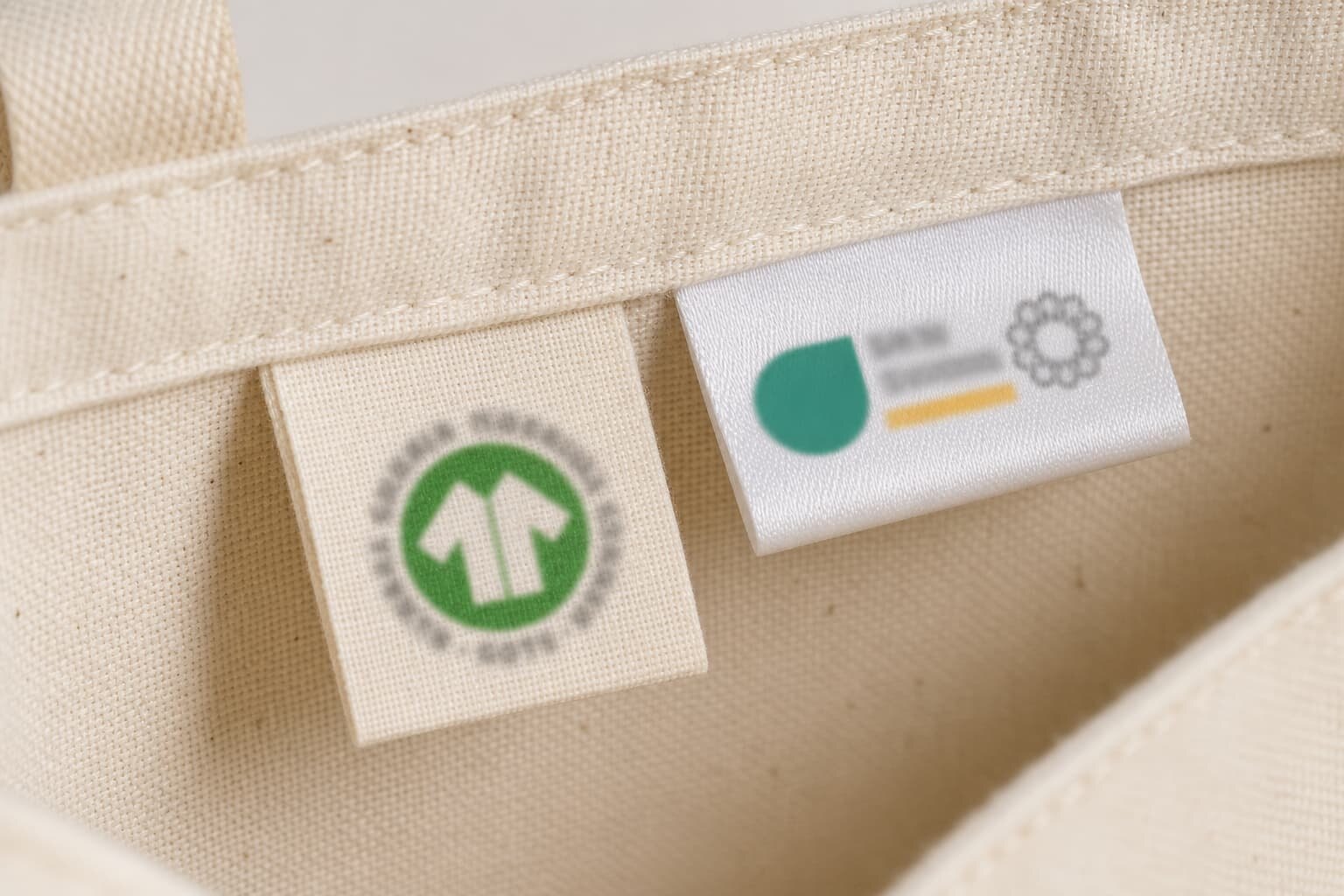
A woven side label or sewn label works well when the brand wants a quieter look or wants to avoid a large printed panel. It also gives you another inspection point: label placement, fray control, thread color, and attachment quality. The right method depends on how the bag will be seen after it leaves the box, not on what looks easiest in a design file.
- For one- or two-color logos, screen print is usually the simplest quote to compare.
- For subtle branding, a woven label or side label can be easier to keep consistent.
- Check print edge sharpness, cure quality, and rub resistance against a sample pack.
Treat size and fold format as part of the spec
Subscription buyers often focus on the bag itself and forget the fold. That is a mistake, because the tote has to fit the box, mailer, or kit tray with the rest of the program. A bag that is technically the right size but folds badly can create packing pressure, uneven stacks, and dimension problems at the fulfillment center.
Tell the factory how the bag will be packed: flat folded, semi-folded, with tissue, with or without a polybag, and how many units per carton. If the bag will be inserted into a kit, ask the supplier to confirm that the folded dimensions fit the kit layout before production starts.
- State the folding method and carton count in the quote request.
- Ask for carton dimensions and gross weight, not just unit price.
- Make sure the tote fits the subscription pack format after folding, not only when open.
What the sample stage should prove
A good sample should prove more than appearance. It should show that the factory can cut, sew, print, trim, and pack the tote the same way every time. If the sample is made with one construction method and the bulk order uses another, the approval has little value. A clean sample also helps you judge how the natural cotton reads under normal warehouse light.
Ask for a pre-production sample, then compare it against a short checklist with measurements, print placement, and defect notes. Keep one signed sample and one signed swatch or print reference. That small discipline saves a lot of back-and-forth when the bulk run begins.
- Measure the sample against the approved spec sheet, not by eye alone.
- Check thread trimming, seam finish, and any odor or staining.
- Approve the fold and packing method before bulk production starts.
How to compare quotes without getting tricked by unit price
A low unit price can hide a missing detail. One factory may include only sewing and fabric, while another includes printing, labels, folding, inner packing, and export cartons. Compare quotes line by line: GSM, construction, print method, sample charges, packaging, carton size, and the production lead time after approval. If those items are not written down, the cheapest quote is often the least complete one.
MOQ logic matters as much as price. A supplier may quote a low MOQ if they use stock natural cotton and simple one-color printing, but the number can climb fast if you change size, handle style, or print coverage. For subscription programs, it is often smarter to pay for a slightly more controlled spec than to chase a low quote that drifts during bulk production.
- Compare at least three quantity tiers so you can see the price curve.
- Separate sample fees, screen fees, packing fees, and freight assumptions.
- Ask whether the MOQ changes when print colors, size, or fabric weight change.
Inspection points that catch the expensive defects
The most useful inspection plan is built around likely failure points. For natural cotton totes, that means checking fabric weight, cut accuracy, stitch quality, print placement, handle reinforcement, stains, and packing consistency. If your program uses AQL or a similar sampling system, align the pass/fail standard to the same document the factory uses so there is no debate at shipment time.
Pull bags from different cartons, not just the top layer. Carton pressure can flatten some units, shift folds, or hide print flaws until the order reaches the warehouse. A good final inspection should catch those differences before freight leaves the factory.
- Check top, middle, and bottom cartons.
- Inspect multiple random units for print shift, seam weakness, and folding consistency.
- Reject or rework any carton with dirt, oil marks, or obvious compression damage.
Common mistakes subscription buyers should prevent
The most common mistake is writing a request that is too broad. If the RFQ only says natural cotton tote, the factory will fill in the blanks with its own assumptions, and those assumptions may not fit your program. The other mistake is over-designing the bag with details that look good in a concept deck but slow production and invite substitutions.
Use measurable terms wherever you can. Replace premium finish with a defined stitch style, a print method, a fabric weight, and an approved sample. That makes the quote readable, the inspection easier, and the bulk order far less vulnerable to last-minute surprises.
- Do not leave GSM, size, and handle length open to interpretation.
- Do not approve artwork without a physical print strike-off.
- Do not accept vague packing language when the bags feed a kitting operation.
Final release checklist before booking freight
Before balance payment and booking freight, confirm that the signed sample, final quote, and production order all match. Recheck the carton count, carton dimensions, label content, packing method, and any spare piece allowance. If the supplier changed one detail during sampling, make sure the written order reflects the change before cargo moves.
This is especially important for subscription brands that rely on predictable inbound flow. A small change in carton size or quantity per carton can affect warehouse receiving, pallet count, and storage layout. The tote may be simple, but the release process should still be disciplined.
- Verify final carton count and packing ratio.
- Confirm the inspection report and approved sample are on file.
- Check that freight booking matches actual carton dimensions and gross weight.
Specification comparison for buyers
| Spec decision | Recommended option | When it fits | Buyer risk to check |
|---|---|---|---|
| Fabric weight | 200-240 gsm natural cotton | Most subscription tote programs that need a balanced cost and hand feel | If the quote does not state GSM, the sample may look different from bulk |
| Fabric weight | 150-170 gsm natural cotton | Light inserts, low-cost mail-in programs, or short-life promotional use | Thin fabric can show contents and may stress seams sooner |
| Print method | 1-2 color screen print | Simple logo work on unbleached cotton at medium or higher volume | Check cure, edge sharpness, and registration tolerance |
| Handle construction | Self-fabric or cotton webbing with bar-tack or X-box reinforcement | Reusable totes that carry heavier inserts or are opened often | Weak handle attachment is one of the fastest failure points |
| Packing format | Flat-folded bulk pack with carton count clearly stated | Subscription kits shipped to a DC or kitting house | Poor fold control can create size drift, wrinkles, and carton crush marks |
Buyer checklist before sampling
- Confirm finished tote size, gusset depth, handle length, and allowed tolerance in millimeters.
- State fabric weight in GSM and whether the cotton is unbleached, bleached, or enzyme-washed.
- Approve the print method, number of colors, print placement, and acceptable registration tolerance.
- Ask for the sample to be checked for seam strength, thread trimming, odor, stains, and folding consistency.
- Lock the packing format: individual polybag or bulk pack, carton count, and carton label details.
- Request quote tiers at multiple quantities so you can compare MOQ logic, not just one unit price.
- Verify lead time for sample, pre-production approval, and bulk production separately.
- Keep one signed golden sample and one approved color or fabric swatch for bulk comparison.
Factory quote questions to send
- What exact GSM or ounce weight is the quoted fabric, and is it stock cloth or custom woven?
- What is the unit price at 1,000, 3,000, and 5,000 pcs, and what changes the price between those breaks?
- Does the quote include screen fees, plate fees, sampling, packing, carton marks, and export cartons?
- What is the expected lead time after sample approval, and what steps can extend it?
- What is the MOQ by fabric type, print color count, and bag size?
- What stitch construction is used at the side seams, bottom, and handle points?
- How will you control print placement and color consistency between sample and bulk?
- What packing method is included, and what are the carton dimensions and gross weight?
- What inspection standard do you use before shipment, and can you share a final QC report template?
Quality-control points to confirm
- Fabric weight matches the approved GSM or ounce target.
- Bag size, gusset, and handle length stay within agreed tolerance.
- Print placement, color, and opacity match the approved sample.
- Handle attachment uses the specified stitch pattern and reinforcement.
- No skipped stitches, loose threads, holes, oil marks, or visible dirt.
- Folded bag size and carton packing density match the shipping plan.
- Cartons are strong, dry, and labeled correctly for the receiving warehouse.
- Bulk goods match the signed sample under warehouse lighting, not only factory lighting.