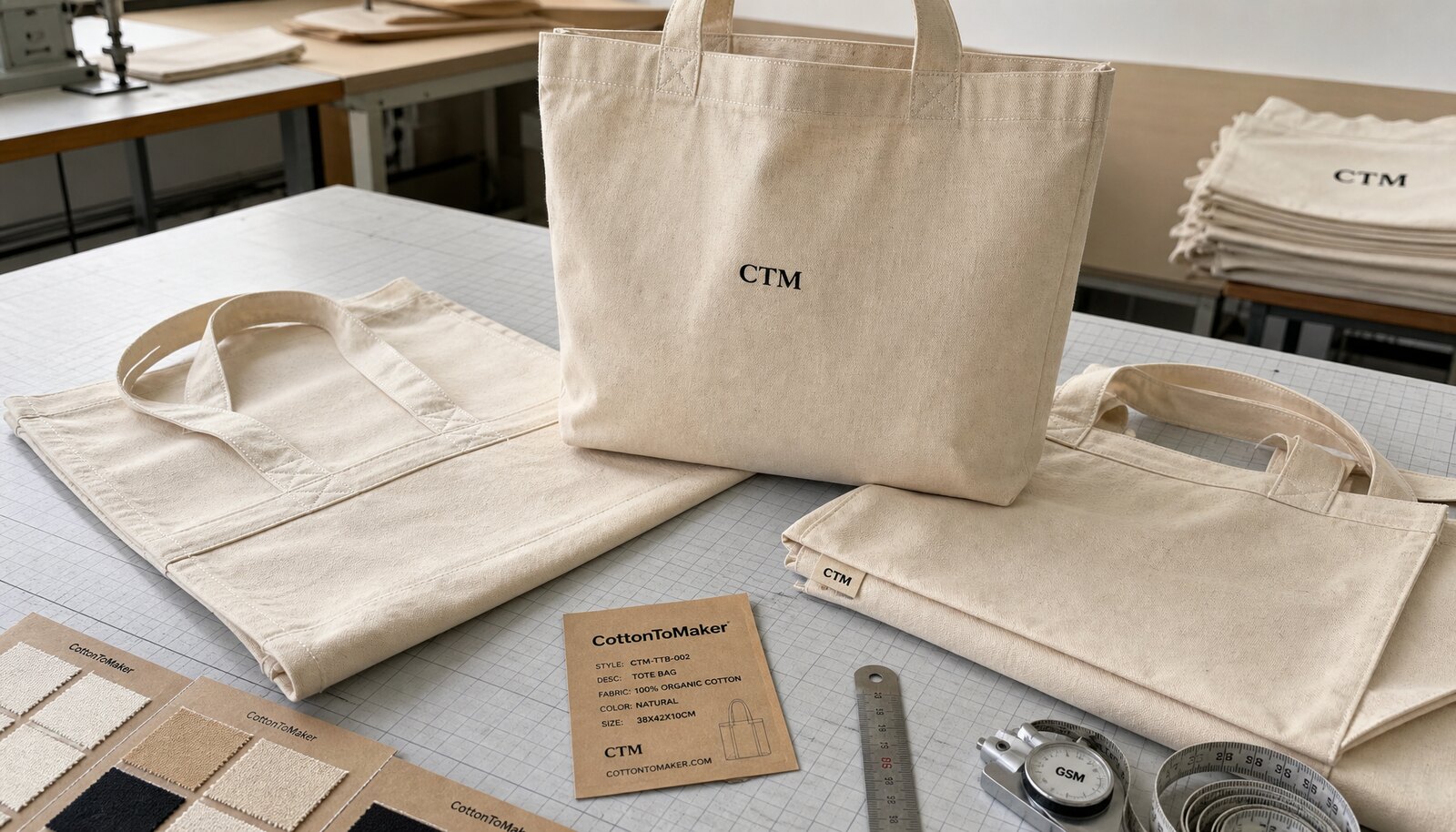
1. Frame the memo around the buying decision
A cost review memo for cotton totes should let finance, marketing, logistics, compliance, and quality approve the same sourcing decision without reworking the RFQ. The memo is not only a price comparison. It should prove that the suppliers quoted the same product, that the chosen tote fits the intended use, and that the cost basis includes the work needed to deliver the order correctly.
Start by naming the purchase context: quantity, use case, destination market, required delivery date, brand or campaign owner, and whether the tote will be given away, sold, packed with merchandise, or used in a retail channel. That context changes the right choice. A light tote may be acceptable for a one-day event bag. It may be a poor choice for books, bottled products, or paid merchandise.
The memo should also separate three decisions that often get blended together: material claim, construction level, and commercial offer. Natural unbleached cotton describes the look and processing state of the fabric. Certified organic cotton describes the agricultural and chain-of-custody claim. A low unit price is only meaningful once the material, construction, print, packing, documents, and inspection basis are clear.
- State the recommended supplier, quantity, Incoterm, currency, and quote validity date in the summary.
- Show whether the selected bag is conventional natural cotton or certified organic cotton.
- List the use case and expected load so quality and fabric weight decisions are anchored in function.
- Identify excluded or unconfirmed costs, such as setup, samples, labels, inspection, freight, duty, or retail packing.
- Record the approval logic: lowest compliant landed cost, fastest acceptable delivery, strongest documentation, or best balance of cost and risk.
2. Separate natural cotton from certified organic cotton
For the Organic Cotton Bags category, procurement language must be precise. A natural cotton tote is usually unbleached and undyed, with a cream or beige shade and visible cotton flecks. That does not make it organic. Certified organic cotton requires a recognized certification path and evidence that the cotton and handling process support the claim. Buyers should not allow suppliers to use natural, eco, organic-style, or cotton look as substitutes for certification.
If the organization needs a certified organic claim on the bag, label, product page, invoice, or marketing materials, the RFQ should state that requirement before pricing. Organic fabric availability, minimums, document lead time, segregation controls, and certification scope can affect cost. A supplier may be able to sew cotton totes but not hold the certification needed to sell or label them as organic.
The memo should clearly show which option is being approved. Conventional natural cotton may be the correct commercial choice when the goal is a simple unbleached cotton appearance without a marketing claim. Certified organic cotton is the correct choice when the claim itself carries brand, compliance, or customer value. Treating these as interchangeable creates audit risk and can lead to rework after artwork, labels, or product descriptions have already been approved.
- Use “natural unbleached conventional cotton” when no organic claim is required.
- Use “certified organic cotton” only when the supplier can provide certification evidence covering the relevant chain of custody.
- Ask for certification copies, scope certificates, transaction certificates or equivalent shipment traceability documents where applicable.
- Confirm whether labels, hangtags, carton marks, invoices, and packing lists need to reference the organic claim.
- Reject vague supplier wording such as “organic feel,” “eco cotton,” or “natural organic color” unless documentation supports the claim.
3. Lock the specification before comparing prices
Cotton tote quotes become unreliable when the RFQ says only “standard natural tote with logo.” Suppliers will fill gaps with their own stock pattern, fabric weight, handle length, stitch method, and packing style. Those assumptions may be reasonable individually, but they make the quote table misleading. The cost memo should restate the specification in operational terms so every price can be judged against the same product.
Use finished dimensions, not only cutting size. Finished width, height, gusset, handle drop, and handle width are what the buyer receives and what inspectors can measure. Include fabric weight in oz and GSM, construction details, print size, print position, packing method, carton quantity, and destination. If the tote must carry a known item, such as catalogs, apparel, gift boxes, or store purchases, include that load expectation.
Avoid relying on style adjectives. Economy, classic, premium, heavy duty, and canvas can mean different things across factories. A supplier calling a bag premium may be quoting 8 oz cotton, while another supplier may use the same word for 6 oz with better finishing. The memo should compare measurable details rather than labels.
- Finished size example: 38 cm W x 42 cm H, no gusset, 65 cm handle length, 2.5 cm handle width.
- Fabric example: natural unbleached cotton, 6 oz, approximately 180 to 200 GSM, plain weave, small cotton flecks accepted.
- Construction example: self-fabric handles with box-stitch or cross-stitch reinforcement at all handle joints.
- Print example: one-color black screen print, front only, 22 cm W x 18 cm H maximum, vector artwork supplied by buyer.
- Packing example: flat packed, 100 pcs per export carton, no individual polybag unless the retail channel requires it.
4. Build a reusable landed-cost model
The most useful procurement memo moves beyond FOB unit price. A supplier with the lowest product price may be more expensive after setup charges, sample fees, cartons, freight, duty, inspection, payment terms, and rework risk are included. The memo should show a landed-cost model that can be reused for future tote orders rather than a one-time price ranking.
A practical model starts with the supplier’s unit price and then adds known order-level charges. Screen setup, artwork adjustment, pre-production sample, custom label, hangtag, barcode sticker, individual packing, export carton upgrade, palletization, third-party inspection, and bank charges should be listed separately. Freight should use actual carton dimensions and gross weight whenever possible. If those numbers are missing, the memo should mark freight as an estimate and treat the missing carton data as a risk.
The model should also show the difference between first order and repeat order. First orders often include screen setup, sample development, and extra approval time. Repeat orders may remove setup charges if artwork remains unchanged, but fabric shade, organic documentation, and quote validity still need confirmation. This distinction helps procurement avoid rejecting a good repeat supplier because the first-order cost looked artificially high.
- Sample calculation structure: product unit price plus setup amortized per unit plus packing extras plus estimated freight plus duty and destination charges.
- Example cost drivers to isolate: GSM upgrade, second print color, larger print area, organic certification requirement, barcode label, and individual packing.
- Quantity scenario: compare 1,000, 3,000, and 5,000 pcs to see whether savings come from true production efficiency or only from spreading setup charges.
- Freight check: request carton dimensions, gross weight, and pieces per carton before final landed-cost approval.
- Approval note: show both first-order landed cost and expected repeat-order landed cost when setup or sampling charges do not repeat.
5. Compare fabric weight against function and freight
Fabric weight is usually the largest product cost driver in a cotton tote. Lighter cotton reduces material cost and shipment weight. Heavier cotton improves handfeel, durability, and perceived value. A strong memo does not automatically choose the heaviest option; it explains why the selected weight matches the intended use and budget.
Ask suppliers to quote fabric weight in both oz and GSM because markets use different conventions. As a practical reference, 5 oz cotton often falls around 140 to 150 GSM, 6 oz around 180 to 200 GSM, 8 oz around 240 to 270 GSM, and 10 oz around 300 to 340 GSM. These ranges are not a substitute for supplier confirmation. Weave, yarn, and finishing can change the final feel and measured weight.
The freight effect becomes more visible at volume. An 8 oz tote may only add a modest unit-price increase compared with 6 oz, but the shipment can weigh more, require stronger cartons, and reduce carton handling efficiency. For large orders, logistics should review gross weight, carton cube, and pallet plan before approval. Natural shade should also be approved by swatch because unbleached cotton can range from cream to light beige.
- 5 oz: suitable for light giveaways, brochure bags, and short-use promotions where cost is the main constraint.
- 6 oz: balanced choice for many corporate events, distributor programs, and everyday branded totes.
- 8 oz: better for retail merchandise, heavier kits, books, and programs where handfeel matters.
- 10 oz and above: appropriate for premium canvas-style totes, but review sewing bulk, print handfeel, and freight cost.
- For repeat orders, retain a fabric swatch and require new shade approval if the fabric lot changes.
6. Evaluate construction as a performance risk
A tote looks simple, but many complaints come from construction: handles pulling loose, uneven top hems, weak bottom seams, broken stitches, poor trimming, or fabric panels cut off grain. The cost memo should identify construction requirements that affect performance and appearance. This is where a slightly higher quote can be justified if the lower quote uses weaker sewing.
Handle details deserve careful review. The quote should state handle material, width, length, drop, and reinforcement method. Box-stitch and cross-stitch reinforcements are common, but factories may vary the reinforcement area, stitch density, and thread quality. If the bag will carry books, packaged goods, or store purchases, handle joints should be treated as a critical inspection area.
Stitch density and seam construction also affect cost. More stitches per inch can improve appearance and strength, but it increases sewing time. Overly loose stitching can make the bag look cheap and may fail under load. The memo does not need to become a sewing manual, but it should state measurable expectations and inspection points so the supplier cannot reduce quality invisibly to protect margin.
- Define handle drop by use: hand carry, shoulder carry, or mixed use.
- Require the same reinforcement method across suppliers when comparing quotes.
- Confirm side seam, bottom seam, top hem, seam allowance, stitch density target, and thread color.
- Reject broken stitches at handle joints, open seams, severe puckering, and untrimmed thread bundles as major defects.
- Use a defined load test instead of accepting “strong handle” as a specification.
7. Control print cost and artwork risk
Most natural and organic cotton tote programs use screen printing for solid logos and repeat orders. Screen printing is efficient, but cost changes with color count, print area, ink coverage, screen setup, and registration difficulty. A small one-color chest-style logo and a large multi-color panel print are not comparable, even if both are described as “logo print included.”
Natural cotton texture affects the result. Flecks, slubs, and uneven fabric absorption can influence edge sharpness and coverage. Water-based and pigment inks can work well, but heavy coverage may stiffen lighter fabrics. Heat transfer may support detailed graphics, yet it changes handfeel and may crack or crease if the bag is folded tightly. Digital printing can help with complex artwork, but color brightness on natural cotton needs sampling.
The memo should state what has been priced and what still needs approval. If marketing changes artwork after quote approval, the supplier may need to requote. Procurement can reduce this risk by attaching final vector artwork, Pantone or color references, placement measurements, and print tolerance to the RFQ and PO.
- Ask whether screen setup, ink mixing, strike-off, curing, and pre-production sample printing are included.
- Confirm print size, print position, number of colors, ink type, color reference, and acceptable placement tolerance.
- Test dry rub and damp rub when the bag may touch apparel, packaging, or light-colored goods.
- Fold the printed sample in the planned packing format to check cracking, blocking, and visible creasing.
- Keep approved artwork files, strike-offs, and placement measurements for repeat orders.
8. Vet suppliers, terms, and documentation
A complete quote should reveal more than price. It should show whether the supplier understands the product, can document the material claim, can meet the packing requirement, and can support inspection. Procurement should review factory role, production location, subcontracted steps, export experience, communication quality, quote completeness, and document capability before recommending award.
Supplier type matters. A direct sewing factory may control cutting and assembly but outsource printing or fabric purchasing. A trading company may coordinate multiple suppliers and provide stronger service for mixed programs, but the buyer should know who is responsible for defects and delays. Printing is often subcontracted, so quote approval should name who controls color matching, curing, strike-off approval, and rework if the print fails inspection.
Commercial terms also belong in the memo. Incoterm, payment terms, deposit requirement, quote validity, sample cost, lead time basis, and inspection responsibility can change the real risk of the order. EXW, FOB, FCA, CIF, and DDP assign different responsibilities. A low EXW price can lose its advantage once inland transport, export clearance, freight, duty, and destination delivery are added.
- Identify the supplier as factory, trading company, print shop, or sourcing agent.
- Record where fabric sourcing, cutting, sewing, printing, labeling, packing, and final inspection take place.
- Request Incoterm, currency, payment terms, quote validity date, sample lead time, production lead time, and shipment handover point.
- For organic orders, confirm certification scope before artwork or labels use the organic claim.
- Assign inspection booking, inspection cost, reinspection cost, and shipment release authority before issuing the PO.
9. Use samples as approval evidence
A physical sample is one of the lowest-cost controls in a tote program. It confirms handfeel, shade, finished size, handle drop, handle reinforcement, print appearance, seam quality, packing behavior, and overall presentation. A digital mockup can help approve layout direction, but it cannot prove fabric weight, stitching, shrinkage, ink behavior, or load performance.
Different samples answer different questions. A stock blank sample can show general construction and handfeel. A fabric swatch can approve natural shade and approximate weight. A print strike-off checks ink, artwork, and placement. A full pre-production sample is the strongest approval standard because it combines actual fabric, construction, print, labels, and packing. The memo should name which sample was reviewed and what remains open.
Sample approval should be documented, not handled by memory. Seal the approved pre-production sample in a reference bag or box with supplier name, date, PO number, fabric weight, print method, color reference, dimensions, and approver. Retain a duplicate swatch or strike-off when possible. This gives inspectors a practical standard and reduces subjective disputes during final inspection.
- Measure the sample using the same method planned for final inspection.
- Approve natural cotton flecks, slubs, and shade range before bulk cutting.
- Confirm label, hangtag, barcode, care label, and carton mark artwork against the final packing instruction.
- Do not release bulk production until pre-production sample, artwork, packing, carton details, and organic documents if required are approved in writing.
- Keep the sealed sample available for incoming inspection, final inspection, and reorder comparison.
10. Finish with QC criteria and a decision-ready recommendation
Quality criteria should be written before the PO. For cotton totes, a useful QC plan includes finished-size tolerance, handle drop tolerance, fabric weight tolerance, shade approval, print placement tolerance, stitch and seam requirements, load test expectation, packing count accuracy, and carton mark accuracy. If the buyer will use third-party inspection, the memo should reference the inspection level and AQL approach agreed with the supplier.
Defect classification makes decisions faster. Critical defects may include unsafe contamination, sharp objects, severe mold, or wrong product identity. Major defects may include wrong fabric, incorrect size outside tolerance, weak handle attachment, severe stains, misprinted logo, poor print adhesion, missing organic documentation for an organic claim, or wrong packing. Minor defects may include small loose threads, slight approved shade variation, or natural cotton flecks accepted in the sealed sample.
The final recommendation should be short and evidence-based. Instead of “Supplier B has the lowest price,” write why the chosen supplier is commercially compliant: correct fabric, approved sample, complete quote, acceptable Incoterm, realistic lead time, clear carton data, required documents, and workable QC process. If a cheaper offer is rejected, state the reason, such as lighter GSM, missing setup charges, incomplete certification, weak sample stitching, or unconfirmed lead time.
- Recommended supplier basis: compliant material claim, approved sample, complete landed-cost data, realistic delivery, and acceptable inspection plan.
- Accepted cost basis: unit price includes specified print, handle construction, standard export cartons, setup charges, and listed packing requirements.
- Risk ranking: high for missing organic documents or unapproved sample; medium for estimated freight or pending carton data; low for minor artwork placement adjustment before production.
- Cost reduction options: reduce GSM, print area, color count, handle length, or packing complexity only with brand-owner approval.
- PO condition: production starts after written approval of sample, artwork, packing instruction, carton details, QC criteria, and certification documents where required.
Specification comparison for buyers
| Buying scenario | Likely cost drivers | Freight and packing effect | Procurement decision note |
|---|---|---|---|
| 500 pcs, 6 oz natural cotton, one-color print | Higher unit price because setup, sampling, and handling are spread over fewer units; screen setup may be material to first-order cost | Often ships by courier or LCL; carton dimensions and gross weight still matter because bulky flat-packed bags can rate by volume | Use for pilot orders, urgent events, or sample market tests; do not benchmark this price against larger repeat runs |
| 1,000 pcs, 6 oz natural cotton, bulk packed | More competitive unit cost; fabric may come from stock if size and construction are standard | Bulk cartons reduce packing labor and material; confirm 50 or 100 pcs per carton and carton strength | Good minimum comparison point for many branded programs if lead time and carton data are complete |
| 3,000 pcs, 6 oz natural cotton, one-color print | Screen setup becomes less important per unit; cutting and sewing efficiency improves | LCL or consolidated freight may be economical; inland handling and carton cube can influence landed cost | Useful quantity for comparing suppliers because cost differences are less distorted by small-order fees |
| 5,000 pcs, 8 oz natural cotton, reinforced handles | Higher fabric consumption, more sewing bulk, and possible stronger needle/thread requirements | Higher gross weight and carton stress; confirm export carton grade, moisture protection, and pallet plan if needed | Choose when durability and brand feel justify the extra material and freight cost |
| 10,000 pcs, certified organic cotton tote | Organic fabric, certification handling, transaction documents, and traceability administration can add cost | Large runs need early carton and booking data; organic documentation must match shipment and invoice details | Use only when organic claim is required and documents can support marketing, compliance, and audit review |
| Natural unbleached conventional cotton | Lower processing complexity than dyed cotton; shade variation must be managed by swatch approval | No dye-lot matching, but natural shade can vary between fabric lots and reorders | Correct choice when the buyer wants the natural look without making an organic claim |
| Certified organic cotton | Requires valid certification scope, chain-of-custody evidence, and transaction certificate process where applicable | Documentation timing can affect shipment release and claim approval; keep organic goods separated and identified | Specify certification before quoting; do not upgrade a conventional quote after award without requoting |
| Screen print versus heat transfer | Screen print is efficient for solid one- or two-color artwork; transfer can help detailed graphics but changes handfeel | Heavy ink or transfer film may affect folding, carton rub, and perceived quality on lighter fabrics | Select by artwork, expected durability, and approved sample, not by print label alone |
| Bulk carton packing versus retail unit packing | Bulk packing reduces labor, labels, and material; retail packing adds barcode, hangtag, polybag or paper wrap, and inspection steps | Retail packing increases carton planning and receiving accuracy requirements; bulk packing can wrinkle more during transit | Quote both only if both channels are real; avoid paying for retail presentation on event giveaways |
Buyer checklist before sampling
- Define whether the requirement is natural unbleached conventional cotton, certified organic cotton, recycled cotton blend, or another material claim.
- Record finished tote dimensions: width, height, gusset, handle drop, handle length, handle width, and opening width.
- State fabric weight in both oz and approximate GSM, plus the accepted production tolerance and weighing method if critical.
- Identify the intended load: documents, apparel, boxed merchandise, books, retail purchases, or light event giveaways.
- Specify construction: handle material, reinforcement method, side seam, bottom seam, top hem, stitch density target, and thread color.
- Confirm print method, ink type, color count, artwork size, print placement, color reference, setup charges, and strike-off requirement.
- Separate conventional natural cotton approval from organic claim approval, including documents required before PO and before shipment.
- Ask for Incoterm, currency, quote validity, payment terms, MOQ, price breaks, sample charges, tooling or setup charges, and lead time basis.
- Request carton quantity, carton dimensions, gross weight, net weight, carton material, pallet plan if applicable, and packing photos before shipment.
- Define sample approval, sealed sample retention, AQL inspection level, defect classification, load test, and shipment release responsibility.
Factory quote questions to send
- Is the fabric natural unbleached conventional cotton, certified organic cotton, recycled cotton, or a blend, and what documentation supports that statement?
- For certified organic cotton, what certification standard applies, which company in the chain is certified, and can transaction certificates or equivalent traceability documents be provided for the shipment?
- What exact fabric weight is quoted in oz and GSM, and what mass-production tolerance will be accepted against the approved swatch?
- Where are fabric sourcing, cutting, sewing, printing, labeling, packing, and final inspection performed, and which steps are subcontracted?
- Is the price based on finished size or cutting size, and what finished-size tolerance is included after sewing and finishing?
- What handle length, handle drop, handle width, reinforcement stitch, stitch density, seam construction, and thread specification are included?
- Which print method, ink type, print area, number of colors, setup charges, curing process, and print tolerance are included in the quote?
- Can you quote 5 oz, 6 oz, 8 oz, and 10 oz options at 500, 1,000, 3,000, 5,000, and 10,000 pieces using the same finished size and print?
- What is the MOQ by fabric weight, organic certification requirement, size, print design, colorway, label, packing method, and shipment destination?
- What Incoterm, currency, payment terms, quote validity date, lead time basis, sample lead time, and production capacity are assumed?
Quality-control points to confirm
- Measure finished width, height, gusset, handle drop, handle width, opening width, and print placement against the sealed sample and PO tolerance.
- Check fabric weight against the approved swatch or buyer-defined GSM method; a common commercial tolerance should be agreed before production, not after inspection.
- Compare natural cotton shade under consistent lighting against the approved swatch, allowing normal flecks only if they were accepted during sample approval.
- For organic orders, verify product labels, carton marks, invoices, packing lists, and certification documents use consistent material and claim language.
- Inspect for holes, stains, oil marks, mold, severe slubs, contamination, mixed shade panels, sharp objects, and unacceptable creasing.
- Check seam allowance, stitch density, skipped stitches, broken stitches, loose threads, puckering, top hem straightness, and handle reinforcement at all four handle joints.
- Use a practical load test, such as hanging the approved target weight for a defined time, then checking handle joints, side seams, and bottom seam for tearing or stitch failure.
- Inspect print size, placement, registration, edge sharpness, pinholes, ink coverage, curing, cracking after folding, and dry or damp rub transfer risk where relevant.
- Verify labels, hangtags, barcode stickers, care labels, organic claim wording, customer markings, carton marks, and packing sequence against approved artwork.
- Apply an agreed AQL plan, commonly using critical, major, and minor defect classes, and define who can authorize shipment if defects require sorting or rework.