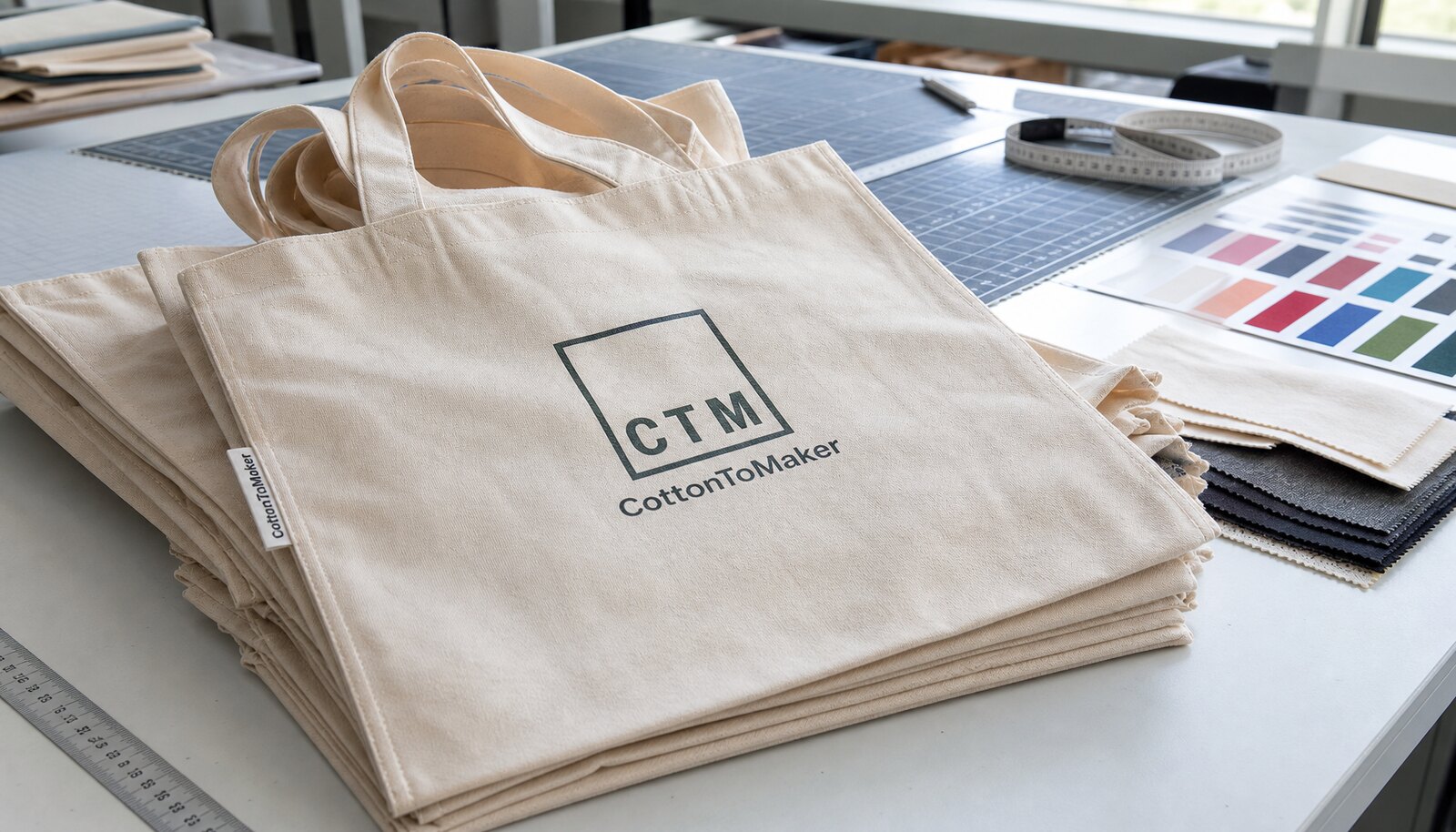
1. Start with the event load, not the lowest tote price
A natural cotton tote looks like a simple event item until it arrives at the venue and has to carry real contents. Procurement teams often receive a request that says only “natural cotton tote with logo,” but the correct material choice depends on what the bag will carry, how long it must last, how visible the brand will be, and how the bags will be packed and distributed. A tote for a one-day conference folder can be lighter than a tote intended for books, bottles, product samples, or resale after the event.
The first sourcing mistake is treating every natural cotton tote as the same commodity. A low-cost open-weave 130 GSM bag and a 200 GSM canvas-light tote may both be described as natural cotton, yet they behave differently in print, sewing, packing, and attendee perception. If the RFQ does not state the event load and service life, suppliers will protect their own cost assumptions. One may quote the thinnest workable fabric, another may quote a stronger construction, and the buyer ends up comparing numbers that do not describe the same product.
For event buyers, the practical starting point is a content list. Write down whether the tote will hold a badge packet, catalogs, notebook, apparel, cosmetics, a drink bottle, a boxed giveaway, or several sponsor inserts. Dense items matter more than bulky light items. A large but light T-shirt puts less stress on seams than a small hardback book. Once the load is known, the supplier can recommend a fabric weight, handle reinforcement, and seam type that fit the real job.
- For paper-only handouts, prioritize print clarity, clean folding, and low carton cost.
- For delegate kits, balance fabric strength, handle comfort, and consistent packing count.
- For product sampling events, check bottom seam strength and handle joins before approving bulk.
- For premium or reusable campaigns, move beyond GSM and review weave density, finishing, and hand feel.
- For sustainability-led events, confirm the material claim before marketing describes the bag as organic or recycled.
2. Cotton type: natural, organic, recycled, and what buyers can actually claim
The phrase natural cotton usually refers to the undyed or unbleached appearance of the bag, not automatically to organic farming, recycled content, or a certified supply chain. This distinction matters because event campaigns often use tote bags to communicate sustainability. If the bag will be promoted as organic cotton, procurement needs documentation that supports that claim. A natural beige color alone is not evidence of organic status.
Conventional natural cotton is usually the most accessible option for budget-driven event totes. It can still be a practical material when the buyer wants a reusable-looking bag without paying for additional certification requirements. Certified organic cotton is a better match when the brand or event has a responsible sourcing policy, but buyers should expect higher material cost, more paperwork, and sometimes stricter MOQ because certified inputs and handling must be controlled. Recycled cotton blends can support waste-reduction messaging, but they often have more visible texture, shade movement, or fiber inconsistency, so print testing becomes more important.
Supplier type changes how these claims are managed. A direct cut-and-sew factory may buy fabric from mills and rely on mill documents. A trader may coordinate multiple subcontractors and provide a consolidated quote but may need extra time to trace documents. A vertically integrated supplier may have better control over fabric, printing, and sewing, but still needs to show what is covered by certification. Event buyers should ask who owns each step: fabric sourcing, printing, sewing, packing, and documentation.
- Do not allow sales copy to say organic unless certification scope and transaction documents support it.
- Ask whether certification applies to fabric only or to finished bag production and handling.
- For recycled cotton, approve a physical shade band because recycled fiber blends can vary more than virgin cotton.
- For conventional natural cotton, define appearance standards such as acceptable seed flecks, slubs, and beige tone.
- Keep marketing language aligned with documented material facts to avoid claim risk.
3. GSM is useful, but weave density decides how the bag feels and prints
GSM is the fastest way to frame a tote specification, but it is not the whole specification. Two cotton fabrics can both be 160 GSM and still feel different if one uses a looser yarn and open weave while the other uses a tighter construction. The open fabric may drape softly and cost less, but it can distort during cutting and sewing, show more light through the panel, and break fine print edges. A tighter plain weave or canvas-light fabric usually improves logo presentation and perceived quality, even when the GSM number is similar.
For many event buyers, 140-160 GSM is the working range for standard giveaways. It is light enough to manage cost and freight, but not as fragile as very low GSM fabric. For a more substantial delegate bag or reusable branded tote, 180-220 GSM is often a better range. Above that, the bag may start to feel more like retail merchandise than a simple event handout. That can be exactly right for a paid product or premium activation, but excessive for a single-day conference where cartons must be moved quickly and freight cost is sensitive.
Shrinkage is often forgotten when buyers compare GSM. Unwashed cotton can shrink after laundering, steam pressing, or moisture exposure. If the tote is not marketed as washable, shrinkage may not be a major performance issue, but it can still affect print distortion and size consistency if fabric relaxes during production. When the program promotes reuse, ask for a simple shrinkage test on approved fabric. A realistic tolerance should be agreed before bulk cutting, not after the buyer sees shorter bags in the carton.
- 120-130 GSM: lowest cost area, but check transparency, seam strength, and print show-through.
- 140-160 GSM: common event giveaway range for light to moderate contents.
- 180-220 GSM: stronger hand feel and better structure for delegate kits or brand campaigns.
- 240 GSM and above: useful for retail-style totes but increases material cost, sewing bulk, and freight.
- Always approve the physical fabric swatch because GSM alone does not define weave, softness, opacity, or print surface.
4. Finishing, shade, and the reality of natural cotton appearance
Natural cotton is not a perfectly uniform white material. Depending on fiber, yarn, washing, and finishing, the final bag may show seed flecks, tiny dark specks, slubs, or beige shade variation. Some buyers like this because it signals a natural product. Others are surprised when bags do not look identical to a clean digital mockup. The right approach is to define the acceptable appearance range before production.
Finishing affects price and consistency. Unbleached natural cotton keeps the raw beige look and is common in event totes. Bleached cotton gives a cleaner base but changes the environmental and visual story. Washed or pre-shrunk fabric can improve hand feel and reduce later shrinkage, but adds process cost and may make the tote softer or more wrinkled. A calendered or smoother finish can help print sharpness, while a rougher surface may suit a rustic event aesthetic but reduce fine-line print clarity.
Shade banding is a procurement issue, not only a design issue. If the supplier cuts panels from different fabric rolls, bags within the same shipment may vary. Slight natural variation can be acceptable, but visible light/dark bands on the front panel or mixed shades in the same carton may be rejected by a brand team. Ask for an approved shade range using physical swatches or controlled photos, and instruct the supplier whether rolls should be separated by carton, by batch, or mixed only within an approved tolerance.
- Define whether seed flecks are acceptable as part of the natural cotton look.
- Reject oil marks, mildew odor, excessive stains, holes, and foreign fiber contamination even if minor slubs are accepted.
- Use a shade band for natural cotton instead of relying on one perfect sample.
- If the tote will have a pale logo, test whether the natural beige ground changes the perceived print color.
- For multi-location events, keep shade batches organized so one venue does not receive noticeably different-looking bags.
5. Construction choices that change both cost and failure rate
Tote construction is where suppliers can quietly reduce cost if the RFQ is vague. A bag may keep the same front-panel artwork but change handle width, stitch density, bottom seam, top hem depth, or reinforcement. These differences may not be visible in a quotation summary, yet they decide whether the bag survives use. Event buyers should specify construction in plain language and attach a simple drawing or approved sample whenever possible.
Handles deserve special attention. The buyer should state either total loop length or handle drop, because factories may interpret shoulder carry differently. A handle drop around 25-30 cm is often comfortable for shoulder carry, but the final choice depends on body size and target use. Narrow handles reduce fabric consumption but can dig into the hand under load. Wider handles or webbing handles improve comfort but may change the appearance and unit cost. Handle joins should be reinforced with box stitching, bartacks, or another agreed method when the bag carries more than light paper.
The body construction also matters. A flat tote is economical and works well for simple brochures. A bottom gusset or side gusset increases usable volume but adds sewing time and measurement points. A turned top hem looks cleaner and reduces fraying risk. Bottom seam reinforcement becomes important for dense items such as books, drink bottles, or product boxes. If the event kit is known in advance, load a sample bag and hang it for a short period before mass approval. It is a basic check, but it catches many weak handle or seam interpretations.
- State finished body width and height, not only approximate bag size.
- Specify handle width, handle drop, stitch pattern, and reinforcement.
- Set stitch density expectation for functional seams, such as stitches per inch or stitches per centimeter if your QC team uses that measurement.
- Define whether thread should match natural cotton, match the print, or contrast intentionally.
- Use a sewn pre-production sample as the construction reference, not a flat artwork proof.
6. Print method selection: match artwork, fabric surface, and order economics
Printing is often the biggest visible quality risk on a natural cotton tote. Screen print remains a practical choice for event quantities with one or two solid logo colors. It can be cost-effective at scale and gives a familiar promotional look. However, each extra color adds setup, registration control, and inspection risk. A fine sponsor lockup with small text may not print cleanly on an open-weave cotton base, even if the digital proof looks perfect.
Digital printing and heat transfer have their place. Digital print can handle more colors, gradients, or shorter runs, but the result depends on fabric pretreatment, surface smoothness, and color management. Heat transfer can reproduce detailed graphics and work for urgent smaller orders, but buyers should evaluate hand feel, edge lift, and cracking along fold lines. Embroidery can feel premium for a small mark or side detail, but it is usually not the most efficient method for a large front-panel event logo.
The safest approval path is a strike-off on the actual fabric. Do not approve a print only from a screen image or paper proof. Cotton absorbs ink, texture breaks edges, and natural beige ground changes color perception. The strike-off should be checked after curing, after folding, and after reasonable handling. If the event tote will be reused or washed, add rub and wash tests. For a one-day giveaway, a dry rub and visual curing check may be enough, but the requirement should be written.
- Use screen print for bold artwork, simple color count, and medium-to-large quantities.
- Use digital print when artwork complexity outweighs setup efficiency.
- Use heat transfer only after checking adhesion, edge lift, hand feel, and fold cracking.
- Avoid very small reversed text on rough natural cotton unless the supplier proves it in a strike-off.
- Require print placement tolerance, such as centered within an agreed millimeter range from the bag edges or top opening.
7. How supplier type and sourcing region affect the quote you receive
Quote variation is not always margin. It often comes from supplier structure. A sewing factory that buys fabric locally may quote aggressively on basic construction but outsource printing. A print specialist may provide excellent logo control but subcontract sewing. A trading company may be easier for documentation, consolidation, and communication, but the buyer should still know which factories perform critical steps. When a tote has a sustainability claim or tight event deadline, hidden subcontracting can become a risk if responsibilities are unclear.
Sourcing region also influences cost structure. Some regions have stronger access to cotton fabric, while others may be better at low-MOQ promotional sewing or faster print turnaround. Local suppliers near the event may reduce freight risk and allow easier sample review, but unit cost may be higher. Overseas suppliers may offer stronger unit pricing at volume, but buyers must account for sample transit, production buffer, customs, carton durability, and final-mile delivery to the venue or kit packer. The lowest unit price can lose its advantage if cartons arrive late or require repacking.
Procurement should ask different questions depending on supplier type. With a direct factory, ask about machine capacity, fabric booking, inline QC, and print subcontractor control. With a trader, ask for transparency on production sites, inspection responsibility, and document ownership. With a local distributor, ask whether the quoted bag is stock, made-to-order, or imported on demand. Each model can work, but each has different risk points.
- Direct factory: stronger production control, but verify print and documentation capability.
- Trader or sourcing agent: useful coordination, but require clear subcontractor responsibility and approved samples.
- Local distributor: good for urgent timelines, but confirm whether material and construction can be customized.
- Print shop with sewing partner: strong artwork control, but inspect seam and handle construction carefully.
- For certified organic cotton, ask who holds certification and how finished goods are traced through production.
8. Building an RFQ that lets procurement compare line by line
A strong RFQ prevents the classic problem of receiving five prices for five different bags. The RFQ should include finished dimensions, GSM, cotton type, weave preference, handle construction, print artwork, print method, label details, packing, carton marks, quantity breaks, sample requirements, QC acceptance points, and shipment destination. It does not need to be complicated, but it must remove the assumptions that normally hide in tote pricing.
Quantity breaks are important because tote cost does not move evenly. Fabric buying, screen setup, sewing line efficiency, packing labor, and carton configuration all respond differently to order size. A second print color may add more than ink cost because it increases registration time and risk. A woven label may require a separate MOQ. Individual polybags may add labor and material cost while also increasing carton volume. Asking for separate lines helps procurement understand what drives price and what can be changed if the budget is tight.
Sampling should also be quoted separately. A blank swatch proves fabric. A print strike-off proves the artwork on the chosen material. A sewn pre-production sample proves size, construction, handle, and overall appearance. If the supplier charges for samples, that is not necessarily a problem. It may be better than receiving a free but non-representative sample. The buyer should ask whether sample charges are refundable, whether courier cost is included, and whether revised samples are charged again.
- Ask for pricing at realistic event quantities, such as 500, 1,000, 2,500, 5,000, and 10,000 pieces if relevant.
- Require one quote version with the exact target spec and one value-engineered option only if the supplier clearly marks the differences.
- Separate screen/setup charges, label charges, special packing charges, and certification/document charges.
- Ask for lead time by milestone: swatch, strike-off, pre-production sample, fabric booking, production, inspection, and freight-ready date.
- Keep every supplier on the same print size, print location, GSM, and packing instruction before comparing unit prices.
9. QC acceptance criteria: make the standard measurable
QC language must be more specific than “good quality.” A factory may reasonably pass a tote that your event team rejects if the standard was not defined. For natural cotton totes, measurable QC should cover fabric, dimensions, stitching, print, appearance, packing, and documentation. The exact thresholds can vary by program, but they should be agreed before production starts and repeated on the purchase order or inspection checklist.
Fabric checks should include GSM tolerance, shade range, odor, holes, stains, and unacceptable contamination. For natural cotton, minor flecks may be normal, but oil marks and mildew odor are not. Shrinkage should be tested if the tote is sold or promoted as reusable or washable. A buyer may set a shrinkage tolerance such as within 3-5 percent after the agreed wash method, depending on the fabric and finish. The key is not the exact number alone; it is agreeing on the test method and acceptance before cutting bulk fabric.
Construction QC should focus on functional failure points. Handle joins should be tested with a load appropriate to the event contents. If the bag will hold a 3 kg kit, the test should reflect that reality with a reasonable safety margin. Seam pull or hanging-load checks can reveal weak stitching, fabric tearing, or handle creep. Print QC should include color target, opacity, registration, print placement, dry rub, wet rub where relevant, and curing. Packing QC should include carton count, folded size, carton marks, and whether bags are clean enough to hand to attendees without extra handling.
- Suggested measurement tolerance: agree limits for width, height, gusset, handle drop, and print placement in millimeters or centimeters.
- Suggested GSM tolerance: write the accepted range, often plus or minus 5 percent unless the project requires tighter control.
- Suggested shade control: approve a physical shade band and define when shade banding on front panels becomes a defect.
- Suggested seam check: inspect handle joins, side seams, top hem, and bottom seam for skipped stitches, open seams, and thread breaks.
- Suggested print check: verify dry rub resistance, curing, registration, opacity, edge clarity, and print location against the strike-off.
- Suggested packing check: open cartons randomly, count pieces, check fold direction, and compare carton labels with the event SKU list.
10. Packing, freight, and event receiving are part of material selection
Packing should be decided while the material is selected, not after production finishes. Heavier GSM fabric increases carton weight and may reduce pieces per carton. A gusseted tote takes more space than a flat tote. Individual polybags improve presentation but add packing labor, waste, and carton volume. These details affect freight cost, warehouse handling, and the speed of event kit assembly. A buyer who approves a premium heavy tote without asking for packed dimensions may be surprised by the logistics cost.
Event receiving is time-sensitive. Cartons may go directly to a venue, a kit packer, a regional distributor, or a brand warehouse. Each destination has different needs. A venue delivery may need clear event code labels and manageable carton weights. A kit packer may need bags folded in the same direction so staff can insert materials quickly. A retail activation may need individual packaging, barcode labels, or presentation folds. If cartons must be split by city or by sponsor kit, that instruction should be in the quote because it changes labor and labeling.
The final approval package should include the signed spec sheet, approved fabric swatch, print strike-off, pre-production sample, carton packing instruction, and inspection checklist. This is the buyer’s protection when the schedule tightens. Event tote orders often run on fixed dates; there is no value in a cheaper bag that arrives late, arrives dirty, or requires repacking the night before opening. A procurement-grade natural cotton tote specification reduces rework, makes prices comparable, and gives the event team a bag that performs as intended.
- Request packed carton dimensions and gross weight before final cost approval.
- Set maximum carton weight if event staff or kit packers will manually handle cartons.
- Use carton marks that include event name, SKU, quantity, color, print version, and carton number.
- Confirm whether cartons must be palletized, mixed, split by destination, or kept as single-SKU cartons.
- Inspect cartons for crush, moisture, and count accuracy before shipment or immediately on arrival.
Specification comparison for buyers
| Spec decision | Common options | Best fit for event buyers | Practical tradeoff | QC or quote point to lock |
|---|---|---|---|---|
| Cotton type | Conventional natural cotton | Budget-sensitive conferences, trade shows, one-time giveaways | Usually easiest to source and price, but sustainability claims are limited unless separately documented | Do not describe as organic unless valid certification and transaction documentation are available |
| Cotton type | Organic cotton, natural color | Brand, NGO, education, wellness, and sustainability-led events | Higher material cost and sometimes tighter MOQ, but stronger alignment with responsible sourcing programs | Request certification scope, fabric composition, and whether finished bag handling is covered by the supplier's chain-of-custody process |
| Cotton type | Recycled cotton blend | Programs prioritizing waste reduction or textured natural look | Can have more shade variation, shorter fibers, and a slightly rougher hand feel depending on blend | Approve shade band, fiber blend, and print strike-off because recycled content can affect opacity and surface consistency |
| Fabric weight | 120-130 GSM plain cotton | Very light handouts with flyers only, where lowest unit cost matters | Thin, more transparent, less structured, and less forgiving for dark or large prints | Set maximum load expectation and inspect for print show-through and seam distortion |
| Fabric weight | 140-160 GSM cotton | Standard event giveaway, registration bag, delegate kit with light inserts | Good cost-to-utility range, but still not ideal for heavy bottles, books, or boxed samples | Use sewn sample load check and require GSM tolerance, commonly plus or minus 5 percent unless otherwise agreed |
| Fabric weight | 180-220 GSM cotton canvas-light | Reusable event tote, premium delegate bag, retail-facing activation | Better hand feel and print base, higher raw material cost, slightly heavier freight, sometimes higher MOQ | Confirm shrinkage, stitch density, handle reinforcement, and packed carton weight before PO |
| Fabric weight | 240 GSM and above | Retail merchandise, heavier product carry, high-retention campaign bags | Strong presence but may be overbuilt for simple events; folding bulk and freight increase | Check needle marks, seam bulk, print cracking on folds, and whether the sewing line can maintain consistent top hems |
| Weave density | Open plain weave | Low-cost soft tote with light structure | Lower price, softer drape, but more distortion and lower print edge definition | Ask for thread count or approved swatch and reject excessive slubs, holes, or skewed panels |
| Weave density | Tighter plain weave or canvas-light | Cleaner print area and better body without moving into heavy canvas | Costs more than open weave but improves perceived quality and reduces logo breakup | Approve actual roll fabric, not only GSM, because equal GSM can feel different if yarn and weave differ |
Buyer checklist before sampling
- Write the event use case first: giveaway, delegate kit, retail activation, sponsor gift, merchandise, or product carry bag.
- List actual contents and estimated loaded weight, including dense items such as books, water bottles, boxed samples, electronics, or catalogs.
- Choose the cotton claim carefully: conventional natural cotton, certified organic cotton, recycled cotton blend, or another documented material.
- Define body size as finished dimensions after sewing, not cutting dimensions, and include acceptable tolerance for width, height, gusset, and handle length.
- Select a GSM range and approve a physical swatch; do not compare quotes where one supplier uses 140 GSM and another uses 180 GSM.
- Ask for weave and finishing details: plain weave, canvas-light, washed, unwashed, pre-shrunk, bleached, unbleached, or dyed.
- Confirm whether natural shade variation, seed flecks, slubs, and minor cotton specks are acceptable and define the rejection line for visible panels.
- Specify handle width, total loop length or handle drop, attachment method, stitch pattern, and reinforcement requirement.
- State top hem, side seam, bottom seam, and gusset construction in the RFQ so suppliers do not reduce cost by simplifying sewing.
- Provide print artwork size, Pantone or color target, number of print locations, number of colors, and whether print must be centered to panel, seam, or bag opening.
Factory quote questions to send
- Are you quoting conventional natural cotton, certified organic cotton, recycled cotton blend, or another fabric, and what documentation supports that material description?
- Is your company the cut-and-sew factory, the printing facility, a trader coordinating subcontractors, or a vertically integrated supplier handling fabric, print, sewing, and packing?
- What exact GSM, yarn count if available, weave type, and finishing process are included in this price?
- Is the fabric greige, unbleached natural, bleached, dyed, washed, or pre-shrunk, and how does that affect shade, shrinkage, and cost?
- What is your normal GSM tolerance and how do you verify it during incoming fabric inspection?
- What shrinkage should we expect after washing or steam exposure, and can you test the approved fabric before bulk cutting?
- What bag size, handle drop, handle width, top hem, seam type, stitch density, and reinforcement are included in the quoted construction?
- What maximum practical load do you recommend for this construction, and what seam or handle pull test can you perform?
- Which print method are you pricing, how many colors and locations are included, and are screen/setup charges separate or included?
- Can you produce a strike-off on the actual bulk fabric and test it for dry rub, wet rub where relevant, wash resistance, and fold cracking?
Quality-control points to confirm
- Incoming fabric GSM checked against approved specification, commonly with a written tolerance such as plus or minus 5 percent unless the buyer sets another standard.
- Fabric width, roll shade, weave defects, holes, oil marks, odor, moisture, excessive slubs, and visible contamination checked before cutting.
- Natural color shade controlled by approved shade band; avoid mixing noticeably different rolls on the same visible bag panel or within the same carton if shade variation is material to the brand.
- Shrinkage tested on approved fabric when relevant, with tolerance written in advance, for example within 3-5 percent after agreed wash or steam test depending on fabric and finish.
- Finished body width, height, gusset, handle drop, handle width, and print position measured against the signed pre-production sample and tolerance chart.
- Stitch density verified on top hem, side seams, bottom seam, and handle attachment; no skipped stitches, open seams, broken thread, or loose bartacks on functional areas.
- Handle attachment checked by pull or load test appropriate to the intended contents; reject seam tearing, fabric creep, or handle distortion beyond agreed limit.
- Seam strength reviewed at side seam and bottom seam, especially for bags carrying books, bottles, boxed samples, or delegate kits with dense contents.
- Print color, opacity, registration, edge clarity, placement, curing, and surface hand feel matched to approved strike-off under consistent lighting.
- Dry rub test performed for printed areas, especially dark inks on natural cotton; wet rub or wash test added when the bag is promoted as reusable or washable.