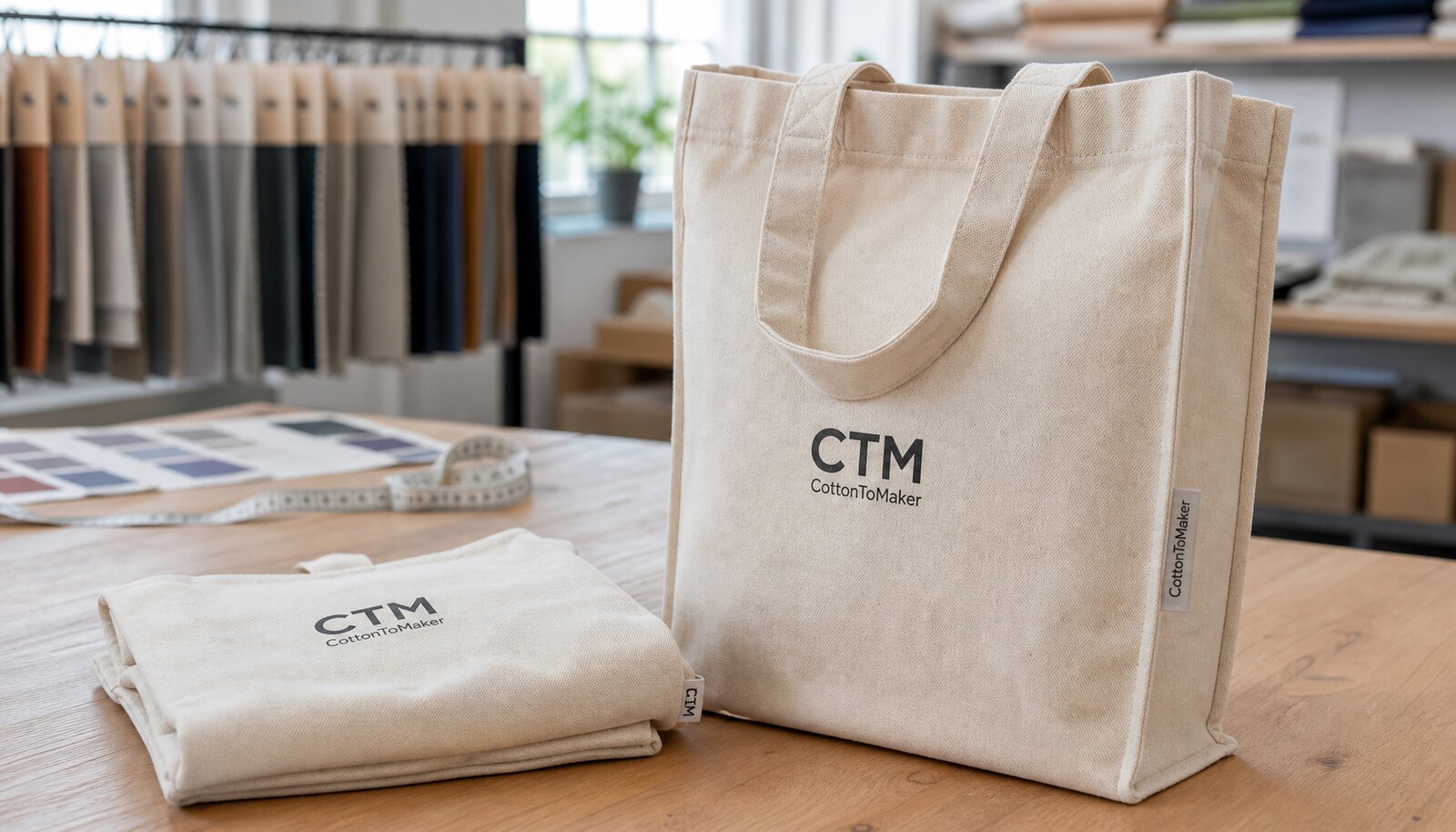
1. What this audit should prevent
A natural cotton tote looks simple, but corporate buying teams usually discover problems late: the fabric feels lighter than the approved sample, the logo prints dull on the off-white base, handles distort under load, carton labels are wrong, or the supplier cannot support an organic claim after the purchase order is issued. A supplier audit checklist should prevent those issues before price approval, not after goods are packed and the event date is fixed.
For procurement teams, the audit is not only a compliance exercise. It is a way to make every supplier quote the same construction, fabric, artwork, packing, lead time, and documentation assumptions. If three factories quote “natural cotton tote 38 x 42 cm” without GSM, handle drop, print size, packing method, Incoterm, and certification scope, the lowest unit price may simply be missing important cost drivers.
Use the checklist to separate acceptable suppliers from suppliers who only provide fast pricing. A reliable supplier should be able to explain what is made in-house, what is subcontracted, how materials are checked, how print color is approved, how cartons are labeled, and what evidence will be available before shipment.
- Use the audit to compare process control, documentation quality, and landed-cost assumptions, not only unit price.
- Treat natural cotton, certified organic cotton, recycled cotton, and cotton blends as different sourcing options with different evidence requirements.
- Ask for measurable specifications before requesting final commercial approval.
- Check whether the supplier understands corporate distribution needs such as event kits, employee onboarding, retail hangtags, barcode labels, or multi-office delivery.
- Do not approve a supplier that cannot provide a complete quote, sample plan, inspection plan, and documentation plan for the exact order.
2. Define the tote’s job before asking for price
A procurement team should define the usage scenario before auditing suppliers. A one-day conference tote can use lighter fabric, simpler screen print, and bulk packing. An employee welcome tote, retail resale tote, or premium client gift needs stronger handles, cleaner sewing, more controlled branding, and better packing. Without this usage definition, factories tend to quote a generic giveaway bag that may not match the buyer’s brand risk.
The specification should state carried load, distribution channel, expected reuse, artwork importance, and any sustainability or organic claim. For example, an A4-friendly tote carrying brochures has different acceptance criteria from a retail tote carrying packaged goods. The first may prioritize cost and legible print; the second may require heavier GSM, a hangtag, barcode label, consistent fold, cleaner thread trimming, and stricter appearance grading.
This step also prevents over-specification. Not every corporate tote needs heavy canvas, individual polybags, or premium labeling. If the tote is used only for internal event materials, bulk packing and a standard natural cotton body may be enough. If it will be photographed, resold, or distributed to senior clients, the audit should move closer to a retail-quality standard.
- Corporate event bag: often 5–6 oz / 170–200 GSM, simple screen print, standard size, bulk packed.
- Employee welcome tote: usually 6–8 oz / 200–270 GSM, reinforced handles, cleaner finishing, controlled folding.
- Retail or distributor tote: often 8 oz and above, stricter visual standard, hangtag, barcode, unit packing, and carton sorting.
- Premium branded tote: may require heavier canvas, gusset, inner pocket, custom woven label, upgraded print, or more detailed inspection.
- Organic cotton tote: requires documentation control, approved claim wording, and clear separation from ordinary natural cotton in quoting and labeling.
3. Audit cotton type, organic evidence, and fabric control
Fabric is the largest technical cost driver in a natural cotton tote. Suppliers may quote by ounce, GSM, yarn count, or a loose description such as “6 oz cotton.” For proper comparison, ask for both ounce and GSM, the weave type, and whether the fabric is natural unbleached cotton, certified organic cotton, recycled cotton, conventional cotton, or a blend. Natural cotton usually has a warmer off-white color and visible seed flecks; bleached cotton looks cleaner but is not the same material story.
For the Organic Cotton Bags category, the difference between natural and organic must be controlled carefully. Natural cotton describes appearance and processing level; organic cotton describes how cotton is grown and processed under a certification system. A natural-looking cotton tote is not automatically organic. If the corporate buyer will make an organic claim on packaging, a website, retail tag, or ESG report, the supplier must provide evidence that covers the material and the relevant production chain.
The audit should also check fabric consistency. A sample can be made from leftover higher-grade cloth while bulk production uses different stock. Request a current bulk fabric swatch and ask for GSM tolerance in writing. A small GSM reduction can affect hand feel, print opacity, shrinkage, and handle strength. Keep the approved fabric swatch attached to the sealed sample so inspection has a physical reference.
- Ask whether the fabric is greige, washed, pre-shrunk, bleached, dyed, or otherwise finished.
- Request actual GSM tolerance, not only a target number such as “200 GSM.”
- For organic cotton, request certificate scope, supplier name, facility coverage, material description, validity date, and order-level transaction evidence where applicable.
- Match organic claim wording across quotation, PO, invoice, hangtag, carton mark, and buyer marketing copy.
- Confirm whether any non-cotton components are used, such as polyester thread, synthetic labels, transfer film, or non-cotton drawstring parts.
- Keep approved fabric swatch, shade reference, and sealed sample available for final inspection.
4. Verify construction details that affect failure rate
Most tote failures happen at handles, side seams, bottom corners, and print areas near folds. During supplier audit, ask how the factory controls stitch density, seam allowance, thread quality, handle reinforcement, and trimming. A tote may look acceptable in a photo but fail when loaded with catalogs, sample packs, water bottles, or retail products. Handle reinforcement is especially important because the bag becomes a moving advertisement for the buyer’s brand.
Finished dimensions must be defined after sewing and pressing. If the buyer states 38 x 42 cm but the factory measures cut panels before seam allowance, the shipped bag can be smaller than expected. Even a 1–2 cm difference can create problems when the tote must fit a folder, gift box, product insert, or retail display. State whether the measurement includes gusset depth and how handle drop is measured.
Construction should be reviewed on a real sample, not only a flat technical drawing. Check whether the handle width is comfortable, whether seams twist after light loading, whether the opening is even, and whether the bag stands or folds as required. If the tote is intended for heavier reuse, ask the factory to show how handle joints are reinforced and how internal seams are finished.
- Specify finished width, height, gusset, handle length, handle drop, and acceptable tolerance.
- Define measurement after sewing and pressing; do not accept only cut-panel measurements.
- Request cross-stitch, box stitch, or bar-tack reinforcement where load carrying is important.
- Check stitch density on side seams and handle joints, not only external appearance.
- Confirm whether seams are overlocked, folded, bound, or left with raw internal edges.
- Ask the supplier to state thread type, stitch count range, and inspection method for broken or skipped stitches.
5. Match print method to artwork and cotton surface
Screen printing is usually the most reliable option for corporate logos on natural cotton totes when the artwork uses one to three solid colors. It can deliver a clean result, works well for repeat orders, and is practical for medium and large quantities. However, the audit should confirm screen setup, ink type, curing method, print position tolerance, and whether the factory can hold the required brand color on natural cotton, which is warmer and more textured than white fabric.
Heat transfer or digital transfer may be suitable for gradients, small details, or many-color artwork, but it creates different risks: film edge feel, cracking, gloss mismatch, and rub or wash performance. Embroidery can suit premium corporate programs but adds cost, weight, and potential puckering on lighter fabric. The supplier should explain the trade-off between logo detail, durability, hand feel, and cost, instead of choosing the print method only because it is convenient for production.
Corporate buyers should approve printed color on the actual fabric, not only on a digital mockup. Natural cotton seed flecks and uneven texture can show through ink. Large solid logos may need heavier ink deposit and proper curing. If the bag will be folded with the logo facing outward, test whether the fold creates a permanent mark or causes ink transfer.
- Send vector artwork with Pantone references, print size, print side, and placement distance from seams.
- Require a printed strike-off or pre-production sample for new artwork, new fabric, or a new supplier.
- Check ink coverage on natural cotton because seed flecks and surface texture can affect logo clarity.
- Ask for dry and wet rub checks for dark, large, or high-contrast prints.
- Confirm setup charges, screen charges, transfer charges, and reorder costs separately from bag unit price.
- State print-position tolerance, such as acceptable movement from center line, before bulk printing begins.
6. Understand MOQ and quote structure before judging price
MOQ for a natural cotton tote is not one number. A factory may have one MOQ for stock fabric, another for custom fabric weaving, another for custom printing, another for organic cotton procurement, and another for woven labels, hangtags, barcode labels, or special packing. A low MOQ can be realistic for a simple printed stock-size tote, but not for a custom GSM, custom dyed fabric, certified organic material, private woven label, individual barcode, and multi-SKU packing requirement.
Corporate buyers should ask which part of the order creates the MOQ. If the supplier says 500 pieces, confirm whether that includes custom logo printing, final packing, and any organic documentation cost. If a distributor needs 300 pieces per branch across multiple logo versions, total order quantity is not the only issue; print setup, color changes, carton sorting, and packing-list accuracy may drive cost and lead time.
A complete quote should make landed-cost comparison possible. Ask for unit price, setup cost, sample cost, packing cost, carton data, lead time, payment terms, quote validity, and Incoterm. Without carton quantity, carton dimensions, gross weight, and CBM, freight planning remains uncertain. Without clear Incoterm, suppliers may appear cheaper because local export or inland costs are excluded.
- Separate MOQ for blank tote, printed tote, custom size, custom fabric, organic cotton material, custom label, hangtag, and custom packing.
- Ask whether mixed artwork versions can share the same fabric production run and whether each version has a print setup charge.
- Check if the factory charges extra for split delivery, branch-level carton marks, barcode labels, or assorted packing.
- For repeat orders, ask whether screens, dies, labels, and artwork files are stored and for how long.
- Compare unit price together with setup charges, sample fees, packing charges, inland charges, and Incoterm.
- Require written confirmation of lead time after sample approval, not only after deposit payment.
7. Treat sample approval as the production contract
A sample is not only a sales tool. For corporate procurement, it becomes the physical reference for bulk production and final inspection. Best practice is to approve a pre-production sample that includes final fabric, final finished size, final handle construction, final print, final label, final fold, and final packing method. Stock samples are useful for judging workmanship, but they should not be used as final approval when the bulk specification is different.
Sample approval should be staged for important or first-time orders. Start with a fabric swatch to approve shade, hand feel, GSM, and organic documentation if needed. Then approve a printed strike-off to confirm artwork, color, curing, and print texture. Finally approve a sewn pre-production sample that shows construction, labels, packing, and carton mark assumptions. This sequence reduces the chance that the buyer approves a beautiful logo on the wrong fabric or a correct fabric with the wrong handle.
When reviewing samples, load the tote with realistic contents, check handle comfort, fold it as it will be packed, and inspect whether the print cracks, sticks, or transfers. Natural cotton can wrinkle and show creases, so packing should be approved with the product. If the bag will go into a gift kit, test the actual insertion process before bulk production.
- Approve fabric swatch, printed strike-off, and sewn pre-production sample in sequence for high-risk orders.
- Mark the approved sample with date, version number, specification number, and written buyer approval.
- Keep one sealed sample with the supplier and one with the buyer, agent, or inspection company.
- Confirm whether sample lead time includes artwork adjustment, material preparation, print curing, and sample shipping.
- Reject vague approvals such as “similar to sample” when corporate branding, organic claim, or retail quality matters.
- Update the PO if the approved sample changes GSM, size, print method, handle, label, or packing.
8. Dedicated supplier audit: evidence, capacity, subcontractors, and corrective action
A supplier audit for corporate tote procurement should go beyond product photos and price negotiation. Before PO approval, the buyer should confirm that the factory can document its business identity, production capacity, process controls, certification evidence, inspection records, and corrective-action handling. This is especially important for organic cotton totes because documentation must support the material claim as well as the physical product.
Start with basic documentation. Request the factory business license or registration, export capability where relevant, product scope, factory address, equipment list, key process flow, and recent internal QC records. For certified organic cotton, check that certificates cover the correct company, material, process, and period. A certificate shown in a sales presentation is not enough if it belongs to a different company, expired facility, or upstream mill only.
Capacity should be tested with practical questions. Ask how many tote bags the factory can cut, print, sew, trim, and pack per day for your construction. Ask what other orders are running during your planned production window. A supplier may have enough sewing machines but limited printing capacity, or may control sewing but outsource printing. Subcontracting is not automatically unacceptable, but it must be declared, controlled, and inspectable.
Corrective-action handling is a strong indicator of supplier maturity. A reliable supplier can show how defects are recorded, who approves rework, how reinspection is handled, and how the buyer is informed. A weak supplier simply promises “no problem” without records. For event-critical corporate launches, choose suppliers that can provide evidence, not only reassurance.
- Minimum documents before PO: business registration, factory address, process flow, equipment list, capacity statement, quote sheet, sample plan, and QC checklist.
- For organic cotton: current certification scope, material source evidence, transaction certificate where applicable, and matching product description on commercial documents.
- Subcontractor control: written disclosure of outsourced printing, washing, dyeing, labeling, or packing; approval method; and inspection responsibility.
- Inspection records: examples of fabric checks, in-line sewing checks, print checks, final inspection reports, and defect photo logs.
- Capacity evidence: daily output estimate by process, number of lines or machines, peak-season constraints, and named production contact.
- Corrective action: root-cause note, rework method, responsible person, completion date, reinspection result, and buyer approval before shipment.
9. Packing and export details can change landed cost
Packing is often treated as a small detail, but it affects freight cost, carton damage, warehouse handling, and buyer complaints. Natural cotton totes can absorb moisture and dust, so export cartons should be clean, strong, dry, and suitable for the transport mode. Bulk packing is usually economical, but individual packing may be required for retail distribution, event kitting, e-commerce fulfillment, or branch-level allocation.
Procurement teams should request carton quantity, carton dimensions, gross weight, net weight, and CBM before comparing freight estimates. A quote with a lower unit price but inefficient carton packing can lose its advantage at the landed-cost stage. If the tote is folded too tightly, the print may crease or the bag may arrive with heavy fold marks. If bags are packed too loose, cartons may crush, shift, or arrive with uneven counts.
Packing instructions should be written before bulk production because they affect labor and materials. Decide whether the tote needs a simple bulk fold, individual polybag, recycled paper band, belly band, hangtag, barcode label, or destination label. For organic cotton claims, make sure packaging and labels do not overstate certification and that product descriptions match approved wording.
- Define bulk packing, individual polybag, recycled paper band, belly band, hangtag, barcode label, or retail pack early.
- Ask whether desiccants, inner liners, or moisture control are recommended for the shipping route and season.
- Confirm master carton marks: PO number, item number, destination, quantity, carton number, gross weight, and barcode if required.
- Request carton drop and compression consideration for heavier tote programs or long transit routes.
- For distributor orders, confirm split carton labels, packing lists by destination, and no mixed cartons unless approved.
- Check that folded size does not damage the print or make the tote difficult to kit with other items.
10. Final approval, inspection, and shipment release
A corporate tote order usually has a fixed event date, campaign launch, retail delivery window, or employee onboarding schedule. Lead time should be planned from artwork confirmation and sample approval, not from the first inquiry. The schedule must include sample making, sample shipping, buyer review, bulk material preparation, printing, sewing, trimming, packing, internal QC, third-party inspection if needed, export booking, and transit.
Inspection planning should be agreed before production begins. For first orders, premium programs, organic cotton claims, large quantities, or event-critical deadlines, third-party inspection is usually safer than relying only on supplier photos. The inspection should compare goods against the sealed sample, written specification, packing instruction, artwork file, and approved documents. It should also verify carton labels and quantities because a good bag packed in the wrong carton can still fail the launch.
Define pass/fail criteria in advance. Critical defects may include wrong material, unsupported organic claim, wrong logo, unsafe contamination, severe odor, missing labels, or carton count mismatch. Major defects may include wrong size beyond tolerance, weak handles, visible stains, failed print curing, skipped stitches, or incorrect packing. Minor defects may include small loose threads or slight cosmetic variation within agreed limits. Shipment should not be released until critical issues are corrected and reinspection evidence is accepted.
- Build the timeline backward from required delivery date, with buffer for sample revision and inspection rework.
- Freeze artwork, fabric, size, handle, label, and packing before bulk material is ordered.
- Schedule final inspection when at least 80% of goods are packed, or according to the buyer’s inspection policy.
- Ask for production photos at fabric receiving, cutting, printing, sewing, trimming, packing, and carton sealing stages.
- Use the sealed approval sample, approved swatch, artwork file, and packing instruction as inspection references.
- Do not release shipment with unresolved critical defects, unsupported organic claims, wrong cartons, or unapproved substitutions.
Specification comparison for buyers
| Spec decision | Recommended option | When it fits | Buyer risk to check |
|---|---|---|---|
| Fabric weight | 6 oz / about 200 GSM natural cotton for standard corporate giveaways; 8 oz / about 270 GSM for stronger reuse | 6 oz fits conferences, welcome packs, document bags, and light retail inserts; 8 oz fits premium programs, heavier contents, and repeated office use | Some quotes list ounce but not GSM, or use a looser weave that feels thin. Request GSM tolerance, weave description, and a pre-production swatch from current bulk stock. |
| Cotton type | Natural unbleached cotton for general sustainability positioning; certified organic cotton only when claim evidence is required | Natural cotton fits many corporate programs because it avoids dyeing and keeps a simple cotton look; certified organic cotton fits ESG reporting, retail labeling, or buyer policy requirements | Do not allow normal natural cotton to be described as organic. Verify certification scope, transaction documents, product description, and invoice wording before approving organic claims. |
| Organic claim level | Certified organic cotton with valid scope certificate, transaction certificate where applicable, and controlled labeling | Needed when the company will state “organic cotton” on a hangtag, website, retail label, or sustainability report | A supplier may show a certificate that covers the company but not the product, process, or current order. Match certificate holder, facility, material, date, and chain-of-custody evidence. |
| Print method | Screen print for 1–3 solid colors; heat transfer or digital transfer for gradients, small details, or many-color artwork | Screen print is usually best for corporate logos and repeat orders; transfer helps when artwork is complex or photographic | Low-cost quotes may use thin ink deposit, poor curing, or transfer film that cracks. Require a printed strike-off, rub check, print position tolerance, and curing confirmation. |
| Handle construction | Self-fabric handles with cross-stitch, box stitch, or bar-tack reinforcement at stress points | Best for daily-use corporate totes carrying brochures, laptop accessories, product samples, or retail goods | Check handle width, handle drop, stitch density, thread quality, and reinforcement pattern. Weak handle attachment is a common field failure. |
| Bag size | A4-friendly finished size around 38 x 42 cm, with buyer-confirmed tolerance and measurement method | Fits documents, catalogs, employee welcome materials, and most event inserts without excessive fabric cost | If dimensions are quoted before sewing or shrinkage, finished size may be smaller. Define finished measurement after sewing and pressing. |
| MOQ logic | Separate MOQ for blank bag production, custom printing, custom label, and custom packing | Useful when buyers need a first trial order before committing to annual volume or multiple office rollouts | A supplier may accept low MOQ but recover cost through setup, label, packing, inland, or sample charges. Compare total quoted structure, not unit price alone. |
| Packing | Bulk packed with moisture control; individual polybag, paper band, hangtag, or barcode only where distribution requires it | Bulk packing suits internal distribution; retail, kitting, e-commerce, and branch delivery may need unit packing and carton-level sorting | Over-packing raises cost and carton CBM; under-packing risks dirt, moisture marks, compression, and mixed-destination errors. |
| Inspection point | Pre-shipment inspection against sealed approval sample and written AQL or buyer defect list | Recommended for first orders, event-critical programs, retail goods, high-value branding, or new suppliers | Inspection is weak if no sealed sample, tolerance list, or carton data exists. Confirm inspection timing, packed quantity threshold, defect classes, and photo reporting before production. |
Buyer checklist before sampling
- Confirm whether the bag is natural unbleached cotton, certified organic cotton, recycled cotton, conventional cotton, or a blend; do not rely on marketing wording alone.
- For organic cotton claims, request current certification evidence, chain-of-custody documents, transaction certificate where applicable, and correct invoice and label wording before PO approval.
- Ask for fabric weight in GSM and ounces, acceptable tolerance, weave type, shrinkage or finishing notes, and whether the sample fabric is from current bulk stock.
- Define finished bag width, height, gusset, handle length, handle drop, seam allowance, and measurement tolerance after sewing and pressing.
- Send vector artwork with Pantone references, print dimensions, print placement, side of print, and whether the logo must remain readable after normal folding.
- Request a pre-production sample showing final fabric, final print method, handle reinforcement, label, packing method, carton mark style, and any retail or barcode label.
- Check MOQ separately for blank bag, custom size, fabric production, printing, woven label, hangtag, barcode label, individual packing, and split delivery.
- Require quote data to include unit price, setup or screen charges, sample charges, label cost, packing cost, carton quantity, carton size, gross weight, CBM, lead time, payment terms, quote validity, and Incoterm.
- Audit whether cutting, sewing, printing, trimming, finishing, and packing are controlled in-house or subcontracted; request names or process controls for subcontracted steps where relevant.
- Review factory documents before PO: business license, certification scope, recent inspection reports, production capacity statement, QC flow, equipment list, and corrective-action process.
Factory quote questions to send
- What exact material will be used for bulk production: natural cotton, certified organic cotton, recycled cotton, conventional cotton, or blend, and what GSM tolerance do you control?
- If organic cotton is quoted, which certification standard covers the material and your process, and can you provide current scope evidence plus transaction documentation for the order where applicable?
- Is the quoted GSM measured before or after washing, pressing, or finishing, and can you provide a fabric swatch from current production stock?
- What is your minimum order quantity for blank bags, printed bags, custom size, custom labels, hangtags, barcode labels, and custom packing, and which item drives the MOQ?
- Which print method do you recommend for our artwork, and what ink type, curing process, color tolerance, print-position tolerance, and rub test method will you use?
- Are cutting, sewing, printing, labeling, and final packing done in your own facility, or will any process be subcontracted? If subcontracted, how do you approve and inspect that partner?
- How many stitches per inch will be used on side seams and handles, what thread will be used, and what reinforcement method will be applied at handle attachment points?
- What sample types can you provide before production: stock sample, material swatch, printed strike-off, size sample, pre-production sample, or sealed approval sample?
- What are the estimated lead times for sample approval, bulk fabric preparation, printing, sewing, trimming, inspection, packing, and export handover?
- What carton quantity, carton dimensions, gross weight, net weight, and CBM should we use for freight estimation and warehouse planning?
Quality-control points to confirm
- Fabric GSM measured against approved swatch with buyer-agreed tolerance and recorded by lot.
- Natural cotton shade, seed fleck level, slubs, yarn contamination, odor, and stains reviewed under normal light against approved reference.
- Organic cotton documentation checked against PO wording, certificate scope, transaction evidence where applicable, product label, and invoice description.
- Finished bag size checked after sewing and pressing, not only on cut panels.
- Handle length, width, handle drop, reinforcement stitching, and pull strength checked on random samples.
- Print position, color, edge sharpness, ink coverage, curing, odor, and dry/wet rub resistance compared with approved strike-off or sealed sample.
- Seam strength, stitch density, seam allowance, loose thread trimming, skipped stitches, broken stitches, and broken needle holes inspected.
- Label, hangtag, barcode, care wording, corporate logo placement, country-of-origin marking, and retail information verified against artwork approval.
- Packing count, inner packing method, fold method, carton marks, moisture control, carton strength, carton sealing, and pallet or loading condition checked before shipment.
- Production lot consistency confirmed when the order is split across multiple fabric lots, sewing lines, print batches, artwork versions, or destinations.