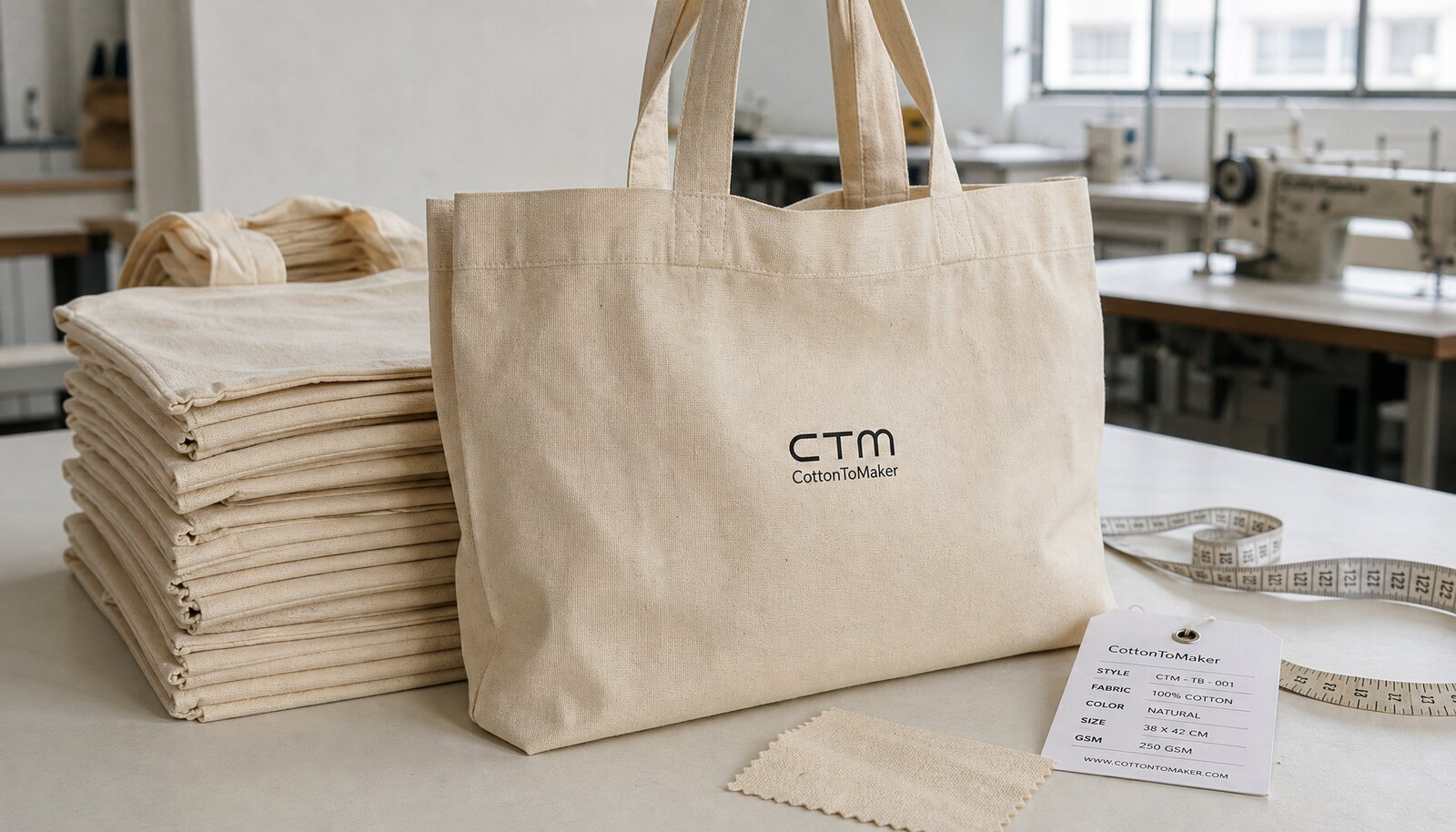
Why natural cotton shopping bags are a launch item, not a generic tote order
When a brand launches with natural cotton shopping bags, the bag is rarely just packaging. It becomes the first physical touchpoint a customer sees at retail, at an event, or in an unboxing flow. That makes the spec more important than many buyers expect: the bag has to hold product weight, carry the logo cleanly, and still look like a deliberate brand item rather than a commodity promo bag.
The most common buying mistake is treating all cotton shopping bags as interchangeable. They are not. A 120 GSM bag with a loose stitch line, for example, may work for light giveaways but creates complaints when used for grocery or retail carry. A launch order should be defined by function first: how much weight it must hold, how often it will be reused, and what shelf impression it must create.
- Launch bags need stronger acceptance criteria than event giveaways.
- Brand buyers should define the use case before comparing quotes.
- The same artwork can require very different fabric and print specs.
Choose the right fabric weight, weave, and handle construction
For most natural cotton shopping bags for brand launches, the workable range is 140–180 GSM. Below that, the bag may feel too thin and print can telegraph through the fabric. Above that, the unit cost rises quickly and the bag can become too stiff for folding into retail packaging. If the bag is intended for repeated carry, 160 GSM is often the middle ground that balances cost, appearance, and strength.
The weave matters as much as the GSM. A plain weave can be economical and suitable for clean print areas, while a heavier canvas-style weave gives a more premium hand feel and better structure. Handle construction deserves equal attention: self-fabric handles are common for launch budgets, but reinforced handles with extra stitching are safer if the bag may carry bottles, boxed goods, or heavier retail purchases.
- 140–150 GSM: better for light retail use, promo programs, and controlled cost.
- 160 GSM: common launch spec when the bag must look solid and still stay affordable.
- 180 GSM: better for premium retail positioning or heavier daily carry.
- Reinforced handle stitching is worth the small cost uplift when bag failure would hurt the brand.
Print method choices and what they do to the quote
The print method is one of the biggest cost drivers on natural cotton shopping bags. For simple logos, one- or two-color screen printing is usually the best value because setup is straightforward and the print remains bold on natural fabric. When the artwork has gradients, small type, or many colors, heat transfer may be proposed, but buyers should check whether the transfer will crack, peel, or sit too plasticky after use.
A clean RFQ should define the artwork area in centimeters, not just say “front logo.” The factory needs the exact print size, the position from top edge and side seam, and the color reference. If the launch includes multiple SKUs with different logos or seasonal messages, quote each version separately so tooling and print setup do not hide in the unit price.
- Screen print: best for strong brand marks and repeatable launch runs.
- Heat transfer: useful for detail, but inspect durability and surface feel.
- Embroidery: premium look, but usually raises cost and can distort lighter fabric.
- Woven label or side label: useful when the launch needs subtle branding, not large artwork.
Supplier routes: direct factory, trader, or mixed sourcing model
For a launch order, the supplier route should match the brand’s tolerance for risk and the need for consistency. A direct factory is the strongest option when you want control over GSM, handle reinforcement, print registration, and packing. A trader can be easier when you need several bag types in one shipment or when the order is small and the buyer needs faster coordination across factories.
Mixed sourcing can work, but it must be managed carefully. In this model, one source handles printing while another handles sewing or packing. That can reduce cost in some cases, yet it creates risk around color drift, print misalignment, and delayed handoff between processes. If the brand launch has a fixed store date, the cleaner route is usually one factory responsible for the full production flow.
- Direct factory: best for technical control and lower process confusion.
- Trader: useful for small MOQs or bundled sourcing, but ask where sewing actually happens.
- Mixed sourcing: only use if the buyer can manage separate approvals and schedule handoffs.
Comparison of sourcing routes for launch orders
The cheapest quote is not always the best launch route. Procurement teams should compare the supplier’s actual control over fabric, print, sewing, and packing, because hidden outsourcing often shows up later as uneven seams or late dispatch. For natural cotton shopping bags, the right supplier is the one that can repeat the approved sample, not the one that simply posts the lowest ex-works figure.
Use the table below to compare sourcing routes the way a factory sales engineer would: by process control, not just by price. A slightly higher quote can be acceptable if it reduces sampling cycles, improves carton accuracy, and shortens the path to bulk approval.
- Write decisions in measurable language, not only descriptive wording.
- Ask for sample photos plus one physical approval sample for important orders.
- Keep quotation, sample approval, and inspection notes tied to the same spec version.
What a workable quote looks like, line by line
A proper quote for natural cotton shopping bags should separate fabric cost, sewing cost, print cost, accessory cost, and packing cost. If all five are blended into one number, the buyer loses the ability to compare one supplier against another. It also becomes hard to see where a price jump is coming from when the artwork changes or the bag size increases by only a few centimeters.
As an example of quote structure, a factory may show one price for a 140 GSM blank bag, then add a print setup fee, then add per-color print charges, then show a separate carton charge. That is normal. What matters is whether the quote also states the base fabric origin, stitch spec, handle length, and packing quantity per carton. Without that detail, the buyer cannot tell whether two suppliers are actually offering the same product.
- Insist on separate lines for fabric, print, labels, packing, and carton cost.
- Compare ex-works price only after specs are fully aligned.
- If one quote is much lower, check GSM, seam reinforcement, and packing detail first.
MOQ logic for brand launches: how to avoid overbuying or underquoting
MOQ should be set by artwork complexity and fabric availability, not by habit. A simple natural cotton shopping bag with one print color can often support a lower MOQ than a multi-color launch bag with woven label, side mark, and special packing. If the brand is testing the market, it is usually smarter to order a smaller first run with enough room for a second repeat order, rather than locking inventory into one oversized batch.
From the factory side, MOQ is driven by setup efficiency. Sewing lines, print screens, and carton material all need a minimum volume to stay economical. Buyers should ask whether MOQ applies per color, per size, per artwork, or per shipment. Those are not the same thing, and confusion here is one of the fastest ways to get a quote that looks good but cannot actually be produced at the stated price.
- Small launch run: prioritize simple artwork and limited colorways.
- If the project may repeat, keep artwork and size standard for easier reorders.
- Separate MOQ for print setup from MOQ for finished bags whenever possible.
Sample approval: the checks that prevent expensive bulk mistakes
Do not approve a launch bag from artwork alone. The sample should show actual fabric hand feel, actual print opacity, and actual stitch quality. A pre-production sample is the right gate because it reflects the real factory process, not just a hand-made mockup. The buyer should compare the sample against a defined spec sheet that includes size, handle drop, seam allowance, print placement, and packing style.
A useful sample routine is simple: first approve fabric swatch, then print strike-off, then full pre-production sample. This sequence catches problems early. On natural cotton, print density can change once the ink meets the open weave, so a design that looks fine on a digital proof may still appear too light or too dark in bulk. The factory should keep the sample as the bulk reference, and the buyer should keep one signed copy for receiving inspection.
- Measure bag width, height, gusset, and handle length on the sample.
- Inspect print edge sharpness and logo alignment near seams.
- Rub-test the print lightly to see whether ink transfers or smears.
- Check that the sample folds and stacks the way the retail pack requires.
Packing, labeling, and carton spec for retail and wholesale buyers
Packing is often ignored until the shipment arrives. For a brand launch, that is too late. Natural cotton bags are prone to crease marks, dust marks, and carton compression if packed loosely. Bulk packing may be fine for distributor orders, but retail and branded launch programs often need a cleaner inner pack, a barcode label, or a consistent fold that makes the bag presentable when opened.
Carton count should be set around warehouse handling, not only around factory convenience. A carton that is too heavy can slow receiving and increase damage risk. Buyers should also define whether the cartons need to be double-walled, moisture-protected, or palletized. If the bags are going into multiple retail locations, carton marking should include color, size, SKU, and pack count so the receiving team can sort inventory quickly.
- Specify fold direction and finished packed dimensions.
- Use inner poly or paper bands if the bags must stay clean in transit.
- Mark cartons by SKU, color, size, and quantity to prevent receiving errors.
Lead time, production risk, and a practical landed-cost view
For standard natural cotton shopping bags with simple print, a realistic lead time after sample approval is often 15–30 days, but only if the fabric is in stock and the artwork is locked. The schedule extends quickly if the buyer changes the print size, adds a label, or requests a new carton spec after approval. For launch projects, the hidden risk is not sewing speed alone; it is the chain of approvals that sits in front of bulk production.
When comparing landed cost, procurement should calculate more than the ex-works bag price. Add sample freight, carton cost, inland movement, any labeling, and the cost of a rejected batch if the print or stitch spec is wrong. A slightly higher unit price can still be the better buy if it reduces rework or avoids late launch penalties. For natural cotton shopping bags for brand launches, schedule reliability often has more value than the last cent saved on the bag.
- Standard lead time is only valid after sample approval and artwork lock.
- Changing labels or packing after approval can push the schedule back.
- Use landed cost, not factory price alone, when comparing suppliers.
Specification comparison for buyers
| Spec decision | Recommended option | When it fits | Buyer risk to check |
|---|---|---|---|
| Fabric weight | 140–180 GSM natural cotton canvas or plain weave | Retail launch bags that need a better hand feel and fewer complaints about transparency | Too-light fabric can show contents, wrinkle badly, and collapse after first use |
| Bag construction | Single-panel or simple gusset with reinforced handles | Launches that need a clean look and controlled cost | Unreinforced handles can fail after repeated grocery loading |
| Print route | 1–2 color screen print or heat transfer for small graphic areas | Brand logos with solid shapes and repeat orders | Fine details may blur; misregistered print becomes visible on natural fiber |
| Supplier route | Direct factory with bag focus | When you need control on fabric, stitching, and packing spec | Factories that outsource sewing may quote well but miss seam consistency |
| MOQ strategy | 500–3,000 pcs per color/artwork for launch runs | New brand launches with uncertain sell-through | Very low MOQ often raises unit cost and can weaken fabric or print control |
| Sampling plan | Pre-production sample with approved fabric swatch and print strike-off | When branding, color tone, and handle length must match launch visuals | Approving only a flat artwork file creates mismatch risk on finished bags |
| Packing format | Bulk packed with inner poly or paper band, then carton by size/color | Wholesale, distributor, and retail replenishment orders | Loose packing increases scuffing and count errors at dispatch |
| Quality standard | Stitch strength, size tolerance, print position, and odor check | Any brand launch where first shipment sets retailer confidence | Ignoring dimensional tolerance leads to shelf inconsistency and return risk |
| Lead time route | 15–30 days after sample approval for standard specs | Routine launches with available fabric and simple print | Custom dyed fabric, rush packing, or complex labels can extend schedule quickly |
Buyer checklist before sampling
- Confirm final bag size, handle drop, fabric weight, and whether the bag needs a gusset or bottom fold.
- Lock the print method, print size, Pantone target, and artwork placement before sampling.
- State whether the order is for retail shelves, event distribution, e-commerce inserts, or wholesale cartons.
- Specify MOQ by color, by artwork, and by total order so the factory does not quote the wrong split.
- Approve a pre-production sample with fabric swatch, print strike-off, and stitching reference.
- Define carton quantity, inner packing, barcode or SKU label needs, and pallet preference if applicable.
- Set acceptance criteria for seam strength, size tolerance, print registration, and visible defects.
Factory quote questions to send
- What fabric weight and weave are you quoting, and can you show the exact GSM tolerance?
- Is the quote based on printed bags, woven labels, side labels, or embossing, and what is included in the setup fee?
- What is the MOQ by color and by artwork, and how does the unit price change at the next price break?
- What sample will you send before bulk production: blank sample, printed sample, or full pre-production sample?
- How are the bags packed per carton, and is carton marking or barcode labeling included?
- What lead time applies after sample approval, and what events would extend it?
- Which stitching points and seam allowances are standard on this quote, and where are optional reinforcements priced separately?
Quality-control points to confirm
- Fabric GSM must match the approved range and feel consistent across the shipment.
- Handle stitching should be reinforced and visually even, with no skipped stitches or loose thread tails.
- Print placement should stay within the agreed tolerance and not drift into seams or gussets.
- Bag size tolerance should be controlled so retail-facing units look consistent on shelf.
- The fabric should be free from oil marks, discoloration, holes, and strong odor.
- Carton counts, inner packs, and SKU labels should match the packing list and purchase order.
- A pull test on handles and seam junctions should be performed on sample units from production.
- If natural cotton is unbleached, color variation should remain within the agreed shade band.