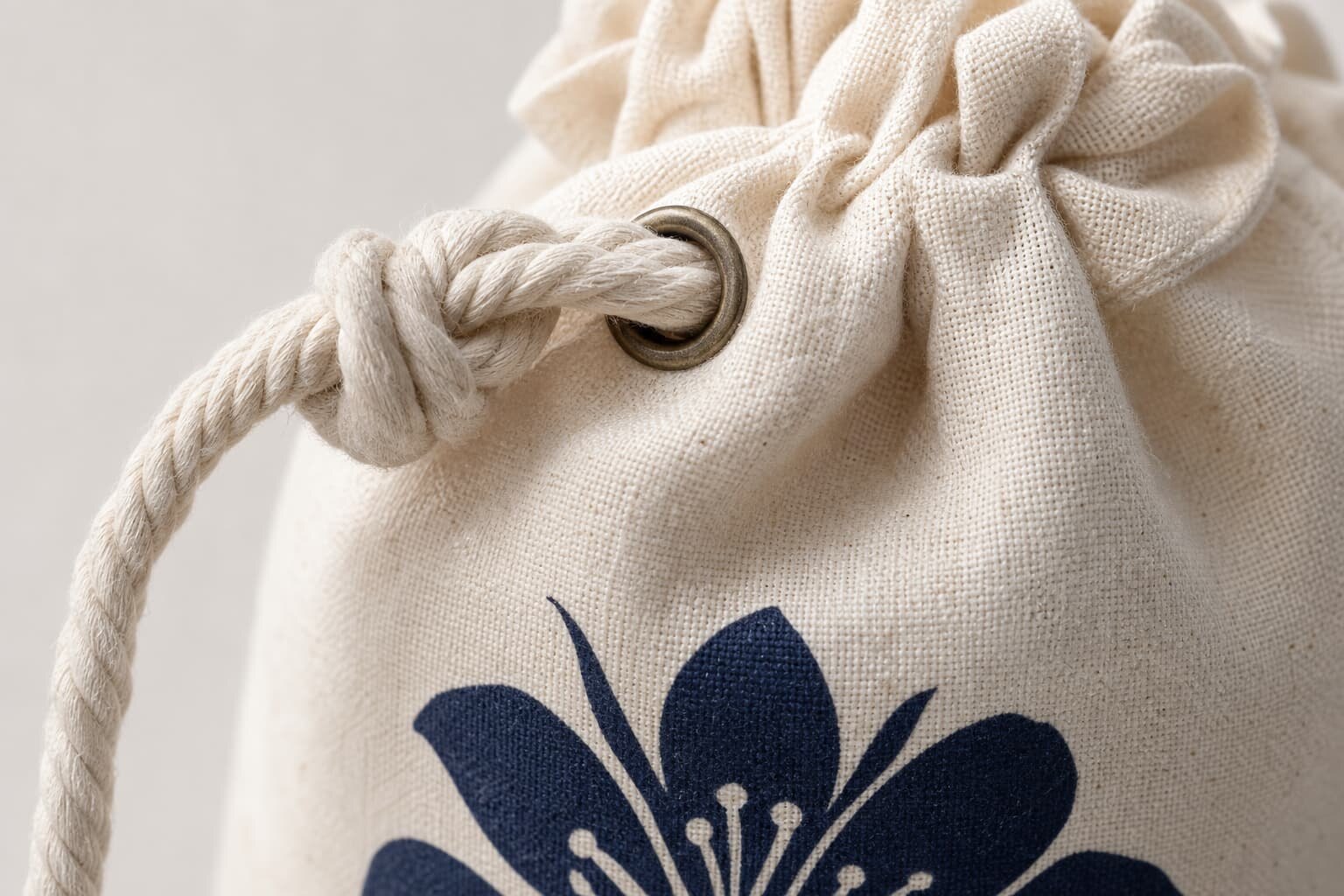
Audit the Supplier Around One Buying Problem
A muslin drawstring pouch looks simple, which is exactly why many bulk orders go wrong. The buyer approves a photo, the supplier quotes a low unit price, and the production team later discovers that the fabric is too transparent, the cord is too short, the printed logo sits too close to the drawstring tunnel, or the pouch cannot hold the intended product without pulling at the seams. A supplier audit should not be a paperwork exercise. It should confirm whether the factory can repeatedly make the same pouch at the approved specification.
For procurement teams, the most useful audit question is not whether the supplier has made pouches before. The useful question is whether the supplier can control fabric, sewing, printing, packing, and schedule on the same order. Muslin pouches often sit between packaging and textile production. Some suppliers understand sewing but outsource print. Some print shops can decorate bags but have weak control over fabric and stitching. Your audit should identify where the real production control sits before you place the purchase order.
- Treat the pouch as a sewn textile product, not as a disposable gift bag.
- Audit the route from fabric roll to finished carton, not only the showroom sample.
- Ask who controls cutting, sewing, printing, trimming, pressing, and packing.
- Use your audit to improve the RFQ, not just to approve or reject a factory.
Confirm the Factory Type Before Comparing Prices
There are three common supplier types in muslin drawstring pouch sourcing: sewing factories, trading companies, and decoration workshops. A sewing factory usually controls cutting, stitching, drawstring insertion, and packing. It may outsource printing if the logo process is specialized. A trading company may coordinate several factories and offer faster communication but must still disclose where quality decisions are made. A print workshop may show attractive logo samples but may not be strong in fabric sourcing, size tolerance, or export packing.
This matters because a quote from a sewing factory and a quote from a print-driven supplier may not include the same risk. If the print workshop buys ready-made blank pouches, it may have limited control over GSM, seam strength, and pouch size. If a sewing factory outsources screen printing, it must still be responsible for print placement, color, curing, and rework. During an audit, ask for the production flow of your exact order, not a general factory profile.
- Ask whether blank pouches are made to order or purchased from stock.
- Request photos or video of the actual sewing line, drawcord insertion area, and packing area.
- Confirm whether printing happens before sewing, after sewing, or on finished blanks.
- Check who signs off the pre-production sample and who has authority to stop production.
- Avoid comparing prices until you know which supplier controls which process.
Lock the Muslin Fabric Specification Early
Muslin is not one fixed fabric. In pouch production, it can mean a lightweight plain-weave cotton, an unbleached natural cotton cloth, a soft washed fabric, or a more open fabric with visible slubs. Buyers should not write only natural muslin pouch in the RFQ and expect identical quotes. A practical RFQ should state target GSM or oz, color, hand feel, shrinkage expectation, transparency tolerance, and whether the fabric must be raw natural, bleached, dyed, washed, or enzyme treated.
For many promotional, cosmetic, jewelry, candle, and amenity pouches, 4 oz to 6 oz muslin is a common working range. Lighter material may reduce cost and carton weight, but it can look too transparent or weak when the product is inserted. Heavier muslin gives better structure but costs more, may feel less soft, and may affect drawstring closure if the fabric is thick around the tunnel. Ask suppliers to send labeled fabric swatches with GSM, not only a finished pouch photo.
- For lightweight inserts, ask for around 135 GSM if transparency is acceptable.
- For retail gift packaging, consider around 160 to 200 GSM for better hand feel.
- For natural cotton, approve shade range because unbleached fabric can vary by lot.
- For dyed muslin, ask whether the dye lot MOQ is higher than the sewing MOQ.
- For washed fabric, confirm shrinkage and whether the pouch is washed before or after sewing.
Check Size, Construction, and Drawstring Function
Muslin pouch buyers often specify outside width and height but forget usable space. The drawstring channel takes height away from the product area. The bottom seam and side seam also reduce internal volume. If a buyer needs to pack a candle jar, soap bar, sunglasses cloth, jewelry box, or bottle accessory, the audit sample should be tested with the real product or a dummy product of the same size and weight. A pouch that matches the flat measurement can still be too tight when filled.
Construction should be defined in plain terms. Confirm whether the pouch uses single drawstring or double drawstring, whether the drawcord exits one side or both sides, and whether the bottom is a simple seam or boxed bottom. Most small muslin pouches use flat side seams and a folded top tunnel. The critical failure areas are the top opening, cord exit holes, side seam near the channel, and bottom corners. During supplier audit, ask the factory how it prevents skipped stitches, fraying, and broken thread in these areas.
- Measure finished width, total height, usable height below the drawcord, and opening width.
- Specify tolerance, such as plus or minus 5 mm for small pouches or a negotiated tolerance for larger sizes.
- Confirm cord length after knotting, because short cords make filling and closing slower.
- Check whether knots are secure and neat, especially for child-facing or retail packaging.
- Test the pouch with the actual product weight before approving bulk production.
Audit Print Method, Placement, and Ink Behavior
Most muslin drawstring pouch logo problems are caused by artwork assumptions. A buyer sends a clean vector logo, but the fabric surface is textured, slightly uneven, and absorbent. Fine letters may fill in, thin lines may break, and large solid blocks may show fabric texture through the ink. Screen printing is usually the most stable bulk method for simple one to three color logos. Heat transfer can help with fine detail or multi-color artwork, but it changes the hand feel. Digital printing is useful for short runs and complex graphics, but the buyer should test color and wash or rub resistance.
Placement is just as important as method. If the logo is too high, the drawstring channel may distort it when closed. If it is too low, the logo can fold around the bottom edge when the pouch is filled. Ask the supplier to mark the print position using distance from the top edge, side seam, and bottom seam. Do not approve a sample only by eye in a photo. Request a flat measurement sheet with print size, print location, and tolerance.
- Use screen print for bold logos, simple icons, and repeat bulk orders.
- Use heat transfer only after checking hand feel, edge finish, and flexibility on muslin.
- Use digital print when design complexity is more important than the lowest unit price.
- Ask for Pantone target and acceptable shade tolerance, but remember natural cotton affects color appearance.
- Require a cured print test so ink does not rub off during packing or consumer handling.
Understand MOQ Logic Before Negotiating
MOQ for muslin drawstring pouches is not only a sales number. It usually comes from fabric sourcing, cutting efficiency, sewing line setup, cord availability, print setup, and packing labor. A supplier may accept a lower MOQ if the pouch uses stock natural fabric, stock cotton cord, one standard size, and one color screen print. The MOQ rises when the buyer needs custom dyed fabric, special cord color, many sizes, multiple print artworks, washed finishing, or individual retail packaging.
Procurement teams should ask suppliers to separate MOQ by variable. A single total MOQ hides the real constraint. For example, the factory may be able to sew 500 pieces, but the fabric mill may require more fabric for a custom dye. The print room may charge a screen setup fee that makes 300 pieces expensive but 2,000 pieces more reasonable. If you understand the MOQ drivers, you can adjust the RFQ without weakening the product. You may combine sizes, keep fabric common, reduce print colors, or use a stock cord to reach a workable price.
- Ask for MOQ by fabric color, pouch size, cord color, and print design.
- Check whether different pouch sizes can share the same fabric lot and print color.
- Ask if sample charges can be credited after bulk order, but do not assume this is included.
- Avoid forcing very low MOQ if it pushes the supplier to use leftover fabric without shade control.
- Compare small-order setup cost separately from true bulk unit cost.
Compare Quotes by Cost Drivers, Not Unit Price Alone
A low unit price can be real, but it can also mean the supplier has removed important details. Common quote gaps include thinner GSM, single drawstring instead of double drawstring, shorter cord, no inner packing, weak export carton, no print setup charge shown, no pre-production sample cost, or unclear incoterms. A buyer cannot compare two suppliers fairly unless both are quoting the same pouch, same sample process, same packing, same inspection requirement, and same delivery term.
Ask for a structured quotation that shows the commercial logic. It does not need to expose the supplier's full factory margin, but it should identify the cost items that affect your order. This is especially useful when internal teams ask why one supplier is 8 percent higher. The answer may be heavier fabric, better cord, stronger carton, included sampling, or a more controlled print method. A quote with enough detail also reduces arguments after purchase order release.
- Fabric: GSM, fabric type, color, and whether it is stock or custom.
- Sewing: pouch size, seam type, drawstring style, and labor assumptions.
- Decoration: print method, number of colors, print size, setup charge, and sample proof charge.
- Packing: individual pack, bundle count, inner carton or polybag, export carton, and moisture protection.
- Logistics: incoterm, inland freight, port, lead time basis, and document requirements.
Use Samples to Test Production Reality
A muslin pouch sample is not only a sales approval item. It is the first controlled production test. The best sample uses the intended bulk fabric, cord, thread, print method, logo size, sewing construction, and packing fold. If the supplier sends a similar stock sample, treat it as a reference only. It can help confirm general workmanship, but it cannot approve bulk production. For order approval, request a pre-production sample and record every accepted detail.
Sample review should include functional tests. Put the real product inside. Pull the drawstring repeatedly. Fold the printed area. Rub the logo with a clean white cloth. Check whether the pouch stands, lies flat, or wrinkles in the way your retail team expects. If the pouch will be used for cosmetics, food-adjacent gifts, hotel amenities, or fragrance products, check odor and clean handling. Natural cotton can absorb warehouse smell if storage and packing are poor.
- Keep one approved sample with the buyer and one sealed sample with the factory.
- Photograph measurement points and print placement, not only the front view.
- Approve fabric shade under consistent lighting and note acceptable variation.
- Ask for revised sample only when the change affects production risk or brand appearance.
- Do not release bulk production until sample comments are closed in writing.
Audit Packing, Cartons, and Shipment Protection
Muslin pouches can be damaged before the buyer ever opens the carton. The most common packing issues are heavy creases, moisture marks, dusty fabric, mixed counts, cord tangling, and carton compression. A low-cost pouch order may still need clean presentation if it is used for retail gifting or brand packaging. Ask the supplier how pouches are folded, bundled, counted, and protected inside the carton. If the pouch must arrive smooth, you may need a different folding method or fewer pieces per carton.
Carton strength and moisture control are practical audit points, especially for sea shipment. Natural cotton can absorb moisture and odor. Overloaded cartons may deform and create permanent wrinkles. For distributors and importers, carton marking also matters because warehouse receiving teams need style number, PO number, color, size, quantity, gross weight, net weight, and carton number. Do not leave carton marking until the final packing day.
- Confirm pieces per inner pack and pieces per export carton before production.
- Ask whether pouches are pressed, steamed, or packed directly after sewing and print curing.
- Specify whether polybags, paper bands, or plastic-free inner packing are required.
- Use desiccant or other moisture control when shipment conditions justify it.
- Check carton drop, compression, and count accuracy if the order is retail sensitive.
Set Lead Time and Inspection Gates
Lead time should be tied to approval gates, not only calendar days. A realistic schedule includes artwork confirmation, fabric sourcing, lab dip or fabric shade approval when needed, sample making, sample approval, bulk fabric arrival, cutting, printing, sewing, trimming, pressing, packing, final inspection, and shipment booking. If a supplier says production takes 20 days, ask when that clock starts. It may start after deposit, after sample approval, after fabric arrival, or after all materials are ready.
Inspection should not wait until the last carton is sealed. A practical order has at least three control points: material check before cutting, in-line check during sewing and printing, and final random inspection after packing. For higher-risk orders with custom dye, tight logo color, or retail display requirements, add a first-article inspection before mass printing. This catches print placement, ink color, and fabric behavior before thousands of pouches are decorated.
- Confirm the lead time start point in the purchase order.
- Ask for material readiness photos or reports before cutting begins.
- Approve first bulk print before full print run if logo quality is critical.
- Schedule final inspection with enough time for rework before vessel or courier cutoff.
- Define who pays for reinspection if the first inspection fails.
Specification comparison for buyers
| Spec decision | Recommended option | When it fits | Buyer risk to check |
|---|---|---|---|
| Fabric weight | 4 oz to 6 oz muslin, roughly 135 to 200 GSM depending on weave | Gift packaging, skincare kits, jewelry, candles, hotel amenities, lightweight retail inserts | Very light muslin may show contents, twist after washing, or fail seam strength tests if the pouch is overfilled |
| Drawcord material | Matching cotton cord for natural look, polyester cord for smoother pull | Cotton cord fits eco-positioned packaging; polyester cord fits repeated opening and tighter budget control | Cord diameter must match tunnel width or the pouch mouth will jam during packing |
| Print method | Screen print for solid logos, heat transfer for fine gradients, digital print for short-run complex artwork | Screen print is the safest bulk option for one to three color brand marks | Ink migration, poor registration, and fabric slub interference can change logo sharpness |
| Seam construction | Lockstitch side seams with reinforced top opening and clean thread trimming | Standard bulk orders where buyers need predictable strength without overengineering | Weak bartacks or skipped stitches near the drawstring channel cause early tearing |
| Closure style | Single drawstring for lower cost, double drawstring for better hand feel and retail presentation | Single cord is acceptable for inserts; double cord is better for gift and shelf-facing packs | Quotes may look cheaper because suppliers omit double cord or reduce cord length |
| Packing method | Flat packed by inner polybag or paper band, then export carton with moisture control | Best for efficient freight and easier inbound count checking | Over-compressed cartons can create hard wrinkles that are visible at retail |
| MOQ logic | Base MOQ on fabric availability, print setup, cord color, and size combination | Works for buyers with multiple SKUs or seasonal sets | A supplier may accept low MOQ but charge hidden setup, fabric dye, or size grading fees later |
Buyer checklist before sampling
- Confirm whether the supplier is a real sewing factory, a trading office, or a print-only workshop subcontracting sewing.
- Ask for actual fabric weight in GSM and oz, not only the word muslin, because muslin can range from very thin gauze-like cloth to firmer cotton fabric.
- Request a pre-production sample using the final fabric, final cord, final print method, final pouch size, and final packing method.
- Check finished size tolerance after sewing, pressing, and drawcord insertion, not only cutting panel size.
- Review logo placement from top edge, side seam, and bottom edge so bulk production does not shift artwork into the drawstring channel.
- Compare quotes line by line for fabric, sewing, drawcord, printing, sampling, packing, carton, inspection, and inland freight terms.
- Verify whether the quoted lead time starts from deposit, artwork approval, fabric arrival, or pre-production sample approval.
- Ask how the factory controls shrinkage, slanted seams, loose threads, needle holes, and print rubbing on natural cotton fabric.
- Confirm export carton strength, carton marking, inner packing count, and whether moisture control is included for sea shipment.
- Define acceptable quality limits and defect classification before production, especially for print stain, color deviation, seam failure, and drawstring function.
Factory quote questions to send
- Are you producing the muslin pouch in your own sewing line, or are sewing, printing, washing, and packing handled by separate subcontractors?
- What fabric options can you quote for this pouch size, including GSM, oz, yarn count if available, width, shrinkage range, and whether the fabric is bleached, natural, dyed, or washed?
- What is the minimum order quantity by size, fabric color, cord color, and print design, and what cost changes if we combine several sizes under one purchase order?
- Which print methods do you recommend for our artwork, and what are the setup charges, color limits, print size limits, and expected tolerance for placement and registration?
- Can you provide a quote breakdown showing fabric, sewing, cord, printing, packing, carton, sampling, mold or screen charge, and inland logistics instead of only one total unit price?
- What is your normal pre-production sample process, and how many days are needed after artwork, fabric, and cord are confirmed?
- What finished size tolerance, GSM tolerance, print color tolerance, and seam strength standard will you accept in the purchase order?
- How will pouches be packed inside the export carton, and how do you prevent moisture, odor, crushed wrinkles, or cord tangling during ocean shipment?
- What inspection points do your QC staff check during cutting, sewing, printing, cord insertion, pressing, and final packing?
- If bulk production fails print color, size, or drawstring function checks, what is your rework process and who pays for reinspection?
Quality-control points to confirm
- Fabric GSM should be checked from bulk fabric rolls before cutting, because a pouch made from underweight muslin can still look acceptable in photos but fail buyer handling tests.
- Finished pouch size should be measured flat with the drawstring relaxed, including width, height below the cord channel, and usable opening size.
- Drawstring function should be checked by opening and closing the pouch several times, including after the pouch is filled to the buyer's intended product weight.
- Print adhesion should be tested by dry rubbing, light scratching, folding over the printed area, and checking whether ink cracks along the muslin texture.
- Seam strength should be checked at the side seam, bottom corner, and drawcord channel because these areas carry most of the stress in packing and consumer use.
- Thread color, cord color, fabric shade, and print color should be compared under consistent lighting against the approved sample, not only against digital artwork.
- Loose threads, oil marks, needle holes, fabric slubs, and stains should be classified before production so inspectors do not argue about natural cotton character versus defect.
- Carton packing should be checked for count accuracy, inner packing arrangement, carton compression, moisture protection, and carton mark consistency with the buyer's receiving system.