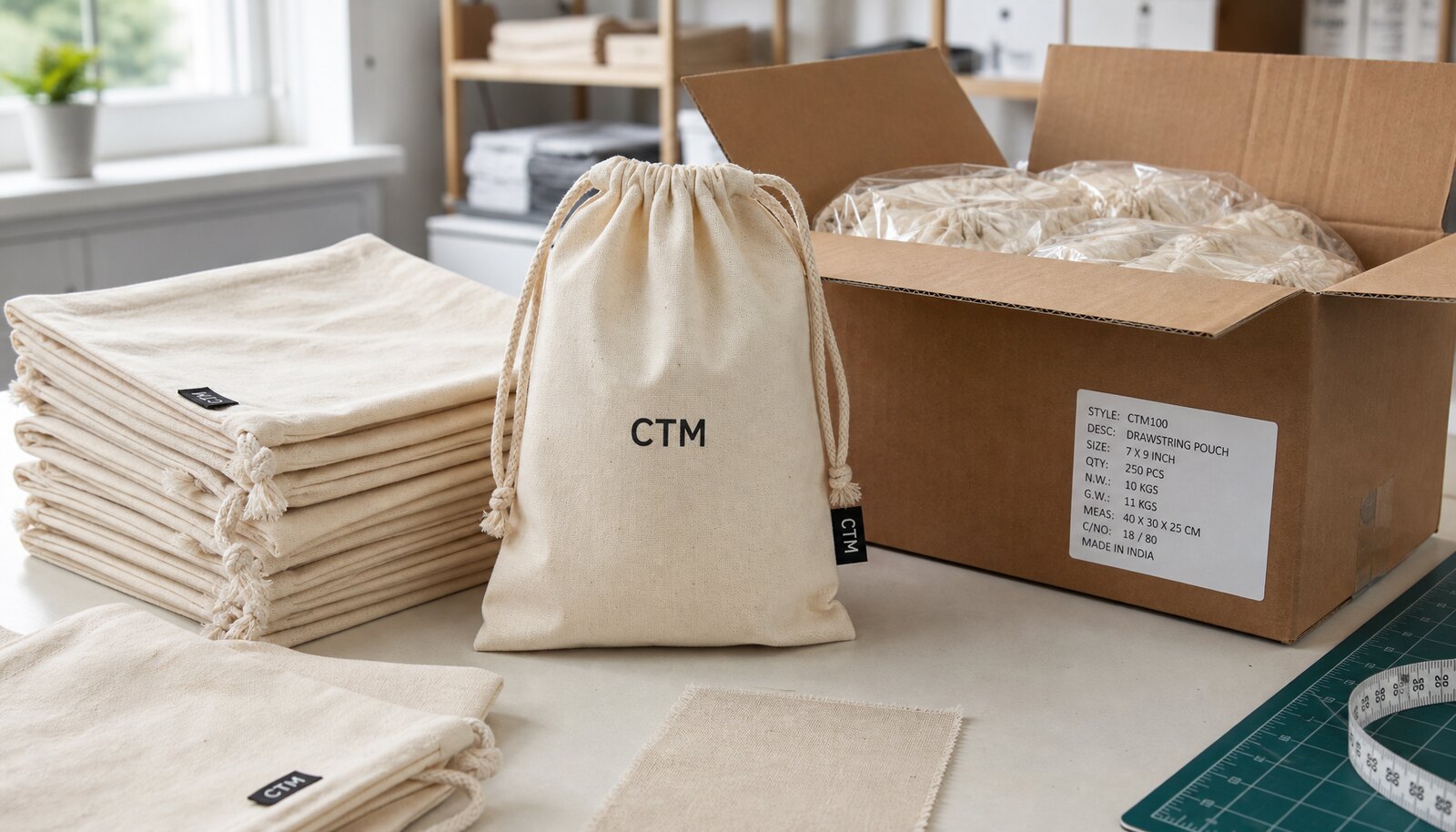
Why carton packing changes the real cost of muslin pouches
For muslin drawstring pouches, carton packing is not a small warehouse detail. It affects unit cost, freight volume, warehouse receiving, barcode control, and complaint risk after arrival. A pouch that looks simple on the quote sheet can become expensive if the supplier assumes loose bulk packing while the buyer expects counted inner bundles, clean retail handling, and strong export cartons.
The main buying problem is comparability. Two suppliers may both quote a 10 x 14 cm natural cotton muslin pouch with a one-color logo, but one price may include 100 pcs per master polybag, 5-ply cartons, printed carton marks, and desiccant. The other may include loose pouches in a weak carton with no inner count label. The lower price is not necessarily a better price; it may only be a less complete packing standard.
- Put the packing method in the RFQ, not only the pouch specification.
- Ask for carton dimensions and gross weight before approving mass production.
- Compare quotes using the same inner packing and carton strength.
- Treat packing photos as approval documents, not casual production updates.
Start with fabric weight before deciding carton quantity
Muslin pouch carton quantity should be calculated after the fabric weight is confirmed. Light muslin around 110-140 GSM is soft and compressible, so more pieces can fit in one carton. Medium muslin around 150-180 GSM has better body for gift packaging and is still efficient to pack. Heavy cotton around 220-270 GSM, often described as 7-8 oz, occupies more carton space and can push carton weight up quickly.
If the buyer gives only pouch size and asks for the cheapest packing, the factory may maximize pieces per carton to reduce carton count. That can create cartons that are too heavy for manual handling or too tightly compressed for clean presentation. Dense compression can also set hard creases into natural cotton, especially if the pouches are packed soon after sewing or printing.
- For 4-5 oz muslin, request a carton weight estimate before fixing pieces per carton.
- For 6 oz muslin, check whether folded thickness affects carton height and pallet stacking.
- For 7-8 oz cotton muslin, limit carton quantity by gross weight first, then by volume.
- For natural unwashed muslin, expect more visible crease lines than on softened or washed cotton.
Match print method with packing pressure
Most muslin drawstring pouches use screen printing because it is cost-effective for solid logos and simple brand artwork. Screen print works well on natural cotton, but the ink must be cured properly before pouches are bundled. If pouches are stacked while ink is still warm or not fully cured, the print can block, transfer, or leave pressure marks on the pouch behind it.
Heat transfer can be useful for small artwork with gradients or detailed color. However, heat transfer films can feel less natural on lightweight muslin and may show edge marks after tight carton compression. Embroidery is less common on very light muslin because the fabric can pucker, but it may suit heavier cotton pouches. For carton packing, the buyer should ask not only which print method is used, but how the factory prevents rubbing and sticking inside the carton.
- Ask for ink curing time and whether pouches are packed the same day as printing.
- Require a rub test on printed samples before bulk packing approval.
- Avoid face-to-face printed logo contact when the ink deposit is heavy.
- Use tissue separation only when necessary because it adds labor, cost, and waste.
Choose loose, bundle, or individual packing on purpose
Loose bulk packing is the cheapest and fastest method. It can work for industrial use, internal kitting, or very low-cost promotional pouches where the buyer will unpack and sort locally. The risk is that loose pouches can twist, drawcords can tangle, counts are slower to verify, and fabric can pick up carton dust. For natural muslin, dust and fibers are more visible than on dark dyed cotton.
Bundle packing is usually the best balance for importers and distributors. The factory counts 25, 50, or 100 pouches, places them in one inner polybag, and labels the bag by SKU. Individual polybags are cleaner and more retail-friendly but add cost, plastic, labor, and carton volume. Buyers should not request individual polybags by habit; use them when hygiene, retail display, barcode handling, or e-commerce fulfillment requires it.
- Loose packing: lowest packing cost, highest receiving effort.
- Bundle packing: practical for wholesale receiving and random count checks.
- Individual polybag: useful for retail or kitting, but increases volume and lead time.
- Paper banding: lower plastic option, but less dust protection than master polybags.
Set carton size and gross weight before the PO
A common mistake is approving the pouch sample and leaving carton details until shipment. By that time, the factory has already planned cutting, sewing, printing, and packing labor. Changing from 500 pcs per carton to 250 pcs per carton may increase carton count, carton cost, label quantity, warehouse time, and sometimes freight volume. It is better to set a target carton standard during quotation.
For many buyers, maximum gross weight is more important than maximum pieces per carton. Warehouse teams may have manual lifting limits, courier networks may surcharge oversize cartons, and pallet plans may require specific carton footprints. The supplier can propose the most efficient carton quantity, but the buyer should give constraints such as maximum 15 kg gross weight, no carton side longer than 60 cm, or pallet height limits.
- Ask for estimated carton dimensions in centimeters, not only pieces per carton.
- Ask for net weight and gross weight separately.
- Confirm whether the carton can be stacked without crushing lower cartons.
- For LCL shipments, avoid weak cartons because handling points are more frequent.
Control moisture, odor, and natural cotton storage risk
Muslin is usually made from cotton, and cotton absorbs moisture from the production and storage environment. If fabric is packed damp, or cartons are stored on a wet floor, the buyer may receive pouches with mildew smell, yellowing, or small dark spots. This is especially relevant for natural unbleached muslin because minor color variation and seed specks are normal, but mildew and water stains are not acceptable.
Moisture control is not only about adding desiccant. The basic controls are dry fabric, dry printing, dry sewing area, dry cartons, and correct warehouse storage before loading. Desiccant can help for sea freight, rainy season, or long storage, but it cannot rescue damp goods packed too early. Buyers should ask the factory how cartons are stored before container loading and whether finished goods sit directly on the floor.
- Require cartons to be stored on pallets or racks, not directly on concrete floors.
- Do not close cartons immediately after steam pressing or wet cleaning.
- Use desiccant for humid season shipments when the route or storage time is long.
- Reject cartons with water marks before loading, even if the pouches inside look acceptable.
Make carton marks useful for receiving, not just shipping
Carton marks should help the buyer's warehouse identify the goods without opening every carton. A good carton mark includes buyer name or code, PO number, SKU, pouch size, color, quantity, carton number, gross weight, net weight, country of origin if required, and destination or warehouse code. For mixed orders, carton numbering should be continuous and match the packing list exactly.
Poor carton marks create expensive receiving problems. If a shipment includes three pouch sizes in the same fabric and similar natural color, warehouse staff cannot rely on visual checks. Opening cartons to identify SKUs slows receiving and increases the chance of mixing clean goods. If barcode labels are required, the buyer should provide label artwork, placement rules, and scan size requirements before production packing starts.
- Use one SKU per carton whenever possible for clean warehouse receiving.
- For mixed cartons, list each SKU and quantity clearly on the carton and packing list.
- Place carton marks on at least one long side; two-side marking is better for pallets.
- Confirm whether shipping marks are printed, labeled, or both.
Understand MOQ logic for packing upgrades
MOQ for muslin drawstring pouches is not only a sewing quantity issue. Custom fabric weight, custom dyed cotton, special drawcord color, individual barcode labels, retail header cards, and custom printed cartons can each have their own minimums. A buyer may request 1,000 pcs with many retail packing details, but the factory may need to charge extra setup because packing materials cannot be purchased efficiently at that quantity.
For standard natural muslin and simple bundle packing, MOQ is usually more flexible because fabric and cartons are common materials. For custom carton size, custom printed inner bags, FSC-style paper bands, or hangtag assembly, the supplier needs more time to source, check, and stage materials. Buyers should separate must-have packing requirements from nice-to-have presentation items, especially for first orders or test launches.
- Standard size plus bundle packing usually gives the most flexible MOQ.
- Custom dyed fabric may require a higher MOQ than custom logo printing.
- Individual barcode labels add labor even when the label itself is inexpensive.
- Printed retail packaging should be quoted as a separate line if order quantity is low.
Build lead time around approval gates
Packing problems often happen when the schedule only includes sewing time. A realistic muslin pouch order includes sample making, artwork approval, fabric preparation, bulk printing, print curing, sewing, trimming, final pressing if required, counting, inner packing, carton packing, inspection, and shipment booking. If the buyer adds a barcode label or changes carton quantity late, the packing team may need to repack finished goods.
The safest workflow is to approve the pouch sample and the packed sample standard before mass packing. This does not always require shipping a full carton sample internationally; clear photos and measurements may be enough for repeat buyers. For new suppliers, new retail packing, or strict warehouse requirements, a physical packed sample is worth considering because it shows fold quality, bundle thickness, label placement, and carton strength.
- Approve fabric and logo sample before bulk cutting when color or print position matters.
- Approve packing layout before the factory starts full carton packing.
- Allow extra time for individual polybags, barcode labels, hangtags, or inserts.
- Do not book final inspection until enough cartons are fully packed and sealed.
Write quote data so suppliers price the same job
A strong RFQ for muslin drawstring pouch carton packing should include finished pouch size, fabric GSM or oz, color, drawcord material, logo size and print method, order quantity by SKU, inner packing method, carton quantity target, carton mark requirements, moisture control needs, and inspection standard. If some details are unknown, ask the supplier to propose options and show the cost difference.
The most useful quote is not just a unit price. It should show pouch unit cost, print cost if separated, packing material cost if upgraded, estimated carton dimensions, pieces per carton, gross weight, sample cost if any, production lead time, packing lead time, and shipment-ready date. This allows procurement teams to compare total landed impact instead of choosing the lowest ex-factory number.
- Ask for one quote with standard bundle packing and one quote with individual retail packing if you are undecided.
- Request carton CBM estimate so freight forwarders can calculate volume early.
- State whether you allow supplier-standard carton size or require your own warehouse carton size.
- Keep all approved packing details attached to the PO and inspection booking.
Specification comparison for buyers
| Spec decision | Recommended option | When it fits | Buyer risk to check |
|---|---|---|---|
| Fabric weight for carton packing | 4-6 oz muslin for light promo pouches; 7-8 oz for retail or heavier contents | Small jewelry, cosmetics, tea, candles, amenity kits, gift packaging | Thin 3 oz fabric can crease badly, distort after printing, and show carton rub marks more easily |
| Print method before packing | Screen print for solid 1-3 color logos; heat transfer only when artwork needs gradients | Brand logos, product names, simple care symbols, event packaging | Insufficient curing or hot stacking can cause print blocking inside bundles |
| Inner packing style | Bundle 25, 50, or 100 pcs in one master polybag with size and color label | B2B distribution, kitting, warehouse receiving, easy count checks | Loose packing saves time but increases dust, count disputes, and drawcord tangling |
| Individual polybag use | Use only for retail hygiene, e-commerce kits, or strict cleanroom-like handling | Cosmetics, baby items, food-adjacent packaging where buyer requires clean presentation | Adds cost, packing time, plastic compliance questions, and larger carton volume |
| Carton strength | 5-ply export carton for most sea freight; stronger board for LCL or heavy 8 oz fabric | Bulk import, distributor stock, mixed-container loading | Weak cartons collapse when pouches are dense, especially with overfilled master cartons |
| Carton quantity setting | Base quantity on packed carton weight below buyer handling limit, not only carton volume | Orders from 5,000 to 100,000 pcs where warehouse labor matters | Too many pcs per carton can exceed manual lifting limits and trigger carton bursting |
| Moisture control | Use dry fabric, dry cartons, and optional desiccant for humid season or long sea freight | Natural cotton muslin, jute-mixed warehouse environment, rainy-season production | Cotton absorbs humidity; mildew smell or yellowing can appear if packed too early |
| Carton marks | Print PO, SKU, size, color, quantity, carton number, gross/net weight, and destination code | Multi-SKU orders and distributor receiving | Missing marks cause receiving delays and mixed SKU claims even when goods are correct |
Buyer checklist before sampling
- Confirm pouch size, fabric GSM or oz, seam allowance, drawcord type, and finished tolerance before carton quantity is calculated.
- Ask whether the supplier quotes loose bulk packing, bundle packing, or individual polybag packing; do not compare prices unless the packing method is the same.
- Set maximum carton gross weight and carton dimensions based on your warehouse, courier, pallet, or container requirements.
- Approve a packed sample or packing photo showing pouch fold method, bundle count, inner bag label, carton mark, and carton sealing method.
- Check that printed pouches are fully cured and cool before bundling, especially for screen print and heat transfer logos.
- Require dry cartons, dry pouches, and moisture control steps if shipping by sea during rainy or humid seasons.
- Specify carton number sequencing and SKU separation rules for mixed-size or mixed-color pouch orders.
- Request pre-shipment photos of open carton, closed carton, carton mark, bundle label, and random count check.
- Define acceptable carton damage level for shipment release, including no crushed corners, no water marks, and no burst seams.
- Keep packing instructions in the purchase order, not only in email messages, so the QC inspector can check against a formal document.
Factory quote questions to send
- What muslin fabric weight are you quoting, in GSM or oz, and is it greige, bleached, dyed, or washed natural cotton?
- What is the finished pouch size tolerance after stitching and pressing, and how does that affect the carton quantity?
- Which print method is included in the quote, and what curing or drying time is allowed before packing?
- Is the unit price based on loose bulk packing, bundle master polybag packing, or individual polybag packing?
- How many pieces per inner bundle and per export carton are included in the quote?
- What are the estimated carton dimensions, gross weight, and net weight for each SKU?
- What carton board grade or ply is included, and is it suitable for sea freight, LCL handling, or courier shipment?
- Are carton marks, barcode labels, desiccants, or palletization included or quoted separately?
- How many days are needed for pre-production sample, bulk fabric preparation, printing, sewing, packing, and final inspection?
- What MOQ applies for custom size, custom GSM, custom dyed fabric, custom drawcord, or individual retail packing?
Quality-control points to confirm
- Measure finished pouch size after sewing, not flat cut panels before stitching.
- Check fabric weight by approved swatch or GSM test where required, because muslin handfeel alone is not reliable.
- Rub test the printed logo before packing and again after packed pouches have been compressed for several hours.
- Open random bundles to confirm actual count, SKU, color, size, and drawcord match the carton label.
- Check whether drawcords are tangled, missing, too short, or pulled into the channel during folding.
- Inspect carton compression condition, sealing tape strength, edge bursting, and wet or oily marks.
- Verify gross weight and carton dimensions against the packing list before shipment booking.
- Confirm carton marks are readable, durable, and placed on the required carton sides.
- Review moisture condition, odor, and fabric cleanliness before cartons are closed.
- Photograph approved packing standard and use it as the inspection reference for the full order.