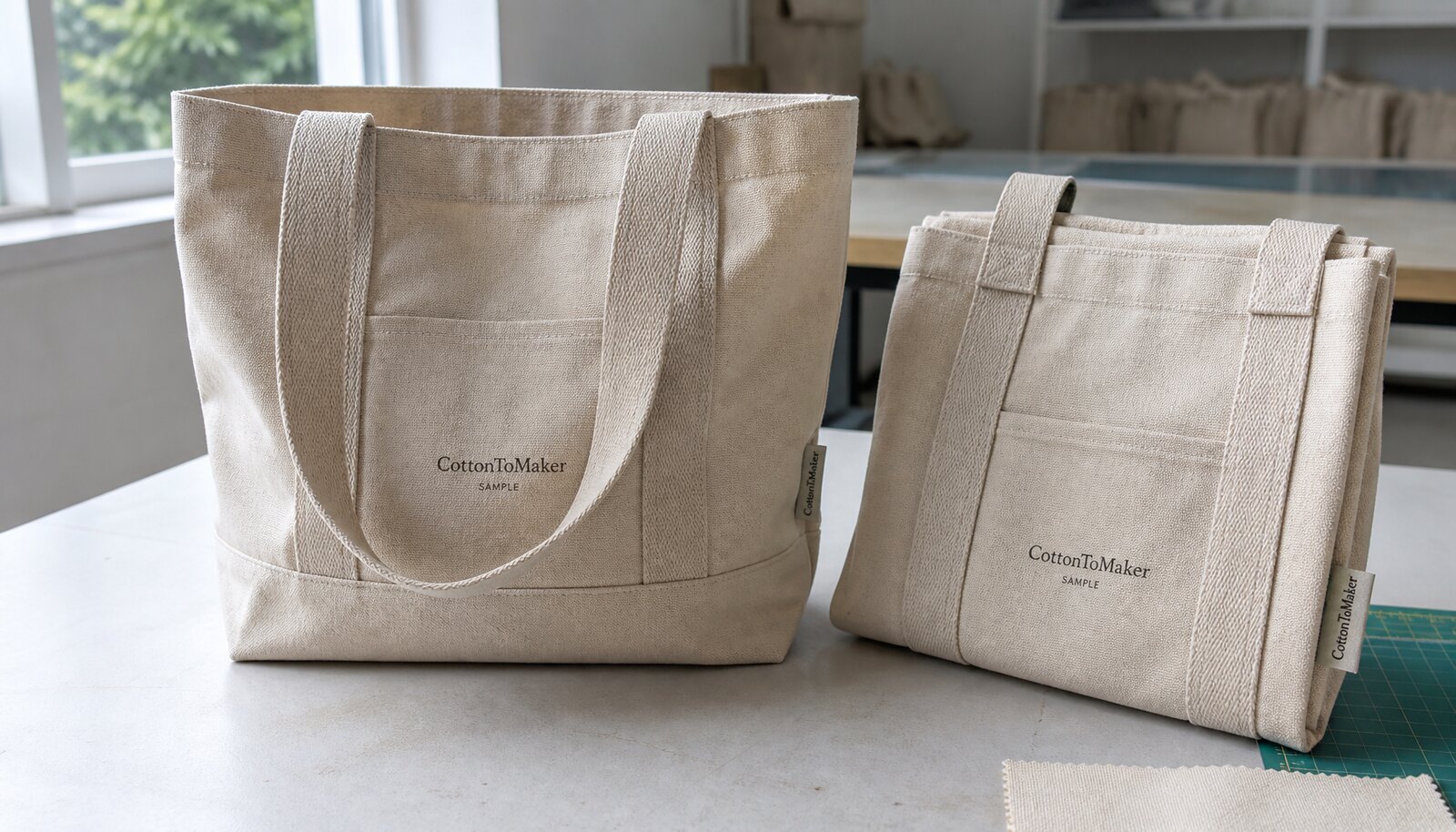
Start with the job the tote has to do
Museum teams do not buy canvas totes for one reason. The same bag can sit in a museum shop as a resale item, move through a book fair as a utility carrier, serve as a member gift, or be packed with a catalog, a program guide, and small merch. Those are different use cases, and they should not share the same spec by default. A tote that looks fine as an event handout can feel too thin on a retail shelf. A tote that feels premium in the shop can be too heavy, too stiff, or too expensive for a one-day program.
The buying decision gets easier when the primary use is named explicitly. If the tote is a resale item, the priorities are shelf presence, repeatability, and controlled decoration. If it is a giveaway, freight volume and speed matter more. If it is a member gift, the hand-feel and print quality matter because the bag is part of the membership experience. If it is a pack-in item, the question is whether it folds cleanly, packs tightly, and survives distribution without looking tired when it reaches the buyer.
- Write the primary use case into the RFQ.
- State the secondary use case if the same tote must serve two channels.
- Decide early whether the tote needs to look retail-ready or merely functional.
Write the body spec around load, structure, and shelf presence
For many museum programs, the body cloth lands in the 12 oz to 16 oz range, roughly 340 to 450 GSM, because that range balances structure, print readability, and freight cost. Lower weights can work for lighter event packs, but they can feel limp and may twist at the seams when books are loaded unevenly. Heavier canvas improves the perceived value and gives the tote a more stable shape, but it also raises sewing effort and freight weight. That tradeoff is commercial, not just aesthetic.
Structure matters just as much as cloth weight. A boxed bottom and side gusset give the bag usable volume for hardcovers, exhibition catalogs, and gift items. A flat tote can be cheaper, but it is less efficient for book fair traffic and less convincing on a shop shelf. Ask the supplier to quote the cut size and the finished size separately, then state the tolerance in millimeters. For the handle, the bag needs a defined drop, a comfortable width, and reinforcement at the attachment points. A museum buyer should ask for handle symmetry, stress-point stitch detail, and seam finish, not just the finished overall size.
- Lock finished dimensions, not only cut dimensions.
- State the target load in kilograms or pounds.
- Specify handle width, handle drop, and gusset depth.
- Require a sample that shows the final seam finish and not just the silhouette.
Use the comparison table to compare real tradeoffs
The table is meant to make the quote review practical. A lower unit price is not meaningful if it comes with lighter cloth, weaker handles, a poor carton plan, or a print method that cannot reproduce the mark cleanly. On paper, two quotes can look close. In production, they can be very different because one supplier is quoting a more robust build and the other is trimming out detail that the buyer will have to rediscover during sample review.
For that reason, compare suppliers against the same spec version and the same acceptance standard. Ask each factory to show where it is taking cost out of the bag. The important questions are not only what the price is, but what changed to get there, whether the change affects shelf presentation or load performance, and whether the change creates a second round of approval before bulk production can start.
Build the RFQ so the quote can actually be used
A useful RFQ is not a wish list. It is a document that forces every supplier to answer the same commercial question. Include one spec sheet with the tote dimensions, fabric weight, handle details, color references, artwork file, print method, packing format, and destination requirements. If the tote will be sold in the museum shop, say so. If it will be distributed by branch or by store, say that too. If the tote must land in a DC with barcode receiving, the carton and label plan needs to be in the RFQ from the start.
It also helps to separate quote content into five blocks: product spec, artwork spec, packing spec, commercial terms, and quality requirements. That keeps the supplier from hiding important assumptions inside a single line item. For example, a supplier can quote the same tote at a very different cost if it is assuming a lighter cloth, a looser handle spec, or retail polybags that the buyer never asked for. The point of the RFQ is to remove that ambiguity before the order is placed.
- Use one spec version for every bidder.
- State whether the order is for resale, giveaway, or pack-in use.
- Require carton dimensions and piece counts in the quote.
- Ask for the lead time broken into sample, materials, production, packing, and dispatch.
Approve the sample like a production buyer
The sample process should be treated as a gate, not a formality. A blank sample proves very little. It does not show how the print behaves on real canvas, whether the handles sit evenly, or whether the tote still looks clean after folding and carton packing. The sample that matters is the pre-production sample made from final cloth, final trims, final print method, and final packing format. That sample should be signed off against the approved spec, not against memory.
Artwork control needs the same discipline. Send vector files, outline fonts, and define the smallest readable text and the thinnest line the factory is allowed to reproduce. Museum artwork often looks simple, but that simplicity can hide tight registration risks or fine details that break on coarse canvas. Keep a sealed master sample and keep the approval note with the revision date, because reorders drift when a plant changes ink, cloth lot, or stitching settings.
- Reject any sample with the wrong artwork revision.
- Reject visible print shift beyond the approved tolerance box.
- Reject handle asymmetry that is obvious in hand or by measurement.
- Do not approve a production run from a blank or incomplete sample.
Compare sourcing routes before you lock the supplier
Direct factory sourcing is usually the strongest choice when the museum wants repeatability. It gives better visibility into cloth, sewing, print placement, and corrective action. If the tote will be reordered across seasons or branches, it is easier to keep the spec stable when the same team is quoting, sampling, and producing the bag. The tradeoff is that the buyer has to manage more detail and cannot rely on a middle layer to clean up the spec.
Trading companies and merchandisers can be useful when the program involves several SKUs, multiple destinations, or a buyer team that wants one contact point for coordination. That can simplify administration, but it also creates a risk that the real maker is hidden from view. A domestic converter can make sense when the final program needs local labeling, last-mile customization, or a faster turnaround on small reorders. The rule is simple: if the buyer cannot identify who sews, who prints, and who owns the corrective action path, the sourcing route is too opaque for a repeat museum program.
- Ask who owns sewing, printing, packing, and corrective action.
- Ask whether the quote is coming from the maker or a middle layer.
- Ask how samples are approved and where the final production happens.
Treat packing and labels as part of the product
Packing can save or waste money quickly. A tote that is folded too loosely wastes carton volume. A tote that is folded too aggressively can arrive with a crease across the front panel that makes it look discounted before it reaches the shelf. Bulk packing by style and color is usually the best balance for museum programs that care about landed cost. Individual polybags make sense only when the retail channel needs them for dust control, barcode presentation, or a premium shelf look.
If the order ships to a central distribution center or to multiple branches, carton labeling should be treated as a production requirement, not as a shipping afterthought. Put style, color, PO, quantity, branch code if needed, and a scannable barcode on every case label. If the warehouse scans cartons, confirm the barcode format before production begins and ask for a carton photo or label proof before the shipment leaves the factory. Mixed cartons, missing labels, and inconsistent counts create receiving delays that add no value.
- Specify bulk pack or individual pack before quoting.
- Define carton label content and barcode format.
- Confirm whether palletizing, stretch wrap, or moisture protection is required.
- Ask for a carton photo proof before dispatch.
Set QC thresholds that match actual museum use
QC should follow the way the bag will be used, not a generic checklist. For museum book fair totes, the key risks are seam failure, handle failure, print misplacement, shade inconsistency, and packing errors. A simple QC workflow works well: review the approved documents, inspect the pre-production sample, do an inline check at the start of production, and then run a final random inspection before release. That sequence catches both process errors and output defects.
It also helps to classify defects by severity. Critical defects are issues that make the tote unusable or wrong for the order, such as an open seam, the wrong artwork, or a mixed color lot that cannot be sold as planned. Major defects are problems that affect function or presentation, such as a handle that is visibly crooked, print shift outside the tolerance box, or a size failure that breaks packing. Minor defects are cosmetic issues that do not stop use but still need a limit, such as stray threads or slight fold marks. If the lot fails, the corrective action should be clear: accept, sort, rework, or reject.
- Use AQL only as the final lot gate, not as the whole QC plan.
- Start with a critical 0 standard unless your house policy says otherwise.
- Set explicit reject triggers for seams, handles, print, shade, and carton count.
- Require photo evidence for any lot that is sorted or reworked.
Manage MOQ, lead time, and reorders as one program
MOQ is rarely a single number. It changes with body color, print count, handle spec, and whether the cloth is stock or custom dyed. The most efficient starting point is usually one body color, one print, and one size on stock natural canvas. As soon as the program adds more than one decoration method, a custom body shade, or multiple pack formats, the setup cost rises and the lead time becomes less predictable. That is not a problem if the buyer expects it and prices it correctly.
Lead time is easier to control when it is broken into steps: artwork approval, sample production, material booking, bulk sewing, packing, and dispatch. That makes the delay source visible. For annual book fair programs, the strongest control move is to standardize the base bag and change only the artwork or secondary label from season to season. Keep the same body cloth, the same handle spec, the same carton rules, and the same master sample. That reduces the chance that a reorder becomes a new development project.
- Treat artwork changes as the main variable and keep the base bag stable.
- Keep a sealed master sample with the spec version attached.
- Do not let the supplier substitute cloth, handle tape, or packing format without written approval.
- Break the schedule into sample, production, packing, and transit so slippage is visible early.
Specification comparison for buyers
| Spec decision | Recommended starting point | Tolerance or acceptance rule | Commercial tradeoff | Reject if |
|---|---|---|---|---|
| Fabric weight and weave | 12 oz to 16 oz natural canvas, roughly 340 to 450 GSM, with a stable plain weave and no obvious thin spots | Target the approved GSM within about plus or minus 5 percent and inspect for shade streaks, slubs, weak weave, or uneven finishing | Lower weights cut freight and sewing cost; heavier cloth improves shelf presence and load feel but raises material and carton weight | The cloth looks limp, shows thin areas under light, or drifts so far from the approved sample that the bag will not present consistently |
| Finished body size and gusset | Quote both cut size and finished size for the body, with a boxed bottom and side gusset if the bag must hold books or catalogs | Use a finished size tolerance around plus or minus 5 mm on body dimensions and keep gusset depth consistent across the lot | Tighter sizing improves packing and shelf consistency; oversized variation creates carton inefficiency and receiving problems | The tote cannot stand as specified, the gusset depth varies visibly, or the finished size breaks the packing plan |
| Handle construction | 25 to 30 mm cotton webbing, reinforced with bar tacks or an equivalent stress-point stitch pattern, with a defined handle drop | Hold handle drop to about plus or minus 3 to 5 mm, keep left and right handles symmetrical, and require consistent bar-tack count and placement | Better reinforcement adds a small sewing cost but materially reduces failure risk on book loads and repeat-use retail bags | Handles are twisted, asymmetrical, too short for comfort, or show loose stitching, skipped stitches, or weak anchoring |
| Top edge and internal seams | Double-turned top edge with clean internal seam finishing, especially if the tote will be sold in a museum shop | No raw edge exposure, no visible fraying after handling, and no skipped stitches or puckering beyond the approved sample | Cleaner finishing raises unit cost slightly but improves perceived value and reduces shelf complaints | Raw edges are exposed, seams pucker badly, or the tote sheds loose threads during inspection |
| Decoration method | One to two color screen print for the main mark, with woven label or embroidery only where it adds value and does not replace the front logo | Print placement should stay within about plus or minus 2 mm of the approved artwork box and match the strike-off closely | Screen print is usually the most economical readable option; embroidery and woven labels add premium cues but can increase cost and sampling time | Fine text is unreadable, lines break up on canvas, the logo shifts out of position, or ink bleeds, cracks, or patches |
| Color control | Natural body cloth with an approved strike-off for the logo color, rather than custom-dyed body fabric unless the program truly needs it | Use the approved physical sample as the master reference and, if the factory measures color, set a delta E target around 2.5 for print and 3.0 for body cloth | Natural body cloth shortens lead time and lowers shade risk; custom dye adds approval steps and can make reorders harder to match | The lot mixes shades, the print color is visibly off from the approved sample, or the body cloth no longer matches the accepted reference |
| Packing format | Bulk pack by style and color with carton labels by branch, store, or DC lane; add polybags only when the retail channel needs them | Carton count must match the packing list exactly, labels must be readable, and folding should not crease the front panel beyond the approved level | Bulk packing lowers labor and volume; retail-ready packaging adds cost but may be required for shelf presentation or barcode handling | Mixed styles appear in the same carton, count is wrong, labels are missing, or the tote arrives creased and unsellable |
| Supplier type | Direct factory for repeat museum programs; trader or merchandiser when you need consolidation; domestic converter when local finishing or compliance matters | The quote must name the actual sewing and printing site, the party that owns corrective action, and the person responsible for sample approval | Direct factory gives better cost transparency and process control; a middle layer can simplify coordination but may hide the real producer | The supplier cannot identify the maker, cannot explain who approves the sample, or cannot show a corrective-action path if the lot fails |
Buyer checklist before sampling
- Define the primary use case before you request quotes: museum shop resale, book fair giveaway, member gift, internal carry bag, or pack-in item.
- Lock the finished dimensions, gusset depth, and handle drop in millimeters, and state the acceptable tolerance on the RFQ.
- Choose the body cloth weight and finish based on load and presentation, not on price alone.
- Specify the decoration method, approved color references, minimum line thickness, and any no-go artwork details such as tiny text or gradients.
- Send a clean vector file and name one internal approver for art, one for quality, and one for commercial signoff.
- State whether the order needs bulk packing, individual polybags, branch-level cartons, or DC-friendly master cartons.
- Ask for a pre-production sample made with final fabric, final trims, final print method, and final packing format.
- Request carton dimensions, piece count per carton, net and gross weight, and any pallet pattern before you approve the PO.
- Ask the supplier for a written QC plan that separates critical, major, and minor defects and defines the inspection method.
- Freeze the spec version and keep a sealed master sample so the reorder cannot drift across cloth lots, inks, or packing formats.
Factory quote questions to send
- What exact fabric construction, GSM, and finished fabric width are you quoting for the tote body?
- What cut size and finished-size tolerance do you hold for body, gusset, handle drop, and print placement?
- What handle tape width, reinforcement pattern, and stitch count are included in your price?
- What decoration method are you pricing, how many colors are included, and what registration tolerance do you hold?
- Can you produce a pre-production sample using final materials and the final packing format, and what is the approval lead time?
- What is the MOQ by size, color, artwork variant, and packing format, and how does the price change if we split the order?
- What carton count, carton dimensions, net weight, and gross weight are included in the quote?
- Who is the actual sewing and printing facility, and who owns corrective action if the sample or bulk lot fails?
- What defects are treated as critical, major, and minor in your inspection process?
- What is the realistic schedule from art approval to ex-factory date, and which step is most likely to move if there is a delay?
Quality-control points to confirm
- Verify the approved spec version, artwork version, and packing version before the first inspection. A mismatch at this stage is a process failure, not a minor defect.
- Check fabric weight against the approved tolerance band, and inspect for thin spots, shade streaks, weave distortion, or visible contamination.
- Measure finished body size, gusset depth, and handle drop after pressing or conditioning, not only at the cutting stage.
- Inspect seam quality for skipped stitches, loose threads, seam puckering, open edges, or weak stress points around the handle attachment.
- Check print placement, artwork orientation, and registration against the approved strike-off. A common rejection trigger is visible shift beyond the agreed tolerance box.
- Perform a simple rub check on the approved test cloth and reject visible transfer, smearing, cracking, or patchiness that would be obvious on a retail shelf.
- Run a load test at or above the expected carry weight for the program. Reject any seam opening, handle tear, or visible distortion that appears under that load.
- Reject mixed shade lots, oil marks, stains, water spots, or any odor that would create an immediate receiving complaint.
- Verify carton count, style, color, PO, branch code, and barcode readability before release. Wrong counts and wrong labels are receiving failures, not cosmetic issues.
- Use AQL as a lot gate if your team wants a formal plan. A common starting point is critical 0, major 2.5, minor 4.0, then adjust for your risk profile and buyer standard.