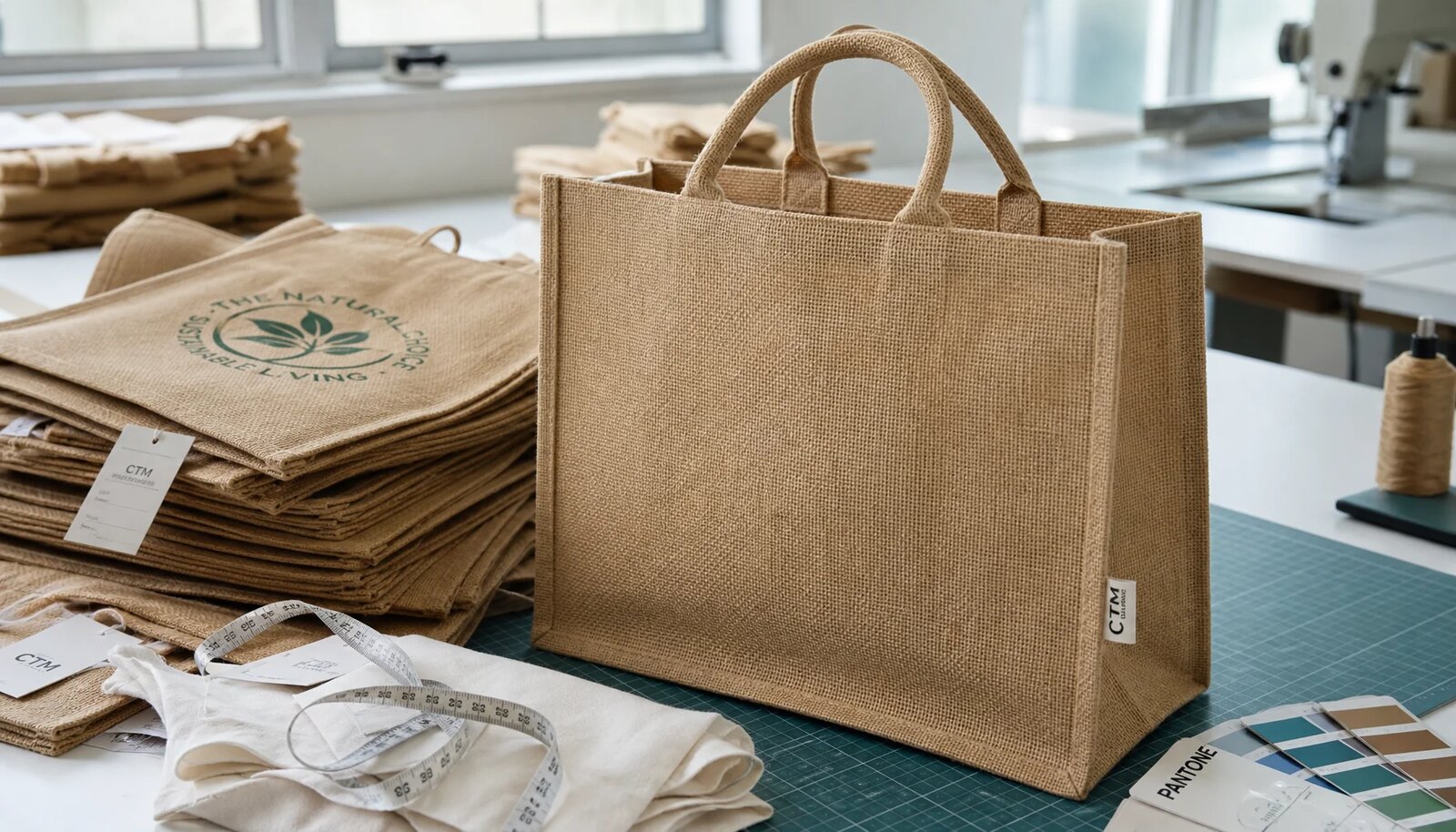
Start with the bag's commercial job, not the lowest MOQ
A strong MOQ negotiation for wholesale jute tote bags starts with the job the bag must do. Eco apparel brands may use the same general tote format for retail checkout packaging, resale accessories, gift-with-purchase programs, wholesale account kits, trade-show carriers, launch mailer inserts, or seasonal packaging. In a product photo those uses can look almost identical. In production, they are different orders. A resale tote needs stronger stitching, cleaner finishing, and more consistent dimensions than a short-run event carrier. A boutique shopping bag may need a sharper logo and better crease control than a warehouse insert.
The weakest opening question is usually, "What is your lowest MOQ?" It sounds direct, but it leaves the supplier to imagine the product. One factory may assume lightweight natural jute, standard cotton web handles, one-color screen print, and bulk flat packing. Another may assume laminated jute, reinforced handles, individual packing, and retailer carton marks. Both quotes can be honest. They are still not comparable.
A better opener is, "For this exact finished spec, what is the MOQ, and which input drives it?" MOQ may be tied to fabric purchasing, cutting table efficiency, handle webbing minimums, screen setup, printing spoilage allowance, label production, carton packing labor, or the factory's willingness to pause a larger line. Once the binding input is visible, procurement has something useful to negotiate. If screen setup is the problem, reduce artwork versions. If handle webbing is the problem, use a stock color. If cutting efficiency is the problem, simplify the size or gusset before weakening the whole bag.
- Define the use case before choosing gsm, handle, reinforcement, print, and packing.
- Ask which input creates the MOQ instead of treating MOQ as one fixed factory rule.
- Compare suppliers only after the same finished construction and packing method are quoted.
Translate the idea into a measurable jute tote spec
A procurement-ready RFQ turns a loose concept into production language. For jute tote bags, the minimum useful specification includes finished width, finished height, gusset depth, fabric gsm, natural or dyed shade, laminated or unlaminated finish, handle material, handle width, handle drop, reinforcement method, print method, print size, print placement, label or trim details, packing method, carton marks, tolerances, and target delivery date. Every blank field becomes a place where suppliers make different assumptions.
Fabric weight deserves careful wording. Laminated jute in the 260-330 gsm range is often used for structured promotional and retail totes because lamination adds body and helps the panel hold shape. Natural unlaminated jute may need a higher target, often around 340-450 gsm depending on bag size and expected load, to feel substantial. These are planning ranges, not universal rules. Weave density, fiber quality, finishing, and lamination can make two fabrics with similar gsm behave differently. That is why physical swatches are more useful than gsm alone.
Dimensions should be defined with measurement points. Many soft jute tote programs work around +/-1 cm for width and height and +/-0.5-1 cm for gusset and handle drop, but the correct tolerance depends on construction and retailer expectations. State how the inspector measures: width across the front panel, height from bottom seam to top edge, gusset measured flat at the side fold, and handle drop from the top edge to the inside top of the handle. If the tote must fit folded hoodies, boxed sets, tissue-wrapped garments, or a printed insert, test the actual contents in the sample before approval.
- Use measurable terms: gsm, centimeters, Pantone references, stitch type, handle width, carton count, and tolerances.
- State whether the tote must stand upright, fold flat, carry a target weight, or protect a premium retail presentation.
- Request both fabric swatches and a full finished sample when handfeel, odor, print, or structure matters.
Separate base-bag MOQ from decoration MOQ
MOQ usually improves when the buyer reduces variation. A factory may support a lower first order if the program uses one bag size, one fabric shade, one handle material, one print location, one print method, and one packing method. Every added variable creates setup time, sorting risk, leftover materials, and inspection complexity. A launch program with three jute shades, four handle colors, and five artworks is not one production run. It is a group of small runs under one purchase order.
One practical tactic is to separate the blank bag from the decoration. If an apparel brand needs multiple seasonal graphics, ask whether the supplier can produce one blank jute tote construction and print separate artwork lots from that shared base. Cutting and sewing stay efficient, while the brand keeps some creative flexibility. The supplier may still require a minimum per artwork because screens, ink setup, strike-offs, and inspection are separate. Even so, the program is easier to negotiate than changing bag size, fabric, and handle for every graphic.
Quantity bands tell a clearer story than one MOQ number. Ask for 500, 1,000, 2,500, 5,000, and 10,000 pieces on the same spec. If the unit price drops sharply between 500 and 1,000 and then flattens, setup cost is probably being absorbed early. If the price keeps improving at higher quantities, material purchasing or line efficiency may matter more. Procurement can then decide whether to place a pilot order, increase volume, or negotiate a committed reorder without buying inventory blindly.
- Ask for MOQ per base bag, per artwork, per print color count, and per packing method.
- Use standard fabric shade and handle materials when low first-order quantity is important.
- Read the quantity-band price curve before deciding whether higher volume is worth the inventory risk.
Normalize quotes before comparing unit price
A low unit price is useful only when the same product and commercial terms are being compared. In jute tote sourcing, a supplier can lower price by reducing gsm, using a looser weave, shortening the handle drop, removing reinforcement, changing print method, reducing carton quality, packing bags more tightly, or excluding screen and sample charges. None of those decisions is automatically wrong. Hidden decisions are the problem.
Build a quote comparison sheet with one row per supplier and one column for every cost-sensitive item. Include finished size, gsm, lamination, handle material, handle width, handle drop, reinforcement, print method, print color count, print size, label or trim, sample fee, screen charge, packing method, pieces per carton, carton CBM, lead time, incoterm, payment terms, quote validity, inspection responsibility, and documentation included. If a field is blank, treat it as an open commercial risk until it is answered.
Incoterms need the same discipline. EXW, FOB, CIF, and DDP quotes are not interchangeable. For a fair comparison, ask suppliers to quote the same incoterm and handoff point, or separate product cost from logistics cost in your landed-cost model. The cheapest factory price may not be the cheapest landed option if carton volume is high, packing is inefficient, inspection is excluded, or documentation support is weak.
- Compare unit price only after gsm, handle, print, packing, carton data, and incoterm match.
- List excluded charges separately so setup costs stay visible in the purchasing decision.
- Ask for quote validity because jute, freight, and currency movements can affect repeat pricing.
Negotiate MOQ with operational trade-offs
Good MOQ negotiation gives the supplier a practical reason to say yes. Instead of only pushing for a smaller run, offer a simpler run. You might accept an in-stock natural jute shade, use standard cotton webbing, keep one print position, reduce print colors, approve bulk flat packing, or consolidate artwork versions. These choices reduce setup pressure while preserving the construction details that affect customer experience.
Negotiate the first order and reorder together. For example, ask for a manageable first production quantity with a written reorder price and a lower repeat MOQ once the approved sample, screens, artwork, carton marks, and production notes already exist. This works well for eco apparel brands testing retail demand, wholesale partner uptake, or a seasonal drop. It limits overbuying while giving the supplier a more credible path to repeat business.
Payment timing and approval discipline can also influence flexibility. Suppliers are more likely to consider a smaller run when artwork is final, buyer feedback is fast, deposits are on schedule, and the production window avoids peak capacity. Still, do not trade away sample approval, written tolerances, or inspection rights. A lower MOQ is not a win if the bags arrive with weak handles, poor print coverage, strong odor, or carton count errors.
- Offer simplification: standard shade, standard handles, one base style, fewer artworks, and one packing method.
- Negotiate repeat-order MOQ, price validity, and screen retention while discussing the first order.
- Protect sample approval, tolerances, and QC rights even when pushing for a lower minimum.
Design artwork for the jute surface
Jute is coarse, absorbent, and naturally uneven compared with cotton canvas or synthetic fabrics. That texture affects print clarity. Fine lines, tiny type, tight gaps, gradients, and pale ink colors can lose definition. Screen print is often the most predictable option for bold one- or two-color logos at wholesale volume. Heat transfer can work for complex artwork or shorter runs, but adhesion, edge behavior, and handfeel need testing on the actual jute surface. Embroidery, woven patches, or leather-look patches can create a more premium result, but they change cost, MOQ, lead time, and inspection criteria.
Artwork files should be prepared for manufacturing, not just presentation. Provide vector artwork, Pantone references, exact print dimensions, and placement measurements from the top edge and side seam. Ask the supplier to confirm minimum line thickness, minimum gap between shapes, smallest readable type size, and print registration tolerance. For many jute screen-print programs, buyers should be cautious with very thin lines under roughly 1 mm and small text under roughly 6-7 pt, but the supplier should confirm limits based on mesh, ink, fabric, and print area.
A print strike-off is a production control step. It should use the actual jute material and the intended print method. Review it under normal store-like light and at close range. Natural jute background color will affect ink appearance, so exact paper-based color matching is not realistic. Define an acceptable visual range and keep a sealed approved strike-off or sample for bulk inspection. If the logo is central to brand presentation, do not approve bulk printing from a digital mockup alone.
- Use bold artwork and limited colors when MOQ flexibility and print consistency matter.
- Confirm line, gap, type, placement, and registration limits before sample making.
- Approve a strike-off on actual jute and keep it as the inspection reference.
Use samples as a production control gate
A sample is not just a buyer preview. It is the best point to catch construction, fit, print, odor, and packing problems before they repeat across bulk production. Test the sample with the real product or an accurate weight equivalent. If the tote will carry folded apparel, put the garment stack inside. If it will hold boxed accessories, test the box corners against the gusset and seams. If it will be sold as an accessory, inspect it as a finished retail item, not a disposable carrier.
Use a written sample approval checklist. Measure width, height, gusset, handle width, handle drop, print size, print placement, and top-edge straightness. Inspect stitch tension, stitch density, skipped stitches, thread ends, handle symmetry, seam fraying, bottom corners, label placement, stains, odor, lamination bubbles, and inside cleanliness. Jute can have natural slubs and fiber variation, but oil marks, mildew odor, broken fibers, open seams, and weak handle attachment should not be excused as natural character.
When revisions are needed, separate must-fix items from preferences. A handle that fails a load test, a bag that does not fit the product, a print that is badly misregistered, or an odor that remains after airing is a production issue. A small natural shade variation may be acceptable if it matches the approved swatch range. Send correction notes with marked photos, measurements, and pass/fail language. Final approval should reference a dated sample, spec sheet, artwork file, strike-off, and packing instruction.
- Approve samples against written criteria, not memory or a photo alone.
- Test fit, carrying performance, odor, print, and packing behavior before bulk approval.
- Keep one sealed approved sample with the supplier and one with the buyer or inspector when possible.
Define QC standards before production starts
Quality control for jute totes needs more than a final glance at finished bags. Jute naturally includes slubs, color variation, and surface irregularity, so buyers should define which variations are acceptable and which are defects. Critical defects include unsafe sharp objects, mold, strong chemical or mildew odor, wrong branding, wrong material, broken handles, severe contamination, or goods that cannot be sold. Major defects may include wrong size outside tolerance, weak handle stitching, open seams, severe stains, visible print misalignment, lamination bubbles, wrong carton count, or incorrect artwork. Minor defects may include small loose threads, slight shade variation, or small fiber irregularities that do not affect appearance or function.
If using AQL inspection, agree on inspection level and defect classifications before production. Many consumer soft goods programs use general inspection levels with separate acceptable quality limits for critical, major, and minor defects, but the exact plan should match order risk and buyer requirements. If the supplier uses an internal inspection method instead, ask to see the checklist and sampling approach. For a new supplier, new construction, or time-sensitive launch, inline inspection is useful because it catches sewing, handle, and print issues before the full order is packed.
Handle testing should be practical and repeatable. Define load weight, hold time or lift cycles, number of samples, and pass/fail criteria. The test weight should reflect expected contents plus a reasonable margin. Record where any failure occurs: handle webbing, stitch line, top hem, side seam, or fabric tear. Print checks should include placement, registration, rub resistance, cracking after folding, and color acceptability against the approved strike-off. Odor checks should happen before final carton sealing, because sealed cartons can intensify odor complaints.
- Classify critical, major, and minor defects before inspection begins.
- Inspect dimensions, stitching, handle strength, print, odor, stains, lamination, labels, and carton count as separate checkpoints.
- Use inline checks for new programs, complex decoration, tight timelines, or suppliers without a proven history.
Plan packing, cartons, and moisture control early
Packing affects landed cost, receiving accuracy, and retail appearance. Jute totes can crease, absorb odor, collect dust, or deform if packed carelessly. Bulk flat packing is often efficient and may reduce packaging material, but cartons should not be overloaded or compressed so tightly that front panels and logos arrive with hard creases. Individual packing can protect cleanliness and simplify distribution, but it increases labor, material use, carton volume, and sometimes conflicts with eco packaging goals.
Carton data belongs in the quote stage, not after production. Ask for pieces per carton, carton dimensions, gross weight, net weight, estimated CBM, inner bundle method, carton board strength if relevant, and carton mark format. These details allow logistics to estimate freight, storage, and warehouse labor. If individual packing increases volume significantly, the lowest unit price may not produce the lowest landed cost. For wholesale or retailer-directed programs, carton marks may need PO number, style number, artwork or color, quantity, carton number, country of origin where required, and destination details.
Moisture control is important because jute is a natural fiber. The right approach depends on route, season, warehouse conditions, and buyer packaging policy. Options may include dry storage before packing, moisture checks, carton liners, desiccants where appropriate, and avoiding damp cartons or floor storage. The goal is not excessive packaging. It is preventing mildew, odor, staining, carton collapse, and retailer complaints. Also confirm folding method. A fold through the logo or inconsistent bundle shape can create extra warehouse labor and reduce presentation quality.
- Quote bulk, inner-bundle, and individual packing options separately with CBM impact.
- Confirm carton marks, count method, folding method, and moisture protection before PO award.
- Evaluate packing by total landed cost and retail condition, not unit price alone.
Build the timeline around approval gates and reorders
Lead time should be broken into steps: RFQ clarification, swatch approval, artwork review, print strike-off, pre-production sample, sample shipment, buyer review, corrections, final approval, material purchase, cutting, printing, sewing, finishing, inspection, packing, documentation, and export readiness. A supplier's "30-45 days" may mean production after all approvals, not the full sourcing calendar. For a new eco apparel launch, the approval phase can take longer than sewing if artwork, size, handle, or packing decisions move slowly.
The most common delays are incomplete artwork, unclear revision comments, unavailable handle webbing, print strike-off failure, custom dyed jute, lamination odor, late carton mark approval, and peak-season capacity. Procurement can reduce delay by sending complete files, consolidating decision makers, approving standard materials, and providing sample feedback in one clear round. Vague comments slow the line because the supplier has to guess, redo, or wait.
Reorder planning should be negotiated before the first PO is closed. Ask how long the supplier will keep screens, approved samples, labels, and production notes. Confirm whether the same base bag can be reordered with new artwork, what MOQ applies to artwork-only changes, and how pricing changes if jute cost or exchange rate moves. For apparel brands with recurring seasonal drops, the best wholesale jute tote bag program is not only a successful first order. It is a repeatable spec that procurement, design, logistics, and retail teams can use without renegotiating every detail from zero.
- Separate sample lead time from production lead time in the launch calendar.
- Treat sample, strike-off, spec sheet, and packing approval as formal gates.
- Negotiate repeat MOQ, screen retention, artwork-change terms, and price validity before the first order ships.
Specification comparison for buyers
| Procurement decision | Best-practice RFQ position | What to ask the supplier to confirm | Buyer risk if left vague |
|---|---|---|---|
| MOQ structure | Quote MOQ by finished style, fabric color, handle color, print design, print color count, label or trim option, and packing method. | Which input fixes the minimum: jute fabric lot, cutting efficiency, handle webbing MOQ, screen setup, lamination, carton packing labor, or shipment consolidation? | A low headline MOQ can rise after artwork, handle color, packing, carton marks, or shipment details are finalized. |
| Fabric weight and finish | State target gsm, weave density, natural or dyed shade, laminated or unlaminated finish, backing material if laminated, and required handfeel. | Can you provide swatches and written tolerances for gsm, shade, odor, lamination adhesion, panel matching, and moisture condition? | A cheaper quote may rely on lighter cloth, loose weave, brittle lamination, uneven shade, or a finish that creases, smells, or prints poorly. |
| Finished size and gusset | Define finished width, height, gusset, seam allowance expectation, pressing method, and measurement points. | Are measurements taken flat after pressing and before packing? What tolerance do you apply to width, height, gusset, and handle drop? | Small measurement drift can stop folded apparel, boxed sets, inserts, or retail kits from fitting consistently. |
| Handle construction | Specify cotton webbing, jute webbing, rope, or self-fabric handles with width, drop, reinforcement, thread type, and stitch pattern. | What is the handle width, drop length, stitch density, X-box or bartack detail, and load test method? | Weak attachment, narrow webbing, poor symmetry, or loose stitching can cause failures during store handling and customer reuse. |
| Print and decoration | Match artwork to the jute surface: screen print for bold logos, transfer only after adhesion testing, embroidery or patchwork for premium programs. | What are the minimum line thickness, smallest readable type size, color limit, registration tolerance, curing method, and expected ink behavior on this material? | Fine detail may blur, pale inks may lose contrast, transfers may lift, and embroidery may distort coarse panels without a tested sample. |
| Brand color and placement | Define Pantone references, logo size, print location from top and side edges, label position, and acceptable placement tolerance. | Will you make a strike-off on actual jute and keep one sealed approved sample for bulk inspection? | Brand marks may shift, ink color may change against natural jute, or labels may sit unevenly across production lots. |
| Packing and cartonization | Quote bulk flat pack, inner bundles, and individual pack options separately with pieces per carton, carton size, gross weight, net weight, and CBM. | How will bags be folded, protected from moisture, counted by carton, marked, and palletized if required? | Packing changes can alter freight cost, crease risk, warehouse labor, receiving accuracy, and sustainability claims. |
| QC standard | Set measurable inspection points for dimensions, gsm, stitching, handle strength, print, odor, stains, lamination, inner cleanliness, and carton count. | Which AQL level or sampling plan is used? How are critical, major, and minor defects defined for this style? | The order may pass a casual visual check while failing on repeated retail defects that were never classified. |
| Compliance and documentation | Confirm fiber composition, country of origin marking, care or handling notes if needed, restricted substance expectations, and retailer documentation. | Can the supplier provide composition declaration, packing list, commercial invoice details, inspection records, and any requested test report before shipment? | Missing or inconsistent documents can delay customs, retailer receiving, or internal sustainability review. |
Buyer checklist before sampling
- Define the tote's buying job first: retail shopping bag, resale accessory, gift-with-purchase, wholesale account kit, event carrier, e-commerce insert, or seasonal packaging item.
- Create one master spec sheet before quoting: finished width, height, gusset, fabric gsm, finish, handle material, handle width, handle drop, stitch reinforcement, thread color, print method, artwork size, placement, packing, carton marks, and tolerances.
- Set practical tolerances before RFQ. Many jute tote programs use about +/-1 cm for width and height, +/-0.5-1 cm for gusset and handle drop, and about +/-5% for gsm, but confirm what is realistic for the chosen construction.
- Ask suppliers to quote the same quantity bands, such as 500, 1,000, 2,500, 5,000, and 10,000 pieces, using the same spec, packing, incoterm, currency, and quote validity period.
- Separate base bag MOQ from decoration MOQ. Confirm whether the minimum applies per blank bag construction, per fabric color, per handle color, per print artwork, per print color count, or per shipment.
- Limit first-order variation where possible. Use one base construction and ask whether multiple graphics can be printed as separate artwork lots on the same blank tote.
- Provide vector artwork with Pantone references, exact print size, placement from top and side edges, minimum line thickness concerns, and any small type that must remain legible.
- Request material swatches before a full sample, especially for natural shade, dyed jute, lamination, lining, colored handles, or light-color printing.
- Approve a print strike-off on the actual jute fabric before bulk printing when logo color, edge sharpness, or ink coverage matters.
- Define sample approval criteria in writing: size, gusset, handle drop, handle alignment, stitch density, loose threads, print registration, ink coverage, odor, stains, lamination bubbles, label placement, and packing condition.
Factory quote questions to send
- What exact jute fabric are you quoting, including gsm, weave, natural or dyed shade, lamination or coating, backing material if laminated, and fabric shade/gsm tolerance?
- Is the MOQ calculated per finished style, fabric color, handle color, print design, print color count, label option, packing method, or shipment? Which factor is the binding constraint?
- Can you quote the same finished bag at 500, 1,000, 2,500, 5,000, and 10,000 pieces without changing gsm, handle, print method, packing, carton quality, or incoterm?
- What is included in the unit price, and what is separate: sample fee, screen charge, artwork setup, embroidery digitizing, woven label, hangtag loop, carton printing, inner packing, inspection, documentation, or bank fees?
- What tolerances do you use for finished width, height, gusset, handle drop, handle width, print placement, print registration, gsm, shade, and carton count?
- Which print method do you recommend for this artwork on this jute surface, and what minimum line thickness, minimum gap, smallest readable type, color limit, and curing process should we follow?
- Can you produce a material swatch, print strike-off, and full pre-production sample, and will you keep one sealed approved sample for production and final inspection reference?
- How do you control odor and moisture risk for jute, laminated panels, printed panels, adhesives, and packed cartons before shipment?
- How do you test handle strength and seam durability? Please confirm load weight, hold time or lift cycles, number of samples, and where failures usually occur.
- What AQL level or inspection approach do you support for final inspection, and how do you classify critical, major, and minor defects for jute tote bags?
Quality-control points to confirm
- Verify fabric gsm against the approved swatch or test report range. A common purchasing tolerance is about +/-5%, but the accepted range should be written into the PO or inspection checklist.
- Compare shade, weave, and natural fiber variation against the approved swatch under consistent lighting. Jute will vary, but front and back panels within one bag should not look mismatched enough to affect retail presentation.
- Measure finished width, height, gusset, handle width, and handle drop after light pressing and before final packing. Record measurement points so the factory and inspector use the same method.
- Inspect handle reinforcement on inspected samples: stitch pattern, stitch density, back-tack security, thread breaks, loose loops, symmetry, alignment, and top-edge distortion.
- Run a practical handle load test using expected contents plus a margin. Record load weight, hold time or lift cycles, sample size, and whether failure occurs at the handle, seam, fabric tear point, or stitch line.
- Review seam construction, bottom corners, gusset folds, raw edges, overlock or binding quality, skipped stitches, needle damage, fraying, and loose thread length.
- Check print quality at normal retail viewing distance and close range: registration, color match, ink coverage, edge sharpness, pinholes, cracking, smearing, rub resistance, and placement from top and side edges.
- Run an odor check on natural jute, laminated jute, dyed panels, adhesive trims, transfers, and printed areas before goods are sealed into cartons. Strong chemical, mildew, or damp odor should trigger hold-and-review.
- Inspect inside surfaces for loose fibers, dust, oil marks, adhesive residue, lamination bubbles, unfinished seams, sharp trim, and contamination that could contact apparel.
- Confirm label, hangtag loop, care note, or brand trim placement against the approved sample, including stitch color, orientation, and distance from seam or top edge.