Why MOQ is the real negotiation point on custom canvas wine carriers
For eco apparel brands, the hardest part is rarely the bag shape. The real friction is MOQ because the carrier sits in a strange middle ground: it is simple enough to make at low cost, but not simple enough to ignore sewing time, print setup, carton packing, and finishing. If you treat it like a basic tote, you will miss the extra labor in divider stitching, handle reinforcement, and retail packing. If you treat it like a premium gift box, you will overpay for features that do not move sell-through.
A useful negotiation starts with the end use. Is this a retail add-on, a corporate gift, a winery merch item, or a private-label wine accessory? Each use case changes the acceptable MOQ logic. Retail buyers often need smaller first runs and better packaging consistency. Distributors care about repeatability and carton efficiency. Brand owners usually want a simple path to a test order, then a clearer price break at the second run.
- Single-bottle carrier: easier to lower MOQ, faster to sample, lower sewing time.
- Two-bottle carrier: more labor, more fabric consumption, more rejection risk if divider alignment is off.
- Premium gift program: often needs better print quality and retail pack-out, which raises MOQ or setup charges.
- Launch order: negotiate for a workable minimum on a plain construction first, then upgrade details after demand is proven.
Start with the spec that drives price, not the quote that looks cheapest
The fastest way to compare supplier quotes is to freeze the core spec before asking for numbers. For custom canvas wine carriers, the key variables are fabric weight, number of bottles, print method, handle build, divider style, and packing format. A supplier can quote a low unit price on 10oz canvas with a one-color print, then the price jumps once you add 12oz fabric, a reinforced base, and a stitched divider. That is not necessarily a bad quote; it is just a different product.
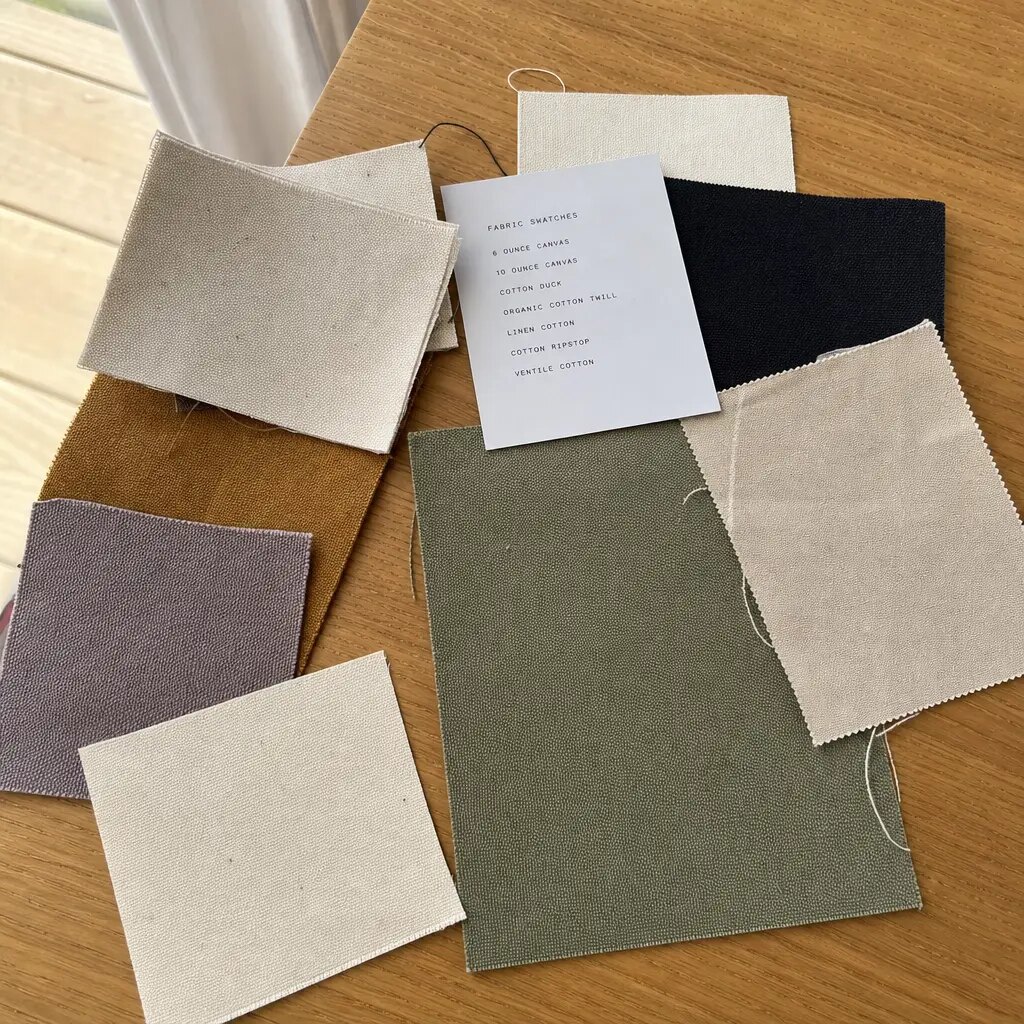
A buyer should define the product in a way that a factory can cut and sew without interpretation. Use a target fabric weight like 12oz or 14oz canvas, identify whether the canvas is bleached, natural, or dyed, and state the acceptable color tone. For eco apparel brands, natural canvas often wins because it reduces dye cost and keeps the look aligned with sustainable positioning. But natural canvas can also show specks, weave irregularity, and color variation, so the spec should allow normal shade banding rather than demanding a lab-grade white surface.
- 12oz canvas is a good retail baseline for moderate structure and manageable cost.
- 14oz canvas works better when the carrier must stand upright or support heavier glass.
- A simple 1-color screen print usually gives the cleanest MOQ-to-cost balance.
- Embossed or woven branding is better for subtle premium positioning but may change lead time and sampling steps.
How suppliers build MOQ on this product
MOQ is usually built from four buckets: fabric prep, print setup, sewing labor, and packing. On a custom canvas wine carrier, a factory may be willing to buy fabric in low quantity if they already stock the cloth, but the print or label setup can still force a higher minimum. If the logo needs a new screen, plate, or woven label card, the supplier will spread that setup cost across the order. That is why one supplier may offer 300 pieces while another insists on 1,000 for the same visual design.
The best way to negotiate is to separate the order into a base item and add-ons. For example, ask for a plain 12oz canvas carrier with one-color print as the first run, then quote optional upgrades for lining, divider, hangtag, and closure. You do not need to win every feature in order to win the order. The objective is a controllable first shipment that protects your margin and gives you a clean re-order path.
- Stock fabric lowers MOQ more reliably than custom-dyed canvas.
- One-color print keeps setup simple and makes re-orders easier.
- Custom woven labels can be economical if used across several bag styles, not only one SKU.
- Retail-ready packing often carries its own MOQ because labor and carton configuration need stable production planning.
Comparison table: sourcing routes that change your MOQ outcome
For buyers negotiating a first order, the supplier route matters as much as the spec. A direct factory, a trading company, and a local converter will each quote different MOQ logic. The cheapest unit price is not always the lowest-risk path if the supplier cannot prove bag sewing competence, print consistency, or packing discipline. Use the comparison below to decide which route matches your buying stage.
If you are testing demand, a direct factory with stock canvas and a simple logo print is usually the most practical path. If you need one-stop service and have a complex retail pack-out, a trading route may be easier, but expect less transparency on true cost drivers. If your order is small and urgent, a local converter can help, though the fabric cost will often be higher.
What to compare when suppliers send different quotes
Two quotes can look similar while hiding very different assumptions. One may include the inner packing and carton marks, another may only cover bare units in bulk. One may use 12oz canvas with a soft handle; the other may use a lighter cloth that looks close in a photo but fails in hand. The buyer’s job is to normalize the quote to the same spec and then compare total landed cost, not headline unit price alone.
The most common trap is accepting a low FOB number and discovering later that sample fees, plate fees, label fees, and packing fees were excluded. For a product like a wine carrier, even a small add-on can change your margin because the base item is low-cost. Ask the supplier to break out fabric, labor, printing, packaging, and miscellaneous charges. Once you can see the cost stack, you can negotiate the line items that actually move the total.
- Match fabric weight, dimensions, print method, and packing before comparing prices.
- Request separate pricing for sample, bulk, and re-order quantities.
- Identify whether the quote includes carton marks, barcode labels, or individual polybags.
- Convert everything to landed cost if you need to compare suppliers in different regions.
Use acceptance criteria before you approve a sample
Sampling is not just for aesthetics. It is your chance to catch construction mistakes that become expensive once production starts. For custom canvas wine carriers, the sample must prove bottle fit, handle comfort, seam strength, and logo placement. If the carrier is for two bottles, test both bottle diameters, because a tight divider can make one side fit while the other side bows outward. That problem rarely shows up in a flat lay photo.
Set the sample approval standard in practical language. The logo should sit straight and not cross a seam unless the design explicitly allows it. The fabric should match the approved weight and feel. Stitching should be even, with no skipped stitches or loose ends. If the carrier includes a snap or closure, test opening and closing several times. A sample that only looks good for one photo is not a production-ready sample.
- Measure internal width against the bottle diameter you actually plan to ship.
- Inspect bar tacks, divider seams, and the top hem under close light.
- Compare the sample against the quote line by line to prevent spec drift.
- Keep one approved sealed sample for factory reference during bulk production.
Packing choices change both damage rate and freight cost
Packing is often ignored until the first shipment arrives with crushed corners or dusty surfaces. A canvas wine carrier usually does not need elaborate individual boxing, but it still needs a sensible pack method. Bulk packing into master cartons works well for wholesale and distributor orders, provided the units are folded consistently and protected from abrasion. If the carrier is sold through retail, a simple polybag or belly band may be needed to keep presentation clean.
Carton planning should be part of the quote, not an afterthought. Ask for carton dimensions, units per carton, and gross weight early, because those numbers affect sea freight density and warehouse receiving. If the item has a divider or a reinforced base, folding method matters. A poorly folded unit can distort the profile, raise carton height, and reduce how many units fit per carton. On low-margin bag programs, that alone can cost more than a small fabric upgrade.
- Use consistent folding direction so every carton stacks the same way.
- Protect printed areas from rubbing against seams or metal closures.
- Specify if the carton needs master marks, product code labels, or barcode stickers.
- Check that carton quantity matches your distribution model, not just the factory’s convenience.
Lead time risks are usually hidden in material and approval delays
A common mistake is quoting lead time only from the moment PO is signed to the shipping date. Real schedules include fabric availability, sampling, print approval, cutting, sewing, inspection, and packing. If you need a fast launch, the biggest risk is not the sewing line; it is waiting for approval on a logo strike-off or a fabric tone that the supplier is sourcing for the first time. That is why low MOQ and fast lead time are not always compatible if the spec is still changing.
The buyer should push for a milestone schedule. A workable plan might include sample lead time, approval window, bulk production start, and pack-out date. If the supplier cannot name each stage, the shipment is exposed to slippage. For eco apparel brands that coordinate seasonal drops, even a one-week delay can push the product past a sales window or into a weak promotional period.
- Treat first production as a schedule trial, not a guaranteed repeat cycle.
- Allow time for color and print approval if the logo has fine details.
- Add buffer if the factory is sourcing custom labels, snaps, or specialty thread colors.
- Get the supplier to confirm whether approval delays stop the lead-time clock.
A practical landed-cost view for first orders
When you negotiate MOQ, think in terms of landed cost per sellable unit. A quote that looks higher on paper can still win if it includes better packing, lower reject risk, and fewer rework loops. For example, a cleaner 12oz build with one-color print and bulk carton packing may produce a lower landed cost than a cheaper-looking bag that arrives with weak handles or inconsistent logo placement. Replacements, credit notes, and delayed launches are hidden costs that rarely appear in the original PO.
The cleanest buying strategy is usually to simplify the first order and lock the repeatable features. If your brand wants a premium look, build that premium into one or two visible elements only, such as a woven label or better base reinforcement. Do not stack six custom options into the first run unless the margin can support the extra approval and QC work. A controlled first order gives you a better baseline for future negotiation, because you will know which upgrades actually move sell-through.
- Compare all-in unit cost after print, labeling, packing, and freight assumptions.
- Separate one-time setup charges from recurring production charges.
- Use the first order to validate selling price, not to maximize every design feature.
- Reserve premium upgrades for the options with the strongest retail value.
Buyer checklist before you send the RFQ
A clear RFQ saves days of back-and-forth and lowers the chance of getting quotes that are impossible to compare. For this product, the RFQ should describe the carrier style, bottle count, canvas weight, print method, handle style, closure, and packing. The goal is not to micromanage the factory. The goal is to give the supplier enough information to quote the same thing you intend to buy.
A well-built RFQ also helps procurement teams defend the commercial decision internally. If the buyer can show that the quote was normalized across fabric, print, packing, and lead time, the chosen supplier becomes easier to approve. That matters when the first order is small and the commercial team wants a path to scale. The more accurate the RFQ, the better the re-order baseline.
- Product: single-bottle or two-bottle canvas wine carrier.
- Fabric: 12oz or 14oz canvas, natural or dyed.
- Branding: one-color screen print, woven label, or emboss.
- Construction: open top, snap closure, divider, reinforced handles, base insert if required.
- Packing: bulk pack, polybag, retail insert, carton marks, barcode labels.
- Target order size: trial quantity and expected repeat volume.
Specification comparison for buyers
| Spec decision | Recommended option | When it fits | Buyer risk to check |
|---|---|---|---|
| Fabric weight | 12oz canvas for standard retail; 14oz if the carrier must hold shape | Best for branded wine gifts, eco lifestyle retail, and repeat use programs | Too-light fabric can wrinkle, collapse, or show print distortion after sewing |
| Print method | 1-color screen print for MOQ control; woven label or emboss for premium minimal branding | When the design is simple and you need stable unit cost at moderate volume | Complex multi-color prints raise setup cost and often trigger higher MOQ |
| Handle construction | Reinforced self-fabric handles with bar tacks at stress points | Suitable for 1-2 bottle carriers used in retail or corporate gifting | Weak handle stitching causes returns even when the bag body looks fine |
| Bottle divider | Fixed divider stitched into the lining for 2-bottle carriers | When the buyer needs bottle separation and a neater gift presentation | Loose dividers shift during transit and can rub labels together |
| MOQ route | Plain stock body with custom print and label for the first order | When testing market response or launching a new SKU | Supplier may quote low MOQ but add hidden charges for labels, packing, and plate setup |
| Lining choice | Unlined for lowest cost; thin PP or cotton lining when bottle protection matters | If the carrier is used for gifting rather than long-distance freight protection | A decorative lining can raise labor cost without improving actual protection |
| Closure | Open top or simple snap button | When fast packing and lower part count matter | Magnets, zippers, or metal snaps can increase lead time and failure points |
| Supplier route | Direct factory with full bag line and print workshop | For buyers who need pricing control and repeat production | Trading layers may hide true MOQ, extend approvals, and slow problem resolution |
| Packing method | Bulk pack with carton inner dividers or simple polybag plus master carton | When warehouse receiving speed and freight density matter | Poor carton protection can crush corners and create storage dust issues |
Buyer checklist before sampling
- Confirm bottle size range, carrier capacity, and whether the bag is for 750 ml bottles only or also champagne-style bottles.
- Lock the fabric weight target, usually 12oz or 14oz canvas, before asking for quotes.
- Specify print area, number of colors, and whether the logo must stay aligned to seams or pockets.
- State if you need a divider, lining, closure, label, or hangtag; each one changes labor and MOQ.
- Request sample photos of stitching, handle reinforcement, and corner construction before approval.
- Ask for carton size, units per carton, and whether cartons need barcodes or retail marks.
- Get the production lead time broken into fabric sourcing, sample approval, mass production, and packing.
- Compare landed cost, not just FOB unit price, especially if the supplier offers low MOQ with high packing charges.
Factory quote questions to send
- What is your MOQ for the exact fabric weight, print method, and construction we are requesting?
- Is the quoted price based on stock canvas, custom-dyed canvas, or greige fabric with later finishing?
- Does the price include printing, woven label, hangtag, sewing thread color matching, and inner packing?
- What is the sampling charge, and is it refundable against a confirmed bulk order?
- How many days do you need after sample approval for bulk production and final packing?
- What carton quantity and carton dimensions do you recommend for this carrier style?
- Which QC points do you inspect before shipment, and can you share a sample inspection report format?
- Are there extra charges for custom divider construction, reinforced handles, or specialty closures?
Quality-control points to confirm
- Fabric weight should stay within an acceptable tolerance of the agreed GSM or oz target; buyers should not accept a visibly thinner cloth than the approved sample.
- Logo placement should match the approved strike-off or digital proof within a reasonable seam-to-print tolerance.
- Handle bar tacks must be even, dense, and placed at both stress ends; loose stitching is a rejection point.
- Divider seams should be straight and secure, with no puckering that could distort bottle fit.
- Top edge and side seams should be trimmed cleanly with no loose thread tails or exposed raw fabric beyond the agreed construction.
- If a snap or closure is specified, closure alignment and fastening strength must be tested on multiple units from the same carton.
- Cartons should arrive without crush damage, moisture marks, or packing shortages, and unit count should match the packing list.
- Pre-shipment samples should reflect the final bulk spec for fabric, logo, label, and packing, not a downgraded substitute.